Leave the Spear in the Wall

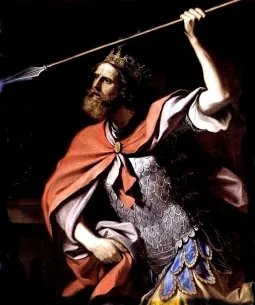
And Saul hurled the spear, for he thought, “I will pin David to the wall.” But David evaded him twice.

1 Samuel 18:11, ESV

And Saul sought to pin David to the wall with the spear, but he eluded Saul so that he struck the spear into the wall. And David fled and escaped that night.

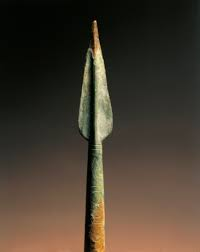
Saul’s spear shows up later in David’s life, and it becomes a vital component in his growth as Israel’s next king.

But David doesn’t know that yet. In 1 Samuel 26 we read about David’s second encounter with the spear of Saul.

The scene is in the wilderness and David’s on the run. Now the badlands are a good place to hide as any Western movie knows. I think David had his scouts and I suppose that there were also men who knew every rock and cave in that wasteland. They were hiding from Saul.

“So David and Abishai entered the encampment by night, and there he was—Saul, stretched out asleep at the center of the camp, his spear stuck in the ground near his head, with Abner and the troops sound asleep on all sides.”

1 Samuel 26:7

Sneaking into Saul’s camp was bold and audacious. Saul was sleeping and scripture says that David’s companion desperately wanted to kill Saul, but David refused, David, looking through the darkness lighted on Saul’s spear. Perhaps he remembered back to when Saul tried very hard to kill him.

He avoided that spear a long time ago, and now he escapes it again.

The tables have completely turned. Given a chance to end King Saul’s life, he refused; he would not kill him. When you think about it, many problems would’ve been solved, and David would take his rightful place as Israel’s new king.

But David spiritually understood God’s heart. He understood the spiritual principle of “turning the other cheek” and “loving your enemies.” He overcame with love and kindness. And lots of grace.

“Do not be overcome by evil, but overcome evil with good.”

Romans 12:21, ESV

The Greek word for “overcome” is νικάω which can be translated as “to conquer or to come forth victorious.” It is also used when someone is arraigned before a court of law but wins the case.

To follow Jesus means you entirely reject using the spear. It’s not for you. Never.

“We win by tenderness. We conquer by forgiveness.”

Frederick W. Robertson

We must leave the spear in the wall. You must not throw it back.

Like David, we are to trust the Father. We’re to be secure in His timing. And yes, we each must use kindness and brokenness to overcome dark things. When you think about it, Jesus also faced evil without defending Himself. The spear showed up again and we see that our Savior allowed it to pierce His side on the cross.

You must leave the spear in the wall.

You mustn’t use the spear when it seems you can wield it at the perfect moment, and like Jesus you need to allow it to save your enemies from their sin.

These three spears are evidence you “have God’s heart.”

Boasting for Dummies


“Let not the wise man boast in his wisdom, let not the mighty man boast in his might, let not the rich man boast in his riches,”

“but let him who boasts boast in this, that he understands and knows me, that I am the Lord who practices steadfast love, justice, and righteousness in the earth. For in these things I delight, declares the Lord.”

Jeremiah 9:23-24

There is bad boasting (v.23), and good boasting (v.24). When I think of someone who brags it’s almost always in a negative sense. 

Boasting is one way pride becomes visible, it’s the way we exaggerate or embellish our identity. We magnify ourselves, amplifying our achievements beyond what is reality. We must understand that all it really is is arrogance on display.

There is no room for braggarts in the Church.

You cannot sanctify boasting. It is pride that we vocalize and use to influence. We want to change another person’s perspective of you. We desperately want others to admire and think better of us. Some have postulated that it really is nothing more than masking insecurity. I think they’re right.

The Word differentiates between good and bad boasting.

The book of Jeremiah (9:23-24) does precisely that. It explains that what is worldly: wisdom, strength, money– is the wrong way of seeking recognition and importance. God’s people are to declare (brag) that they are in an intimate relationship with God.

We understand, we know that we have a loving connection with the Lord. We learn we can brag about Him.

I encourage you to become aware of how you conduct yourself in front of others. We seldom think of ourselves realistically. For many of us our lives are so intertwined with the false that we struggle with what is true.

God resists pride. (James 4:6.)

Jeremiah tells us we can choose to be different. We can swivel from the negative to the positive. We must quit exalting any attainment we have and instead boast that we now know God.

No longer do we strut, but now we choose to kneel.

“Humility is to make a right estimate of one’s self.” 

Charles Spurgeon


The Stomach Churning Sin of Manasseh

God’s temple was now filled with an evil darkness. King Manasseh made the Lord’s holy place a fountain of sin and filth. Instead of holiness, it was an evil place.

He brought in dark things that were twisted, perverted and clearly forbidden.

“Manasseh led Judah and the inhabitants of Jerusalem astray, to do more evil than the nations whom the Lord destroyed before the people of Israel.”

2 Chronicles 33:9, ESV

His own darkness was now encouraged by others, it became accessible, available and promoted:

  • The high places were rebuilt throughout the land.
  • Altars to Baal rebuilt, using images of wood.
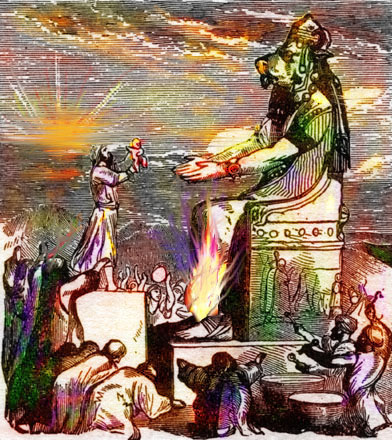
  • In the holy temple, altars to the “starry host,” astrology, plain and simple.
  • Human sacrifice of his own sons to Molech, a false god. Murder.
  • He practiced soothsaying, used witchcraft and sorcery, and consulted mediums and spiritists.

Evil was being encouraged and something wicked was replacing all that was good and true. The analysis of Manasseh’s policies was way beyond disturbing. Of all the kings of Judah, he was the most sinful and the most corrupt. He was at the bottom of the barrel.

The Hebrew word for “led astray” can be translated seduced.

Manasseh was an incredibly immoral man, a king who ruled for 40 years. “He did all he could to pervert the national character, and totally destroy the worship of the true God; and he succeeded.” (Clarke)

It’s believed that he put Isaiah to death by cutting him in two.

Moreover Manasseh shed very much innocent blood, till he had filled Jerusalem from one end to another, besides his sin by which he made Judah sin, in doing evil in the sight of the LORD.

1 Kings 21:16

But then something happened.

And the LORD spoke to Manasseh and his people, but they would not listen. Therefore the LORD brought upon them the captains of the army of the king of Assyria, who took Manasseh with hooks, bound him with bronze fetters, and carried him off to Babylon.

2 Chronicles 33:10-11

Assyria came knocking on Manasseh’s door. I think there was a certain mercy here, but also discipline. Manasseh had “hooks,” inserted through his jaw and out of his mouth. Like a fish he was led to Babylon, a trophy of the power of the army of Babylon.

It was from a dark dungeon that Manasseh cried out to the Lord and repented.

(2 Chronicles 33:12-13.)

There’s a Jewish fable that when Manasseh cried out to God the angels boarded up the windows in heaven. They wanted to block out his prayer so God wouldn’t be able to hear. But God, rich in mercy, bored a hole in front of His throne to hear Manasseh’s desperate cry.

The Lord’s intention was to forever show His kindness and grace given to the most awful repentant sinner.

I believe that Manasseh was the “Prodigal Son” of the Old Testament.

God is not at a loss when He moves to bring us back to Himself. He can woo or whip. He can draw or drive. He can work rapidly or slowly, as He pleases. In other words, He is free to be God! And in His own way, at His own pace, He brings us back.

     Tom Wells

God is wildly in love with you. Yes, the sin you’ve committed is awful, but the Lord wants you to come back. He may discipline you, but He forgives everything if you’ll turn and repent.

No matter how awful your sin, He forgives and restores. Manasseh is proof of that.

Sources:

2 Chronicles 33:1-20

2 Kings 21:1-18

Enduring Word commentary

alaskabibleteacher.com

Leaders Who Are Kind and Generous

“And the king said, “Is there not still someone of the house of Saul, that I may show the kindness of God to him?” Ziba said to the king, “There is still a son of Jonathan; he is crippled in his feet.”

 2 Samuel 9:3, ESV 

That crippled man was named Mephibosheth.  He was injured by the actions of a nurse, she accidentally dropped him as she was trying to escape the palace (2 Sam. 4:4).  He was just five years old. It was not of Mephibosheth’s doing, but someone else made a mistake, and it totally and irrevocably changed his life.

As a result, for the rest of his life, he would always use crutches.

It may be of interest, but Mephibosheth’s name means, “shame,” and perhaps this would’ve been an integral part of how people treated him or even how he saw himself. But David was a different sort of king (as kings go), and he elevates Mephibosheth to the feasting table.

King David wants to bring this crippled man to a lavish dinner.

Interesting. I believe that there are a great many people like Mephibosheth.  They’ve been injured by someone else’s stumbling.  It seems we pass these things on to each other.  And the lameness we inflict may not be physical.  It may be spiritual or emotional.  Sometimes we injure others without knowing what we have really done to them.

Whether we know it or not, we are capable of much evil. 

Some of the most evil woundings that are done are usually on a moral or spiritual level. If you break your arm, you will heal.  But if I wound your spirit you may not ever recover. These injuries are incredibly devastating.  When someone harms us on this level it can completely undo us, for a lifetime. (And perhaps, maybe even forever.)

We can read of King David’s truly majestic treatment of Mephibosheth in 2 Samuel 9. He actively blessed him, and perhaps that is the proactive action we ought to take. We must make an effort to always strengthen the people around us.

As a king, this was a very minor incident. Hardly worth recording in the lofty affairs of state. But as a man, to restore Mephibosheth, was definitely one of David’s greatest decisions.

I would suggest that kindness should always be a key part of someone who is in authority, especially those who are serving others in leadership.

But there’s another concept here– we discover something that is profoundly true about us in Paul’s letter to the Church in Ephesus.  It’s here, in 1:5, that we see that God our Father, acts like David, and receives Mephibosheth–just like God receives us to Himself. We find that we’re adopted, loved, and held, and we get a prime place at the table. Forever and ever.

God decided in advance to adopt us into his own family by bringing us to himself through Jesus Christ. This is what he wanted to do, and it gave him great pleasure.”

Ephesians 1:5, NLT

We may use crutches, but we walk by faith. This verse in Ephesians may be the greatest lesson and the most profound experience we can have as believers.

alaskabibleteacher.com

Loving His Throne

“A Christian is not a person who believes in his head the teachings of the Bible. Satan believes in his head the teachings of the Bible! A Christian is a person who has died with Christ, whose stiff neck has been broken, whose brazen forehead has been shattered, whose stony heart has been crushed, whose pride has been slain, and whose life is now mastered by Jesus Christ.” 

-John Piper

Philippians 3:20, MSG

It seems to me that the purpose of our life is not to find our freedom. It’s really meant to find our Master.


But the idea of being a slave to anyone is repugnant. We chafe at this, and yet man was never meant to be separated from the Lordship of Jesus. We’re instructed repeatedly with the New Testament idea that “our life is not our own”  Over and over God proclaims Himself as the King.


That troubles us somewhat.

Not so much when life is fairly good, granted, but in those hard moments when a decision must be made between enjoying the titillating “lusts of the flesh,” or accepting the fruits of the Spirit. This is one of those “lordship moments.” They come and go, and they show us exactly who we are.


If you’re really going to be authentic–a legitimate and real disciple, then you must determine who is going to be in charge, and this isn’t one of those casual decisions. Your decision must become a settled issue.


You must securely fix the throne in your heart and spirit.

The thief on the cross knew salvation, he was promised an eternity with God simply by faith. But I submit to you that he had put himself under the Lordship of Jesus, simply by recognizing the sign, “the King of the Jews.” I believe he saw and understood its implications. Jesus was King! He knew and understood.


This is a very hard word for some, but so many of our personal issues hinge on this.


I know this first-hand. It is a monumental struggle. You must admit to not only having Jesus as your Savior, but you also must put your life under His total Lordship.  You need to pick up your cross daily in order to follow.  You need to learn how to kneel.


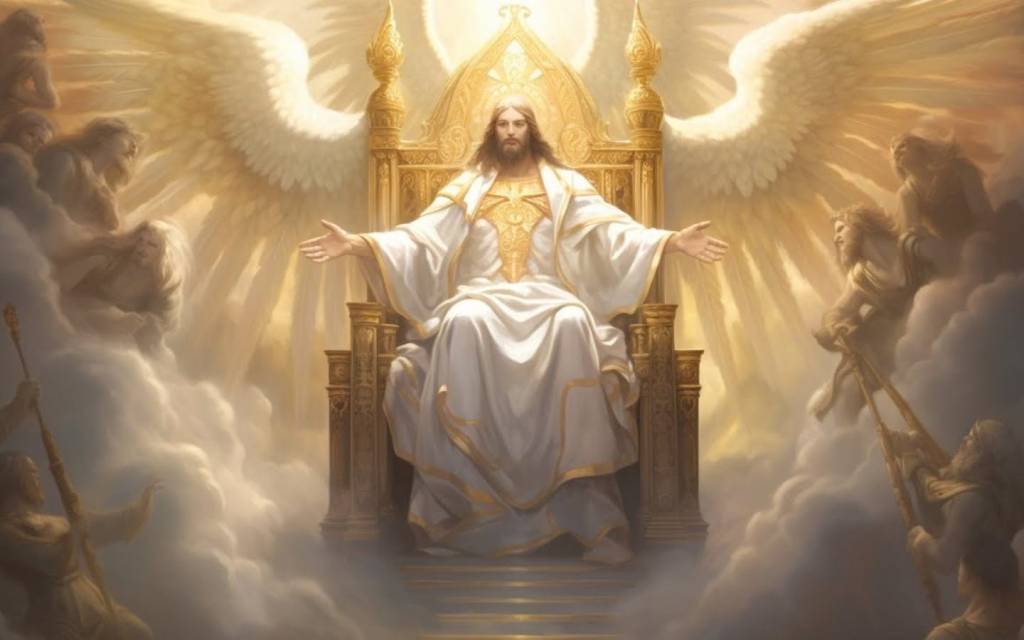
I’ve chosen a depiction of Jesus on His throne to open up this post–it’s done on purpose, even if it’s an artist’s take.  I simply want you to understand the supreme call He has on your life. Here’s Bob Dylan, and he nails this idea down:


But you’re gonna have to serve somebody, yes indeed
You’re gonna have to serve somebody
Well, it may be the devil or it may be the Lord
But you’re gonna have to serve somebody


You must learn, here and now, how to kneel before the Sovereign King

Deer Feet for the Believer

“He made my feet like the feet of a deer
    and set me secure on the heights.
35 He trains my hands for war,
    so that my arms can bend a bow of bronze.”

2 Samuel 22:34-35

David’s Song of Deliverance

This entire psalm was written after David was delivered from the hand of Saul. David had been a fugitive for years and had experienced extreme difficulties. He had been pushed to the brink many times, yet maintained a close walk with God.

This verse in 2 Samuel has always blessed me. The image of a deer who has been put on a mountaintop through the direct action of the Lord–it’s a place of safety, a position of victory. It comes as a decisive maneuver of the Holy Spirit.

Psalm 18:33

David had learned things in the wilderness that he would never have otherwise. At times life got pretty extreme for him. When he struggled it was understandable. He followed the path that God laid out. It wasn’t easy for David, but he walked in faith and not by sight.

Danger surrounded David on every side – physically, spiritually, emotionally, socially. It would come from enemies, and even from his dearest friends.

God’s people are not immune from trials. It’s good to know that these are now orchestrated by our Father, and they’re purposeful and planned.

The prophet Isaiah extends the imagery of a deer in his prophetic ministry, but adds other ideas as well. The lame, mute and the desperately thirsty are descriptive of people who are given a special grace and touch. They’re promised something. They receive the promise of the Lord Jesus Christ.

“Then shall the lame man leap like a deer,
    and the tongue of the mute sing for joy.
For waters break forth in the wilderness,
    and streams in the desert;”

Isaiah 35:6

“David thought of how deer seem to skip from place to place and never lose their footing. God gave him the same kind of skill in working through the challenges brought by his enemies.”

David Guzak

alaskabibleteacher.com

It Gets Even Better

I just saw a t-shirt. “It gets better,” and inside me something connected, it resonated. If there is something like spiritual mirth and laughter, I could barely contain myself. I wanted to shout and dance, but being an old man I knew I had to take extra Advil if I did. (Besides I was in Safeway.)

Romans 8:18

 The last 20 years are something I’d rather forget and erase. It seems I’ve been hit with just about everything awful you can imagine. After each incident I find myself thinking, “finally, it’s done,” but no, it’s not really done, there’s more coming. I’m smiling as I write these words. “But no, it’s not.” Ha!

Being slammed over and over has created within me a special longing for my real home. When I ponder the eternity of heaven the knots of this life begin to unravel, and I see life as it really is. You see present day life is quite temporary, and these many issues will be forgotten.

The Apostle is remarkably clear about this.

“Neither count my life dear unto myself, so that I might finish my course with joy,” is Paul’s take on his life’s issues. To finally complete all of the moments–and do it with joy, is his goal. Crossing the tape triumphantly is the hope of the staggering believer. And it is mine.

My pain is just for a simple singular moment, but eternity is time on steroids.

It is forever and ever and ever and ever.

On my end, the exchange I make is hardly perfect. I turn in my “sawdust” and get gold in return, and who can turn this trade down? My ugliness becomes eternal beauty and who can resist such a deal? These terrible things that hurt me so badly carry an everlasting weight of glory.

Brother, please believe this. Yes, I know, it hurts.

The Greek word “worthy” in verse 18 can be translated “having weight” which suggests a heaviness or burden that must be carried. But even so, it’s temporary. It enters but passes, even though at the moment it seems forever. You carry it for a moment–but that is all. and it’s done.

I look, and gaze into eternity, and laugh in joy.

Thorns for the Whore

“Therefore I will hedge up her way with thorns,
    and I will build a wall against her,
    so that she cannot find her paths.”

Hosea 2:6

A holy prophet is told to marry a prostitute–sounds crazy I know, but this union was intentionally commanded by God. It served to announce to Israel the present condition of their hearts, (1:2). In God’s eyes, Israel was nothing more than a spiritual whore. They would now be forced to grapple with this truth.

Her name was Gomer, and the prophet was Hosea.

The truth is sometimes a very hard thing. God has a bellyful of Israel’s prostitution, the nation has repeatedly went astray, they’re full of sin and idolatry. What else can God do to break this ‘spell’ and get their attention?

O.K. So why this hedge of thorns?

  • This hedge was initiated by God Himself
  • It was not vindictive; it wasn’t meant to destroy
  • Sin will never satisfy those in a covenant relationship with Him
  • Repentance was the goal God wanted to see
  • It’s function was to resist their sin and idolatry
  • This hedge was to bring Israel back into a right relationship with Himself

Imagine being restrained by the Lord in this way. Spiritual handcuffs and fetters and anything else that would restrict you from sin. He loves you and as a believer you belong to Him exclusively. He will discipline you if you persist in your sin. (But that is a good thing.)

He does this out of an everlasting love that’s forever loyal to you.

The very next verse (v. 7) is the response of Israel to being hedged in. It seems to be doing what He intends it to do. The ‘block’ seems to be working. (This sounds a bit like the “prodigal son.”)


“She shall pursue her lovers
    but not overtake them,
and she shall seek them
    but shall not find them.
Then she shall say,
    ‘I will go and return to my first husband,
    for it was better for me then than now.’

Hosea 2:7

When you receive Jesus as your Savior you now belong exclusively to Him. That covenant is far more than eternal life. It also means that He is fully and irrevocably committed Himself to making you a holy person. He disciplines when you persist in sin. But it’s done out of love.

Some have suggested praying the hedge of thorns over straying children or family. Perhaps that’s what is necessary. Pastors and elders could intercede for wandering believers using the same example found in Hosea 2. I believe God hears us as we pray.

“We often learn more of God under the rod that strikes us than under the staff that comforts us.”

   Stephen Charnock

“I Kept You From Sinning”

Genesis 20:6

This is called restraining grace, the doctrine that teaches that God intervenes to prevent sin from happening.

Both the pagan king Abimelech and the patriarch Abraham have problems. One wants to add Sarah to his harem (lust), and the other pretends that Sarah isn’t his wife, but his sister (cowardice).

The dream:

Abimelech goes to bed and has a “God dream.” The Lord threatens him with death for taking another man’s wife. King Abimelech protests and pleads for his life. (Dreams were significant in Genesis.)

God relents and to Abimelech’s credit the Lord understands that this was done from a clear conscience. It seems that Abraham’s spinelessness has given the wrong idea about Sarah. She isn’t his sister, but his wife!

There are some interesting issues here. Not only is the king prevented from sinning here, but we see the lengths God went to protect Abraham and Sarah’s marriage. They were to be the parents of the nation of Israel. God would see to that.

There are real consequences to our sin. We will reap what we sow (Galatians 6:7), but God’s grace protects the believer who desires to be Christ-like. He is a shield to the man who runs to Him.

It probably happens more than you realize. I’ve found that there is a still, small voice that speaks to the Spirit-filled believer. Sometimes we ignore it and sometimes we obey it, but it’s there. It’s meant to guide us.

Our conscience is the “sheriff” of our souls. It’s our compass.

It seems that little is said about conscience anymore, but it’s imperative that you recognize it. Conscience tells you whether something is right or wrong. It’s our guide and must be closely watched over. It can become seared and clouded–it can be defiled. But it also can be purified and made holy.

Our conscience knows this. It’s a spiritual fact.

Ligonier.org

For further study: Psalm 12:7; Proverbs 11:6; Proverbs 13:6; 1 Peter 3:12.

alaskabibleteacher.com

The Giant Goliath, and Sexy Bathsheba

I have wondered about this. It strikes me that there are two giants that David encountered in his walk with God. Granted, there are many other events and people that he experienced, obviously. But there are these two that stick out:

The Goliath showdown, and the Bathsheba fiasco.

These seem to be hinges or pivot points that would change the entire course of king David’s life, and his faith in God. They’re to be an encouragement and warning to us, as both are incredibly significant.

This is a powerful chapter, for it reveals David’s spectacular faith in God. When the boy David killed Goliath it changed the entire future of Israel. One stone from his sling was all it took. Israel routed the Philistine army. David’s faith was the spark that made victory real.

David became a hero that day, and quickly ascended into Saul’s favor. It was both a military and a political development that Israel needed and king Saul welcomed it, the kingdom thrived. The boy David became the man of the hour, a national hero which everyone talked about.

I’d like to point out that David had already been anointed by Samuel to be the next king. This, combined with David’s celebrity status pushed king Saul over the edge–Saul developed a deep resentment that became insanity. David handled this adroitly, fleeing into the wilderness (with his faith) for years.

At this point David is now king and is fighting the Ammonites. The Israelites were besieging Rabbah, the capital city of that country, and it seems like it’s an intense battle. But interestingly enough, David remained in Jerusalem. (And I can’t figure out why.) David can’t sleep so he paces the rooftop and it’s then things get crazy.

David spies Bathsheba who is cleansing herself from her monthly cycle. She is a very beautiful woman, and king David inquires about her. He lusts after her which results in him more or less raping her, commiting adultery and then murdering her husband. This is all very disturbing.

When David had sex with Bathsheba it set in motion the ugliest chain of events imaginable. It seems that up to now David has taken the intiative of events, and then, after this great evil, his story shifts and for the rest of his life he becomes acted upon, a “victim.” He reacts, but doesn’t act anymore.

For the rest of his life he will struggle. All because of lust.

In 2 Samuel 12 David is confronted by a prophet for these sins. Samuel speaks with a parable that penetrates David’s heart. The king responds, “he shall restore the lamb fourfold, because he did this thing, and because he had no pity,” (v. 6). And interestingly enough, David would indeed pay fourfold. There would be four major incidents after this that he would now face.

David faced two “giants” in his walk with God. They were very different but both life altering. He killed Goliath but was not able to destroy his lust with Bathsheba.

Sometimes one “giant” is not enough. It would be nice if that was the case. David walked in victory for a period of time, but failed both himself, his family and his kingdom. Lust always is an act of the will, a deliberate decision that destroys all that it touches. David would be forgiven, but the damage was already done.

There would be dire consequences for everyone.

I believe that our giants were meant to be slaughtered. That is their function and purpose for the faithful believer. There can be no compromise. They’ll take different forms and will often approach you in peculiar ways. Paul tells us to wear God’s armor in Ephesians 6:11-18. I don’t think that protection should be taken off–you dare not only wear it only on special occasions.

Brother, sister–you must be covered all the time.

King David is a lesson for us. There is tremendous pain for us if we deliberately choose to compromise with the giants in our lives. Some of you already understand this; others will. I promise you.

    Oswald Chambers

Bryan Lowe

alaskabibleteacher.com