Your Plow is Waiting

“No one who puts his hand to the plow and looks back is fit for the kingdom of God.”

Luke 9:62 (context, vv. 57-62)

Every disciple has his plow. Sometimes it’ll be obvious, everyone sees it; other times it’ll be buried deep inside, and no one knows. A plow is a perfect word to describe exactly what the Holy Spirit is doing–and its descriptive of the determination of a disciple who is slowly learning how to follow.

When you’re trying to grow-up you’ll grasp this foundational lesson. You have to be single-minded and really focused to stay moving ahead. You cannot look behind at what has been done. You can’t turn around to admire your work, rather we look at the tree that is keeping us lined up with Jesus.

You will sweat and get tired. Your full effort is needed to keep the plow in the hard earth. You aren’t pushing, the oxen is pulling, but you’re the one who weighs it down while keeping your furrow relatively straight. It’s harder than it looks. (Thank God for the modern tractor.)

In case the plowman starts to look back, his plow line would become crooked. If that happens, the field he is plowing will not yield a full harvest. A good plowman has learned he must hold on. In following Jesus, we are to keep our eyes on Him, and never let our minds and hearts wander away. (Hebrews 12:1-2.)

“To keep our hand on the plow while wiping away the tears–THAT is Christianity.”

-Watchman Nee

To follow means looking and moving forward. We must understand this–it’s the very essence of walking a path. We’re walking out the journey. Sometimes we feel Jesus’ joy as His follower, but occasionally we won’t. We’re learning to understand it more and more. But no matter what, we keep putting heel-to-toe. We are followers after all.

Jesus lived this; He steadfastly set His face to go to Jerusalem (Luke 9:51).

“To learn strong faith is to endure great trials. I have learned my faith by standing firm amid severe testings.”

-George Mueller

Thinking Out Loud About Dying

A dear Christian friend has built his own coffin. He now uses it as a coffee table in his living room until the day he dies. I’m told that Trappist monks next to their monastery an open grave, a constant reminder of the certainty of death. When they file past it, they understand that everyone must die.

Do you see death-smiling as a type of leer or as an evil grin upon the face of an enemy that is about to bring you pain? Or is the smile a gentle one that offers solace at a time when fear may be raging?  

Psalm 90:4-6

In ancient Israel, Psalm 39 served as a “memento mori”—a reminder of human mortality. “Oh LORD, make me know my end and what is the measure of my days; let me know how fleeting I am!” (v. 4). David understood that life is somewhat insignificant in the light of eternity.

Remember that you must die someday. 

Ecclesiastes 8:7-8

Memento mori is a reminder of the inevitability of death. Jesus’s words, “Very truly I tell you, unless a kernel of wheat falls to the ground and dies, it remains only a single seed. But if it dies, it produces many seeds” (John 12:24).

As we adopt the reality of dying we must refuse the worldly ideas of death:

  • Our fear
  • Our doubts
  • Our frustration and cynicism
  • The loneliness
  • Satanic attack

    William Gurnall

In the New Testament, Jesus exhorts his disciples to pick up their crosses daily and to remember their death as they follow him to the Place of the Skull: “If any want to become my followers, let them deny themselves and take up their cross daily and follow me” (Lk 9:23).

As you integrate memento mori into your life, you will find more fruit in the practice if you are able to connect within the community of the Church who are on the same journey. Talk with family and close friends about your journey.

Knowing you’re going to die and face a certain judgement is a bit unnerving. It’s also a definite way of defeating sinful habits. When we understand this, much evil is now avoided and renounced. Yes, you’re barreling into a real encounter with God. That you can be sure.

Our judgement is very much real. But we have a perfect plea. Jesus has paid the price for us. It’s His blood that delivers us and fully redeems us. Standing (or kneeling) we realize the love and mercy He has for us. When we stand before God, we stand complete.

  Helen Keller

There should be no fear of dying.

We’re fully and irrevocably forgiven. You can be sure of that. We can smile at death, knowing that it leads us into a perfect connection. Are you afraid? Yes, I understand. But know, if you’ve accepted Jesus as your Savior and Lord, the payment for all your sins, you’re forgiven.

alaskabibleteacher.com

Without Your Wound?

angel6

The subject of “the pool at Bethesda” alludes to the Thorton Wilder play, “The Angel that Troubled the Waters.” 

The play tells of a physician who comes to the pool of Bethesda, hoping to see the stir, and then be the first in the water, and healed of his debilitating depression.  An angel appears and troubles the water. Everybody at the pool hopes to be the first one in and to be healed of their disability.

An angel appears and blocks a physician at the very moment he is about to step into the pool and be healed.

angel1

Angel: “Drawback, physician, this moment is not for you.”

Physician: “Angelic visitor, I pray thee, listen to my prayer.

Angel: “This healing dear physician, is not for you.”

Physician: “Surely, surely, the angels are wise. Surely, O Prince, you are not deceived by my apparent wholeness. Your eyes can see the nets in which my wings are caught; the sin into which all my endeavors sink half-performed, cannot be concealed from you.”

Angel: “I know.”

Physician: “Oh, in such an hour was I born, and doubly fearful to me is the flaw in my heart. Must I drag my shame, Prince and Singer, all my days more bowed than my neighbor?”

Angel: Without your wound, where would your power be?” 

“It is your very sadness that makes your low voice tremble into the hearts of men. The very angels themselves, cannot persuade the wretched, and blundering children on earth, as can one human being broken on the wheels of living.

Later, the person who enters the pool first, and was healed rejoices in his good fortune, then turns to the physician before leaving and says:

“But come with me first, an hour only, to my home. My son is lost in dark thoughts. I — I do not understand him, and only you have ever lifted his mood.”

“Only an hour… my daughter… since her child has died, sits in the shadow. She will not listen to us, but she will listen to you.”

The play pierces me with this line— “Without your wound where would your power be?“ That thought causes me to look at my many weaknesses with an entirely different perspective.

Paul’s teachings offer us a powerful revelation: it is through our weaknesses that we can authentically minister to others, just as Jesus did by going to the cross. This priniple slowly permeates my understanding, and emphasizes the reasons behind my weaknesses.

Paul boldly declares that it is the very things we perceive as weak that have the potential to cultivate strength and truth within us and to others. It is my sincere hope that the ministry of alaskabibleteacher.com will impact lives by declaring this.

I hope so anyway. Please pray for me. I desperately need it.

I first encountered this excerpt in the book, “Abba’s Child: The Cry of the Heart for Intimate Belonging,” by Brennan Manning. The book is a worthy read, and worth finding if you can. The play is based on the biblical verses of John 5:1-4, however, it changes the end of the parable. The play is fictitious.

Check out Brennan Manning’s Facebook page for more info.

alaskabibleteacher.com


Why, God Why?

Job 7:20, 13:24, 9:29, 24:1, 10:18

Job’s profound suffering is one of the most extreme in all of human history. He is essentially a godly man who loses everything (except his faith). Job must pick up the pieces after “catastrophic ” sudden pain and total loss.

Only the brutality of the cross of Jesus eclipsed the suffering of Job.

Job is being tested with dark horrors. Will he “curse God and die” as his wife suggests? Will he cave in to the final four “friends” and accept their twisted theology? (I guess that you have to read chapters 38-39 to find out).

The Book of Job has been regarded as inaccessible and archaic by many.

Unfortunately, many believe this assessment and look elsewhere for comfort. I would agree that Job is a challenging book, but so is Macbeth or Plato. There are plenty of easier books to read; but if we choose to avoid Job, our faith will always be deficient. We will miss something vital.

Job is less an explanation and more a revelation of suffering. “Why” questions go unanswered. “Who” questions matter. I suppose this seems unfair to Job. It certainly seems so to me, but straight answers in a fallen world won’t get any traction at all.

One more thing. The Book of Job is about “twisted” theology. Job’s friends “toe-the-party-line” of theology that is logical. But don’t be mislead by their pronouncements, for they seem reasonable but they are all very much flawed.

I always find it strangely amusing when some quote Eliphaz or one of the other “friends” to encourage or comfort a suffering saint. They totally miss the point of the book. We desperately want to give out good counsel but we really don’t understand.

“If I have the gift of prophecy and can fathom all mysteries and all knowledge, and if I have a faith that can move mountains, but do not have love, I am nothing.” 1 Cor. 13:2

You can’t split your theology from love and get away with it. Something toxic happens if you try.

When you read “Job’s friends” you must remember that. These are lessons it takes a long time to learn. Unless the Holy Spirit tutors you, be very slow to speak. (Job’s friends were at their best at the beginning when they said nothing at all.)

The broken believer, hobbled by chronic illness, has much to learn from Job. He is like “the poster child” for those afflicted. My own illnesses are always an issue of course, but God is fully in control. He brings beauty out of the ashes. He has been more than gracious.

“To bestow on them a crown of beauty
instead of ashes,
the oil of joy
instead of mourning,
and a garment of praise
instead of a spirit of despair.
They will be called oaks of righteousness,
a planting of the Lord
for the display of his splendor.”
Isaiah 61:3

Give Me Dove’s Eyes


“Behold, you are beautiful, my love;
    behold, you are beautiful;
    your eyes are doves.

Song of Solomon 1:15

Doves have single vision. They can only see one thing at a time, that makes them unique. They are one of a kind. Doves are also the emblem of the Holy Spirit in scripture, and when they are mentioned we should be alerted that something spiritual is happening.

What the Shepherd is proclaiming is “she only has eyes for me, she sees no one else.” For the true believer there isn’t anything that can take the place of Him. Vain philosophy, political involvement, Eastern mysticism, science, or empty materialism should never take the place of the Lord Jesus. Never, ever.

We need “dove’s eyes.” We must see Jesus only.

There are a lot of noble things we can get involved in. Good things, yes, but not the best, we need to fix our eyes on Jesus. I have personally seen brothers, sisters, and whole churches lose their vision, and focus on something other than their “first love.”

Satan hates our intimacy with Jesus.

There are many preachers and teachers in the Church who no longer have dove’s eyes. Satan has blurred their vision, and they have lost the intimacy they once had with Jesus. Most of the time, they don’t even realize it.

This saddens me.

I remember a blazing church who once closed down entire blocks in San Francisco. They worshiped Jesus intensely. They were powerful evangelists who took the Church into the streets and brought with them a passion. They were people on fire. It was a pleasure to work with them, they were so in love with Jesus.

But within two years they lost it.

They adopted a political stance that was commendable, but it diminished their first love for Jesus, and Satan was pleased. The church quickly split in a dozen different ways. This isn’t a new thing, the apostle Paul saw it and was afraid for the church in Corinth.

“For I feel a divine jealousy for you, since I betrothed you to one husband, to present you as a pure virgin to Christ. But I am afraid that as the serpent deceived Eve by his cunning, your thoughts will be led astray from a sincere and pure devotion to Christ.”

2 Corinthians 11:2-3 

In the book of Revelation, chapters 2 and 3 emphasize the level of intimacy each Church possesses. “Angels” come and carry the message of repentance and a return to that first love. I have to think that having dove’s eyes comes as a result of being filled with God’s Spirit.

We now can look at things, with the eyes of the Holy Spirit. Jesus thinks that is beautiful.

Return dear one, come back to the Lord Jesus. Let your first love blaze again. Don’t allow Satan to sidetrack you into something that is good, but not the best. Have “dove’s eyes” that only see Jesus. –Amen and amen.

Why this Waste?

 “A woman approached him with an alabaster jar of very expensive perfume. She poured it on his head as he was reclining at the table. When the disciples saw it, they were indignant. “Why this waste?” they asked. “This might have been sold for a great deal and given to the poor.”

Matthew 26:7-9

Is it possible we’re missing something here?

Just previously Jesus warned His disciples that He was about to be crucified. Apparently, they didn’t understand. And immediately after that, the Pharisees and elders begin to get serious about putting Him to death. The word “plot” is used. At this point, things have gotten deadly.

Jesus is at the home of Simon the leper; he’s eating and drinking. Simon is a little-known character with a common name; perhaps he’s a man whom Jesus had healed? (He and his home would’ve been unclean if his disease was present.)

In comes a woman carrying an alabaster jar that was only used for holding perfume of the highest quality. John 12 tells us that this was Mary, the sister of Martha (remember that story)?

She carries an alabaster perfume which was extremely expensive, worth almost a year’s wages. What she’s about to do is extravagant, the neck of the bottle is broken and Mary begins to pour it on the feet of Jesus.

The cost of the poured-out perfume is exorbitant.

Immediately the disciples object. This seems to be the first time that they agree that what she was doing was totally out of line. They can’t believe what she’s doing is okay. All they can see is something too extravagant, and far too lavish.

They considered the cost–it’s almost a year’s wages. “Why was this perfume wasted?” That’s a logical analysis. “The oil could’ve been sold!” It would have helped a lot of poor people who could have really used it. The book of John amplifies all of this:

“But Judas Iscariot, one of his disciples (he who was about to betray him), said, “Why was this ointment not sold for three hundred denarii and given to the poor?” He said this, not because he cared about the poor, but because he was a thief, and having charge of the moneybag he used to help himself to what was put into it.”

John 12:4-6

If we try to think this through we just might agree with them. That’s a lot of money, and it’s such a waste. (You might as well have dumped it down the drain, Mary.)

A week from this “Jesus-Mary-anointing,” the Lord would be whipped, and struggle through the streets of Jerusalem carrying an obscenely heavy cross. Jesus would then be stripped of His clothing and then be crucified. Some have suggested that the scent of the perfumed oil would still be present. Perhaps He could smell that oil as He suffered and died?

It’s interesting what small things can do.

“It is in the process of being worshiped that God communicates His presence to men.”

   C.S. Lewis

“For God no cost is too high. Anything can be sacrificed if only we may please Him. Let us daily learn to be obedient children.”

    Watchman Nee

God’s Extravagant Love

Anointed by God

He predestined us to be adopted as sons through Jesus Christ for himself, according to the good pleasure of his will, to the praise of his glorious grace that he lavished on us in the Beloved One.

Ephesians 1:5-6

These particular verses establish the believer’s election. That involves being predestined or having a “pre-destiny” to be adopted as sons and daughters.

He predestined us to be adopted as sons. This is meant to be staggering. He’s made a profound move to bring the adopted (us) into a place of the family with this place of the divine. He chose us, and we simply accept this choice.

Sons. Not slaves. We’ve now included in this predestination that has made us His family. His own family!

For himself, according to the good pleasure of his will, What can we say? It’s what He wanted to do. He has willed our adoption. He wanted it, and because of this, we belong. We’re now part of His family tree.

To the praise of his glorious grace that he lavished on us in the Beloved One. “Praise” here is a strong word in the original text. It’s the highest level there is. It’s very intense.

“Glorious grace.” This glory is fully attached to grace and in a way it intensives it. Grace here is something undeserved and yet it’s given to us freely. It belongs exclusively to God, but it’s like a “Christmas present.” It’s now given to each of us to open up what God has given us.

The word “grace” is charis in Greek and it can be translated as a benefit, bounty, “that which affords joy, pleasure, delight, sweetness, charm, loveliness.” It’s a word with a lot of dimensions to it.

Lavished on us in the Beloved One. It’s extravagant and excessive and it’s poured out on one’s spirit without measure. When one first believes in Jesus, (the beloved one) it completely saturates us. This poured-out grace isn’t earned or deserved, rather He has made His decision to heap on us a powerful love.

B

God, Have Mercy On Me

Luke 18:9-14

“He also told this parable to some who trusted in themselves that they were righteous and looked down on everyone else: 10 “Two men went up to the temple to pray, one a Pharisee and the other a tax collector. 11 The Pharisee was standing and praying like this about himself: ‘God, I thank you that I’m not like other people—greedy, unrighteous, adulterers, or even like this tax collector. 12 I fast twice a week; I give a tenth of everything I get.’”

13 “But the tax collector, standing far off, would not even raise his eyes to heaven but kept striking his chest and saying, ‘God, have mercy on me, a sinner!’ 14 I tell you, this one went down to his house justified rather than the other, because everyone who exalts himself will be humbled, but the one who humbles himself will be exalted.”

He despised others. As a Pharisee he prided himself as a holy person; he stood before God and congratulated himself. I believe that self-righteousness has many levels. You can be blatant and obvious about it, or it can be subtle and hidden. But we must understand that the father sees and knows. Notice the “we all” here in Isaiah 64:6

(Hmm. Is that what He sees? A menstrual rag? You got to be kidding!)

We often advance ourselves by demeaning those who struggle hard with their sin–there are those who see and somehow know that they’re superior. We don’t come out and say so; but we’ve arrived— but guess what— God (and scripture) tell us something radically different.

But we’re not dealing here with a hidden self-righteousness. The Pharisee truly believes that he is special. He stands and doesn’t kneel. He feels comfortable and confident in the holy presence of God Almighty. He’s not like the others. He is sure that he’s holy.

Look though, the tax-collector was being brutally honest.

He didn’t need anyone to tell him how sinful he was—he understood his own wickedness. Jesus’ story reveals God’s love for those who know that they’re twisted inside. Notice the heart of the tax-collector:

  • “He stood afar off” which showed his awareness of his separation from God.
  • “He wouldn’t even raise his eyes to heaven,” which declared his humility in the presence of God.
  • He kept “striking his chest,” which tells us of a deep pain over his sin against God.
  • He prayed, ‘God, have mercy on me, a sinner!’ This describes his desperate heart.

These both came to pray, but that is all they had in common.

The Pharisee came to the temple to show off his righteousness, the tax-collector out of a terrible despair. It strikes me that the text in verse 11 says the Pharisee “began praying to himself.” It seems that his prayer never really met God—he was proud and showy, doing the things God hates (Prov. 29:23).

Things really came obvious in verse 14. That’s the critical point of the entire story—“one went down to his house justified rather than the other.” Wow! What a statement. One professionally religious man, sure of his holiness, the other a sinful sinner, who came humble and broken. One showed off his faith—boasting with a legalistic swagger. The other desperate and desolate, completely undone.

But it was the tax-man who became righteous in the eyes of God.

Humility is the foundation of the kingdom of Jesus. In Matthew 5:3-4 makes a lot of sense—to be “poor in spirit” and to “mourn” are the bedrock of a Christian’s discipleship. To be justified (made right) was a gift. He didn’t try to earn it, and there wasn’t a probationary period. The tax-collector now became righteous; the Pharisee carried his sin.

God wants us to have a broken-heart. He rejects everything else. I suppose that the question is this: Do you mourn over your sin? 

Psalm 34:18

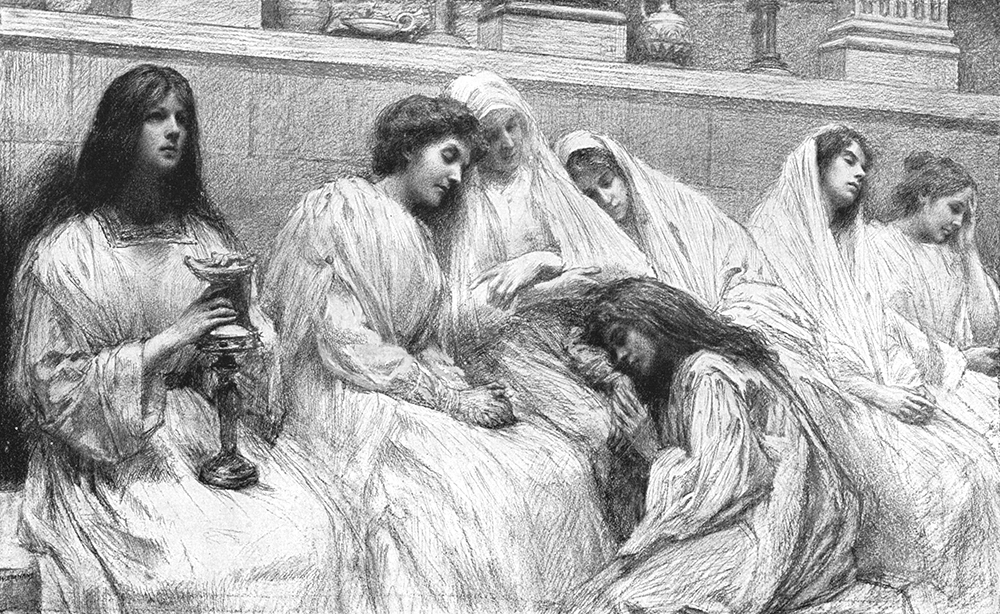
Art by Eugène Burnand

Spiritual Sloth

Matthew 25:1-13

“At that time the kingdom of heaven will be like ten virgins who took their lamps and went out to meet the groom. Five of them were foolish and five were wise. When the foolish took their lamps, they didn’t take oil with them; but the wise ones took oil in their flasks with their lamps. When the groom was delayed, they all became drowsy and fell asleep.

“In the middle of the night there was a shout: ‘Here’s the groom! Come out to meet him.’

“Then all the virgins got up and trimmed their lamps. The foolish ones said to the wise ones, ‘Give us some of your oil, because our lamps are going out.’

“The wise ones answered, ‘No, there won’t be enough for us and for you. Go instead to those who sell oil, and buy some for yourselves.’

10 “When they had gone to buy some, the groom arrived, and those who were ready went in with him to the wedding banquet, and the door was shut. 11 Later the rest of the virgins also came and said, ‘Master, master, open up for us!’

12 “He replied, ‘Truly I tell you, I don’t know you!’

13 “Therefore be alert, because you don’t know either the day or the hour.

There were three stages in every ancient Jewish wedding.

  • Engagement–when fathers got together to make sure that it would be a good match.
  • Betrothal—a ceremony in which formal promises were made by the lovers.
  • Marriage—a surprise arrival, usually a year later, by the groom at the home of the woman.

Each was incredibly important. There couldn’t be any short-cuts; one just didn’t jump into this. It wasn’t a Las Vegas approach to just getting hitched. This parable was an extension of the previous verses in Matthew 24:36-51 and had to do with being prepared.

We can extract this from the third step of marriage. The groom would show up at night, and torches were used to light their way, (apparently the flashlight hadn’t been invented yet). Within Jesus’ parable was the idea of suddenness or surprise.

But no one knew exactly when the groom would show up.

Hence there is an emergency feel to this story. The text states in verse 5:

Five of them were foolish and five were wise.”

The story hinges on this sentence. Readiness is the issue here. Everything of any significance must take on the sudden arrival of the groom’s entourage. The virgins, apparently, would go out to meet him—the torches mingling their light, and drive out any darkness. (It seems that 10 was the acceptable number for a proper rabbinical ceremony).

The problem was that only 1/2 of them were ready. It’s interesting to note that everyone was sleeping. Obviously, that didn’t mean anything for it was the availability of “oil” that would make the difference. The idea was a surprise visit.

The oil was the key. And for us, it represents the Holy Spirit.

Sleep is not the whole issue here, but being prepared is. Five girls were foolish, they were simply not ready. They realized their error and tried to finagle oil from the others, but ultimately that would short everyone in their group. There was an idea that a trip to the local oil merchant would work. It was an idea anyway.

But it was already too late!

The door was closed. The five simply missed it. They stood outside knocking and calling, but they didn’t enter in on time. Reading between the lines, I sense they were desperate. Verse 12 is meant to penetrate and reveal the price of tolerating spiritual sloth.

“He replied, ‘Truly I tell you, I don’t know you!’

The purpose of this parable is the ending line that stresses alertness in a society that dulls everything. The temptation is to act like you’re spiritually aware when you’re not. It’s one of our greatest sins. We assume our lamps are lit when the reality is that our oil (the Holy Spirit) is running close to zero. When our sloth gets mixed with hypocrisy it’ll surely destroy us.

We’re snoring our way to spiritual death.

We must resist slumber and slothfulness. Jesus asserts that his virgins must be prepared and ready for his coming. We must be ready, we must—the price of our unreadiness is high indeed.

“Take care of giving up your first zeal; beware of cooling in the least degree. Ye were hot and earnest once; be hot and earnest still, and let the fire which once burnt within you still animate you. Be ye still men of might and vigor, men who serve their God with diligence and zeal.”

    Charles Spurgeon

Art by Eugène Burnan

Repairing Your Nets

“Yet those who wait for the Lord
Will gain new strength;
They will mount up with wings like eagles,
They will run and not get tired,
They will walk and not become weary.”

Isaiah 40:31, NASB

The word “wait” used here is powerful. It’s an awesome word, never used casually in the Hebrew scriptures. It does not mean to be uncaring or idle. Sometimes we wait in line at the grocery store, or maybe we’re waiting for a phone call. We wait all the time, and often, we don’t even realize it.

The Hebrew word for ‘wait’ is special. It’s qāvâ. It means, ‘to bind together by twisting.’ It’s an active word.

It sometimes means to work like a fisherman repairing his nets to get them ready for tomorrow’s catch.

(There are always holes to mend after a long night’s efforts.)

When we wait spiritually, repairing our nets, the following should be used. Much of this can be done in prayer.

  • Calming ourselves, setting aside everything that doesn’t fit
  • Reading His word
  • Seeing His face
  • Hearing His voice
  • Keeping pace with Him, whether He moves (or doesn’t)

Fixing our nets is a cool way to describe our journey, right? Sometimes, when we think about waiting, we usually only think about it in English, and that can be annoying. It often stops us from truly understanding the true meaning of ‘wait’.

I strongly believe that the Holy Spirit wants us to understand the concept of being closely connected to Him. Sadly, we are often held back by our own definitions, rather than embracing the definitions found in God’s Word.

“The LORD is good to those who WAIT for him,
to the soul who seeks him.”

Psalm 27:14

Sometimes we are instructed by someone to “wait on the Lord.” This instruction can be challenging and we are unsure exactly how we should do it. It’s usual for us to simply show agreement through a smile and a nod. We never completely grasp the essence of that word.

He becomes my source of power that comes from waiting.

He is now the sturdy bond that I am intertwined with. (Maybe this is how He gives strength and power to His people?) We must listen to this, and the Lord is very enthusiastic about guiding us into this fresh form of closeness.

The promise in Isaiah 40:31 talks about receiving new strength, like an eagle’s wings, a holy energy. This verse is important for us, especially today; we need this kind of strength right now. We need to repair our nets as often as we can.

“Waiting for God is not laziness. Waiting for God is not going to sleep. Waiting for God is not the abandonment of effort. Waiting for God means, first, activity under command; second, readiness for any new command that may come; third, the ability to do nothing until the command is given.”

    G. Campbell Morgan

alaskabibleteacher.com