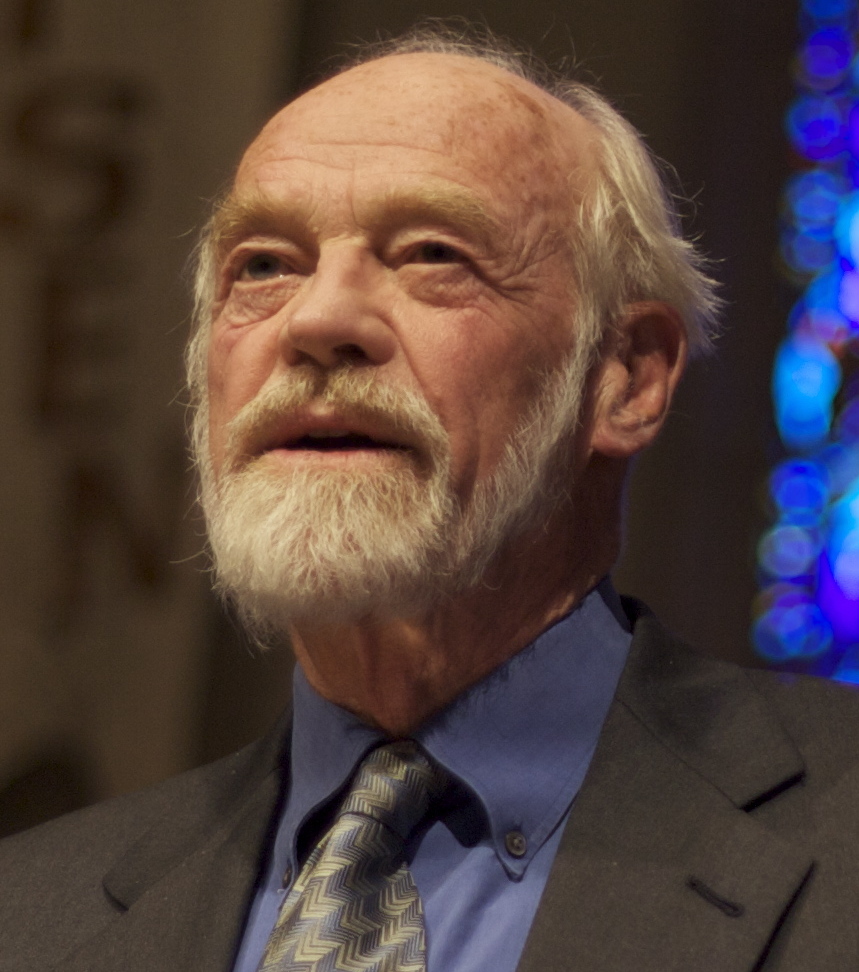
The following excerpt is from the devotional book, “Living the Message,” by Eugene H. Peterson. This pastor-professor is probably the person I want to grow up to be like; he has a gentleness and eloquence that is seldom seen–and highly respected.
Dr. Peterson died in 2018.
***********
“When Christian believers gather in churches, everything that can go wrong sooner or later does. Outsiders, on observing this, conclude there is nothing to this religious business, except perhaps, business…and a distant one at that. Insiders see it much differently.”
“Just as a hospital gathers the sick under one roof and labels them as such, the Church collects sinners.”
“Many people outside are just as sick as the ones inside, but their illnesses are either undiagnosed or disguised. It is similar with sinners outside the church.”
“One way to define spiritual life is getting so tired and fed up with yourself you go on to something better, which is following Jesus.”
Some other quotes by Eugene Peterson:
“All the persons of faith I know are sinners, doubters, uneven performers. We are secure not because we are sure of ourselves but because we trust that God is sure of us.”
“Suffering attracts fixers the way road-kills attract vultures.”
“When we sin and mess up our lives, we find that God doesn’t go off and leave us- he enters into our trouble and saves us.”
“That’s the whole spiritual life. It’s learning how to die. And as you learn how to die, you start losing all your illusions, and you start being capable now of true intimacy and love.”
“American religion is conspicuous for its messianically pretentious energy, its embarrassingly banal prose, and its impatiently hustling ambition.”
13 Therefore take up the whole armor of God, that you may be able to withstand in the evil day and having done all, to stand firm. 14 Stand therefore, having fastened on the belt of truth and having put on the breastplate of righteousness, 15 and, as shoes for your feet, having put on the readiness given by the gospel of peace. 16 In all circumstances take up the shield of faith, with which you can extinguish all the flaming darts of the evil one; 17 and take the helmet of salvation, and the sword of the Spirit, which is the word of God,“
Eph. 6:13-17, ESV
You’re called to be armor-plated. Ephesians is quite clear about this, and we DARE not live without spiritual protection, and as a matter of fact, we must wear each piece to survive spiritually. To be ‘naked’ is to invite disaster. Neglecting to dress appropriately brings cataclysmic disaster. We dare not minimize the need for armor.
Each piece listed must be worn. This is a scriptural mandate for every believer in Jesus.
“The whole armor of God” explains the equipment we need to survive spiritually. Here’s a list and a brief comment on the six:
The belt of truth–this pulls everything together and holds us and keeps us secure in the truth.
The breastplate of righteousness–our spiritual heart is protected by knowing we’re accepted by the Father. Being right with God is not a feeling nor is it a mere hopeful wish.
The shoes of the gospel (of peace)–the idea of standing in place (“to stand”) explain our ability to be fixed on grace. When we wear battle shoes we cannot be pushed back or lose our footing. Wearing gospel shoes brings us spiritual stability. We can stand in place, rooted and strong.
The shield of faith–is a vital way of protecting ourselves from the evil arrows shot by the enemy. Satan targets us when he thinks that we aren’t using faith to defend ourselves.
The helmet of salvation–this is the realization that our mind is protected. This vital piece brings us wholeness as we understand what Jesus has done. We know we are saved and wearing our helmet is our protection from demonic-inspired lies.
The sword of the Holy Spirit–the only offensive weapon we have, and it’s all we need. The Word of God will frighten the enemy and push him back. The Word slices and cuts down every obstacle and every lie.
Only those who are spiritual perceive the reality of the spiritual foe and hence engage in battle. Such warfare is not fought with arms of the flesh. Because the conflict is spiritual so must the weapons.
I must stress that clothing yourself is vital. You dare not live spiritually naked wearing nothing. You will be totally vulnerable to the satanic wickedness that is swirling around you. I’m afraid it’s all very real and sobering and there is no escape clause until you finally arrive in heaven.
“We know [positively] that we are of God, and the whole world [around us] is under the power of the evil one.”
1 John 5:19, Amplified Bible
I’m afraid you haven’t been given an option in all of this. Our battle equipment in Ephesians 6 is not just some theological preference or concept. It’s real.
Over 40 years of following Jesus have taught me that most believers struggle because they won’t arm themselves for battle. They refuse to acknowledge the environment they’re in and don’t realize the spiritual battle they are facing. They like the sentiment behind this particular passage, (it stirs their heart) but the reality of the battle never fully sinks in.
They end up leaving their armor behind.
The good news is that we have already won because of what the Lord has done. Wearing the armor strengthens and stabilizes us. He pours out His grace, and there will be times of rest of that I am certain. “He leads me beside still waters.”
As obedient and faithful believers we need to realize we’re secure in Him. Yes, there is a terrible fight, but “The battle is the Lord’s.”
“For you equipped me with strength for the battle; you made those who rise against me sink under me.”
“Watch, O Lord, with those who wake or weep tonight, and give your angels and saints charge over those who slumber.“
“Tend your sick ones, O Lord Christ,Rest your weary ones,Bless your dying ones,Soothe your suffering ones,Pity your afflicted ones,Shield your joyous ones,”
“And all for your love’s sake.”
Amen.
Augustine
Woven into this ancient ‘evening prayer’ is an idea of God meeting us with overflowing grace and kindness. There is a strong sense of God watching everyone! And there is also a “tending” sense that He has overall.
As I read this prayer, I seem to focus on the single phrase, “shield your joyous ones.” To think that these joyful people need protection strikes me as odd. Why do they even need a “shield?” Of all people, don’t they have it together?
God sees to our every need, and His flock can be incredibly needy.
As I thought it through, I started to realize that joy is its best standing in the shadow of warfare. The joyful ones are companions– “buddies” who share the same ‘fox hole’ on enemy lines. But this isn’t a grim thing, Nehemiah told those trying to build the city walls,
“The joy of the Lord is your strength”
Neh. 8:10
Joy connects with the desperate need of the moment; it is the muscle of all ministry. And as a result, perhaps more vulnerable.
He didn’t say that the joy of the Lord is our happiness, cheeriness, or merriment.
But rather, joy would impart strength, and stiffen one’s ability to go to war for our brothers and sisters, our churches, and our communities. There are certain epoxy resins that will only harden when a special light is used on them. Maybe joy transforms into strength when we step toward our Father.
We need to spiritually protect and cover those who are His “joyous ones.” They can be found sprinkled throughout our churches and ministries. And they need us to shield them. They seem to be quite exceptional, and seemingly invulnerable. But that isn’t the case. We need to pray for them. Joyful people inspire me in battle.
“The joy of the Lord will arm us against the assaults of our spiritual enemies and put our mouths out of taste for those pleasures with which the tempter baits his hooks.”Matthew Henry
Here are several quotes written by Brennan Manning. They’re definitely thought-provoking and should be prayed through. I think they’re worth considering. If you like them great, if not that’s ok too.
“The gospel declares that no matter how dutiful or prayerful we are, we can’t save ourselves. What Jesus did was sufficient.”
“When we wallow in guilt, remorse, and shame over real or imagined sins of the past, we are disdaining God’s gift of grace.”
“God loves you unconditionally, as you are, and not as you should be because nobody is as they should be.”
“I could more easily contain Niagara Falls in a teacup than I can comprehend the wild, uncontainable love of God.”
“In my experience, self-hatred is the dominant malaise crippling Christians and stifling their growth in the Holy Spirit.”
“The splendor of a human heart that trusts it is loved unconditionally gives God more pleasure than Westminster Cathedral, the Sistine Chapel, Beethoven’s “Ninth Symphony”, Van Gogh’s “Sunflowers”, the sight of 10,000 butterflies in flight, or the scent of a million orchids in bloom. Trust is our gift back to God, and he finds it so enchanting that Jesus died for love of it.”
“Those who have the disease called Jesus will never be cured.”
“The men and women who are truly filled with light are those who have gazed deeply into the darkness of their own imperfect existence.”
“God loves us as we are…not as we ought to be, because we are never going to be as we ought to be.”
“The ragamuffin gospel reveals that Jesus forgives sins, including the sins of the flesh; that He is comfortable with sinners who remember how to show compassion; but that He cannot and will not have a relationship with pretenders in the Spirit.”
“The North American Church is at a critical juncture. The gospel of grace is being confused and compromised by silence, seduction, and outright subversion. The vitality of the faith is being jeopardized. The lying slogans of the fixers who carry religion like a sword of judgment pile up with impunity. Let ragamuffins everywhere gather as a confessing Church to cry out in protest. Revoke the licenses of religious leaders who falsify the idea of God. Sentence them to three years in solitude with the Bible as their only companion.”
“When I get honest, I admit I am a bundle of paradoxes. I believe and I doubt, I hope and get discouraged, I love and I hate, I feel bad about feeling good, I feel guilty about not feeling guilty. I am trusting and suspicious. I am honest and I still play games. Aristotle said I am a rational animal; I say I am an angel with an incredible capacity for beer.”
“For a whole year they met with the church and taught a great many people. And in Antioch the disciples were first called Christians.”
Acts 11:26, ESV
Some have suggested that the word “Christian” (grk. christianos) was meant as a slur or insult. It meant little Christs, or mini-Christs. Perhaps that was the best the unbelievers came up with. They identified believers in Jesus and slapped a label on them that was supposed to mock and demean them.
But guess what? The early Christians loved it!
The disciples very quickly adopted it as a great explanation of their new identity. It became a badge of honor. The early Church of disciples became known as little Christs. This now identified them, and they wholeheartedly embraced this new nickname.
From all that I’ve read I see Antioch as a pretty interesting place. It was a city of almost 300,000 people and it had some major Roman temples, and amphitheatres. The city was fully entrenched in the economy and military of the empire. Antioch was regarded as the eastern capital of Rome.
After heavy persecution in Jerusalem, Christians moved north and made Antioch their home base.
This verse (Acts 11:26) tells us that Paul spent a considerable amount of time there teaching the church. After a generation or two, Ignatius of Antioch took over leadership of the Church. By 390 AD the city had almost 200,000 believers!
I’m not sure why, but the word “Christian” is only used 3x in the N.T. (Go figure?) Just maybe the letters of Paul and Peter predated the new label? IDK.
“Every Christian is to become a little Christ. The whole purpose of becoming a Christian is simply nothing else.”
C.S. Lewis
To be a mini-Christ is a pretty profound calling. I think of the 12 being sent out by Jesus to heal and announce the arrival of His kingdom in a new way. In essence they duplicated Jesus’ ministry. (Matthew 10:5.) The more we know Him, the more like Christ we become. (Matthew 11:29.)
Now don’t get me wrong, we are definitely NOT little gods. No way! We are simply broken people who battle sin and must be filled with the Holy Spirit constantly. (Acts 13:52.) In no way, shape, or form are we anything more than human.
And yet we also are little-Christs!
His Spirit comes when, in our neediness we make room for Him in our hearts and minds, and simply ask in faith. Your faith must be humble, and never ever, be proud or arrogant. We are called to reveal the heart of Jesus to an unbelieving world.
Persecution, in its different intensities, will also be present for mini-Christs. Jesus repeatedly warned us to expect it.
“I have said these things to you, that in me you may have peace. In the world you will have tribulation. But take heart; I have overcome the world.”
John 16:33, ESV
So where do we go from here? Mother Teresa once said, “Calcuttas are everywhere if only we have eyes to see. Find your Calcutta.” It’s probably closer than you’ve ever imagined. Open your eyes and receive the reality of being a little-Christ sent out into this world.
Goliath was almost 10 feet tall, a warrior since birth–we read of his armor–he was like a Sherman tank. And David was just a very small, skinny boy–nothing more.
Young David stood and looked at Goliath face-to-face. (If it’s been awhile, you can read of this encounter in1 Samuel 17.) My guess is that Goliath preened and strutted into the field of battle, and the boy David was stepping up for his very first try at hand-to-hand combat. David is called a “youth” in Hebrew, which means anyone from infancy to adolescence.
And that’s when Goliath begins to blaspheme loudly. Perhaps that’s what giants do best.
He boasts. He mocks. He believes he is superior, and his arrogance seems to know no bounds. In his mind the center of the universe is the Philistine army, and he is their champion. He is contemptuous of everything else–physical or spiritual.
Essentially all you need to know is that Goliath is a human wood chipper.
Everyone who has faced him has been destroyed. No one has ever survived. But he has never met David before. And Goliath knows nothing of the living God. It amazes me, but David never backs down, his reaction to the ‘human mountain’ of Goliath was to run directly at him.
This is an astonishing faith!
“As the Philistine moved closer to attack him, David ran quickly toward the battle line to meet him. Reaching into his bag and taking out a stone, he slung it and struck the Philistine on the forehead. The stone sank into his forehead, and he fell facedown on the ground”.
1 Sam. 17:48
Many of us face our giants. They come with many names, some are called guilt, pride, doubt, or despair and lust. And they come with many other names as well.
Satan our enemy has marched out on the field of battle, arrogant and supremely confident of his ultimate triumph over us. I suppose that should terrify us. Over the years we’ve been indoctrinated to accept sin’s control, and our inevitable slavery–with a spirit of timidity.
We’ve been rightly told that there are enemies that can destroy us.
As believers we are especially hated in the spiritual world of darkness. Our destruction is inevitable in the mind of the evil one. Satan still expects to win over your soul, but Jesus stands as our advocate shielding you. I believe you are saved because He really did die for you.
Our own particular favorite demonic ‘monster’ is real and brutal.
Yet so many believers are intimidated, listening, and then surrendering to the boasting of the giant. The warfare dimension gets nullified, and soon becomes irrelevant. Despair reaches us and has the full intention of taking total control. It’s never satisfied with just a little bit.
He passed through the dark intimidation and influence to approach Goliath. There was no doubt to cloud his mind. David took a spiritually aggressive position, he took on the fear, and then ran directly at the giant Goliath. His spirit was untouchable. This is the boy who wrote Psalm 23.
Some of us stare down our giants repeatedly, over and over.
As believers, we might struggle. We can turn our hearts over to despair. Sometimes we actually make ourselves available to the enemy’s workings. When we do this the enemy spreads his influence to others through us. And any confidence we might have through faith is dissolved into doubt and confusion.
But the victory we have in Christ allows us liberty, through the Blood of Him who defeats our own Goliath of despair. We can run into the battle. We fight our giant, but we’re never defeated.
“Soon the battle will be over. It will not be long now before the day will come when Satan will no longer trouble us. There will be no more domination, temptation, accusation, or confrontation. Our warfare will be over and our commander, Jesus Christ, will call us away from the battlefield to receive the victor’s crown.”
“Come to Me, all who are weary and heavily burdened [by religious rituals that provide no peace], and I will give you rest [refreshing your souls with salvation]. 29 Take My yoke upon you and learn from Me [following Me as My disciple], for I am gentle and humble in heart, and you will find rest (renewal, blessed quiet) for your souls.”
Matthew 11:28-29, Amplified Bible
He is inviting us.
Jesus requests our presence in one simple statement, “come to Me.” This phrase must be our starting point. It’s how you begin daily. If you’re His disciple, it’s imperative that you obey. But this concept is nuanced, it has profound meanings.
“All who are weary.” Each of us carries a heavy load. Sin has weight, whether we believe it or not. When I start to see this, I really begin my discipleship. Apart from Jesus’ invitation I will try to carry this heaviness on my own. This is called “religion,” and it’s a bad thing.
“My guilt overwhelms me— it is a burden too heavy to bear.”
Psalm 38:4
“I will give you rest.” It’s His gift, given to each believer. It isn’t earned, you don’t deserve it. His heart is for you to “rest.” The original Greek word often means “to refresh, or to cease your work.” Every true disciple knows this, and understands that Jesus rather laying a terrible burden on us, takes it off.
We must understand our calling.
Another burden (His own burden), is now given to us. It’s Jesus’own weight shared with believers. But it’s a restful burden that gives joy and peace. There are no longer sweaty religious rules, but authentic rest. Real discipleship is now based on love, not duty.
To follow Him in obedience is the happy delight of every disciple. When you are in love with Him the rigors of obedience have little weight.
“It never cost a disciple anything to follow Jesus; to talk about cost when you are in love with anyone is an insult.”
“For I am gentle and humble in heart,” is His nature. He always acts this way, it is who Jesus is. This is how He behaves to each of us. It becomes the very essence of how He relates to human beings, always gentle and completely humble. Sometimes we add things that obscure this, and we see Jesus in our own particular image. (Maybe that’s a way of defining idolatry?)
And finally--“and you will find restfor your souls.” Again, the Greek here is quite instructive: rest, “cessation of any motion, or labor.” My walk, following Him, isn’t working harder, but being in a joyful rest. God’s saints aren’t called to sweat, but walk in the sureness of the presence of Jesus inside them.
Life can be awfully hard. Trials come and we get overwhelmed.
The joyful rest is only a slice of what heaven will be like. If joy and peace are a wonder now, just you wait, our future holds promises of a continual awareness of Him in our new bodies. This fallen world will be completely remade. Sin, sadness and Satan will be no more.
“And me? I plan on looking you full in the face. When I get up, I’ll see your full stature and live heaven on earth.”
“Praying at all times in the Spirit, with all prayer and supplication. To that end, keep alert with all perseverance, making supplication for all the saints,
19 and also for me, that words may be given to me in opening my mouth boldly to proclaim the mystery of the gospel, 20 for which I am an ambassador in chains, that I may declare it boldly, as I ought to speak.”
Eph. 6:18-20, ESV
I am convinced that our most challenging work is learning to pray. Whenever we experience revival, whenever we rediscover our true calling and purpose for living, we do so by prayer. Prayer isn’t the way to get things, it’s how we change.
Prayer is the way we become like Jesus.
Satan’s primary focus is to destroy our prayer lives, he works to eliminate our communion with our Father. He detests that, and he and his demons (and the world system) work overtime to tear down our walk. The enemy concentrates everything on our prayer life.
This passage (v.v. 18-20) emphasizes several truths about prayer. If you take apart these you’ll discover how to shape and direct your ‘time on your knees.’ Notice the following.
There are four “alls” used in verse 18, and they must be understood.
All times
All prayer
All perseverance
All the saints
If we go further we see that the word “all” in Greek, (although it’s a simple adjective), gets used 1245 times in the Bible. It can mean:
all manner of
the whole or entirety
everything, or the totality of
completely
With this in mind we see that Paul stresses the complete effort of prayer and its focus. All the time, every kind, no matter what and for your brother and sisters in Christ need. It’s work, spiritual work. It seems that once we put the armor on (verses 10-17) we can stand in God’s own strength. It’s from that we start to learn prayer.
It’s not enough to wear your armor. There’s something you must do wearing it.
If we’re clothed in armor it’s pretty much for the exclusive purpose of prayer. Yes we must dress for war and protection, true, but its ultimate purpose is prayer and intercession. Don’t just wear it but pray out of it. It’ll be work, but you must do this, even if you sweat. You must strive in prayer, so much is counting on you.
You can make a difference.
The Church is counting on you. “Paul,” (symbolizing all pastors and elders, teachers and leaders), absolutely need your prayers. We need boldness, and we need grace and love, and only God can give it, if you’ll only intercede for us.
God will do nothing unless you start to pray. He’s waiting for you to ask. He wants you to intercede for others.
It will not be easy. The enemy wants to suppress your prayer life. He absolutely hates it. Satan wants to see you passive and dull and you cannot let him do this. You have a very critical part and place in God’s kingdom. Perhaps others are waiting for you, and perhaps you’re the only one who can step in the gap for them.
You’ve been given a part of God’s field to care for, you have your own sphere of influence. No one else has it, but you.
There many different ways to pray:
On your knees
walking
standing or sitting
vocally, or in your focused thoughts
with others, a group
using a prayer list, (very helpful).
“arrow” prayers, (those with 1-2 sentences that end up in His throne room).
using the Psalms or reading the many prayers in the Bible
(I know there are many more, but these are what comes to mind right now.)
There’s a “school” of prayer and the Holy Spirit intends to teach you.
Don’t play hooky. You’ll make mistakes or perhaps lose focus. The Spirit will teach you holy stamina. You might pray for one or two minutes at first, but it’ll grow and you’ll learn endurance. Remember though–you’re most like Jesus when you start to intercede for others.
Just maybe your sanctification will come when you start to pray?
“You need not cry very loud; he is nearer to us than we think.”
“Behold, these are but the outskirts of his ways, and how small a whisper do we hear of him! But the thunder of his power who can understand?”
Job 26:14
Job’s suffering has led him to this point. He realizes how little he understands God. I guess pain can have a powerful effect on how we see things. Job has learned the immensity of God.
In verse 14 he speaks about the “outskirts” the word in Hebrew means the mere edge, or fringe. One translation of this verse reads like this: “These are only a few of the things that God does. We only know about a few small things. If he used all of his power, we could never understand.“
“That being the case, let’s consider God’s capacity for just a moment. He’s not only “high capacity”, He’s “infinite capacity.” He never sleeps or slumbers. He is perfect in all His abilities. There isn’t a single thing that He doesn’t know, and there is no one more powerful than Him. And unlike humans who can only be in one place at one time, He is everywhere at the same time. This is amazing, and just like the Psalmist said in Psalm 113, “Who is like the Lord our God?”The answer, very simply, is no one.”
John Piper
“For now we see in a mirror dimly, but then face to face. Now I know in part; then I shall know fully, even as I have been fully known.” (1 Cor. 13:12)
I’m thinking about Moses who asked to see God’s glory. Moses was called “the friend of God,” but he wanted to see more. God’s response was that He couldn’t because it would kill Moses. But provision was made for him to see the backside of God as Moses was in a cleft of a rock. (Exodus 33.)
The Bible doesn’t reveal it all. But we’re given enough. Job told us that only the outer fringes can be seen by men and women. We see His periphery, but we must understand our limits. We’re told that we will see Him someday–but not yet. But at the moment of death, we will see Him.
The Lord Jesus came to show us the Father. “In [Christ] all the fullness of deity dwells bodily.” When we see Jesus we see the Father. Reading the Gospels we are encountering God, because Jesus reveals Him fully.
“He is the radiance of the glory of God and the exact imprint of his nature, and he upholds the universe by the word of his power.”
Hebrews 1:3
“Oh, the depth of the riches and wisdom and knowledge of God! How unsearchable are his judgments and how inscrutable his ways!”
Life can get out of hand sometimes, becoming hectic and frantic. It seems like we’ve got 1000 ‘irons in the fire.’ The anxiety of doing everything creates fear and worry. We cannot possibly keep up. There isn’t enough hours in the day.
We are not at rest with ourselves, or with the Lord.
And oh my, the news, the internet, and our cell phones create awful issues if we can’t manage them with the Holy Spirit’s direction and purposes. Our computers seem like a pipeline for darkness. Unless they’re “given” to God, they can destroy you.
What causes me anxiety? I’m quite sure you can add your own issues.But here’s a partial list:
ambition, self-promotion, pride, jockeying for position
family issues, marriage and children
my job and career, “keeping up with the Joneses”
religious ‘duties’
finances, bills
politics, media
unrepented sin, separation from God, peace is missing
But I assure you, there is rest.
The Old Testament uses a word, נוח or ‘nuach.’ It’s a Hebrew word. Both Moses and Jesus understood the implications. It means calming, to become quiet or still. To rest quietly.
“And He said, “My Presence will go with you, and I will give you rest.”
(Exodus 33:14)
This promise is given to Moses; frankly, he’s overwhelmed by his burden. In the “tent of the meeting” he battles with God, and it’s in that place Moses insists on the Lord’s active presence on him and on the people. He will not take another step unless God does this.
“Come to Me, all you who labor and are heavy laden, and I will give you rest.“
(Matthew 11:28)
The Lord Jesus calls each of us to rest in Him. It seems we work hard and we carry awful heavy burdens. Jesus uses the word, “Come” which is typically a command or an imperative. (It can be used with an explanation mark!)
Jesus understands our hearts and our effort and “labor.” He fully grasps that we’re “heavy laden” much of the time. His invitation is to come and find the peace of a resting disciple. It is His gift to us, and only Jesus can give it to us.
“‘Come’; he drives none away; he calls them to himself. His favorite word is ‘Come.’ Not, go to Moses – ‘Come unto me.’ To Jesus himself we must come, by a personal trust. Not to doctrine, ordinance, nor ministry are we to come first; but to the personal Saviour.”