A Stone’s Throw Away

tumblr_static_tumblr_static_1odvenqfc6kkgwo0sg0skgsco_1280

“And He withdrew from them about a stone’s throw, and He knelt down and began to pray,”

Luke 22:41

WHO KNOWS WHAT JESUS IS THINKING as he entered the Garden? His disciples followed Jesus but scripture states that he proceeded ahead of them. He knew He must find some much-needed strength through prayer— this verse tells us he went “a stone’s throw.”

Often we share in the sorrows of the people closest to us, and Jesus wants His disciples to follow him. And they do, but not all the way. They came very close but didn’t really understand the full nature of the pain that was beginning for Jesus. They slept while he agonized. He was for the first time perhaps, needing someone close.

Some who are reading this will make the same trip to the garden.

Perhaps every believer makes the trip to ‘Gethsemane,’ but not as mere observer or tourist. The garden is a distinct place of testing and of sorrow. And each disciple will experience it for themselves. The servant is not above his master.” We must follow the Lord Jesus, and it’s not going to be easy.

I’ve gone to the Garden myself, sitting in the dark, waiting for Him to come. And He does. And He is my light.

Jesus is very close. He stands by us. He listens and watches.

He completely understands what it means to be alone with sorrow. The believer can lean on Jesus as the pain continues. He sends his “Comforter” to each, as He personally escorts us through this time in the “garden.” He comes in grace and is completely kind. He truly is just a stone’s throw away.

“God is our refuge and strength, always ready to help in times of trouble.”

Psalm 46:1

“No physician ever weighed out medicine to his patients with half so much care and exactness as God weighs out to us every trial. Not one grain too much does He ever permit to be put in the scale.”

   Henry Ward Beecher

alaskabibleteacher.com

Braided Up With God Himself

wait_bench_ocean

“Yet those who wait for the Lord
Will gain new strength;
They will mount up with wings like eagles,
They will run and not get tired,
They will walk and not become weary.”

Isaiah 40:31

The particular word “wait” is a force to be reckoned with. It’s not used passively in the Scriptures. It does not mean to be apathetic or lazy. Sometimes we wait in line at the grocery store, or maybe we’re waiting for a phone call. We regularly wait all the time, we don’t even realize it.

The Hebrew word for ‘wait’ is special. It’s qāvâ. It means, ‘to bind together by twisting.’

It will sometimes mean to work like a fisherman who repairs his nets to get them ready for tomorrow’s task.

(There are always holes to mend after a long night’s work.)

When I truly wait on God, I realize that I’m actually repairing myself for His heart and for His work.

  • Seeing His face
  • Hearing His voice
  • Keeping pace with Him, whether He moves or doesn’t

It’s a fascinating way of describing something, isn’t it? Sometimes, when we think of waiting only in the context of the English language, it can become a frustrating delay. This often causes us to miss out on the true meaning of ‘wait’.

I strongly believe that the Holy Spirit wants us to understand this. Sadly, we are often held back by our own definitions, rather than embracing the definitions found in God’s Word.

“The LORD is good to those who WAIT for him,
to the soul who seeks him.”

Psalm 27:14

For those of us who are sick – in body or mind – being told to “wait on the Lord” can be difficult to accept. It’s common for us to feel frustrated with this because we don’t fully grasp the true meaning of ‘waiting.’ We get close to understanding it, but we never quite reach that simple word.

“WAIT for the LORD;
be strong, and let your heart take courage;
WAIT for the LORD!”

Psalm 27:14

He is now the strong cord I am braided into. (Perhaps this is how He imparts strength to His people?) We need this, and the Lord is quite eager to lead us into this new kind of intimacy.

“The LORD is good to those who WAIT for him,
to the soul who seeks him.”

Lamentations 3:25

The promise in Isaiah 40:31 talks about getting new strength, like an eagle’s wings, a holy energy. This verse is important for us, we need this kind of strength right now. I just want to inspire you during your prayer time to become consciously and purposefully connected to the Lord.

It’s only then can we can put our nets back together again.

    G. Campbell Morgan

alaskabibleteacher.com

Following Jesus on the Flowered Path

There is an old French fable about Jesus. It’s pretty interesting. I came across it several years ago and I’ve been considering it since. Now, it’s a legend of course–a story, a simple folk tale. But maybe it will speak to your heart like it did mine.

We experience moments of fleeting joy as we travel through life. Do you remember how life was before knowing Jesus? It was dull and empty. But now, as His followers, we walk on His beautiful path, learning to be obedient, grateful, and devoted in prayer and worship. It can be challenging, but can you sense the wonderful presence of Jesus? Do you notice the beauty around you?

Discipleship can be tough, but even in the hard times, it’s eternally worth it.

Perhaps we’ll see the flowers blooming as we follow in His steps.

And sometimes you must be patient, just a little while longer.

I’m beginning to see His flowers flourish in His steps through my difficulties. Jesus is close. Don’t be alarmed if your own walk takes you through this awful valley. Very often there are tears, but pay attention, our path is full of flowers, and even when we are hurt. Especially when we hurt.

Amy Carmichael

– Amy Carmichael

In life’s journey, amidst challenges and awareness of sin, it is important to remember to raise our heads, appreciate the beauty around us, and find joy in the presence of Jesus. He is there, even when it seems like we’re all alone.

Worship out of affliction becomes a special sacrifice that God values highly.

When we come with tears into His presence it means something special to our Father. The combination of pain and praise is a potent spiritual mixture. I don’t think I’ve fully grasped this. But there are blossoms and flowers, even if I can’t fully see them yet.

I guess that he patriarch Job is a prime example of this. One of themes of the book is that his life is wrecked and his faith when almost is totalled. The writings of this ultimate sufferer are pretty profound.

Job 13:15, ESV

Dear one, keep on the flowered path with Jesus. Don’t look at this present and physical life, your gaze needs to be on eternity. Good things are about to happen, but it may take some time. Remember that when times get rough.

Revelation 21:4, ESV

When There’s Too Much Pain

“You have given me many troubles and bad times, but you will give me life again. When I am almost dead, You will keep me alive.”

Psalm 71:20, NCV

“He was despised and forsaken of men, A man of sorrows and acquainted with grief.”

Isaiah 53:3, NASB


I have never spoken out like this, but my wife and I had a daughter who died in a terribly vicious way–she was stillborn, dead at birth, in November 1999. She was doing great, up to a week before Lynnie’s due date. We knew that in a few days, we would be able to see her– face-to-face. What a joy that was going to be!

But yet that’s not what happened.

Elizabeth Grace Lowe died from strangulation from her own umbilical cord. Nothing could have been done. My wife had noticed a moment of very frantic activity, as Elizabeth fought for her life. We plummeted from ecstatic joy to devastating sorrow in just seconds. It came “out of the blue,” totally unexpected. Who could prepare us?

We were completely undone. 

“For the Lord will not reject forever,
For if He causes grief,
Then He will have compassion
According to Him there is abundant lovingkindness.
For He does not afflict willingly
Or grieve the sons of men.”

Lamentations 3:32-33, NASB

Yes, there can be horrifying pain, but there are also solid promises.

There can be brutal sadness, but there are those specious Psalms. There is a blessing for all those who grieve. This topic deserves far more attention than this simple post. (If you’re in the thick of things, I’m trusting the Holy Spirit will help you to your next step.)

There can be such sorrow in this life, far much more than the human heart can possibly contain. But our Savior has a title (one of many). He is called the “Man of Sorrows.” He is the one who is “on point.” He leads us through such intense hostility and mind-numbing pain. He is there when the switch is flipped on us and it becomes instantly dark. He can’t, won’t, and will not leave you to face your pain alone. He knows.

There are a few things that I want to communicate to you.

These have come out of great darkness. I have tried awfully hard to be a disciple, even though I’m doing the worst job of it. These may be right, or wrong, or just okay–you decide. I don’t really know anymore.

  1. God amazingly takes the full weight of our pain and sorrow (Isa. 45:6-7, NLT). He doesn’t shift the blame or deny His work in the life of people. He’s fully sovereign. (Sometimes we need to adjust our theology.) Maybe it’s hard to trust Him right now–that’s more than understandable. In eternity, I believe, it’ll make perfect sense. Sometimes, we need to wait.
  2. Jesus has fully entered into our sorrows. All that you are feeling right now, He feels. If you feel you are at a minus 10, then He does as well. As you suffer, He is closer than your shadow. He knows us. He feels it all. Please don’t short-circuit over this.
  3. Nothing is ever wasted. We really shouldn’t treat these moments of sorrow as a waste. Have you ever wondered at Jesus’ ‘economy’ after the 5000 were fed?  He assigns value to the leftovers. The disciples pick up their baskets and collect everything again. Nothing will go to waste.  I strongly suspect that His kingdom works this way.
  4. This pain, this sorrow, is the intensive crash course in becoming a person of mercy. You now will always walk with a limp. At times the scars will be quite visible to those who can really see. This pain will become forever a “healed wound,” (but a wound nevertheless). It helps to seek out others who have walked this same path. And yet, to be honest, I don’t think I will ever fully trust a person (or a pastor even) who doesn’t walk with a limp.
  5. You will need (but maybe not accept) the transformation of your suffering into glory. This will take some time, and it almost feels like you’re not progressing at all. I encourage you to re-think each of these simple points. The Holy Spirit may be working, perhaps behind the scenes.
  6. Finally remember this: God is not a monster, stomping on us like a boy crushes ants. He has carried all of our pain and illness. He clearly comes alongside every suffering believer. It is Satan who would suggest to you that God is a Celestial Menace, not worthy of our love. I will be very blunt with you, that idea has to be implicitly rejected. Its origins are truly satanic.

“The LORD is close to the brokenhearted; he rescues those whose spirits are crushed.”

Psalm 147:3

“The Spirit of the Sovereign LORD is upon me, for the LORD has anointed me to bring good news to the poor. He has sent me to comfort the brokenhearted and to proclaim that captives will be released and prisoners will be freed.”

Isaiah 61:1

“He heals the wounds of every shattered heart.”

Psalm 147:3, TPT
 
I’m pretty much convinced that this post is a bit much for some. But please hold it close, maybe it’ll matter later on? (But I hope not.)
 

“A teardrop on earth summons the King of heaven.”

    Chuck Swindoll

*


Serving God at Night


A song for going up to worship.

“Behold, bless ye the Lord, all ye servants of the Lord, who by night stand in the house of the Lord.

Lift up your hands in the sanctuary, and bless the Lord!

The Lord who made heaven and earth bless thee out of Zion!”

Psalm 134

This remarkable Psalm is part of an elite group known as “the Psalms of Ascent.” There are 15 Psalms (120-134) sung as the congregation of Israel went up the steps of the temple in Jerusalem. They would sing each in “rounds” with each other.

As you can well imagine, this made the ascent slow, but meaningful. As you read the three verses of 134, I get a picture of worshipers turning back and blessing the Levites. This takes place at the very end of the day. The Levites, and other godly ones who lived in the Temple, (remember Anna and Simeon, in Luke 2?)

They were the support staff for the priests.

I have some general thoughts about this Psalm:

V.1, “Behold, bless ye the Lord, all ye servants of the Lord, who by night stand in the house of the Lord.”

The first significant thought is “Lord” mentioned three times. The word is the recognition of someone’s status and standing. We call Him Lord, because He is that (and more). The second has to deal with the Levitical “night shift.”

They served and guarded the Temple during the wee hours of the night.

They probably cleaned, stacked wood, sharpened knives and maintained the Holy Place with its needs. There was no real glory working the night shift. There were no people to serve. The crowds were for the day shift. (Here’s a weird thought– think “Disneyland at 2:00 a.m.”) There was also a contingent of non-Levite people ministering to the Lord as well. They had no duties, and only the priests could serve through their work.

The Levites working at night were not ‘second best.’ At least, not in the eyes of the Holy Spirit. They were integral in both presence and service to the Lord. To despise them is to reveal one’s ignorance. They definitely mattered.

V. 2 “Lift up your hands in the sanctuary, and bless the Lord!

I’ve worked nights before. It’s a real adjustment. You never feel like you’ve had enough sleep, and it is really hard to be positive and cheerful.  I could get pretty grouchy at times. But an exhortation is given, a shout and a blessing as the crowds leave. “Raise up your hands– and praise Him!” It is as the work, although necessary, would be secondary. The worship however, was primary. We need to hear that.

Each of these three verses of this Psalm contain the word “blessing!”

V. 3, “The Lord who made heaven and earth bless thee out of Zion!”

To be blessed (literally, made “lucky”) by our Creator and Lord is pretty profound. As a kid who read a lot, I think of ‘fairy dust.’ I know better now, but to be blessed by God is deeply significant. To summarize, I believe this Psalm is speaking of those in the church who are doing “hidden service.” No one sees them really.

They go about there duties quietly, and purposefully. The only recognition is from God– who sees all. I must encourage you to keep on. There are many more than you think who see your hidden ministry to the Father. You are His ‘night shift.’ You’re seen by few, but Him. He knows what you do.

“There are many of us that are willing to do great things for the Lord, but few of us are willing to do little things.”

     D.L. Moody

God’s Night Shift, Psalm 134:1-3

A song of ascents.

“Now bless the Lord,
all you servants of the Lord
who stand in the Lord’s house at night!
Lift up your hands in the holy place
and bless the Lord!

 May the Lord,
Maker of heaven and earth,
bless you from Zion.

Psalm 134:1-3

Not every Levite labored during the day. The night shift continued their work. Granted, no sacrifices were offered, but the “night priests” stood to protect the Ark, gather wood, and keep the incense burning and cleaned up the blood. But most importantly they must worship and pray for Israel.

“Servants of the Lord” is a phrase that resonates in my heart. Those words are both a comfort and a responsibility and that seems to open this passage up. We’ve got a Master, and we serve Him only. And I know and believe that worship was the main responsibility of the night watch!

“Christians believe that true worship is the highest and noblest activity of which man, by the grace of God, is capable.”

-John Stott

Worship is the central work of the disciple, it’s what we’re called to do. Evangelism, missions, and preaching are fine. But prayer and intercession must be the heartbeat of each believer. It’s the holy calling of the Church. When does the church service end? Never!

The service really gets going Monday through Saturday!

In this short Psalm, (just 3 verses!) we’re introduced to a group of Levites who are working the night shift. What they do is hidden–it’s not seen by others. They keep the fires stoked, gather wood, and patrol the walls. But more importantly, they stand and worship and intercede for Jerusalem.

No real recognition is given, and the spotlight is rarely shined on them.

They serve at night, vitally essential but seldom seen. And yet they intercede for the nation. They “bless” the Lord and the people of God. That’s their place and position. They must do this. Israel must be blessed. These night shift workers insist on it!

The church needs nursery workers and Sunday school teachers. So many are working behind the scenes. Often the deacons and elders of a church are rarely seen and seldom acknowledged. So much is concealed. Their work is a hidden one. But the Father sees.

In a church, someone has to clean the bathrooms and take out the garbage, and others will make coffee or shovel snow. They vacuum and straightened the chairs. They are the ones who collect the mail and prepare the overheads. There’s always something to do. And it’s a hidden work carried out with no one watching. No one, but God.

“It is good to give thanks to the Lord,
    to sing praises to your name, O Most High;
to declare your steadfast love in the morning,
    and your faithfulness by night,

Psalm 92:1-2

Serving at night can be a challenge, not all can lead worship or preach the sermon on Sunday morning. Those called to do those tasks serve in the day. But those who serve the Lord at night also labor, and sometimes that hiddenness behind the scenes has its own special challenges.

This may come as a surprise, but it takes as much of the Spirit to work the night shift as it does to stand behind the podium and preach the Word. I believe that this is true! These hidden ones carry out much of the ministry of the Church. Few notice, but God Himself sees them.

“They [Levites] are exhorted to fill the night with prayer and watchfulness and to let their hearts go up in blessing to Jehovah. The voice of praise should echo through the silent night and float over the sleeping city.”

Alexander MacLaren

alaskabibleteacher.com

Sharp Knife Worship

In biblical hermeneutics, the “Law of First Mention” states that the initial occurrence of a word or concept in scripture determines its subsequent understanding. Obviously the book of Genesis is a main source of these initial mentions.

In Genesis 22, we have the story of Abraham and Isaac on Mt. Moriah.

Abraham has tied his son on an altar to offer him as a sacrifice in obedience to God’s direction (v. 2). His faith is tested to the ultimate extreme. Abraham shows us how to enter into real worship.

Genesis 22:4-5

This is the first time in scripture the word “worship” is used.

It sets the singular tone for all the scriptures on this subject. I guess what’s really interesting is that there are no musical instruments involved. There were just these needful things:

  • stones
  • wood
  • rope
  • fire
  • a knife
  • and Isaac, (the would be ‘lamb.’)

When the Hebrew word for ‘worship’ was used for the first time, it was infused with the idea of a sacrifice. Abraham is the first ‘worship leader’ and he has no guitar. No piano, or drums either. No musical instruments whatsoever. No amplifier, no overhead lyrics to speak of.

Just a handmade altar, and a very sharp knife.

In the end, as Abraham raises that knife, and he is suddenly stopped, (to the relief of us all). His faith has withstood the test, and he has genuinely ‘worshiped.’

Gen. 22:11-12

Principle One:

There really can’t be worship without sacrifice.

Sometimes we think that only talented and gifted people should lead worship, and maybe they should. But in reality, we all must worship, regardless of our talents or skills. Let’s remember that worship isn’t about impressing others, but it’s about expressing our devotion and commitment to God. But in the long run, there needs to be a sacrifice of some sort. It may be something small, but it’s always dear.

Principle Two:

The first worshiper didn’t use a guitar, but a knife.

This difference keeps the idea of sacrifice in its definition. I truly believe that there can’t be real worship without sacrifice. The knife thrust he was ready to use wasn’t backed up by drums or piano. Yet Abraham understood worship every step he took to Mt. Moriah with the knife in his belt.

Jesus is my Isaac, my sacrifice. He died so I now live.

We must realize our sacrifice is the Lamb of God. It’s His blood on God’s altar for our sin. As believers, our faith firmly rests in this spiritual fact. It’s a sacrifice, and He did it for us. We of all people have cause to really worship.

    John Piper

Are You Resting? נוח Nuach

Life can get out of hand sometimes, becoming hectic and frantic. It seems like we’ve got 1000 ‘irons in the fire.’ The anxiety of doing everything creates fear and worry. We cannot possibly keep up. There isn’t enough hours in the day.

We are not at rest with ourselves, or with the Lord.

And oh my, the news, the internet, and our cell phones create awful issues if we can’t manage them with the Holy Spirit’s direction and purposes. Our computers seem like a pipeline for darkness. Unless they’re “given” to God, they can destroy you.

What causes me anxiety? I’m quite sure you can add your own issues. But here’s a partial list:

  • ambition, self-promotion, pride, jockeying for position
  • family issues, marriage and children
  • my job and career, “keeping up with the Joneses”
  • religious ‘duties’
  • finances, bills
  • politics, media
  • unrepented sin, separation from God, peace is missing

But I assure you, there is rest.

The Old Testament uses a word, נוח or ‘nuach.’ It’s a Hebrew word. Both Moses and Jesus understood the implications. It means calming, to become quiet or still. To rest quietly.

This promise is given to Moses; frankly, he’s overwhelmed by his burden. In the “tent of the meeting” he battles with God, and it’s in that place Moses insists on the Lord’s active presence on him and on the people. He will not take another step unless God does this.

The Lord Jesus calls each of us to rest in Him. It seems we work hard and we carry awful heavy burdens. Jesus uses the word, “Come” which is typically a command or an imperative. (It can be used with an explanation mark!)

Jesus understands our hearts and our effort and “labor.” He fully grasps that we’re “heavy laden” much of the time. His invitation is to come and find the peace of a resting disciple. It is His gift to us, and only Jesus can give it to us.

 “‘Come’; he drives none away; he calls them to himself. His favorite word is ‘Come.’ Not, go to Moses – ‘Come unto me.’ To Jesus himself we must come, by a personal trust. Not to doctrine, ordinance, nor ministry are we to come first; but to the personal Saviour.”

CH Spurgeon

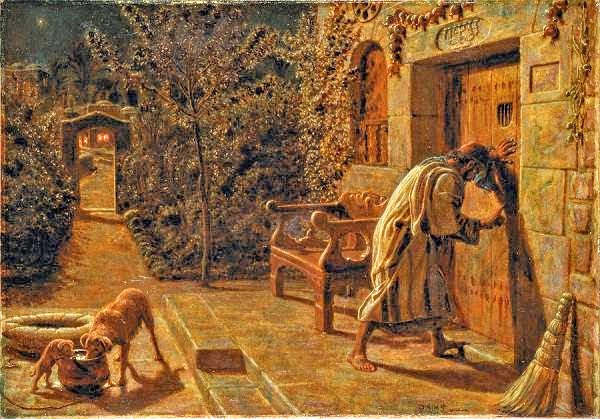
Breaking Down the Door

Luke 11:5-8

This parable is known by some as “the Importunate Neighbor.” That’s an excellent description. Importunate is defined as being persistent, especially to the point of annoyance or intrusion. It’s tenacious and stubborn–not giving up even when being ignored, and that describes what’s happening here.

What immediately proceeds this parable is Luke’s version of the Lord’s prayer, which the disciples requested. They wanted to understand the methods and mechanics of praying–perhaps the Pharisee’s prayers weren’t quite up to snuff–they wanted more; and they insisted that Jesus instruct them.

The disciples wanted to do prayer right.

A typical Jewish home had sleeping quarters (one room!) located on a raised platform. A ladder was used to access that level (which could be crowded, sometimes two to a bed.) Often their livestock were brought inside. And when it was time to get up, everyone got up. That explains the homeowner’s reluctance to give bread to his neighbor. To get up, light a lamp, wasn’t a solitary affair.

He’s obviously unenthusiastic to make that effort.

The word used here to explain the neighbor actions is ἀναίδεια “anaídeia,” which is only used once–it’s translated as impudence, shamelessness, audacity or chutzpah. It’s a Greek word that explains the knocker’s rudeness. He won’t stop. He knocks and pounds until he gets his bread. Not having bread for his guests is unheard of, for it violates all kinds of convention.

The unwritten law of Jewish hospitality demanded action. 

This is part of Jesus’ view on prayer. It means we must be inappropriate sometimes–even to the point were we are being rude.

Immediately following this parable (the very next thought) are the following instructions:

“So I say to you, ask, and it will be given to you. Seek, and you will find. Knock, and the door will be opened to you. 10 For everyone who asks receives, and the one who seeks finds, and to the one who knocks, the door will be opened.”

Luke 11:9-10

Perhaps it’s this intensity that’s lacking.

We “pray” but don’t insist. We desire but don’t demand. Maybe it takes a certain shamelessness to make prayer work. Jesus emphasizes a necessary attitude to praying God’s way. It’s never automatic, but in this parable we see words that move the Father’s heart, and loosen his hand. In Jesus’ teaching, prayer means effort.

It means spiritual work. He wants us to know this. It is important.

“There is neither encouragement nor room in Bible religion for feeble desires, listless efforts, lazy attitudes; all must be strenuous, urgent, ardent. Flamed desires, impassioned, unwearied insistence delight heaven. God would have His children incorrigibly in earnest and persistently bold in their efforts. Our whole being must be in our praying.”

    E.M. Bounds

f

Ponder the Word

“But his delight is in the law of the Lord, and on his law he meditates day and night.”

Psalm 1:2

In Psalm 1:2 the Hebrew word for meditation is hagah. In this Psalm we have a contrast between the blessed and the “not-so-blessed,” and it commands that as Jesus’ followers that we process the reality of this to become blessed by our Father.

In Psalm 1:1 the word blessed is used, and actually just in the book is Psalms alone blessed is used 51 times. The word has a very simple and concise meaning: “to be happy.” I really don’t think we can minimize how important it is to be happy.

In 1:2 we read hagah or meditate. That Hebrew word is a little bit more complicated and it seems more nuanced than “blessed.”

Hagah, or meditate means:

  • to chew a cud like a cow
  • to growl like a lion who is eating an antelope
  • to moan or groan
  • to talk to oneself, or mutter or whisper
  • finally, it can mean to muse or imagine

Yeah, it’s an interesting word and I suppose all of these meanings are to be factored into meditation [hagah]. It seems that these five definitions shape the different meanings that go into our understanding.

Using the above definitions, this is how it might look:

  1. sometimes I regurgitate the word like a cow chewing its cud
  2. at times I attack it like a lion
  3. I moan and groan as I wrestle with it, seeking for a handhold
  4. thinking about the passage I talk to myself about its meaning
  5. I imagine being there, sometimes it’s like I’m a “fly-on-the-wall”

When we come to God’s words, the Bible, we are required to assimilate all that the Holy Spirit graciously gives. When He gives us something from the Word we must apply it to ourselves. You can do this through any of the 5 definitions I’ve given.

The Holy Spirit is the One who ignites His Word into our hearts.

Joshua 1:8, ESV

alaskabibleteacher.com