Boasting for Dummies


“Let not the wise man boast in his wisdom, let not the mighty man boast in his might, let not the rich man boast in his riches,”

“but let him who boasts boast in this, that he understands and knows me, that I am the Lord who practices steadfast love, justice, and righteousness in the earth. For in these things I delight, declares the Lord.”

Jeremiah 9:23-24

There is bad boasting (v.23), and good boasting (v.24). When I think of someone who brags it’s almost always in a negative sense. 

Boasting is one way pride becomes visible, it’s the way we exaggerate or embellish our identity. We magnify ourselves, amplifying our achievements beyond what is reality. We must understand that all it really is is arrogance on display.

There is no room for braggarts in the Church.

You cannot sanctify boasting. It is pride that we vocalize and use to influence. We want to change another person’s perspective of you. We desperately want others to admire and think better of us. Some have postulated that it really is nothing more than masking insecurity. I think they’re right.

The Word differentiates between good and bad boasting.

The book of Jeremiah (9:23-24) does precisely that. It explains that what is worldly: wisdom, strength, money– is the wrong way of seeking recognition and importance. God’s people are to declare (brag) that they are in an intimate relationship with God.

We understand, we know that we have a loving connection with the Lord. We learn we can brag about Him.

I encourage you to become aware of how you conduct yourself in front of others. We seldom think of ourselves realistically. For many of us our lives are so intertwined with the false that we struggle with what is true.

God resists pride. (James 4:6.)

Jeremiah tells us we can choose to be different. We can swivel from the negative to the positive. We must quit exalting any attainment we have and instead boast that we now know God.

No longer do we strut, but now we choose to kneel.

“Humility is to make a right estimate of one’s self.” 

Charles Spurgeon


Deer Feet for the Believer

“He made my feet like the feet of a deer
    and set me secure on the heights.
35 He trains my hands for war,
    so that my arms can bend a bow of bronze.”

2 Samuel 22:34-35

David’s Song of Deliverance

This entire psalm was written after David was delivered from the hand of Saul. David had been a fugitive for years and had experienced extreme difficulties. He had been pushed to the brink many times, yet maintained a close walk with God.

This verse in 2 Samuel has always blessed me. The image of a deer who has been put on a mountaintop through the direct action of the Lord–it’s a place of safety, a position of victory. It comes as a decisive maneuver of the Holy Spirit.

Psalm 18:33

David had learned things in the wilderness that he would never have otherwise. At times life got pretty extreme for him. When he struggled it was understandable. He followed the path that God laid out. It wasn’t easy for David, but he walked in faith and not by sight.

Danger surrounded David on every side – physically, spiritually, emotionally, socially. It would come from enemies, and even from his dearest friends.

God’s people are not immune from trials. It’s good to know that these are now orchestrated by our Father, and they’re purposeful and planned.

The prophet Isaiah extends the imagery of a deer in his prophetic ministry, but adds other ideas as well. The lame, mute and the desperately thirsty are descriptive of people who are given a special grace and touch. They’re promised something. They receive the promise of the Lord Jesus Christ.

“Then shall the lame man leap like a deer,
    and the tongue of the mute sing for joy.
For waters break forth in the wilderness,
    and streams in the desert;”

Isaiah 35:6

“David thought of how deer seem to skip from place to place and never lose their footing. God gave him the same kind of skill in working through the challenges brought by his enemies.”

David Guzak

alaskabibleteacher.com

Mixing Authority With His Mercy

On the next day, when they had come down from the mountain, a great crowd met him. 38 And behold, a man from the crowd cried out, “Teacher, I beg you to look at my son, for he is my only child. 39 And behold, a spirit seizes him, and he suddenly cries out. It convulses him so that he foams at the mouth, and shatters him, and will hardly leave him. 40 And I begged your disciples to cast it out, but they could not.” 

41 Jesus answered, “O faithless and twisted generation, how long am I to be with you and bear with you? Bring your son here.” 42 While he was coming, the demon threw him to the ground and convulsed him. But Jesus rebuked the unclean spirit and healed the boy, and gave him back to his father. 

43 And all were astonished at the majesty of God.”

Luke 9:37-43

All of this takes place immediately after Jesus’ transfiguration. He has shown Himself to be God, wrapped tightly into manhood–He’s fully and completely the Word made flesh. He is the Creator, and He is holding the universe together. Who really can fathom this?

Overflowing with immense strength, yet also enveloped in unfathomable kindness.

He meets this desperate man, a man who is carrying incredible weight, a burden that had taken over his life. Jesus steps into a theological circus, after all, the scribes had shown up, and the disciples were disputing with them. The terrible need of the demonized boy had been forgotten.

The disciples had tried to free him, they really had.

Let’s face it, between the gathering crowd and the arguing scribes, they were overwhelmed–completely out of their element. Defeated, they didn’t know what to do. (Isn’t this a description of much of today’s church?)

The father of the demonized boy was desperate. He watched the bizarre scene unfold with tears in his eyes, yet he knew he had no other answers. He despaired but continued to wait. What else could he do?

Sometimes we as the Church stress theological niceties, and look beyond the awful needs around us. We would rather debate than serve. We prefer to assert rather than meet the incredible pain around us. How sad is this? We constantly meet terrible pain, and we choose to reside in some strange theological bubble of our own making.

When Jesus comes down from glory on the mountain, He immediately faces off with a desperate man and a demonized son. This father is terribly overwhelmed–the disciples had made a try (or two or three) and yet couldn’t free the boy. The demons had ignored their efforts and laughed at attempts to free him. These particular demons decided to stay inside this boy. The disciples could do nothing about it.

But when Jesus shows up, all hell breaks loose. Literally.

There is amazing power here. Jesus, already shown to be God on the mountain top, now declares His authority over the ugliness of the darkness. He absolutely demolishes the works of Satan. He steps forward and they must retreat.

Jesus dismantles the evil and decisively frees the boy.

The passage ends with this, “And everyone was amazed by the greatness of God.” We can connect this power to what we observed on the mountain peak–His Words are strong enough to keep the world in its position! He is the All-Powerful One, full of intense mercy who has decided to walk by our side. He fights against darkness and liberates us. He loves us.

“But have we Holy Spirit power – power that restricts the devil’s power, pulls down strongholds and obtains promises? Daring delinquents will be damned if they are not delivered from the devil’s dominion. What has hell to fear other than a God-anointed, prayer-powered church?”

   Leonard Ravenhill

Is Jesus Your Friend, or Just a Doctrine?

“A rule I have had for years is: to treat the Lord Jesus Christ as a personal friend. His is not a creed, a mere doctrine, but it is He Himself we have.”

  ~D.L. Moody

Friendship with God can be quite liberating for the believer. It releases us from the terrible bondage of religion and ritual with all its negative connotations. Intimacy with our Lord will carry us beyond creed or doctrine to the place of true communion. We fellowship with Him directly in person.

It’s not that the Law is bad, but in the intense light of God’s love, it’s a poor substitute for real discipleship. We often put an undue value on rules and religious effort, but that misses out on grace completely. Doctrine is a good servant, but it’s a poor master.

God’s grace always trumps our legalism. Love truly surpasses rules, without breaking them.

As good evangelicals, we can talk big about “a personal relationship.” That is indeed crucial. But few are the believers that walk in a daily friendship with their Savior, and that is truly a tragedy.

As a teacher of God’s Word, I mourn over my students when they miss out on what is real and true. I’m afraid for them. They haven’t come to the place of being a friend of Jesus.

John 15:15, ESV

Friendship with Jesus will bring true guidance. He shares secrets and wisdom with his friends. We are brought into a true knowledge of the Kingdom through companionship with the King. We are not slaves– or drones, slavishly serving out of fear. We are His confidantes.

We’re His friends!

Jesus wants to confide in us; sharing wisdom and truth hidden by time and sin. And his kingdom is chock full of great mysteries! He is looking to bring us into the willingness of daily communion. I believe its only through intimacy with Jesus can we handle what He wants to teach us. (see Psalm 25:14; John 15:15.) We will simply short-circuit if we’re not intimate with Him.

He will heal our wounds, and forgive all our sins. He is truly our Savior as well as our friend.

But that friendship comes with a price. It means we are now tethered to the Lord. That can get old, especially when I want to do my own thing. It seems I will continually have to lay something down and choose to accept being bonded with Him, and to always follow.

But my soul now has a best friend. Or just maybe, Jesus has been my friend all along, and I just didn’t know it.

alaskabibleteacher.com

Your Heavy Load

Matthew 11:28-29, Amplified Bible

He is inviting us.

Jesus requests our presence in one simple statement, “come to Me.” This phrase must be our starting point. It’s how you begin daily. If you’re His disciple, it’s imperative that you obey. But this concept is nuanced, it has profound meanings.

“All who are weary.” Each of us carries a heavy load. Sin has weight, whether we believe it or not. When I start to see this, I really begin my discipleship. Apart from Jesus’ invitation I will try to carry this heaviness on my own. This is called “religion,” and it’s a bad thing.

“My guilt overwhelms me—
    it is a burden too heavy to bear.”

Psalm 38:4

“I will give you rest.” It’s His gift, given to each believer. It isn’t earned, you don’t deserve it. His heart is for you to “rest.” The original Greek word often means “to refresh, or to cease your work.” Every true disciple knows this, and understands that Jesus rather laying a terrible burden on us, takes it off.

We must understand our calling.

Another burden (His own burden), is now given to us. It’s Jesus’own weight shared with believers. But it’s a restful burden that gives joy and peace. There are no longer sweaty religious rules, but authentic rest. Real discipleship is now based on love, not duty.

To follow Him in obedience is the happy delight of every disciple. When you are in love with Him the rigors of obedience have little weight.

 Oswald Chambers

“For I am gentle and humble in heart,” is His nature. He always acts this way, it is who Jesus is. This is how He behaves to each of us. It becomes the very essence of how He relates to human beings, always gentle and completely humble. Sometimes we add things that obscure this, and we see Jesus in our own particular image. (Maybe that’s a way of defining idolatry?)

And finally--“and you will find rest for your souls.” Again, the Greek here is quite instructive: rest, “cessation of any motion, or labor.” My walk, following Him, isn’t working harder, but being in a joyful rest. God’s saints aren’t called to sweat, but walk in the sureness of the presence of Jesus inside them.

Life can be awfully hard. Trials come and we get overwhelmed.

The joyful rest is only a slice of what heaven will be like. If joy and peace are a wonder now, just you wait, our future holds promises of a continual awareness of Him in our new bodies. This fallen world will be completely remade. Sin, sadness and Satan will be no more.

“And me? I plan on looking you full in the face. When I get up, I’ll see your full stature and live heaven on earth.”

Psalm 17:15, MSG

The Dark and Theological Niceties

“On the next day, when they had come down from the mountain, a great crowd met him. 38 And behold, a man from the crowd cried out, “Teacher, I beg you to look at my son, for he is my only child. 39 And behold, a spirit seizes him, and he suddenly cries out. It convulses him so that he foams at the mouth, and shatters him, and will hardly leave him. 40 And I begged your disciples to cast it out, but they could not.” 41 Jesus answered, “O faithless and twisted generation, how long am I to be with you and bear with you? Bring your son here.” 

42While he was coming, the demon threw him to the ground and convulsed him. But Jesus rebuked the unclean spirit and healed the boy, and gave him back to his father. 43 And all were astonished at the majesty of God.”

Luke 9:37-43

All of this takes place immediately after Jesus’ transfiguration. He has shown Himself to be God, wrapped tightly into manhood–He’s fully and completely the Word made flesh. He is the Creator, and He is holding the universe together. Who really can fathom this?

Full of power, but also completely covered with incredible compassion. He meets this desperate man, a man who is carrying incredible weight, a burden that had taken over his life. Jesus steps into a theological circus, after all, the Scribes had shown up, and the disciples were disputing with them. The terrible need of the demonized boy had been forgotten.

The disciples had tried to free him, they really had.

But between the gathering crowd and the arguing Scribes, they were overwhelmed. His disciples were completely out of their element. Defeated, they didn’t know what to do. (Isn’t this a description of much of today’s church? Maybe?)

Sometimes we as the Church can only stress theological niceties.

Often we look beyond the awful needs around us. We rather argue with each other rather than love. We prefer to debate rather than meet the incredible pain around us. How sad is this? We constantly meet terrible pain, and we choose to reside in some strange theological bubble of our own making.

When Jesus comes down from glory on the mountain, He immediately faces off with a desperate man and a demonized son. This father is terribly overwhelmed–the disciples had made a try (or two) and yet couldn’t free the boy. The demons had ignored their efforts and laughed at attempts to free him. These demons decided to stay inside this boy. The disciples can do nothing about it.

But when Jesus shows up, all hell breaks loose, quite literally.

There is amazing power here. Jesus, already shown to be God on the mountain top, now declares His authority over the ugliness of the darkness. He’s been unleashed and absolutely demolishes the works of Satan. He dismantles the evil and decisively frees the boy.

And all were astonished at the majesty of God.”

We can link this power to what we’ve seen on the mountain top–His Words are powerful enough to hold the world in place! He is the Almighty One that has chosen to walk shoulder-to-shoulder with us. He pushes against the darkness and sets us free.

“But have we Holy Spirit power – power that restricts the devil’s power, pulls down strongholds and obtains promises? Daring delinquents will be damned if they are not delivered from the devil’s dominion. What has hell to fear other than a God-anointed, prayer-powered church?”

   Leonard Ravenhill

alaskabibleteacher.com

Maximum Servanthood

“He came to Simon Peter, who said to him, “Lord, do you wash my feet?” Jesus answered him, “What I am doing you do not understand now, but afterward you will understand.” Peter said to him, “You shall never wash my feet.” Jesus answered him, “If I do not wash you, you have no share with me.”

John 13:6-8 (context vv. 3-17)

Chapter 13 always rocks my world. I visualize this, like a fly on-the-wall, watching it happen–and then I replay it over, and over in my mind. It always unravels me. Why does this have to happen? What does this passage tell me about Jesus, and his kingdom? (John 13).

Why can’t I just walk away from it, and leave it be?

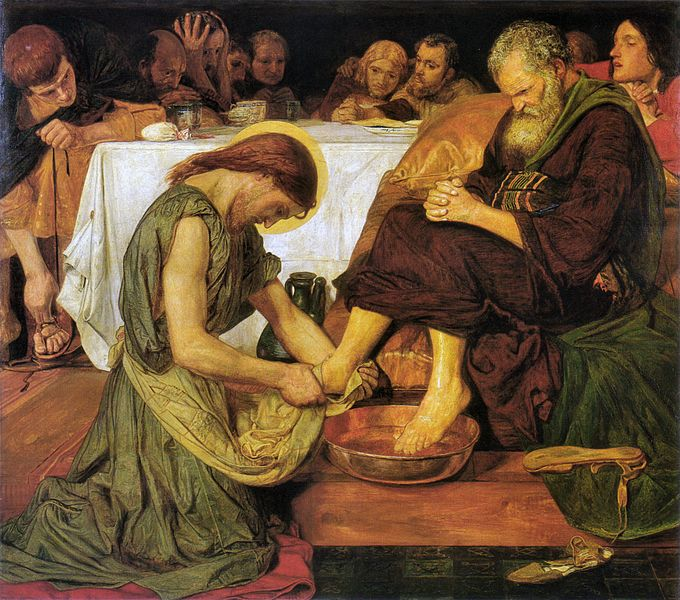
Jesus made himself a slave, (or perhaps he was always a slave all along, and we just didn’t realize it?) Foot-washers were pretty much regarded as sub-human, mindless drones who mechanically performed a necessary duty. The lowest of the low, the very least of the least.

But Jesus took that role on himself, he laid aside his garments, and his Godhood. (They landed in a pile in the corner of the room). When he knelt down to scrub feet (making sure he got between the toes), it was deity serving man. This God/rabbi intentionally did this, not reluctantly or halfheartedly–but carefully.

He was their teacher.

Custom demanded he enjoy the prerogatives of that position. But he wouldn’t, and didn’t. He mustn’t. As I stress over this, I must conclude he really was their “teacher,” but not in the way I expect. What he was doing on his knees, was instructing them in the art of loving each other. He showed us a leader in action.

Real disciples function best when they wash between the toes.

There was a point in Jewish history when the people actually demanded that God would give them a king, instead of a judge (1 Samuel 8:5-9). God warned them that this wasn’t in his plans–but they insisted. They had to have one, everyone else did. We still must have celebrities, and then we wonder why they short circuit on us. Who can resist the privilege, and the limelight?

Peter of course was classic Peter.

It seems that whenever he resists, he gets rebuked. He makes it quite clear that Jesus will never wash feet–that Jesus will never use a basin or towel and serve him like this. It was outrageous. It didn’t fit in Peter’s personal theology. He had no room for Jesus the slave. Perhaps Peter knew that to follow meant he would have to do the same thing?

Jesus still washes feet.

He sits us down and takes off our shoes and socks, and scrubs us clean. And we hate it. But to be washed by him is a condition of our discipleship. Every follower must be clean, and he continues his work to this day. We sin daily, even as his own, and he cleans us up–and yet somehow that really bothers us.

“Does God ask us to do what is beneath us? This question will never trouble us again if we consider the Lord of heaven taking a towel and washing feet.

 Elisabeth Elliot

alaskabibleteacher.com

Our Work is Our Worship, “Avad”

It’s interesting–the Hebrew word for worship is also used for work. I think that is pretty significant. Seeing and understanding this is a life-altering experience. It completely changes the way we look at discipleship. Worship and work/serve go together, and God sees them as one and the same.

To work [avad] as a “farmer”and serve as a worshiper [avad] overlap.

  • “The LORD God took the man and put him in the garden of Eden to work it [avad] and keep it.”
  • Serve [Avad] the Lord with gladness! Come into his presence with singing!”

Genesis 2:15 and Psalm 100:2

Notice that both work and worship use the same Hebrew word.

  • “Six days you shall labor, and do all your work, [avad].”
  • “When peoples gather together, and kingdoms, to worship [avad] the Lord.”

And wow! There are dozens of verses that link our work with our worship. The implications are profound–we’re to see our Sunday worship and our jobs as one and the same. Typically we don’t see it that way. Our Monday through Friday are in a separate category than what we do on Sunday.

Our work and our worship overlap. God intends it that way, and we grow in obedience if we also accept the fact that they’re not separate. Our occupation, whether we’re flipping burgers or being a brain surgeon, is to be an act of worship.

One small Hebrew word can mean so much.

Our whole paradigm shifts when we understand that our worship is far more than 20 minutes on a Sunday morning. It’s to extend to all we do throughout our week. Our Monday job is just as significant to God as our shared time with our brothers on Sunday.

This understanding gets used in the New Testament as we see our work and worship are connected.

“Whatever you do, work heartily, as for the Lord and not for men, 24 knowing that from the Lord you will receive the inheritance as your reward. You are serving the Lord Christ.”

Colossians 3: 23-24

“Not by the way of eye-service, as people-pleasers, but as bondservants of Christ, doing the will of God from the heart, rendering service with a good will as to the Lord and not to man.”

Ephesian 6:6-7

Lois Tverberg, En-Gedi Resources

alaskabibleteacher.com

The Shepherd’s Own Voice

John 10:1-5, ESV

 “Truly, truly, I say to you, he who does not enter the sheepfold by the door but climbs in by another way, that man is a thief and a robber. But he who enters by the door is the shepherd of the sheep. To him the gatekeeper opens. The sheep hear his voice, and he calls his own sheep by name and leads them out. When he has brought out all his own, he goes before them, and the sheep follow him, for they know his voice. A stranger they will not follow, but they will flee from him, for they do not know the voice of strangers.”

What joy can be found in the Shepherd’s care, and to hear his voice. Nothing really can match this wonder. We follow as he leads us. The voice is an integral part of this passage and the foundation of discipleship that is real.

Please understand: You really can’t walk with him unless you hear him. We belong to him. We’re his flock that he keeps and provides for.

And He knows our name!

That’s the intimacy found in these verses. We’re never forgotten and he will never overlook us. To think otherwise is slander and an attack on his present-day ministry. Jesus is our good shepherd. He always will be.

“Intimacy with God comes in whispers, not shouts.”

     Woodrow Kroll

He sometimes whispers, and yet this world can’t hear him (or they refuse to). To be perfectly honest, my ‘busy-ness’ silences Him. I suppose that the real issue isn’t with Him, but with myself.

“And after the earthquake, there was a fire, but the Lord was not in the fire. And after the fire, there was the sound of a gentle whisper.”

1 Kings 19:12

He doesn’t speak through a windstorm, earthquake, or fire. He chooses to speak very quietly, and that’s a problem for me. In the original Hebrew, the word “whisper” can be translated as “calm, something gentle.” He speaks this way if only we shut up for a little while.

If we are to recognize God’s voice, we must belong to Him. We hear His voice best when we spend time in Bible study and quiet prayer. The more time we spend intimately with God and His Word, the easier it is to recognize His voice and His leading in our lives. He’s always speaking, and we’re seldom listening.

The flock hears the shepherd, and it’s that voice that breaks through our cluttered-up life. We can hear, and it’s that communication that encourages us to walk through life—one day at a time. Just today. That’s all you must do.

There are so many other voices. Please dear one, you must ignore them.

So many are speaking, and so many want us to hear and follow them. But in reality, they want us to leave the Shepherd and his flock behind. But we can’t allow this, we must learn to listen to him alone.

alaskabibleteacher.com

Art by Eugène Burnan

Yirah, Fear/Awe

Hebrew for Awe and Fear

Psalm 33:8, ESV

Whenever I’m in Northern California I simply have to visit the redwoods. Walking through them always directs me to the immense God who created these massive trees. Since I live in Alaska I’m also surrounded by stunning beauty: mountains, glaciers, eagles, forests and fireweed.

To truly see reality is to live in yirah.

I believe that God intentionally created the world to inspire awe in us. The complexity of creation is truly remarkable, with scientists dedicating their lives to understanding it. There is so much about the cosmos that remains beyond our comprehension, which leads us to consider how much more unfathomable its Creator must be.

Often missing from our lives and worship is yirah, or “awe, fear.”

“The fear [yirah] of the Lord is the beginning of wisdom, and the knowledge of the Holy One is insight.”

Proverbs 9:10

Three observations I need to make. These are something to consider:

  1. Believers are to teach our children the yirah of the Lord. It must be learned which implies that it’s not something natural to us. “So that they may learn to fear me all the days that they live on the earth, and that they may teach their children so.” (Deut. 4:10.)
  2. His love for us can’t be diminished by His power and might. I believe that these three are not mutually exclusive–you can’t have one without having the other. They can’t be separated. “But with you there is forgiveness, that you may be feared.” (Psalm 130:4.)
  3. Submitting to God with awe and yirah will lead you to obedience and consistency. Loving Him becomes a joy when we respect and honor in fear of our Father.

“Just as obedience to the Lord is an indication of our love for him, so is it also a proof of our fear of God.”

Jerry Bridges

alaskabibleteacher.com