Leave the Spear in the Wall

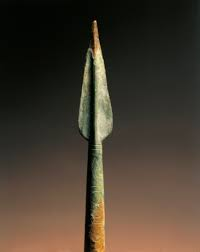
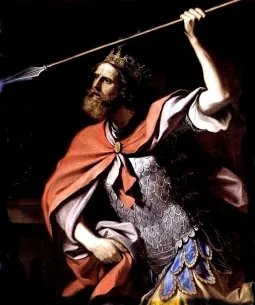
And Saul hurled the spear, for he thought, “I will pin David to the wall.” But David evaded him twice.

1 Samuel 18:11, ESV

And Saul sought to pin David to the wall with the spear, but he eluded Saul so that he struck the spear into the wall. And David fled and escaped that night.

Saul’s spear shows up later in David’s life, and it becomes a vital component in his growth as Israel’s next king.

But David doesn’t know that yet. In 1 Samuel 26 we read about David’s second encounter with the spear of Saul.

The scene is in the wilderness and David’s on the run. Now the badlands are a good place to hide as any Western movie knows. I think David had his scouts and I suppose that there were also men who knew every rock and cave in that wasteland. They were hiding from Saul.

“So David and Abishai entered the encampment by night, and there he was—Saul, stretched out asleep at the center of the camp, his spear stuck in the ground near his head, with Abner and the troops sound asleep on all sides.”

1 Samuel 26:7

Sneaking into Saul’s camp was bold and audacious. Saul was sleeping and scripture says that David’s companion desperately wanted to kill Saul, but David refused, David, looking through the darkness lighted on Saul’s spear. Perhaps he remembered back to when Saul tried very hard to kill him.

He avoided that spear a long time ago, and now he escapes it again.

The tables have completely turned. Given a chance to end King Saul’s life, he refused; he would not kill him. When you think about it, many problems would’ve been solved, and David would take his rightful place as Israel’s new king.

But David spiritually understood God’s heart. He understood the spiritual principle of “turning the other cheek” and “loving your enemies.” He overcame with love and kindness. And lots of grace.

“Do not be overcome by evil, but overcome evil with good.”

Romans 12:21, ESV

The Greek word for “overcome” is νικάω which can be translated as “to conquer or to come forth victorious.” It is also used when someone is arraigned before a court of law but wins the case.

To follow Jesus means you entirely reject using the spear. It’s not for you. Never.

“We win by tenderness. We conquer by forgiveness.”

Frederick W. Robertson

We must leave the spear in the wall. You must not throw it back.

Like David, we are to trust the Father. We’re to be secure in His timing. And yes, we each must use kindness and brokenness to overcome dark things. When you think about it, Jesus also faced evil without defending Himself. The spear showed up again and we see that our Savior allowed it to pierce His side on the cross.

You must leave the spear in the wall.

You mustn’t use the spear when it seems you can wield it at the perfect moment, and like Jesus you need to allow it to save your enemies from their sin.

These three spears are evidence you “have God’s heart.”

Why this Waste?

 “A woman approached him with an alabaster jar of very expensive perfume. She poured it on his head as he was reclining at the table. When the disciples saw it, they were indignant. “Why this waste?” they asked. “This might have been sold for a great deal and given to the poor.”

Matthew 26:7-9

Is it possible we’re missing something here?

Just previously Jesus warned His disciples that He was about to be crucified. Apparently, they didn’t understand. And immediately after that, the Pharisees and elders begin to get serious about putting Him to death. The word “plot” is used. At this point, things have gotten deadly.

Jesus is at the home of Simon the leper; he’s eating and drinking. Simon is a little-known character with a common name; perhaps he’s a man whom Jesus had healed? (He and his home would’ve been unclean if his disease was present.)

In comes a woman carrying an alabaster jar that was only used for holding perfume of the highest quality. John 12 tells us that this was Mary, the sister of Martha (remember that story)?

She carries an alabaster perfume which was extremely expensive, worth almost a year’s wages. What she’s about to do is extravagant, the neck of the bottle is broken and Mary begins to pour it on the feet of Jesus.

The cost of the poured-out perfume is exorbitant.

Immediately the disciples object. This seems to be the first time that they agree that what she was doing was totally out of line. They can’t believe what she’s doing is okay. All they can see is something too extravagant, and far too lavish.

They considered the cost–it’s almost a year’s wages. “Why was this perfume wasted?” That’s a logical analysis. “The oil could’ve been sold!” It would have helped a lot of poor people who could have really used it. The book of John amplifies all of this:

“But Judas Iscariot, one of his disciples (he who was about to betray him), said, “Why was this ointment not sold for three hundred denarii and given to the poor?” He said this, not because he cared about the poor, but because he was a thief, and having charge of the moneybag he used to help himself to what was put into it.”

John 12:4-6

If we try to think this through we just might agree with them. That’s a lot of money, and it’s such a waste. (You might as well have dumped it down the drain, Mary.)

A week from this “Jesus-Mary-anointing,” the Lord would be whipped, and struggle through the streets of Jerusalem carrying an obscenely heavy cross. Jesus would then be stripped of His clothing and then be crucified. Some have suggested that the scent of the perfumed oil would still be present. Perhaps He could smell that oil as He suffered and died?

It’s interesting what small things can do.

“It is in the process of being worshiped that God communicates His presence to men.”

   C.S. Lewis

“For God no cost is too high. Anything can be sacrificed if only we may please Him. Let us daily learn to be obedient children.”

    Watchman Nee

Do You Speak His Language?

Peter Warms Himself

“The girl asked Peter, “Aren’t you one of Jesus’ disciples?”

“No,” he said, “I am not!”

“The police and the household servants were standing around a fire they had made, for it was cold. And Peter stood there with them, warming himself.”

John 18:17-18, Living Bible

The Galileans had a distinct accent. Just as we easily identify someone from Boston just by the tone and cadence of their speech, Peter had that distinct drawl that told everyone that he came from that same province as Jesus. It was something he couldn’t conceal.

Peter was a very different man in his three years of being with Jesus. And you might say that had transformed him–you might even say that he was now a marked man, the enemy was now quite aware of him. He was no longer a captain of a small fishing boat looking for a catch. He was now the leader of Jesus’ disciples.

The entire text (18:15-18) reveals a confrontation that Peter had with a servant girl, and we hear him making a bold-faced lie. At this very moment Peter was fulfilling the “promise” that Jesus had predicted (Matthew 26:31-32).

What was going through Peter’s head at that moment?

She was a simple servant girl, perhaps one who ministered at the gate of the high priest’s home. It’s interesting that she is the first one to question Peter’s duplicity. Most likely she was just doing her job, watching and listening. She was probably quite alert.

It’s easy to point our finger at Peter. He was a coward, and when he was put on the spot he bailed. People hate cowards–we extol those who take a definite stand against evil. But he was frightened, scared of being connected with Jesus–the man on trial. There was much at stake here.

We also speak with an accent. I know it might be a stretch–but being with Jesus has fundamentally changed us. Our lives now have a specific dialect that others hear, we’re not the same people that we once were.

We open our mouths and others can hear the Kingdom of God. We can’t hide that dialect.

Sometimes I try to pretend that I haven’t been with Jesus, and I’m very ashamed of that. Like Peter, I stand with the others and choose to warm myself by their fire, and I try very hard to make myself inconspicuous. But all I have to do is open my mouth, and I betray who I really am.

It’s really funny, but even servant girls know that I belong to him. He has fundamentally touched me.

“To stand before the Holy One of eternity is to change.”

Richard Foster

Boasting for Dummies


“Let not the wise man boast in his wisdom, let not the mighty man boast in his might, let not the rich man boast in his riches,”

“but let him who boasts boast in this, that he understands and knows me, that I am the Lord who practices steadfast love, justice, and righteousness in the earth. For in these things I delight, declares the Lord.”

Jeremiah 9:23-24

There is bad boasting (v.23), and good boasting (v.24). When I think of someone who brags it’s almost always in a negative sense. 

Boasting is one way pride becomes visible, it’s the way we exaggerate or embellish our identity. We magnify ourselves, amplifying our achievements beyond what is reality. We must understand that all it really is is arrogance on display.

There is no room for braggarts in the Church.

You cannot sanctify boasting. It is pride that we vocalize and use to influence. We want to change another person’s perspective of you. We desperately want others to admire and think better of us. Some have postulated that it really is nothing more than masking insecurity. I think they’re right.

The Word differentiates between good and bad boasting.

The book of Jeremiah (9:23-24) does precisely that. It explains that what is worldly: wisdom, strength, money– is the wrong way of seeking recognition and importance. God’s people are to declare (brag) that they are in an intimate relationship with God.

We understand, we know that we have a loving connection with the Lord. We learn we can brag about Him.

I encourage you to become aware of how you conduct yourself in front of others. We seldom think of ourselves realistically. For many of us our lives are so intertwined with the false that we struggle with what is true.

God resists pride. (James 4:6.)

Jeremiah tells us we can choose to be different. We can swivel from the negative to the positive. We must quit exalting any attainment we have and instead boast that we now know God.

No longer do we strut, but now we choose to kneel.

“Humility is to make a right estimate of one’s self.” 

Charles Spurgeon


Your Shepherd is Speaking

John 10:1-6, The Message

1-5 “Let me set this before you as plainly as I can. If a person climbs over or through the fence of a sheep pen instead of going through the gate, you, know he’s up to no good—a sheep rustler! The shepherd walks right up to the gate. The gatekeeper opens the gate to him and the sheep recognize his voice.”

“He calls his own sheep by name and leads them out. When he gets them all out, he leads them and they follow because they are familiar with his voice. They won’t follow a stranger’s voice but will scatter because they aren’t used to the sound of it.”

6 “Jesus told this simple story, but they had no idea what he was talking about.

For context: 10:7-18

What joy can be found in our Shepherd’s care, and to hear his voice. Nothing really can match this wonder. We follow as he leads. The voice is an integral part of this passage and the foundation of authentic discipleship. You really can’t walk with him unless you hear him. We belong to him. We’re his flock that he keeps and provides for.

He knows our name! That’s the intimacy found in these verses. We’re never forgotten and he will never overlook us. To think otherwise is slander and an attack on his present-day ministry. Jesus is our good shepherd. He always will be.

“Intimacy with God comes in whispers, not shouts.”

     Woodrow Kroll

He sometimes whispers, and this world can’t hear him. To be perfectly honest, my ‘busyness’ silences him. I suppose that the real issue isn’t with him, but with myself.

“And after the earthquake, there was a fire, but the Lord was not in the fire. And after the fire, there was the sound of a gentle whisper.”

1 Kings 19:12

The gentle whisper to a man afraid. This fits the Father’s m.o. He doesn’t speak through a windstorm, earthquake, or fire. He chooses to speak very quietly, and that’s a problem for me. In the original Hebrew, the word for “whisper” can be translated as calm, silence, or something gentle. He speaks this way if only we shut up for a little while.

If we are to recognize God’s voice, we must belong to Him. We hear His voice when we spend time in Bible study and quiet contemplation of His Word. The more time we spend intimately with God and His Word, the easier it is to recognize His voice and His leadership in our lives(.

(Perhaps Psalm 23 should be brought in at this point?)

The flock hears the shepherd, and it’s that voice that breaks through our cluttered-up life. We can hear, and it’s that communication that encourages us to walk through life—one day at a time. Just today. That’s all you must do.

There are so many other voices. You must ignore them.

So many are speaking, and so many want us to hear and follow them. But in reality, they want us to leave the Shepherd and his flock behind.

But we can’t allow this, we must learn to listen to him alone.

(Art by Eugène Burnard)

Leaders Who Are Kind and Generous

“And the king said, “Is there not still someone of the house of Saul, that I may show the kindness of God to him?” Ziba said to the king, “There is still a son of Jonathan; he is crippled in his feet.”

 2 Samuel 9:3, ESV 

That crippled man was named Mephibosheth.  He was injured by the actions of a nurse, she accidentally dropped him as she was trying to escape the palace (2 Sam. 4:4).  He was just five years old. It was not of Mephibosheth’s doing, but someone else made a mistake, and it totally and irrevocably changed his life.

As a result, for the rest of his life, he would always use crutches.

It may be of interest, but Mephibosheth’s name means, “shame,” and perhaps this would’ve been an integral part of how people treated him or even how he saw himself. But David was a different sort of king (as kings go), and he elevates Mephibosheth to the feasting table.

King David wants to bring this crippled man to a lavish dinner.

Interesting. I believe that there are a great many people like Mephibosheth.  They’ve been injured by someone else’s stumbling.  It seems we pass these things on to each other.  And the lameness we inflict may not be physical.  It may be spiritual or emotional.  Sometimes we injure others without knowing what we have really done to them.

Whether we know it or not, we are capable of much evil. 

Some of the most evil woundings that are done are usually on a moral or spiritual level. If you break your arm, you will heal.  But if I wound your spirit you may not ever recover. These injuries are incredibly devastating.  When someone harms us on this level it can completely undo us, for a lifetime. (And perhaps, maybe even forever.)

We can read of King David’s truly majestic treatment of Mephibosheth in 2 Samuel 9. He actively blessed him, and perhaps that is the proactive action we ought to take. We must make an effort to always strengthen the people around us.

As a king, this was a very minor incident. Hardly worth recording in the lofty affairs of state. But as a man, to restore Mephibosheth, was definitely one of David’s greatest decisions.

I would suggest that kindness should always be a key part of someone who is in authority, especially those who are serving others in leadership.

But there’s another concept here– we discover something that is profoundly true about us in Paul’s letter to the Church in Ephesus.  It’s here, in 1:5, that we see that God our Father, acts like David, and receives Mephibosheth–just like God receives us to Himself. We find that we’re adopted, loved, and held, and we get a prime place at the table. Forever and ever.

God decided in advance to adopt us into his own family by bringing us to himself through Jesus Christ. This is what he wanted to do, and it gave him great pleasure.”

Ephesians 1:5, NLT

We may use crutches, but we walk by faith. This verse in Ephesians may be the greatest lesson and the most profound experience we can have as believers.

alaskabibleteacher.com

Deer Feet for the Believer

“He made my feet like the feet of a deer
    and set me secure on the heights.
35 He trains my hands for war,
    so that my arms can bend a bow of bronze.”

2 Samuel 22:34-35

David’s Song of Deliverance

This entire psalm was written after David was delivered from the hand of Saul. David had been a fugitive for years and had experienced extreme difficulties. He had been pushed to the brink many times, yet maintained a close walk with God.

This verse in 2 Samuel has always blessed me. The image of a deer who has been put on a mountaintop through the direct action of the Lord–it’s a place of safety, a position of victory. It comes as a decisive maneuver of the Holy Spirit.

Psalm 18:33

David had learned things in the wilderness that he would never have otherwise. At times life got pretty extreme for him. When he struggled it was understandable. He followed the path that God laid out. It wasn’t easy for David, but he walked in faith and not by sight.

Danger surrounded David on every side – physically, spiritually, emotionally, socially. It would come from enemies, and even from his dearest friends.

God’s people are not immune from trials. It’s good to know that these are now orchestrated by our Father, and they’re purposeful and planned.

The prophet Isaiah extends the imagery of a deer in his prophetic ministry, but adds other ideas as well. The lame, mute and the desperately thirsty are descriptive of people who are given a special grace and touch. They’re promised something. They receive the promise of the Lord Jesus Christ.

“Then shall the lame man leap like a deer,
    and the tongue of the mute sing for joy.
For waters break forth in the wilderness,
    and streams in the desert;”

Isaiah 35:6

“David thought of how deer seem to skip from place to place and never lose their footing. God gave him the same kind of skill in working through the challenges brought by his enemies.”

David Guzak

alaskabibleteacher.com

Weak Eyes

Stuck in the wonders of scripture we read about Leah and her sister Rachel. We see the two daughters of Laban have become Jacob’s wives. We must step into Genesis 29 to see more.

Jacob longs for Rachel. She is his “soul mate” and because he’s in love, the customs and technicalities of the day somehow get by him. Because of this, he will have to take on Laban’s subtle trickery, where daughters get exchanged, and we must sort out who is who.

Laban’s deception creates a huge crisis for everyone. 

But it seems Jacob just rolls with it. I suppose deception has always been Jacob’s strong suit. (But when we see a deceiver like Jacob gets deceived, that can’t be all bad).

But it’s Leah that I tend to think about. Her own issues are unique. Genesis 29 explains it a bit cryptically,

“Leah’s eyes were weak, but Rachel was beautiful in form and appearance.” 

Genesis 29:17

You must know that there is confusion by commentators about the “weak eyes.” Some take it literally (as in, she is very “near-sighted,”) while others who look at the original Hebrew find the words to be a bit looser and vague. They tend to think that this is a polite way of saying she really wasn’t pretty.

The text also states that Leah was “hated.”

Genesis 29:30-31.

She is wounded, and life requires that she live as unwanted. She is a woman of tragedy and broken hopes and dreams. She will always live as a reject. At best, she will always be a distant second, and perhaps a bit scorned and neglected for this.

I conclude that Leah is the champion for the challenged.

I love Leah and I think I understand her. Her life is a long tragedy and very full of sadness. For the next 30-40 years she will always be a cast-off, someone who has been broken on life’s bitter vagaries. She’s a fellow struggler, and a survivor.

Her sad life is comparable to us who have to fight so hard over our own illness or handicaps.

She must’ve been challenged by her terrible weakness. I understand this. My own life has been “topsy-turvy” and a really hard struggle. Somehow it seems we must work through these things way too much.

It doesn’t seem fair. 

For those of you who are confined to a wheelchair, or must use a cane, or who deal with a physical or mental illness. Leah should be our hero. For those who have been betrayed by addiction, or who have felt rejected through a bitter divorce– Leah speaks to us.

She is for every loser and for failures of all stripes. But through all of our setbacks and messes, we must realize that God does love us– even as we weep.

We may have Leah’s eyes, but we also have His grace.

Psalm 139:14

I have a new site at alaskabibleteacher.com.

But God…

But God, being rich in mercy, because of the great love with which he loved us, even when we were dead in our trespasses, made us alive together with Christ — by grace you have been saved.”

(Ephesians 2:4–5)

But God. Short words with a powerful meaning, used over 4100 times in the Bible (every 7 verses). It’s used to imply intervention and change, typically a holy interruption of some kind. This verse in Ephesians 2 describes the Father getting involved in a tangible way.

We were terribly lost–actually the Bible says, “dead.”

But He is rich in love and mercy, and it’s grace (and only grace] that makes us alive. Now we’re not reformed or rehabilitated. These are good words, but the verse describes a resurrection–a revivification. The dead live!

Jesus actually resurrects each believer.

“But God.” Joseph learned that “all things work together for good.” His brothers cruelty sold him into slavery and even though he endured prison, he would become the prime minister of Egypt. After many years his wicked brothers come before him. Revenge? Not on your life.

“As for you, you meant evil against me, but God meant it for good in order to bring about this present result, to preserve many people alive.

Genesis 50:20

Let God have His way with you. Acknowledge His sovereignty by allowing Him to interrupt when He wants to. He is active in our lives. Having resurrected us from the dead, the Holy Spirit becomes actively involved in our lives (and He brings us grace and beauty).

If you do this, I expect great things for you.

“My flesh and my heart may fail, But God is the strength of my heart and my portion forever.”

Psalm 73:26


Love Wears Work Gloves

 “But if anyone has the world’s goods and sees his brother in need, yet closes his heart against him, how does God’s love abide in him?”

“Little children, let us not love in words or talk but in deeds and in truth.”

1 John 3:17-18, ESV

Love is a noble idea, it’s admired and extolled by practically everyone–we see it in our music and poetry, ethics and religion. For the most part it’s a word for something decent and virtuous and honorable. It’s a good thing, but I’m afraid it’s not always scriptural.

You see, Bible love wears work gloves.

It labors and sweats. Bible love has chores to do, and it actively looks and sees what needs to be done. 1 John 3 tells us that we shouldn’t deceive ourselves and only see the world’s definition. That love that a believer has is to be different.

Love, in John’s eyes, is most assuredly “doing.” It burns spiritual calories as it labors to serve our brothers and sisters. Love finds things it can do–it doesn’t just talk but it gets busy. Love sees the need and then gets down to serve.

“You must show sincere love to each other as brothers and sisters. Love each other deeply with all your heart.”

1 Peter 1:22

Working (serving) has nothing to do with our salvation, that is a free gift. We’re saved by grace through the blood of Jesus–that’s a given. And this serving love isn’t drudgery, as a matter of fact, working and serving each other is a joy. The deepest kind of joy there is.

Our words, although important, are really an insufficient way of proving our authenticity.  The love we serve another with isn’t “pretty poetry” kind of love. It’s so easy to just shout out truth and never ever show a working, serving kind of love. 

That disconnect is a bit disconcerting. When do we suppose we figure out that His love is actually a verb?