Timothy was given a remedy for stomach issues, (1 Tim. 5:23)
Paul had to suffer his “thorn in the flesh,” (2 Cor. 12:7)
I find this moderately disturbing. In over 35 years of ministry I have seen a lot. I once prayed over a saint who had a leg that was shorter than the other. She walked in a painful limp, and yet in a brief second, her leg grew. I’ve prayed over terrible fevers, and I instantly saw it leave. I know God heals. He does wonders still.
And yet there has been prayer that doesn’t make it beyond the ceiling.
For believers today who suffer physically or mentally, we may question our faith. (Especially when the healing evangelist comes to town). After 2-3 tries we settle back on our “deficient’ faith feeling a bit miserable.
I honestly don’t think that’s what the Lord wants.
It seems to me that the real issue is not so much a weak faith, but holding on to your faith when you are not healed.
I hear talk about having faith to be healed–but what about the faith that’s needed to be sick?
Why do we suffer from illness? I suspect that for many believers sickness is really there to bring glory to God. Holding onto faith in the midst of pain often encourages those who witness it. I believe that was Paul’s experience (2 Cor. 12:7-10).
Oh dear one, continue to seek healing, (James 5:14).
Healing will happen. We look forward to that special day when all our sin, and all our sickness will be eternally dealt with. Those ugly and painful and savage things will no longer be part of us. We’ll walk unencumbered by earth’s ugly shackles.
“He will wipe away every tear from their eyes, and death shall be no more, neither shall there be mourning, nor crying, nor pain anymore, for the former things have passed away.”
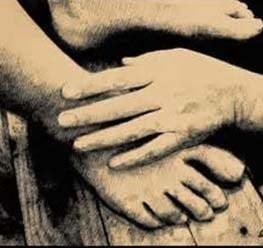
A terrific study is finding the people who fell at Jesus’ feet. Tucked in the Gospels you’ll find stories of those who despair. You’ll also see them come to Jesus in brokenness and humility, without any other recourse. I call these the “people of the feet.”
They came to Jesus because they had no hope otherwise. They were people who were hopeless and wretched, they had long ago run out of options. They came to Jesus, falling down in front of Him. They were all people of the feet.
They were men and women who were truly desperate.
“Now when Mary came to where Jesus was and saw him, she fell at his feet, saying to him, “Lord, if you had been here, my brother would not have died.”
John 11:32
One of the classic scenes in the Gospels is when Mary meets Jesus after her brother’s death. She doesn’t understand Jesus’ delay, Lazarus has been very ill and Jesus could have healed him. She is grieving and confused. But she only has one posture and one place in her heart to be– at the feet!
There are some common characteristics that feet-finders have:
A great need that can’t be met without His touch
To understand one’s true condition–humility, brokenness
To beg for a healing, for self or family
To honor Jesus as the Messiah
To be more receptive to His teaching, to understand Him
To become a witness to others (although it does seem secondary)
The following 3 verses are just a small selection of those who fell at Jesus feet.
“And great crowds came to him, bringing with them the lame, the blind, the crippled, the mute, and many others, and they put them at his feet, and he healed them.”
Matthew 15:30
“But immediately a woman whose little daughter had an unclean spirit heard of him and came and fell down at his feet.“
Mark 7:25
“Then people went out to see what had happened, and they came to Jesus and found the man from whom the demons had gone, sitting at the feet of Jesus, clothed and in his right mind.”
Luke 8:35
But there are several other instances where people came to sit at Jesus’ feet:
Mark 5:22-23, Jairus, a leader in the local synagogue
Luke 7:37-38, a sorrowing mother for her daughter
Luke 8:41, also Jairus
Luke 10:39, Mary, when Jesus was teaching
John 11:32, Mary, meeting Jesus entering Bethany
John 12:3, Mary, with her perfume
Revelation 1:17, John to express what he was seeing (also 19:10)
In every case we find people consciously coming and kneeling at the feet of the Lord Jesus. It was a deliberate action that came from their hearts. Each had a terrible need, and each was without hope.
It’s the end of religion if you’re a feet-finder. No more facades, no more treadmills. Instead your heart forever changes.
Formality and religious politeness are jettisoned. Brokenness and true humility takes their place. A foot-finder is no longer operating on spiritual niceties. Religion is comfortable, noble, and respectable, but it cannot heal or change people deeply.
Feet-finders know that they need Jesus desperately and will go to any length just to be touched by Him. They defy what is conventional and proper. They are not what we call respectable. You can find them at the feet of Jesus. They are feet-finders. Foot-finders weep, kneel, beg, shout. Too many tears and maybe some snot.
Hardly decent to religious people.
Are you really that desperate yet? Have you seen your need, and do you realize how lost you would be without His healing touch?
Often when I do pray, I sometimes think of the woman who was unclean. She speaks to me about approaching Jesus. I see myself in a crushing crowd of people, and I’m reaching out just to touch the hem of His robe. I know only Jesus can stop my own uncleanness. (Matthew 9.)
I’m convinced only Jesus can make me clean and whole.
I’ve tried to be holy and acceptable to Him. But I felt like a juggler, trying to keep my balls in the air all at the same time, and I could never pull it off. So I tried again and again. I was the unofficial master of religious effort.
But I found my rightful place at His feet. It’s where I belong. I love Him.
Now Jesus called together the twelve [disciples] and gave them [the right to exercise] power and authority over all the demons and to heal diseases.
Then He sent them out [on a brief journey] to preach the kingdom of God and to perform healing. And He said to them, “Take nothing for your journey [that might encumber you]—neither a walking stick, nor bag, nor bread, nor money; and do not even have two tunics apiece. 4 Whatever house you enter, stay there until you leave that city [to go to another]. 5 And as for all those who do not welcome you, when you leave that city, shake the dust off your feet [breaking all ties with them] as a testimony against them [that they rejected My message].”
So they began going from village to village, preaching the gospel and healing the sick everywhere.
A disciple’s perspective:
Jesus called the twelve of us together that day for a reason–He wanted us to start doing His work, which, I admit wasn’t really in my thinking. But this was His plan, and He knew exactly what He was doing. I didn’t feel remotely competent, and the thought of doing what Jesus did seemed a bit sacrilegious.
I was intimidated by all of this.
But now I can see that was what He intended all along, to push us into the supernatural–preaching, healing, and exorcising demons. He wanted us to touch people, to meet the needs of the desperate, and by doing so, extend the kingdom of God.
We were all skeptical, obviously. We weren’t Jesus, not by a long shot, and we had no right or ability to do miracles. On our own, I we were still fishermen and tax collectors. And honestly, what Jesus was asking (or commanding?) was for us to leave what we felt was comfortable and to step into His sandals. He wanted us to be just like Him.
He gave us His authority and power–it was His to give.
I suppose that this was the key to it all. We had witnessed fantastic miracles, stunning things that pretty much undid us. Jesus repeatedly defied the laws of nature—with just a word. And we’re His disciples, so I suppose that meant we needed to step out and touch people just like He taught. I guess that was Jesus’ plan for us all along. We just thought it wouldn’t happened this quick.
So the power and authority was given and we became “little Christs.”
Two by two we went in different directions to discover for ourselves what would happen. The needs we encountered were substantial. The world was a needy place that made its home in the pain and darkness of the demonized and the desperate. It seemed overwhelming. I think we all felt weak and very inadequate.
It’s funny, but we suddenly saw all these people through His eyes–it’s like we never had seen them before. We were now cloaked in Jesus’ very own power. When we laid hands on people astonishing miracles began to happen. All at once there were needs all around us. And the people kept coming.
I began to understand what it really meant to love people. We had left the relative safety of learners and had now became doers. I suppose we realized that there was an incredible difference between the two. We were all astonished by what we saw, at that moment we had few doubts about what was happening inside of us.
It changed us like nothing else could!
Being made into “little Christs” now made perfect sense. We saw fantastic miracles and dramatic victories over dark demons. The things we had seen Jesus do were now the things we were doing! Suddenly everything came together and we understood many of the words that He had tried to drill into our thick skulls.
From village to village we went–we stayed with whoever wanted us. The needs we saw were staggering, from sunrise to sunset people came. Wherever we turned there seemed to be somebody else, but Jesus’ own authority was always present, it never diminished or weakened. It was like a bubbling spring that never once ran dry.
I suppose what happened inside me was just as much a miracle as we had seen Him do for others.
I was astonished–up to now I never realized how exciting it was to follow the Lord Jesus. What a joy to see the face of a man or woman who was set free. It was such a thrill to touch a little boy’s dead eyes and suddenly realize that he could see!
So this is what it honestly means to be His disciple!
“Truly I tell you, the one who believes in me will also do the works that I do. And he will do even greater works than these, because I am going to the Father.”
“When he came down from the mountain, great crowds followed him. 2 And behold, a leper came to him and knelt before him, saying, “Lord, if you will, you can make me clean.” 3 And Jesus stretched out his hand and touched him, saying, “I will; be clean.” And immediately his leprosy was cleansed.”
Matthew 8:1-4
It was a wild scene, we can’t forget this. But it’s funny, Jesus through all this sees and hears this leper. He doesn’t respond to the crowd but to the diseased man. The text tells us that the leperous man was on his knees and he was “praying.” His pleas were directed at Jesus.
But remember, the end of the previous verses explains exactly what’s happening. Matthew 7:28-29, (MSG) explains their excitement–
“When Jesus concluded his address, the crowd burst into applause. They had never heard teaching like this. It was apparent that he was living everything he was saying—quite a contrast to their religion teachers! This was the best teaching they had ever heard.“
The crowds responded wildly to the marvelous teaching of Jesus, and that was awesome. We really shouldn’t minimize that. However, in the Gospels, the “crowd” is pretty much a bad term, or at least a neutral one.
I suppose that Jesus seems to ignore the multitude’s extremely positive reaction. He knows it won’t last. The fickle crowd will soon cry out and demand His crucifixion.
But I understand, I’m that leper and He sees me.
Scripture tells me that Jesus now sits in heaven and makes intercession for me. He focuses on just me, I’m the center of His care–but I also know that attention is also on you, and others, and yet I’m assured that He sees me and each of His sheep. This should be a comfort. He concentrates and ministers to the person, and never to the multitude.
Jesus loves you, and He loves me too.
“So he told them this parable: 4 “What man among you, who has a hundred sheep and loses one of them, does not leave the ninety-nine in the open field and go after the lost one until he finds it?5 When he has found it, he joyfully puts it on his shoulders, 6 and coming home, he calls his friends and neighbors together, saying to them, ‘Rejoice with me, because I have found my lost sheep!’”
21 Then Jesus went out from there and departed to the region of Tyre and Sidon. 22 And behold, a woman of Canaan came from that region and cried out to Him, saying, “Have mercy on me, O Lord, Son of David! My daughter is severely demon-possessed.”
23 But He answered her not a word. And His disciples came and urged Him, saying, “Send her away, for she cries out after us.” 24 But He answered and said, “I was not sent except to the lost sheep of the house of Israel.”
25 Then she came and worshiped Him, saying, “Lord, help me!”
26 But He answered and said, “It is not good to take the children’s bread and throw it to the little dogs.”27 And she said, “Yes, Lord, yet even the little dogs eat the crumbs which fall from their masters’ table.”
28 Then Jesus answered and said to her, “O woman, great is your faith! Let it be to you as you desire.” And her daughter was healed from that very hour.
Matthew 15:21-28, ESV
My daughter had a demon living inside her. Please understand me, I love her more than life itself. It was a terrible torment to see her fall under the control of the evil one like this. Every day seemed worse than the previous, and I knew that the day would come that I would lose her completely to the dark pit.
She would be lost forever.
God knows I tried everything. There was the pagan temple to Eshmon. He was our god of healing and protection for our nation, and it was a short walk away. We made trips there to present ourselves for healing. But things got worse, not better.
When Jesus came we knew we had to meet Him.
I was desperate, at the very end of my rope. I was scared. Meeting Jesus’ disciples was the first step and it really didn’t go well at all. They protected Him, and I couldn’t get close enough to speak with Him.
So much was blocking me. I saw so many obstacles, but when your child is suffering like mine, these things mean nothing. I came to the point where I began to shout, over and over for Jesus to intervene. I was asked to stop, I ignored His followers and kept yelling.
This passage asks us to consider many heavy issues. We have questions that need answers. Why did Jesus seem so cold and harsh? What about the “dog” reference, and His seemingly reluctance to heal? What about her ethnicity as a pagan?
Did Jesus know something about the situation we don’t?
I really want to keep this post short, so I won’t try to answer these questions. But the situation is intriguing. It must be noted that Jesus, at this particular point in His ministry, is focusing on reaching the Jewish population. (But that will change in the future.)
And yet there are positive characteristics of this woman that must be considered. These need to be understood to open up this passage. Please ponder them, they put the entire situation in a different light. We see the following:
Her humility
Her patience
Her prayer and worship
Her persistence
Her faith
Each of these are crucial, and Jesus saw them. Yes, we see the obstacles, but we understand her love for her demon possessed daughter that drives her into Jesus’ presence. We see her faith that won’t give up no matter the resistance she encountered.
“Faith sees the invisible, believes the unbelievable, and receives the impossible.“
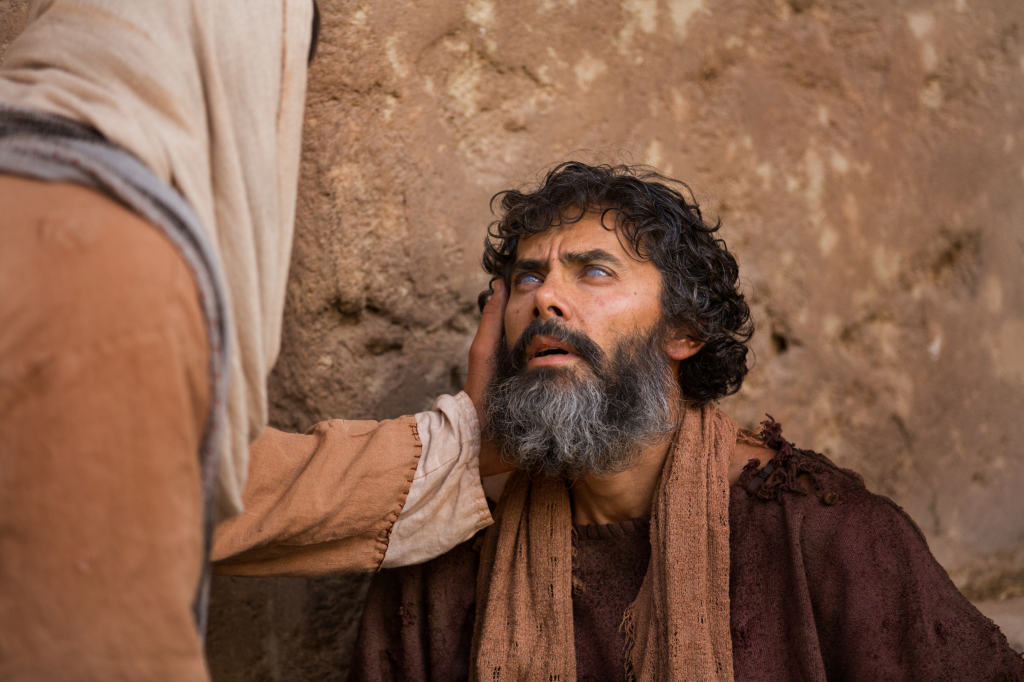
“As he was walking along, he saw a man blind from birth.“
2 “Master,” his disciples asked him, “why was this man born blind? Was it a result of his own sins or those of his parents?”
3 “Neither,” Jesus answered. “But to demonstrate the power of God. 4 All of us must quickly carry out the tasks assigned us by the one who sent me, for there is little time left before the night falls and all work comes to an end. 5 But while I am still here in the world, I give it my light.”
6 Then he spat on the ground and made mud from the spittle and smoothed the mud over the blind man’s eyes, 7 and told him, “Go and wash in the Pool of Siloam” (the word Siloam means “Sent”). So the man went where he was sent and washed and came back seeing!
John 9:1-7
This man had been blind from birth.
I can’t even imagine what blindness would be like. The blind man probably couldn’t imagine having sight. He probably didn’t have a dream-life either–that requires having seen images (a dog, a tree, a mean person) and this wasn’t available to him. He never saw the color red, or saw a mountain.
I suppose we can only imagine what blindness to this degree would be like.
Somehow I’ve come to an idea that this represents fallen men–we’re spiritually blind to the workings and truths of Jesus’ Kingdom. It seems a pretty good explanation of each of us–“blind from birth.” But when you’re blind spiritually you haven’t the slightest of what is real and taking place around you.
“One great power of sin is that it blinds men so that they do not recognize its true character.“
Also notice the response of the disciples who first met this unfortunate man. They don’t see his needs, rather, they want to know the theology behind this. Perhaps that’s how we respond much of the time–we don’t see the needs, we only want to know the reasons. We’re not wise or discerning enough to see what’s really really going on.
Perhaps this is how we operate as immature Christians.
We don’t engage the need, but rather we like having good theology over understanding true passion. It’s easy to philosophize–it’s hard to get down and serve and really love others.
If we really don’t love needy people, we re probably not following Jesus.
It’s funny but Jesus declares Himself to be the light of the world while speaking to the man who is born blind. And it’s also funny that just like there was physical blindness there is a blindness of the Spirit by the disciples–I think it’s even worse.
Third, we discover the gentle mercy that Jesus has when He meets needy people. Now the Lord does accommodate His followers, but not at the expense of engaging the need of the moment. Jesus is full of compassion–most especially when He meets broken people–and as His followers, we must grasp this.
Perhaps good theology isn’t the primary calling of Jesus’ followers.
As I mature in Christ I’m learning (slowly) that people are His real focus. He has come, not to theologise or philosophize, but to meet needs! Sure the reasons why become clearer, but that really isn’t Jesus’ primary goal. I suspect that people will never have impeccable theology.
Classes in systematic theology are really good, but I believe soup kitchens are better.
The blind man is profoundly healed, and Jesus’ love and desire to restore this man is ‘front and center.’ The Lord’s methodology is interesting. Spit and mud, wiped on the blind man’s eyes. In Genesis 1-2 we discover that God made man out of dirt and dust of the ground. Perhaps what He has done here mirrors that work.
And it’s also important to understand that Jesus never performs the exact same healing in the exact same way. For some reason He ‘tailors’ His work to the individuals deepest need. I suppose He doesn’t want us to grab a hold of a formula, as that’s what we want to have.
The story is primarily about a blind man’s healing. It also speaks to the spiritual darkness that afflicts many.
We really must understand this, and we need to understand the tremendous mercy and power of God to both heal and restore. The Lord wants to give you real sight, true spiritual discernment. He really wants this.
There’s a ton more here we can grab, but I suppose there isn’t time. This is merely my take on John 9.
The Spirit of the Lord is upon me; he has appointed me to preach Good News to the poor; he has sent me to heal the brokenhearted and to announce that captives shall be released and the blind shall see, that the downtrodden shall be freed from their oppressors, and that God is ready to give blessings to all who come to him.”
“But I am like a green olive tree in the house of God. I trust in the steadfast love of God forever and ever.”
Psalm 52:8
In Psalm 52 we read of David’s run-in with Doeg, a very bad man, (a mass murderer actually). But David, hearing about the slaughter of 85 innocent priests doesn’t respond in hatred, rather he sits down and writes this song of contemplation which we know as Psalm 52.
It isn’t something written out of wrath and vengeance rather the word that begins his writing is “maskil” which implies– enlightenment, or something reflective, thoughtful, discerning. He sat down and considered Doeg’s awful evil, and by doing this was able to understand own heart as well.
The first is Doeg’s vicious atrocity, and the condemnation that it incurs, (v.v. 1-7). The second was David’s own commitment to following God, and understanding his own place in a very evil world, (v.v. 8-9).
Rather than castigate himself for being discovered in Nob–a circumstance which directly led to the mass murder of these priests (and their families). We find that David does not blame himself. He could have, but he didn’t. Rather he thoughtfully, and carefully, detailed his own “observations” of the whole sordid matter.
David could easily have destroyed himself with guilt and grief. He didn’t.
He chose not to play the losing game of ‘what if.’ He instead would be like a green olive tree rooted himself in the holy temple and into the protective presence of God. David knew he would destroy himself if he didn’t place himself there. It was a deliberate decision.
It would keep himself sane.
It seems to me that trees work heavily into David’s own theology and that this is how he sees his relationship with God. He’s planted and therefore able to survive terrible trials. He shows us how to survive and thrive.
His roots would need to go very deep though.
David’s thoughtful imagery is himself as an olive tree planted in God’s presence.
I believe knowing this is the antidote to the poison of guilt. Perhaps we should follow his example?
“They are like trees planted along a riverbank, with roots that reach deep into the water. Such trees are not bothered by the heat or worried by long months of drought. Their leaves stay green, and they never stop producing fruit.”