Breaking Down the Door

Luke 11:5-8

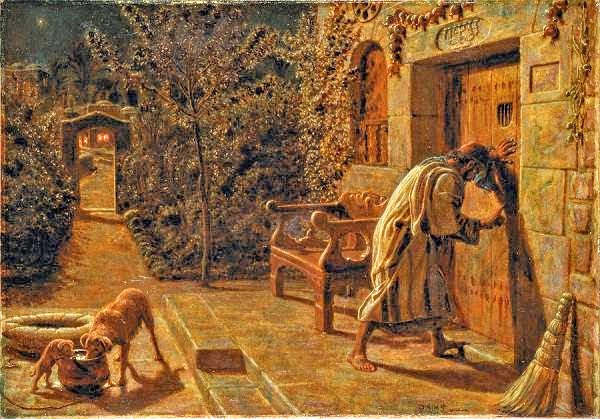
This parable is known by some as “the Importunate Neighbor.” That’s an excellent description. Importunate is defined as being persistent, especially to the point of annoyance or intrusion. It’s tenacious and stubborn–not giving up even when being ignored, and that describes what’s happening here.

What immediately proceeds this parable is Luke’s version of the Lord’s prayer, which the disciples requested. They wanted to understand the methods and mechanics of praying–perhaps the Pharisee’s prayers weren’t quite up to snuff–they wanted more; and they insisted that Jesus instruct them.

The disciples wanted to do prayer right.

A typical Jewish home had sleeping quarters (one room!) located on a raised platform. A ladder was used to access that level (which could be crowded, sometimes two to a bed.) Often their livestock were brought inside. And when it was time to get up, everyone got up. That explains the homeowner’s reluctance to give bread to his neighbor. To get up, light a lamp, wasn’t a solitary affair.

He’s obviously unenthusiastic to make that effort.

The word used here to explain the neighbor actions is ἀναίδεια “anaídeia,” which is only used once–it’s translated as impudence, shamelessness, audacity or chutzpah. It’s a Greek word that explains the knocker’s rudeness. He won’t stop. He knocks and pounds until he gets his bread. Not having bread for his guests is unheard of, for it violates all kinds of convention.

The unwritten law of Jewish hospitality demanded action. 

This is part of Jesus’ view on prayer. It means we must be inappropriate sometimes–even to the point were we are being rude.

Immediately following this parable (the very next thought) are the following instructions:

“So I say to you, ask, and it will be given to you. Seek, and you will find. Knock, and the door will be opened to you. 10 For everyone who asks receives, and the one who seeks finds, and to the one who knocks, the door will be opened.”

Luke 11:9-10

Perhaps it’s this intensity that’s lacking.

We “pray” but don’t insist. We desire but don’t demand. Maybe it takes a certain shamelessness to make prayer work. Jesus emphasizes a necessary attitude to praying God’s way. It’s never automatic, but in this parable we see words that move the Father’s heart, and loosen his hand. In Jesus’ teaching, prayer means effort.

It means spiritual work. He wants us to know this. It is important.

“There is neither encouragement nor room in Bible religion for feeble desires, listless efforts, lazy attitudes; all must be strenuous, urgent, ardent. Flamed desires, impassioned, unwearied insistence delight heaven. God would have His children incorrigibly in earnest and persistently bold in their efforts. Our whole being must be in our praying.”

    E.M. Bounds

f

Crushed Grapes

2 Corinthians 1:8

     David Wilkerson

The word is in New Testament Greek is θλῖψις, or thlipsis. It means affliction, trouble, or pressure. It’s used 45 times in the NT and it seems to be used in a negative sense. Personally I think “pressure” is the most intriguing.

To write anything on suffering and pain is a bit of a fool’s errand.

It’s a broad subject and it will vary from person-to-person.

And I’ve no special insight to give. I know this. Perhaps though, something will come of this. Personally, I have had several traumatic (and dramatic) brushes with pain and suffering. Almost all of them have come as a believer–(I hope that doesn’t mess with your theology).

Looking at the Apostle Paul we can see suffering clearly. Often his ministry was extremely hard. He wrestled repeatedly over his churches and his own sin. When we look at the totality of his work we start to realize that being crushed was part of calling. He understood the challenge of himself and his message.

I write this first to remind you that to minister true grace in any real capacity will mean difficulty. But I also want to encourage you to see that God will always bring life when we remain obedient to Him.

That’s how it works. (At least I think so.)

    Alan Redpath

Choosing a Pierced Ear

Body piercing has become pretty much acceptable just in the last ten years. 

Studs are placed in a hole or piercing to make a permanent decoration.  I have seen a fair amount of it, and I think that a stud in the tongue has got to be the most intrusive.  (I recently read of a young girl who died after her tongue was pierced from an infection).

There is “body piercing” in scripture.  In Deuteronomy 15:12-18, slaves who are being set free by their master after six years of service, could, if they loved and were loved by their master, could choose to remain a slave to him.

“But if your slave says to you, “I don’t want to leave you,” because he loves you and your family and has a good life with you,17 stick an awl through his ear into the door; he will be your slave for life. Also do this to a female slave.”

Deuteronomy 15:12-18

This was a decision that required elders to act as witnesses.  It was significant as well as completely binding.  I like to think of the ceremony to be kind of a cross between a wedding and a circumcision. (Sounds fun, huh?!)

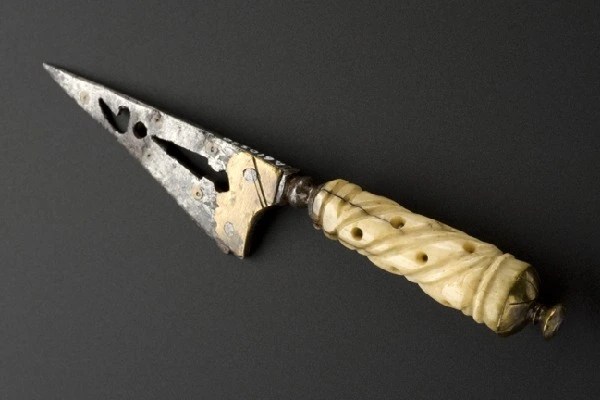
The slave would be led to a doorpost and the master would take an awl, and push it through his ear lobe.  This designated the slave to be forever “owned” by a specific master.  Herein lies a picture of the Christian.

Many times in the New Testament we are called to be servants (slaves) of Christ.

Peter, Paul, James, and Jude referred to themselves as “bond servants of Jesus Christ” in their epistles. This is not a forced servitude. It’s a choice made in love!

There are many believers who have done the same, they have fallen in love with their Savior.  They do not plan on a life apart from Him.  So spiritually they have gone to the doorpost, the awl is pushed through their ear, and they are marked from that point on.

Although the ear was pierced physically in the Old Testament, a different kind of piercing takes place in the New.  In Romans 6:16 we read,

“Surely you know that when you give yourselves like slaves to obey someone, then you are really slaves of that person. The person you obey is your master. You can follow sin, which brings spiritual death, or you can obey God, which makes you right with him.”

Romans 6:16, (NCV)

When the prodigal son returned home from the far country he fell before his father and humbly ask,make me your servant.” (Luke 15:19,21) He, in essence, was saying to the father, “pierce my ear.” The father made him a son, but the attitude of the son’s heart had changed to the heart of a servant. So it must be with us. Only then will we live a “pierced ear” life, revealing to all that we are servants of Jesus Christ!

“Savior, I know Thou hast allowed me absolute liberty, to serve Thee, or to go my own way. I would serve Thee forever, for I love my Master. I will not go out free. Mark my ear, Lord, that it might respond only to Thy voice.”

— Jim Elliot, Missionary and Martyr


alaskabibleteacher.com

The Brother and 5080.4 Miles

21 “So that you also may know how I am and what I am doing, Tychicus the beloved brother and faithful minister in the Lord will tell you everything. 

22 I have sent him to you for this very purpose, that you may know how we are, and that he may encourage your hearts.”

Ephesians 5:21-22

There is so much here that communicates Paul’s heart. He’s laid out a ton of theology, and now he ends his heavy letter with this final benediction or blessing. These final verses are not doctrine. Instead they’re more like God’s ‘open window’ directly to the Ephesian’s heart.

Just imagine yourself as a believer living in Ephesus. Reading the letter we should see ourselves there (albeit 2000 years removed). This belongs to you as much as it belonged to the churches in Asia Minor. Please, own it.

You need to see this. It changes our walk from the 1st century to the 21st century.

This letter belongs to you personally. Ephesians is your letter from ‘home.’ So dear one, make it yours, for you are the Holy Spirit’s audience, and you’re very much loved!

Tychicus has been chosen to carry this letter 5,000 miles to the Ephesians.

The journey itself was over 5,000 miles from Rome to Ephesus, walking by Roman roads. (It would be a long trip, longer than walking from San Francisco to Boston!) It was difficult and could be dangerous, but the letter Titus carried was important. It would be painstakingly copied and then sent to all the churches in Asia Minor.

(https://cloudofwitnesses.org.uk/studies/tychicus)

Tychicus is mentioned 6 times in the NT.

He was a gospel ‘veteran’ who ministered with Paul in various places in the Roman empire. It appears he was friends with Timothy, who was the young pastor of the church in Ephesus. Tychicus was someone whom Paul trusted implicitly. After all, he was carrying Paul’s heart in his backpack.

Tychicus was 100% loyal, brave, and completely reliable. I think Paul had confidence that he would do everything necessary to make sure this letter would get through. We find he was able to do this. And you and I, well, we owe a spiritual debt to this faithful man who went the distance for us.

We can skim through this passage and never really see Tychicus at all.

Tychicus seems to have no real preaching ability, but he is called “beloved” and “faithful” in verse 21. In verse 22 he is called a “brother” and a “minister.” That word for minister is διάκονος, deacon and it means “a servant of a king” or a “waiter of tables.” I believe that reveals someone who is a minister to the needy (which is no small thing).

Paul closes his letter with a benediction.

In verses 23-24, we read that the blessing is given to the church. He pronounces “peace, love, and faith.” Paul speaks out of God’s heart to the Ephesians, and as a leader, he is conveying God’s own blessing. A proper benediction that originates from the Lord is hardly just a nicety, something free and easy. You must understand, a pastor’s blessing is powerful.

“Grace be with all who love our Lord Jesus Christ with love incorruptible.”

(verse 24)

alaskabibleteacher.com

The Pearl of Great Price

“Again, the kingdom of heaven is like a merchant looking for fine pearls. When he found one of great value, he went away and sold everything he had and bought it.”

Matthew 13:45-46

The pearl was truly magnificent! This merchant had never seen one like this. It gleamed in his hands, and he knew he must have it. It wasn’t an option, he had to buy it. His response–sell everything to the highest bidder (of course), and buy it.

O.K. I’m going to take a different approach with this parable. Perhaps it’s not us seeking the precious pearl, (the kingdom of Heaven), rather, just maybe it’s about Jesus seeking us. This different interpretation isn’t as weird as it seems. Please read on.

We know that Jesus loves the Church. He gave up Himself for Her.

He loves everyone, but he’s crazy about his people. I have a shirt, and I’ll wear it sometimes when I feel like it could touch someone, it says “Jesus Loves You, but I’m His Favorite.” I know it’s funny, but maybe it’s true? I’m beginning to understand that he loves me, intensely, and He has given Himself to have me.

Perhaps we are the pearl?

Jesus sees, and he must have it. So He comes, and pays the price, he sells it all just to possess us. Now we know that there isn’t anything remarkable about us, and actually, we know our sinfulness, we’re spiritually evil all of the time. The theologians call it “the depravity of man.” (Ecclesiastes 9:3; Job 15:14-16; Matthew 15:19).

We become the “elect”(2 Timothy 2:10) when we really put our faith in what Jesus did for us. Believe me, that’s not what I feel or sense about myself. It’s not what the world sees. But it’s what He perceives, and He desperately wants me to understand, to truly be his own–and I don’t know why he would do such a thing.

It makes no sense to me at all.

“Love has reasons which reason cannot understand.”

    Blaise Pascal

hp

“For God so [greatly] loved and dearly prized the world,

that He [even] gave His [One and] only begotten Son, so that whoever believes and trusts in Him [as Savior] shall not perish, but have eternal life.”

John 3:16, Amplified

Listen Closely to the Rich Young Ruler

Mark 10:17-22

As he was starting out on a trip, a man came running to him and knelt down and asked, “Good Teacher, what must I do to get to heaven?”

18 “Why do you call me good?” Jesus asked. “Only God is truly good! 19 But as for your question—you know the commandments: don’t kill, don’t commit adultery, don’t steal, don’t lie, don’t cheat, respect your father and mother.”

20 “Teacher,” the man replied, “I’ve never once broken a single one of those laws.”

21 Jesus felt genuine love for this man as he looked at him. “You lack only one thing,” he told him; “go and sell all you have and give the money to the poor—and you shall have treasure in heaven—and come, follow me.”

22 Then the man’s face fell, and he went sadly away, for he was very rich.

My name is inconsequential. I suppose all you must know of me is I tried to keep God’s Law and that I was very wealthy. Many believed that being rich was evidence that God approved of me. Of that, I wasn’t too sure. I kept the Law out of fear I suppose, and at times I just knew it wasn’t quite enough.

As I studied I began to realize that riches weren’t going to make me righteous. There was enough Scripture in me to let me know that it wasn’t enough. The prophets, especially Isaiah spoke about the deadliness of wealth, but there was one verse in Proverbs that really disturbed me:

“Your riches won’t help you on Judgment Day; only righteousness counts then.”

This verse and all of the others were the cause of many a sleepless night.

I was tormented by the reality of standing before God with nothing but my money to cover me. Coming under God’s righteous judgment haunted me. I thought of it day and night. I was terrified of being damned. My own righteousness wasn’t enough, and I knew it.

I heard about Jesus (and who hasn’t)–some were claiming that he was the Messiah. He was at least a wonderful teacher and many said he worked miracles. Just perhaps he had answers for me. I hoped so, but I needed to know. It was my questions that drove me to find him.

And finding him was easy–I just followed the crowd.

I went ahead of his retinue of followers. I knelt in his path and waited. I must know what he thought. When he stood before me I asked the question that had haunted me my whole life–“Good Teacher, what must I do to get eternal life?”

Being a good Jew he answered my question with a question. It now seems that he wanted me to see what really mattered. I answered him with my “righteous” commitment to the Law of Moses. I did what was important–at least that’s what I thought. But still, in spite of all that, I felt no security and no real peace.

Jesus looked straight at me, and I knew deep down that he loved me.

But oh those words, His words really disturbed me. He told me that I only lacked one thing, that I must sell everything and distribute the money to the poor. Only by doing that would discover riches in heaven. And only then could I truly follow him.

And that was the thing I could never do.

I went away grieved. If he had asked for anything else I would have done it. You see, my wealth was my real obstacle. Deep down I suddenly knew that everything I possessed was now my stumbling block. It was my idol, my golden calf, and it was a sacrifice that I could never make.

I’ve come to realize now, over my many years, that when I do finally stand before God, I will have nothing to save me. Jesus invited me to follow, and I didn’t.

And that my friend meant I would die in my sin.

Looking Backwards

Luke 9:57-62

57 As they were going along the road, someone said to him, “I will follow you wherever you go.” 58 And Jesus said to him, “Foxes have holes, and birds of the air have nests, but the Son of Man has nowhere to lay his head.” 59 To another he said, “Follow me.” But he said, “Lord, let me first go and bury my father.” 60 And Jesus[g] said to him, “Leave the dead to bury their own dead. But as for you, go and proclaim the kingdom of God.”

61 Still another said, “I will follow you, Lord; but first let me go back and say goodbye to my family.”

62 Jesus replied, “No one who puts a hand to the plow and looks back is fit for service in the kingdom of God.”

There’s to be no whitewashing the way of discipleship–there’s no glamour, no special recognition–no acclaim in it. I guess this is the “real” way of being His follower. The path Jesus has for me demands I give Him my whole heart. Heart enough to turn it all to Him. Heart enough to give Him total commitment.

Jesus seems to make it hard–we can see this in His responses to each prospective disciple. His statements to these possible followers seem harsh, difficult, and a bit “unreasonable,” but He doesn’t receive these men unless they do what He says.

Discipleship demands that we give up what we hold dearest.

What happened to these three “would-be” followers? Did they return home dejected and frustrated? To follow in Jesus’ footprints means we have to give up our personal agendas and turn our backs on what is closest and dearest. We must renounce everything, and give Him preeminence over all.

He must be our Lord, or we can’t follow Him.

These are hard verses with profound implications. But this passage is given to us for a reason. We dare not minimize what it means to be a disciple. We must grasp the plow with both hands, and we can’t look back. The plowman can never look back if he wants to make a straight furrow, and that’s the way the Kingdom works.

Those who follow Jesus realize that they fall woefully short. They start to realize that this path is going to take the grace of God. Every day we must take up the cross, and we must embrace that we’re loved. To be a disciple we need to become intimate friends with the Holy Spirit; He is both our ‘fuel’ and our guide.

“Anyone who claims to be intimate with God ought to live the same kind of life Jesus lived.”

1 John 2:6, MSG

We must obey our Lord. We’re to be intimately close to Him.

“Christianity without discipleship is always Christianity without Christ. Unless he obeys, a man cannot believe.”

    Dietrich Bonhoeffer