Judas Iscariot Speaks to Us

My name is Judas Iscariot, and I betrayed Jesus. It really had nothing to do with avarice or greed. The money was fine, don’t get me wrong, but that isn’t why I turned him in to the authorities. I simply did what they couldn’t. I wanted to force Jesus’ hand, and then he had to drive the Romans out of our country. I was mistaken, I see that now.

Jesus loved each of us, including me. But I didn’t see it at the time.

When he knelt to wash my feet, I was deeply disturbed. When he stripped down to his underwear, I admit I had some serious doubts. Behaving like a common slave wasn’t really in my thinking. It would take extra work to shape him, and to deaden such strange behavior. But it would be worth it in the end, if only Jesus would cooperate.

In my mind I knew that Jesus only needed the right moment to become the next ruler of Israel. That was his destiny, and I was going to help him bring it to pass. I knew that God had called me–this was my purpose. I would be the kingmaker, and Jesus would certainly reward me.

Some have said that Satan lived inside me. But I hardly noticed.

Instead, I was filled with excitement. Finally, the other disciples would come to my side, and together we could make it happen. Enough kneeling, no more groveling–we were going to rule Israel and end the wicked Roman occupation. I truly believed this. He was our Messiah, our deliverer.

The tricky part was to convince Jesus, even if I had to manipulate him if necessary, in order to take control of the situation.

He had to see the opportunity that was waiting for him. He was already immensely popular among the people. We could quite easily turn all of this enthusiasm into a full-blown insurrection. But we obviously needed him to lead us, and I could help him find his way. I knew we could do it.

I believed that this was God’s will for me.

My plan was simple–after I met with the Pharisees, I’d lead them to the garden where Jesus was staying. They insisted on an armed escort, just in case there was trouble among the disciples. I suppose that was prudent, my part in all of this was simply to give Jesus a kiss on the cheek, to signify that he was the one to the soldiers.

I assumed he would resist and fight. I was very wrong.

Nothing went as planned. Jesus didn’t take charge, and he certainly didn’t overthrow the government. As a matter of fact, you could say that the opposite happened; he was silent and refused to answer most of their questions. I did hear him say, “My kingdom is not of this world.” I should have listened.

I realized way too late, that I had shed innocent blood.

I went back to the priests who hired me, and I insisted they take back the silver. They refused. I threw the bag at their feet and left the temple. Ugly thoughts now filled my mind, and I knew without a doubt that I was completely lost.

alaskabibleteacher.com

Why, God Why?

Job 7:20, 13:24, 9:29, 24:1, 10:18

Job’s profound suffering is one of the most extreme in all of human history. He is essentially a godly man who loses everything (except his faith). Job must pick up the pieces after “catastrophic ” sudden pain and total loss.

Only the brutality of the cross of Jesus eclipsed the suffering of Job.

Job is being tested with dark horrors. Will he “curse God and die” as his wife suggests? Will he cave in to the final four “friends” and accept their twisted theology? (I guess that you have to read chapters 38-39 to find out).

The Book of Job has been regarded as inaccessible and archaic by many.

Unfortunately, many believe this assessment and look elsewhere for comfort. I would agree that Job is a challenging book, but so is Macbeth or Plato. There are plenty of easier books to read; but if we choose to avoid Job, our faith will always be deficient. We will miss something vital.

Job is less an explanation and more a revelation of suffering. “Why” questions go unanswered. “Who” questions matter. I suppose this seems unfair to Job. It certainly seems so to me, but straight answers in a fallen world won’t get any traction at all.

One more thing. The Book of Job is about “twisted” theology. Job’s friends “toe-the-party-line” of theology that is logical. But don’t be mislead by their pronouncements, for they seem reasonable but they are all very much flawed.

I always find it strangely amusing when some quote Eliphaz or one of the other “friends” to encourage or comfort a suffering saint. They totally miss the point of the book. We desperately want to give out good counsel but we really don’t understand.

“If I have the gift of prophecy and can fathom all mysteries and all knowledge, and if I have a faith that can move mountains, but do not have love, I am nothing.” 1 Cor. 13:2

You can’t split your theology from love and get away with it. Something toxic happens if you try.

When you read “Job’s friends” you must remember that. These are lessons it takes a long time to learn. Unless the Holy Spirit tutors you, be very slow to speak. (Job’s friends were at their best at the beginning when they said nothing at all.)

The broken believer, hobbled by chronic illness, has much to learn from Job. He is like “the poster child” for those afflicted. My own illnesses are always an issue of course, but God is fully in control. He brings beauty out of the ashes. He has been more than gracious.

“To bestow on them a crown of beauty
instead of ashes,
the oil of joy
instead of mourning,
and a garment of praise
instead of a spirit of despair.
They will be called oaks of righteousness,
a planting of the Lord
for the display of his splendor.”
Isaiah 61:3

The Stomach Churning Sin of Manasseh

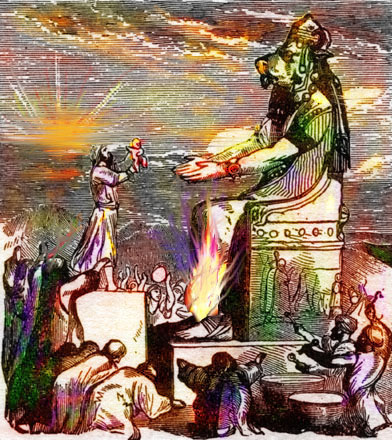
God’s temple was now filled with an evil darkness. King Manasseh made the Lord’s holy place a fountain of sin and filth. Instead of holiness, it was an evil place.

He brought in dark things that were twisted, perverted and clearly forbidden.

“Manasseh led Judah and the inhabitants of Jerusalem astray, to do more evil than the nations whom the Lord destroyed before the people of Israel.”

2 Chronicles 33:9, ESV

His own darkness was now encouraged by others, it became accessible, available and promoted:

  • The high places were rebuilt throughout the land.
  • Altars to Baal rebuilt, using images of wood.
  • In the holy temple, altars to the “starry host,” astrology, plain and simple.
  • Human sacrifice of his own sons to Molech, a false god. Murder.
  • He practiced soothsaying, used witchcraft and sorcery, and consulted mediums and spiritists.

Evil was being encouraged and something wicked was replacing all that was good and true. The analysis of Manasseh’s policies was way beyond disturbing. Of all the kings of Judah, he was the most sinful and the most corrupt. He was at the bottom of the barrel.

The Hebrew word for “led astray” can be translated seduced.

Manasseh was an incredibly immoral man, a king who ruled for 40 years. “He did all he could to pervert the national character, and totally destroy the worship of the true God; and he succeeded.” (Clarke)

It’s believed that he put Isaiah to death by cutting him in two.

Moreover Manasseh shed very much innocent blood, till he had filled Jerusalem from one end to another, besides his sin by which he made Judah sin, in doing evil in the sight of the LORD.

1 Kings 21:16

But then something happened.

And the LORD spoke to Manasseh and his people, but they would not listen. Therefore the LORD brought upon them the captains of the army of the king of Assyria, who took Manasseh with hooks, bound him with bronze fetters, and carried him off to Babylon.

2 Chronicles 33:10-11

Assyria came knocking on Manasseh’s door. I think there was a certain mercy here, but also discipline. Manasseh had “hooks,” inserted through his jaw and out of his mouth. Like a fish he was led to Babylon, a trophy of the power of the army of Babylon.

It was from a dark dungeon that Manasseh cried out to the Lord and repented.

(2 Chronicles 33:12-13.)

There’s a Jewish fable that when Manasseh cried out to God the angels boarded up the windows in heaven. They wanted to block out his prayer so God wouldn’t be able to hear. But God, rich in mercy, bored a hole in front of His throne to hear Manasseh’s desperate cry.

The Lord’s intention was to forever show His kindness and grace given to the most awful repentant sinner.

I believe that Manasseh was the “Prodigal Son” of the Old Testament.

God is not at a loss when He moves to bring us back to Himself. He can woo or whip. He can draw or drive. He can work rapidly or slowly, as He pleases. In other words, He is free to be God! And in His own way, at His own pace, He brings us back.

     Tom Wells

God is wildly in love with you. Yes, the sin you’ve committed is awful, but the Lord wants you to come back. He may discipline you, but He forgives everything if you’ll turn and repent.

No matter how awful your sin, He forgives and restores. Manasseh is proof of that.

Sources:

2 Chronicles 33:1-20

2 Kings 21:1-18

Enduring Word commentary

alaskabibleteacher.com

Jesus Writes in the Dust

John 8:3-11

Then the scribes and the Pharisees brought a woman caught in adultery, making her stand in the center. “Teacher,” they said to him, “this woman was caught in the act of committing adultery. In the law Moses commanded us to stone such women. So what do you say?” They asked this to trap him, in order that they might have evidence to accuse him.

Jesus stooped down and started writing on the ground with his finger. When they persisted in questioning him, he stood up and said to them, “The one without sin among you should be the first to throw a stone at her.” Then he stooped down again and continued writing on the ground. When they heard this, they left one by one, starting with the older men. Only he was left, with the woman in the center. 10 When Jesus stood up, he said to her, “Woman, where are they? Has no one condemned you?”

11 “No one, Lord,” she answered.

I remember how Jesus defended me from the religious men. I had been publically led through the crowds. The temple was filled with people who were there for the festival. It was a time of joy and feasting, but not for me. Definitely not for me.

The religious police escorted me to Jesus. I was now the focus of everyone’s attention. I felt dirty and ashamed. Standing there I could feel the leering looks from the Pharisees; but there was something else as well, a look from Jesus that I had never seen before. There was compassion there, something quite extraordinary. I saw a firm mercy.

I’m ashamed, but I had committed adultery. I slept with a man who wasn’t my husband.

I was to be stoned, to know hard rocks thrown by “holy” men. The Law had pronounced my guilt, and I knew exactly how I was to be punished. And I deserved it. Yet the man I slept with was never charged; he escaped, and I would be put to death. I didn’t blame him.

My shame was now public knowledge–everyone knew, the Pharisees made sure of that. Jesus had been accepted by some to be the Messiah and by others not so much. I wasn’t sure one way or another. I was in a daze, not able to even try to defend myself.

They only put me front and center to test Him. These men who brought me had ulterior motives, they desperately hoped Jesus would stumble. I think they wanted to prove once and all to the crowds that were watching that Jesus really wasn’t the Messiah. They tried to trap him.

Jesus realized the ugly implications of this satanic effort against Him.

Only Rome had the power of execution, and the Mosaic Law declared that I was to die. I stood waiting, expecting the worst. What else could I do?

It’s funny, but Jesus understood all of this. He looked right through this theological trick, and He responded in a way that really shocked everyone. He never spoke, but bowed low and began to write in the dirt with his finger. Amidst their vicious accusations, they pressed their case.

Jesus bent down again, and he wrote some more.

I never knew what he wrote–but I had to believe it must have been something about the sin of the men who were accusing me. At that moment, they dropped the case against me and left. They all filed out, one by one, in dramatic fashion. I now stood alone with Jesus.

Jesus looked directly at me. I was still afraid, but it was strange, I felt a wave of peace as well. I quietly waited, not knowing what He was going to say to me. I half expected the worst.

Yes, he did confront me. He wanted me to acknowledge that those accusing men had left. I saw it and understood. Jesus was asking me to believe that I was now really free. But then he wanted me to understand something that seemed quite crucial.

“Neither do I condemn you,” said Jesus. “Go, and from now on do not sin anymore.”

That dear one was a powerful moment. He set me free with the understanding that He did not condemn me. My new freedom came with a catch–sort of. I knew then that my sin must be renounced. My freedom came with a price. But knowing I was completely released, meant I was now a free woman.

At that moment I understood everything completely.

Needing His Cross Daily

We live in this place.

I confess that peace has never been really high on my list. Love, joy, kindness, and even goodness are clear priorities. Peace… not so much. Until I find out it’s not there. And then I get frantic by its absence and scrambling look for it with bewilderment.

Sometimes I don’t understand why God still loves me. At times like this anxiety eats at me. I beat myself up by my last failure. The guilt of my latest sin grows until it looms larger than the blood that saved me. Sometimes I suppose, religious people seem to have the most neurosis.

I’m afraid that we are taking the ‘present tense’ out of the Gospel.

The past tense is preferable to us as we find it easier to ‘manage’ our Christian life. We like to make check marks on our list. [Church attendance– check. Baptism– check. Bible study– check.] I think it gives me a definite feeling of ‘maturity.’

But these things matter little without intimacy with Jesus Christ.

I certainly haven’t arrived, and it seems at times I’m still the hideous sinner I always was. I cannot pretend otherwise, even with a spiritual truckload of cosmetics at my disposal. I know, I’ve tried. And I’m still ‘ugly.’ I do know forgiveness, and I do walk in its wonderful light (by grace).

I read Luther 30 years ago. (And Bonhoeffer would say something similar.)

“When our Lord and Master Jesus Christ said, ‘Repent,’ he willed the entire life of believers to be one of repentance.”

Martin Luther

This is the first of his 95 Theses nailed to the door of the Castle Church in Wittenberg, Germany. And there is a present tense here we can’t ignore about these declarations. I don’t just repent over smoking, beer drinking, fornication, or hypocrisy, once and done. But my entire way of living is to be one of repenting. To repent everyday opens the door to a true grace-filled discipleship.

“All of the Christian life is repentance. Turning from sin and trusting in the good news that Jesus saves sinners aren’t merely a one-time inaugural experience but the daily substance of Christianity. The gospel is for every day and every moment. Repentance is to be the Christian’s continual posture.”

John Piper

Luther’s last words, on his deathbed, was found written on a scrap of paper stuck in his coat, “We are beggars! This is true.” Even after thirty years, he was only echoing his first thesis.

It seems dear ones, we are to live at the foot of the cross.

A Legion of Demons

Mark 5:1-15

They came to the other side of the sea, to the region of the Gerasenes. As soon as he got out of the boat, a man with an unclean spirit came out of the tombs and met him. He lived in the tombs, and no one was able to restrain him anymore—not even with a chain— because he often had been bound with shackles and chains, but had torn the chains apart and smashed the shackles. No one was strong enough to subdue him. Night and day among the tombs and on the mountains, he was always crying out and cutting himself with stones.

6 When he saw Jesus from a distance, he ran and knelt down before him. And he cried out with a loud voice, “What do you have to do with me, Jesus, Son of the Most High God? I beg you before God, don’t torment me!” For he had told him, “Come out of the man, you unclean spirit!”

“What is your name?” he asked him.

“My name is Legion,” he answered him, “because we are many.” 10 And he begged him earnestly not to send them out of the region.

11 A large herd of pigs was there, feeding on the hillside. 12 The demons begged him, “Send us to the pigs, so that we may enter them.” 13 So he gave them permission, and the unclean spirits came out and entered the pigs. The herd of about two thousand rushed down the steep bank into the sea and drowned there.

14 The men who tended them ran off and reported it in the town and the countryside, and people went to see what had happened. 15 They came to Jesus and saw the man who had been demon-possessed, sitting there, dressed and in his right mind; and they were afraid.

I had so many demons inside me, people called me Legion. I ruled the spiritual world of the Garasenes. People were afraid of me, of what I would do to them. Believe me, they knew. I was a living nightmare, their boogeyman. My days was filled with awful confusion and terror.

And I was completely insane.

I can recall little through my darkness, and I suppose that was for the best. My madness permeated everything. My life had become completely saturated with evil. What little I know I will tell you.

Try to imagine the condensed insanity of a mental hospital crammed into one’s little brain.

That day, I was on the Gerasenes’ “welcoming committee.” I ran to greet Jesus before he even got out of the boat. I remember falling at His feet. I knew instinctively who He was. He was the Lord over my darkness. I suppose that deep down I knew that only He could free me.

The authority of Jesus enabled him to speak directly to my demons. I remember how they tried to negotiate their way out, but with His total authority over darkness, He calmly sent them into a herd of swine nearby.

There were about 2,000 pigs, and when my evil spirits left me, they entered them. The pigs went berserk, squealing and running. I was told later that they destroyed themselves. They couldn’t handle all the evil that I had ‘bottled up’ inside me.

With Jesus’ firm and decisive command, the darkness immediately left me alone.

Suddenly, I could no longer hear the demon’s vile words. I knew that I would no longer have to carry out their disgusting will. There were no longer voices in my head. I stood up as a free man, now walking in the light. Jesus Christ had decisively intervened.

Someone gave me a robe to cover up my nakedness. I sat at Jesus’ feet in a wonderful daze at what had just happened, and it didn’t take long for the townspeople to arrive. They came and found me clothed and completely sane. I suppose it was out of fear that they asked Jesus to leave the region immediately.

I only wish they understood who He really was.

When Jesus was getting into the boat I wanted to join Him. I simply had to be close to Him. But Jesus told me no. He told me that I needed to go home to my family, and I must tell them everything. “Tell them all of the power and mercy I have had on you.” As I watched them sail away I knew that I wanted to do what He asked.

I would now be Jesus’ ambassador to the Ten Towns.

I explained to them everything that had happened to me and all that Jesus could do. I was now His very visible witness. I shared about the power and authority of the Lord Jesus Christ over my incredible darkness. I was now a source of His light to my people.

I had to witness to the others, and it would be my joy to do so.

Lord Jesus, You completely rule the spiritual forces of darkness. Help me to remember this and assist me with my own dark issues. I want to be free from all that opposes You. I must tell others of what you’ve done for me. Amen.

alaskabibleteacher.com

Listen Closely to the Rich Young Ruler

Mark 10:17-22

As he was starting out on a trip, a man came running to him and knelt down and asked, “Good Teacher, what must I do to get to heaven?”

18 “Why do you call me good?” Jesus asked. “Only God is truly good! 19 But as for your question—you know the commandments: don’t kill, don’t commit adultery, don’t steal, don’t lie, don’t cheat, respect your father and mother.”

20 “Teacher,” the man replied, “I’ve never once broken a single one of those laws.”

21 Jesus felt genuine love for this man as he looked at him. “You lack only one thing,” he told him; “go and sell all you have and give the money to the poor—and you shall have treasure in heaven—and come, follow me.”

22 Then the man’s face fell, and he went sadly away, for he was very rich.

My name is inconsequential. I suppose all you must know of me is I tried to keep God’s Law and that I was very wealthy. Many believed that being rich was evidence that God approved of me. Of that, I wasn’t too sure. I kept the Law out of fear I suppose, and at times I just knew it wasn’t quite enough.

As I studied I began to realize that riches weren’t going to make me righteous. There was enough Scripture in me to let me know that it wasn’t enough. The prophets, especially Isaiah spoke about the deadliness of wealth, but there was one verse in Proverbs that really disturbed me:

“Your riches won’t help you on Judgment Day; only righteousness counts then.”

This verse and all of the others were the cause of many a sleepless night.

I was tormented by the reality of standing before God with nothing but my money to cover me. Coming under God’s righteous judgment haunted me. I thought of it day and night. I was terrified of being damned. My own righteousness wasn’t enough, and I knew it.

I heard about Jesus (and who hasn’t)–some were claiming that he was the Messiah. He was at least a wonderful teacher and many said he worked miracles. Just perhaps he had answers for me. I hoped so, but I needed to know. It was my questions that drove me to find him.

And finding him was easy–I just followed the crowd.

I went ahead of his retinue of followers. I knelt in his path and waited. I must know what he thought. When he stood before me I asked the question that had haunted me my whole life–“Good Teacher, what must I do to get eternal life?”

Being a good Jew he answered my question with a question. It now seems that he wanted me to see what really mattered. I answered him with my “righteous” commitment to the Law of Moses. I did what was important–at least that’s what I thought. But still, in spite of all that, I felt no security and no real peace.

Jesus looked straight at me, and I knew deep down that he loved me.

But oh those words, His words really disturbed me. He told me that I only lacked one thing, that I must sell everything and distribute the money to the poor. Only by doing that would discover riches in heaven. And only then could I truly follow him.

And that was the thing I could never do.

I went away grieved. If he had asked for anything else I would have done it. You see, my wealth was my real obstacle. Deep down I suddenly knew that everything I possessed was now my stumbling block. It was my idol, my golden calf, and it was a sacrifice that I could never make.

I’ve come to realize now, over my many years, that when I do finally stand before God, I will have nothing to save me. Jesus invited me to follow, and I didn’t.

And that my friend meant I would die in my sin.

Learning to Love Prodigals

Learning how to forgive

Once I was punched in the face while preaching. I served as a full-time evangelist with SOS Ministries in 1987. I was leading a group to Haight/Ashbury St. in San Francisco. I remember it was really busy, and the it was a good team, and they were excited to take their church to the streets.

Haight/Ashbury was the place the “summer of love” kicked off, it peaked in 1968. It has a certain sense of notoriety, and even in 1983 it still had a dubious reputation as a center of the counter-culture. “A cult a day is born in San Francisco,” a pastor friend once shared with me.

Normally the neighborhood where I took a team would direct me on how to preach. Tonight I focused on God’s love for sinful people.

That message seemed appropriate for this place, and especially on this street. God loves these people very much.

A young man came forward. He told me that he was a backslidden Christian, and his father was an Assembly of God pastor. He had run away from home. Suddenly he began to weep. The entire team seemed to lean forward and I know they were praying earnestly for him. It seemed to me that he was teetering on the brink.

The punch came unexpectedly.

His fist hit me square in the nose. My eyes began to water. Oddly enough he took a step back and began to really cry out. My team wasn’t quite sure how to respond, but I hoped they prayed even harder. I sort of gasped and tried to shake it off. Someone must have called the police.

The Holy Spirit was very much present, both convicting and comforting each of us.

One or two minutes went by and suddenly he stopped sobbing and he became really angry. He took a step and then tried to kick me in the stomach, but I dropped the mic and caught his foot. I was ready for him this time.

About 20 minutes went by before SFPD showed up and asked if I wanted to press charges. I thought for a bit, but deep down I knew that wasn’t the will of my Father. Maybe I should of, I don’t know. But I thought about my own sin and couldn’t judge no one.

The Father was reaching him while teaching me!

God loves His prodigal children very much, He understands the guilt and shame (and frustration) they feel. The Father however is always watching and waiting. He works through life’s circumstances to lead them home. Each belongs to Him. He continues far past what we think is possible. He will never give up.

“We know what real love is because Jesus gave up his life for us. So we also ought to give up our lives for our brothers and sisters.”

1 John 3:16

I suddenly saw a “wounded” brother, very confused and quite angry. Not with me, the team, or the music–but with God who created him, and died for him.

At that moment I just happened to be God’s love for this prodigal.

“How did Jesus expect His disciples to react under persecution? (In Matthew 5:12 He said), “Rejoice and be glad!” We are not to retaliate like an unbeliever, nor sulk like a child, nor lick our wound in self-pity like a dog, nor just grin a bear it like a Stoic, still less pretend we enjoy it like a masochist. What then? We are to rejoice as a Christian should even “leap for joy” (Lk. 6:23).”

     John Stott

“How did Jesus expect His disciples to react under persecution? (In Matthew 5:12 He said), “Rejoice and be glad!” We are not to retaliate like an unbeliever, nor sulk like a child, nor lick our wound in self-pity like a dog, nor just grin a bear it like a Stoic, still less pretend we enjoy it like a masochist. What then? We are to rejoice as a Christian should and even “leap for joy” (Lk. 6:23).”


The Older Brother Syndrome

Luke 15:25-32

25-27 “All this time his older son was out in the field. When the day’s work was done he came in. As he approached the house, he heard the music and dancing. Calling over one of the houseboys, he asked what was going on. He told him, ‘Your brother came home. Your father has ordered a feast—barbecued beef!—because he has him home safe and sound.’

28-30 “The older brother stomped off in an angry sulk and refused to join in. His father came out and tried to talk to him, but he wouldn’t listen. The son said, ‘Look how many years I’ve stayed here serving you, never giving you one moment of grief, but have you ever thrown a party for me and my friends? Then this son of yours who has thrown away your money on whores shows up and you go all out with a feast!’

31-32 “His father said, ‘Son, you don’t understand. You’re with me all the time, and everything that is mine is yours—but this is a wonderful time, and we had to celebrate. This brother of yours was dead, and he’s alive! He was lost, and he’s found!’”

I hated him. I know I shouldn’t but I did. He betrayed all of us with his nonsense. It all started when he demanded that our father immediately divide up our inheritance. Strange I know. It was a shock, like a punch in the stomach. No one knew what to say, it was so bizarre. I have no idea where this idea came from.

He insisted that we divide things up right this instant. He didn’t have the decency to wait for our father’s funeral. It was such a shameful thing that I couldn’t begin to tell you how mortified I was. No one ever heard of anything happening like this before. Even now, after these many years, I can hardly talk about it.

My father simply did what was asked, there was no argument, no resistance.

The property was appraised, and the money was divided up according to custom. We sat at the kitchen table, and the ass watched to make sure that he received every penny that was coming to him. His hungry greed was beyond belief. He oozed arrogance–it was then I really began to hate him.

Never ever had I been so angry and ashamed.

My younger brother never even batted an eye and my father simply did what was asked. My brother didn’t even have the decency to say “thank you.” I desperately wanted to leave, and I couldn’t. I had to be there, and I felt like I was going to throw up.

Enough of that. Let’s move on.

That ass, that brother of mine, suddenly packed up and left. Oh, occasionally I heard of his escapades. There were awful reports of his drunkenness and whoring. He was spending our father’s money as if it would never going to run out. Even talking about it now makes me angry.

The last I had heard was he was now feeding pigs. He had spent every last dime and now it seems he was getting what he deserved. I didn’t shed a tear, I felt no pity. Good, he was getting what he should have gotten all along. I only wished that things would get even worse.

Coming in from the fields I heard a raucous party coming from the house.

I asked one of the servants what was going on. When they told me I was even more shocked. Our father had arranged a celebration, all because my brother had returned. The fatted calf had been killed, the one that was saved for parties, and I heard shouts of joy and dancing. They were celebrating, and that made no sense to me at all.

I had served the estate faithfully, I had sweated to make things work, and I never got a party like this.

My father came out to find me, I had hidden out in a shed–I didn’t want to be a part of this awful charade. When he found me he said that the party had to happen. It seems the scoundrel had the audacity to return–the money was spent, and apparently, he came home in rags–it served him right. He got what he deserved.

He told me that this celebration must happen.

My mind reeled. Could things get even crazier? Never had I heard of anything so bizarre. It was beyond belief. My father wanted me to come in and join them; I’d rather die. You have no idea.

He kept telling me that this had to happen–apparently he was given a new robe, and worst of all he was given the family ring, the ring that declared that he was now a full-fledged son, someone who could have all of the privilege and authority of a son. I had never heard of such foolishness.

My father said this was necessary, that my brother who I hoped was dead, was now alive.

How bad could things get? Perhaps my father had lost his mind.

“Just so, I tell you, there will be more joy in heaven over one sinner who repents than over ninety-nine righteous persons who need no repentance.”

Luke 15:7

Painting: “The Return of the Prodigal Son by Rembrandt, c. 1667, oil on canvas. This picture shown is a small part. Scripture is The Message, a translation by Eugene Peterson.

alaskabibleteacher.com

Lost & Found

On a warm afternoon, a lamb takes a peek at a visitor while eating hay at Fat Rooster Farm in Royalton, Vt., on April 27, 2003. (Photo by Geoff Hansen)

 “All the tax collectors and sinners were approaching to listen to him. And the Pharisees and scribes were complaining, “This man welcomes sinners and eats with them.”

3 “So he told them this parable: “What man of you, having a hundred sheep, if he has lost one of them, does not leave the ninety-nine in the open country, and go after the one that is lost, until he finds it? And when he has found it, he lays it on his shoulders, rejoicing. And when he comes home, he calls together his friends and his neighbors, saying to them, ‘Rejoice with me, for I have found my sheep that was lost.’ Just so, I tell you, there will be more joy in heaven over one sinner who repents than over ninety-nine righteous persons who need no repentance.

Luke 15:1-7

What does it mean to be lost? Some have that much figured out by now, (and if not, we will.) The Bible nails us with this story, and it rings true of the human condition. You don’t need a Ph.D. in Psychology to understand this. The heart and soul of a man and a woman are in an awful state of separation from God, and some are beginning to understand this.

The three stories reveal that the Pharisees and the scribes have issues.

Their whole belief system–the idea of who’s righteous and who’s not, is being rocked. The sinners are coming to listen to Jesus (maybe for the stories, maybe for something else?) The religious regime is mystified, and maybe a bit jealous. Perhaps they were irked at the grace of God they see in Jesus?

Jesus tells His first story, (and he loves to tell stories I’ve found.) Anyway, the parable he shares is 100 words (more or less) and it describes the condition of every man, woman, and child–everyone who has ever existed. He clearly cuts through “religion” like a hot knife through cold butter. He quite succinctly describes us. And wow, these stories are eye-openers.

We’re all lost sheep–wandering, and sometimes very confused.

The paths we’ve taken to get out of our “lost-ness” have only confused us even more. We’ve had to deal with thorns and vultures; it hasn’t been easy, and we’ve never been able to reconnect to safety. Some become “smart” people, others buy fast cars, and some kill their lost-ness with booze or drugs. We find many different ways to keep us from feeling this separation from God.

A very lost sheep.

In Luke 15, we find three parables that all deal with lost things–sheep, coins, and sons. Essentially, they each explain what now has happened to us. Most of us know that the religion of the Pharisees hasn’t worked. Even the sinners understand that much. Sometimes even the very lost have figured that much out, even before the so-called righteous do.

Jesus tracks us down–our confusion has finally lifted enough to see his outstretched arm. The Father has this odd preference for those who know they’ve lost, and these three parables come in a deliberate succession–that should make things pretty clear.

So dear one, will you insist on wandering? Is that what you really want?

alaskabibleteacher.com

w