“And Samuel said, “Has the LORD as great delight in burnt offerings and sacrifices, as in obeying the voice of the LORD? Behold, to obey is better than sacrifice, and to listen than the fat of rams.”
1 Samuel 15:22, ESV
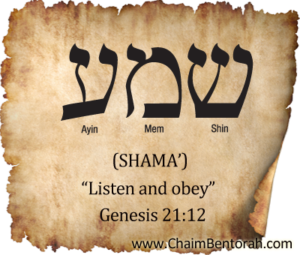
In Hebrew, the word ‘shama’ has a powerful meaning which is hard to translate into English. The word actually means “listening and doing.” Shama is a word that combines both ideas into one. To hear and obey is one word to the Hebrews.
It’s all about activity that’s a result of hearing.
Here, the word shama means to allow the words to sink in, to provide understanding that requires a response—it’s about becoming obedient when you hear His voice. In Hebrew, hearing and doing are the same thing. Obedience to these laws is not about legalism or trying to earn God’s favor—it’s about love and active listening.
We desperately need “shama” as disciples of Jesus.
We must understand that listening to God is needed, but obedience is required. Shama tells us this. We can’t just hear Him without obeying. I believe that obedience becomes easy when we are listening to Him.
And that’s a good thing.
“The willingness to obey every word from God is critical to hearing God speak.”
15 “And they brought unto Him also infants, that He would touch them; but when His disciples saw it, they rebuked them.
16 But Jesus called them unto Him and said, “Suffer little children to come unto Me, and forbid them not, for of such is the Kingdom of God.
17 Verily I say unto you, whosoever shall not receive the Kingdom of God as a little child shall in no wise enter therein.”
Again we were wrong (like usual it seems). I guess that we were trying to maximize Jesus’ ministry. We meant well, but He needed organization. So that was now our “ministry.” We simply felt that Jesus’ time was our concern, and as His disciples we wanted Him to connect with those who really mattered.
The parents were bringing their children to be blessed by Jesus.
“It was the custom for mothers to bring their children to some distinguished Rabbi on the first birthday that he might bless them.”
Jesus made it clear that these children needed to be the focus of our ministry. Our efforts were not to be centered on adults, rather it was misguided thinking that we direct Jesus’ work to be focused and redirected. These little ones were in the way.
Up to now, Jesus’ work was for adults. There were lepers, demon-possessed, paralyzed, tax-collectors all waiting for His ministry. Somehow we overlooked the needs of little children. Again, we were wrong, misguided, and ignorant of the walk of the true believer.
And sure enough, Jesus explained what we were missing. Children were to become our focus. They were the ones who we were to emulate and esteem. The radical thing to us was understanding that these ‘little ones’ were that significant.
I must say that this was a powerful jolt.
“Let these children alone. Don’t get between them and me. These children are the kingdom’s pride and joy. Mark this: Unless you accept God’s kingdom in the simplicity of a child, you’ll never get in.”
Luke 18:16-17, The Message
This was astounding! It was nothing less than another radical thought from our Teacher. Accepting this wasn’t easy, but Jesus was crystal clear. We dare not think otherwise, but to believe this was against all we thought we understood.
Jesus understood that childlikeness was the only way we could enter His Kingdom.
Trust me on this–we believed otherwise. Up to now, we assumed that maturity meant sophistication. It was all about right thinking and good theology that God was looking for. We assumed that being simple wasn’t quite what Jesus wanted from us. Rather we believed the opposite.
Children were now to be our examples. Their simplicity was to be our guide–it was the Kingdom of God’s doorway into true discipleship.
“Part of the exquisite beauty of salvation is its simplicity. Any man, woman, or child can come to Christ with absolutely nothing to offer Him but simple faith-just as they are. Salvation requires nothing more than childlike faith-believing that Jesus Christ died for my sins and accepting His gift of Salvation.”
“Jesus said to them again, “Peace be with you. As the Father has sent me, I also send you.”22 After saying this, he breathed on them and said, “Receive the Holy Spirit. 23 If you forgive the sins of any, they are forgiven them; if you retain the sins of any, they are retained.”
John 20:21-23 (19-23)
This is the second “peace be with you” in this passage. So why the duplication of this peace proclamation? The disciples are sequestered and scared in the upper room (v. 19; and Luke 24:36. Having peace is being emphasized–the disciples were afraid of the Pharisees, but they were also undone by Jesus’ surprise visit.
Peace was definitely a precious commodity for them.
Jesus gives his disciples a mission to do, and they must be as ‘familiar’ with Jesus just as Jesus is with God. The disciples had followed him for three years–seeing incredible miracles, and hearing profound teaching, they’re ready, they just need power.
In track and field, there’s a relay race where a baton is passed from runner to runner, and maybe that’s how it’s working here? We see the same idea in John 17:18.
The baton has now been passed to the disciples.
The breath of the risen Jesus is necessary (and yes, he’s breathing.) What went down here, I don’t know exactly. But Jesus recognizes that his 12 followers will need this to do his work. Also, we might consider Adam in Genesis 2:7 where God’s breath brought him to life, which is pretty awesome when you think of the parallels.
The disciples were pretty much observers, but now they are to take up the ‘mantle’ of Jesus’ work. This is a definite duplication, which connects with the idea of one seed producing many others (John 12:24.) That’s how the Kingdom will come to people.
Verse 23 intrigues me. It seems that our life comes from the breath of Jesus. And it’s the Holy Spirit that gives both power and the authority that’s needed to function like Jesus. We now have the ability to pronounce forgiveness to the new believer, and yet that doesn’t seem a function of the Church today.
I wonder why this is so?
This entire passage is a real humdinger for Bible students. But it clearly declares the Churches new role as we follow in his footsteps. Disciples are to do exactly what Jesus does–with his breath and authority–filled with the Holy Spirit. We have a mission.
If we neglect these things we’re going to fall flat on our face.
“The work of Jesus for His disciples on resurrection Sunday gives an ongoing pattern for His work among His people. Jesus wants to continue this fourfold ministry of assurance, mission, the Holy Spirit and authority to His people today.”
6 He came to Simon Peter, who said to him, “Lord, do you wash my feet?” 7 Jesus answered him, “What I am doing you do not understand now, but afterward you will understand.” 8 Peter said to him, “You shall never wash my feet.” Jesus answered him, “If I do not wash you, you have no share with me.”
Chapter 13 always rocks my world. I visualize this, like a fly on the wall, watching it happen–and then I replay it over, and over in my mind. It always unravels me. Why does this have to happen? What does this passage tell me about Jesus and his kingdom? (John 13). Why can’t I just walk away from it, and leave it be?
Jesus made himself a slave on purpose.
Or perhaps he was always a slave all along, and we just didn’t realize it? Foot-washers were pretty much regarded as sub-human, mindless drones who mechanically performed a necessary duty. The lowest of the low, the very least of the least. (Today they’re the burger flippers and the pool cleaners.)
But Jesus took that role on himself, he laid aside his garments and his Godhood. (They landed in a pile in the corner of the room). When he knelt down to scrub feet (making sure he got between the toes), it was Deity serving man. This God/rabbi intentionally did this, not reluctantly or halfheartedly–but carefully. Brilliantly.
He was their teacher, and custom demanded he enjoys the prerogatives of that position. But he wouldn’t, and didn’t. He mustn’t. As I stress over this, I must conclude he really was their “teacher,” but not in the way I expect. What he was doing on his knees, was instructing them in the art of loving each other.
He showed us a real leader in action.
And isn’t making disciples all about loving (and washing) someone else more than ourselves?
We get things turned around sometimes–we think that spiritual authority is moving up when it’s all about going down. We elevate our pastors and elders, maybe subconsciously–and human nature lets it happen, and then we’re amazed why our leaders struggle so.
Leaders function best when they wash between the toes.
There was a point in Jewish history when the people actually demanded that God would give them a king, instead of a judge (1 Samuel 8:5-9). God warned them that this wasn’t in his plans–but they insisted.
They had to have one, everyone else did. We still must have celebrities, and then we wonder why they short-circuit on us. Who can resist the privilege, and the limelight of the platform?
The Church was never meant to operate like this.
That’s what Jesus said. Instead, it’s we who’ve turned it upside down. It’s we who insist on turning our pastors into minor celebrities. We assert that they take on the role of a “king” (albeit, a little one maybe). Perhaps leaders who stumble and fall do so because we want them to be front and center? Who can handle the privilege and the adulation? I know I can’t.
Peter was classic Peter.
It seems that whenever he resists, he gets rebuked. He makes it quite clear that Jesus will never wash feet–that Jesus will never use a basin or towel and serve him like this. It was outrageous. Unacceptable. It didn’t fit in Peter’s personal theology. He had no room for Jesus the slave. (Perhaps he knew that to follow meant he would have to do the same thing? IDK).
Jesus still washes His people. He has not changed.
He sits us down and takes off our shoes and socks, and scrubs us clean. And we hate it. But to be washed by him is a condition of our discipleship. Every follower must be clean, and he continues his work to this day. We sin daily, even as his own, and he cleans us up–and somehow that really bothers us.
The gifts of leadership are one way of washing feet. At least that’s what our leaders were designed to do. That’s Jesus’ way of doing things. But it seems we’ve adopted Peter’s attitude, and embraced the ‘pre-king’ thinking of Israel. We need our celebrities, we want our kings. We simply can’t imagine it any other way.
“The very first thing which needs to be said about Christian ministers of all kinds is that they are “under” people as their servants rather than “over” them. Jesus made this absolutely plain. The chief characteristic of Christian leaders, he insisted, is humility not authority, and gentleness not power.”
I have to admit, I never really appreciated the depth of Psalm 23:5. I supposed that “He anoints my head with oil” was simply just figurative language for something nice. Poetic. I never knew this definite parallel until recently. But David completely understood and was able to understand the full ministry of the Shepherd.
“You prepare a table before me in the presence of my enemies; you anoint my head with oil; my cup overflows.”
Psalm 23:5, ESV
I recently read this and suddenly I understood.
“Sheep can get their head caught in briers and die trying to get untangled. There are horrid little flies that like to torment sheep by laying eggs in their nostrils which turn into worms and drive the sheep to beat their head against a rock, sometimes to death. Their ears and eyes are also susceptible to tormenting insects.”
So the shepherd anoints their whole head with oil.
“Then there is peace. That oil forms a barrier of protection against the evil that tries to destroy the sheep. Do you have times of mental torment? Do the worrisome thoughts invade your mind over and over? Do you beat your head against a wall trying to stop them? Have you ever asked God to anoint your head with oil?”
He has an endless supply!
His oil protects and makes it possible for you to fix your heart, mind, and eyes on Him today and always! There is peace in the valley! May our good good Father anoint your head with oil today so that your cup overflows with blessings! God is good and He is faithful!!”
Body piercing has become pretty much acceptable just in the last ten years.
Studs are placed in a hole or piercing to make a permanent decoration. I have seen a fair amount of it, and I think that a stud in the tongue has got to be the most intrusive. (I recently read of a young girl who died after her tongue was pierced from an infection).
There is “body piercing” in scripture. In Deuteronomy 15:12-18, slaves who are being set free by their master after six years of service, could, if they loved and were loved by their master, could choose to remain a slave to him.
“But if your slave says to you, “I don’t want to leave you,” because he loves you and your family and has a good life with you,17 stick an awl through his ear into the door; he will be your slave for life. Also do this to a female slave.”
Deuteronomy 15:12-18
This was a decision that required elders to act as witnesses. It was significant as well as completely binding. I like to think of the ceremony to be kind of a cross between a wedding and a circumcision. (Sounds fun, huh?!)
The slave would be led to a doorpost and the master would take an awl, and push it through his ear lobe. This designated the slave to be forever “owned” by a specific master. Herein lies a picture of the Christian.
Many times in the New Testament we are called to be servants (slaves) of Christ.
Peter, Paul, James, and Jude referred to themselves as “bond servants of Jesus Christ” in their epistles. This is not a forced servitude. It’s a choice made in love!
There are many believers who have done the same, they have fallen in love with their Savior. They do not plan on a life apart from Him. So spiritually they have gone to the doorpost, the awl is pushed through their ear, and they are marked from that point on.
Although the ear was pierced physically in the Old Testament, a different kind of piercing takes place in the New. In Romans 6:16 we read,
“Surely you know that when you give yourselves like slaves to obey someone, then you are really slaves of that person. The person you obey is your master. You can follow sin, which brings spiritual death, or you can obey God, which makes you right with him.”
Romans 6:16, (NCV)
When the prodigal son returned home from the far country he fell before his father and humbly ask, “make me your servant.” (Luke 15:19,21) He, in essence, was saying to the father, “pierce my ear.” The father made him a son, but the attitude of the son’s heart had changed to the heart of a servant. So it must be with us. Only then will we live a “pierced ear” life, revealing to all that we are servants of Jesus Christ!
“Savior, I know Thou hast allowed me absolute liberty, to serve Thee, or to go my own way. I would serve Thee forever, for I love my Master. I will not go out free. Mark my ear, Lord, that it might respond only to Thy voice.”
His Ordination Prayer as a Pastor, serving in the Christian and Missionary Alliance
August 18, 1920
O Lord, I have heard Thy voice and was afraid. Thou has called me to an awesome task in a grave and perilous hour. Thou art about to shake all nations and the earth and also heaven, that the things that cannot be shaken may remain. O Lord, my Lord, Thou has stooped to honor me to be Thy servant. No man taketh this honor upon himself save he that is called of God as was Aaron. Thou has ordained me Thy messenger to them that are stubborn of heart and hard of hearing. They have rejected Thee, the Master, and it is not to be expected that they will receive me, the servant.
My God, I shall not waste time deploring my weakness nor my unfittedness for the work. The responsibility is not mine, but Thine. Thou has said, “I knew thee – I ordained thee – I sanctified thee,” and Thou hast also said, “Thou shalt go to all that I shall send thee, and whatsoever I command thee thou shalt speak.” Who am I to argue with Thee or to call into question Thy sovereign choice? The decision is not mine but Thine.
So be it, Lord. Thy will, not mine, be done.
Well do I know, Thou God of the prophets and the apostles, that as long as I honor Thee Thou will honor me. Help me therefore to take this solemn vow to honor Thee in all my future life and labors, whether by gain or by loss, by life or by death, and then to keep that vow unbroken while I live.
It is time, O God, for Thee to work, for the enemy has entered into Thy pastures and the sheep are torn and scattered. And false shepherds abound who deny the danger and laugh at the perils which surround Thy flock. The sheep are deceived by these hirelings and follow them with touching loyalty while the wolf closes in to kill and destroy. I beseech Thee, give me sharp eyes to detect the presence of the enemy; give me understanding to see and courage to report what I see faithfully. Make my voice so like Thine own that even the sick sheep will recognize it and follow Thee.
Lord Jesus, I come to Thee for spiritual preparation.
Lay Thy hand upon me. Anoint me with the oil of the New Testament prophet. Forbid that I should be come a religious scribe and thus lose my prophetic calling. Save me from the curse that lies dark across the modern clergy, the curse of compromise, of imitation, of professionalism. Save me from the error of judging a church by its size, its popularity or the amount of its yearly offering. Help me to remember that I am a prophet – not a promoter, not a religious manager, but a prophet. Let me never become a slave to crowds. Heal my soul of carnal ambitions and deliver me from the itch for publicity.
Save me from bondage to things. Let me not waste my days puttering around the house. Lay Thy terror upon me, O God, and drive me to the place of prayer where I may wrestle with principalities and powers and the rulers of the darkness of this world. Deliver me from overeating and late sleeping. Teach me self-discipline that I may be a good soldier of Jesus Christ.
I accept hard work and small rewards in this life.
I ask for no easy place. I shall try to be blind to the little ways that could make life easier. If others seek the smoother path I shall try to take the hard way without judging them too harshly. I shall expect opposition and try to take it quietly when it comes. Or if, as sometimes it falleth out to Thy servants, I should have grateful gifts pressed upon me by Thy kindly people, stand by me then and save me from the blight that often follows. Teach me to use whatever I receive in such manner that will not injure my soul nor diminish my spiritual power. And if in Thy permissive providence honor should come to me from Thy church, let me not forget in that hour that I am unworthy of the least of Thy mercies, and that if men knew me as intimately as I know myself they would withhold their honors or bestow them upon others more worthy to receive them.
And now, O Lord of heaven and earth, I consecrate my remaining days to Thee; let them be many or few, as Thou wilt. Let me stand before the great or minister to the poor and lowly; that choice is not mine, and I would not influence it if I could. I am Thy servant to do Thy will, and that will is sweeter to me than position or riches or fame.
I choose it above all things on earth or in heaven.
Though I am chosen of Thee and honored by a high and holy calling, let me never forget that I am but a man of dust and ashes, a man with all the natural faults and passions that plague the race of men. I pray Thee, therefore, my Lord and Redeemer, save me from myself and from all the injuries I may do myself while trying to be a blessing to others. Fill me with Thy power by the Holy Spirit, and I will go in Thy strength and tell of Thy righteousness, even Thine only. I will spread abroad the message of redeeming love while my normal powers endure.
Then, dear Lord, when I am old and weary and too tired to go on, have a place ready for me above, and make me to be numbered with Thy saints in glory everlasting. Amen. AMEN.
Hidden in the Old Testament is the idea of the Cities of Refuge. They have incredible meaning for us today.
They speak profoundly to our situation and bring real hope to those who struggle. Six places of safety were given to protect those who accidentally killed another person— maybe an ax head flew and hit someone, and they died as a result.
God told Joshua to establish cities of protection where one could be safe from an avenger. There were six of them, three on the east side of the Jordan river, and three on the west. The cities covered Israel; each was spread out intentionally so they were always close.
That city became a place of asylum for those guilty of manslaughter.
As believers, we know that we’ve committed crimes against God and other people. The burden we carry threatens to undo us. Satan (and his minions) want to destroy us—and honestly, we deserve it. We are essentially spiritual ‘criminals’ who have hurt others and damaged ourselves in the process.
Outside the city, we’re vulnerable—but inside those walls we find safety.
Those who have killed others are protected. If we venture outside, we find our adversary who is waiting. Scripture tells us that we must stay cloistered there until the current high priest dies. Upon his death, we’re released and may leave the city walls.
For broken believers, the whole concept rings true.
The text speaks for itself, and there is spiritual logic in all of this. We see parallels here that speak to our condition. We’ve messed up big time. We also carry issues that the enemy can attack. Depression, bipolar, trauma, and even thoughts of committing suicide— can be a fundamental part of our lives.
I must tell you that safety is found only in the Savior.
Finding God and abiding in him is our place of safety. His walls protect us, Jesus is our high priest, who never dies; that means we need to stay with him, permanently. I like Hebrews 6:18, LB:
“Now all those who flee to him to save them can take new courage when they hear such assurances from God; now they can know without a doubt that he will give them the salvation he has promised them.”
For us especially, we often have problems with the doctrine of assurance of salvation. Our enemy works overtime to accuse us (Rev.12:10). We’re his targets and the lies of many demons assault us. We can, at times, wonder if we’re really saved. We wonder if we are really forgiven, and we doubt our salvation. Satan’s efforts can be constant and crippling.
I encourage you to think this over and pray about this.
21 “So that you also may know how I am and what I am doing, Tychicus the beloved brother and faithful minister in the Lord will tell you everything.
22 I have sent him to you for this very purpose, that you may know how we are, and that he may encourage your hearts.”
Ephesians 5:21-22
There is so much here that communicates Paul’s heart. He’s laid out a ton of theology, and now he ends his heavy letter with this final benediction or blessing. These final verses are not doctrine. Instead they’re more like God’s ‘open window’ directly to the Ephesian’s heart.
Just imagine yourself as a believer living in Ephesus. Reading the letter we should see ourselves there (albeit 2000 years removed). This belongs to you as much as it belonged to the churches in Asia Minor. Please, own it.
You need to see this. It changes our walk from the 1st century to the 21st century.
This letter belongs to you personally. Ephesians is your letter from ‘home.’ So dear one, make it yours, for you are the Holy Spirit’s audience, and you’re very much loved!
Tychicus has been chosen to carry this letter 5,000 miles to the Ephesians.
The journey itself was over 5,000 miles from Rome to Ephesus, walking by Roman roads. (It would be a long trip, longer than walking from San Francisco to Boston!) It was difficult and could be dangerous, but the letter Titus carried was important. It would be painstakingly copied and then sent to all the churches in Asia Minor.
“Travelers journeyed in convoy, sometimes hiring soldiers to protect them from robbers who preyed on the unsuspecting. Roman roads made things somewhat easier but still, walking, perhaps hiring a donkey or paying for passage on a merchant’s ship. Travel was for the brave and the strong.”
He was a gospel ‘veteran’ who ministered with Paul in various places in the Roman empire. It appears he was friends with Timothy, who was the young pastor of the church in Ephesus. Tychicus was someone whom Paul trusted implicitly. After all, he was carrying Paul’s heart in his backpack.
Tychicus was 100% loyal, brave, and completely reliable. I think Paul had confidence that he would do everything necessary to make sure this letter would get through. We find he was able to do this. And you and I, well, we owe a spiritual debt to this faithful man who went the distance for us.
We can skim through this passage and never really see Tychicus at all.
Tychicus seems to have no real preaching ability, but he is called “beloved” and “faithful” in verse 21. In verse 22 he is called a “brother” and a “minister.” That word for minister is διάκονος, deacon and it means “a servant of a king” or a “waiter of tables.” I believe that reveals someone who is a minister to the needy (which is no small thing).
Paul closes his letter with a benediction.
In verses 23-24, we read that the blessing is given to the church. He pronounces “peace, love, and faith.” Paul speaks out of God’s heart to the Ephesians, and as a leader, he is conveying God’s own blessing. A proper benediction that originates from the Lord is hardly just a nicety, something free and easy. You must understand, a pastor’s blessing is powerful.
“Grace be with all who love our Lord Jesus Christ with love incorruptible.”
“And after six days Jesus took with him Peter and James and John, and led them up a high mountain by themselves. And he was transfigured before them, 3 and his clothes became radiant, intensely white, as no one on earth could bleach them. 4 And there appeared to them Elijah with Moses, and they were talking with Jesus.
5 “And Peter said to Jesus, “Rabbi, it is good that we are here. Let us make three tents, one for you and one for Moses and one for Elijah.” 6 For he did not know what to say, for they were terrified.”
“And a cloud overshadowed them, and a voice came out of the cloud, “This is my beloved Son; listen to him.” 8 And suddenly, looking around, they no longer saw anyone with them but Jesus only.”
I could go a hundred different ways with thispassage. After much thought (disorganized most of the time) I’ve decided to go with the following. I know deep down how deficient it is, and I know you have much to add to it, which is very good.
But what I do understand I give to you.
The more I try to process Mark 9 the more I see things that are wildly significant. What happened there was radical, and I realize that I still don’t have a solid grip on it, and if I did I know deep down it’d change my life.
James, John, and Peter. Why these three? Some have suggested that these particular disciples were the ones who desperately needed to see what was going to happen. That’s very possible. Perhaps they were the weakest, and maybe they needed to see the real Jesus in His glory. My personal view is that these three wrote books, epistles. Maybe Jesus understood this, and gave them this earth-shaking experience?
The impact on Peter was profound. “”For we did not follow cleverly devised stories when we told you about the coming of our Lord Jesus Christ in power, but we were eyewitnesses of his majesty. 17 He received honor and glory from God the Father when the voice came to him from the Majestic Glory, saying, “This is my Son, whom I love; with Him, I am well pleased.” We ourselves heard this voice that came from heaven when we were with him on the sacred mountain.” (2 Peter 1:16-18).
Toward the end of Peter’s life he couldn’t shake the Transfiguration and what he witnessed there. He recalled the “glory” but it seems it was the voice that was the most profound. It was that voice that completely altered his life and ministry. (Notice that he mentions it twice in verse 18.)
The Greek word for “transfigured” is metamorphosis. (Like a butterfly coming out of a cocoon.) Jesus wasn’t put in some spiritual “spotlight,” rather the glory that was seen was coming from inside Him. We see that He was God and Jesus revealed Himself clearly as God. The three disciples who were witnesses seem to struggle with exactly what took place. They use human analogies and images to try to explain to us what they saw.
The word “terrified” is the word phobia. Could it be that our encounter with God could go to that extreme? Could we be that we could be terrified in His presence? Does that fit into our theology? You need to decide if it’s significant or not.
And what about Moses and Elijah? Most feel that each represented the Law and the Prophets. I must point out that both had ministered from the top of mountains before? But notice, even though Jesus emanated extreme glory, these two did not. Also, the arrival of these two reinforces the real world of life after death. Both Moses and Elijah were very much alive!
The “human” part of Jesus was temporarily set aside. We know that Jesus was fully man, but here we see Him as He really is–fully and completely God. What a revelation! The three disciples were profoundly touched. Seeing the power and glory of the Creator of the universe on the top of the mountain altered their lives and changed their ministry.
John would write his Gospel and three letters. James wrote the first book in the NT. Peter is credited with the Gospel of Mark and his two books. They “knew” exactly who Jesus was! They had become fully convinced and needed no theological explanation. They finally understood!
So much more should be considered.
What I’ve written today is so incomplete–I feel a little foolish putting this down in this post. But yet I’m actively praying for you that this might add to your understanding. The Transfiguration is profound. It certainly needs to be internally processed by every real believer. And for those who don’t know Jesus yet, I hope you can understand exactly who He is to us who believe.
“In the beginning was the Word, and the Word was with God, and the Word was God.He was with God in the beginning.Through him all things were made; without him, nothing was made that has been made.In him was life, and that life was the light of all mankind. The light shines in the darkness, and the darkness has not overcome it.”