What Jesus Wants Us to Know About God

14 After he had spent everything, a severe famine struck that country, and he had nothing. 15 Then he went to work for one of the citizens of that country, who sent him into his fields to feed pigs. 16 He longed to eat his fill from the pods that the pigs were eating, but no one would give him anything. 17 When he came to his senses, he said, ‘How many of my father’s hired workers have more than enough food, and here I am dying of hunger! 18 I’ll get up, go to my father, and say to him, “Father, I have sinned against heaven and in your sight. 19 I’m no longer worthy to be called your son. Make me like one of your hired workers.”’ 

20 So he got up and went to his father. But while the son was still a long way off, his father saw him and was filled with compassion. He ran, threw his arms around his neck, and kissed him. 21 The son said to him, ‘Father, I have sinned against heaven and in your sight. I’m no longer worthy to be called your son.’

22 “But the father told his servants, ‘Quick! Bring out the best robe and put it on him; put a ring on his finger and sandals on his feet. 23 Then bring the fattened calf and slaughter it, and let’s celebrate with a feast, 24 because this son of mine was dead and is alive again; he was lost and is found!’ So they began to celebrate.

Luke 15:14-24

Sometimes, when reading this we diminish this parable to a really nice story, but nothing more. It comforts us. It’s so evocative after all, but somehow it never enters our spiritual hearts like it’s meant to. We may mentally assent but we do not absorb what it really says.

Luke 15 is magnificent in the deepest sense of the word.

Now if the Bible was a mountain range, then this would be Mt. Everest.

Our Father runs to us because He sees our desperate hearts. His joy can’t be explained but only received. It’s just the way He is.

Just perhaps it will take an eternity to understand this simple parable? If so, we should get started now.

There are just three characters here in Luke 15:14-24: there’s the Father, the son, and the elder brother–and each plays an integral part. The prodigal is the main character, yet the father is the main focus. The son is a wastrel, a good-for-nothing rascal who blows his father’s inheritance on parties, booze, and prostitutes. He lives for the moment, he seeks pleasure in those things which will come very close to destroying him.

But haven’t we all done that?

The father represents God, who represents the loving patriarch of the parable. He’s the one who has turned over the prodigal’s portion of the inheritance. To a degree I suppose he has funded the prodigal’s descent into depravity, and yet it was the son who decided to go crazy. The father is certainly not to blame.

But nevertheless, in this story, the father is the main character. Not the prodigal.

His actions are very difficult to grasp. God behaves outrageously, and His character is difficult to understand or fathom. (After all, who acts this way?) Granted we think our earthly fathers might do this for us–but even that may be a stretch for some. Yet this parable describes how God feels about sinners.

He is passionately in love with sinners.

The mysteries of this parable explain who God is, and His love for nasty varmints like us. We are His Church, and yet we still need to come home. Again.

And we serve a running God.w

“Jesus wants to make it clear that the God of whom he speaks is a God of compassion who joyously welcomes repentant sinners into his house.”

Henri J.M. Nouwen, Return of the Prodigal Son

(My favorite painting. Rembrandt’s painted this in 1669. I know that that was done long ago, but I enjoy seeing and reacting to what he did. I’m always blessed.)

alaskabibleteacher.com

The Pharisee & the Tax Collector

Luke 18:10-14

 “Two men went to the Temple to pray. One was a proud, self-righteous Pharisee, and the other a cheating tax collector. 11 The proud Pharisee ‘prayed’ this prayer: ‘Thank God, I am not a sinner like everyone else, especially like that tax collector over there! For I never cheat, I don’t commit adultery, 12 I go without food twice a week, and I give to God a tenth of everything I earn.’

13 “But the corrupt tax collector stood at a distance and dared not even lift his eyes to heaven as he prayed, but beat upon his chest in sorrow, exclaiming, ‘God, be merciful to me, a sinner.’ 14 I tell you, this sinner, not the Pharisee, returned home forgiven! For the proud shall be humbled, but the humble shall be honored.”

Meet the Pharisee:

I had it all together. I had shaped myself to be the ultimate Pharisee–the Pharisees of the Pharisees. I understood the Law; I could quote whole books, forward and backward. I fasted twice a week, and tithed everything, right down to my herbs and spices. I had it all together.

And I made sure everyone saw my commitment.

I strenuously kept God’s Law. I was consumed by understanding it, I tried to grasp all its nuances and complexity. The 10 commandments were emblazoned on all that I did. I wanted everyone to know that I was one of “the pure ones,” for that was the meaning behind the word Pharisee. I knew that I was pure.

I went to the Temple every day to pray, I stood holy and set apart, standing before a real and holy God. I was always the truest example to the people of Israel. I always stood when I prayed, for I was completely committed to doing all that the Law demanded of me.

One day I saw a wicked man in God’s holy temple. I had to thank God that we were total opposites. He was a tax collector and an evil person. I really was nothing like him. I rejoiced that I had become a true example of a righteous man.

I knew I was righteous, and certainly not at all like that sinful tax collector.

———————-

Meet the Tax Collector:

I didn’t have it all together. I understood this and was horrified that I had become so evil. I came to the Temple, driven by my guilt and shame–no one had to tell me this, for I knew my sin and I was deeply ashamed.

Why I came, I don’t know. I honestly didn’t belong here, and I kept a distance from the front. I guess that’s where I belonged. On the fringes before the Holy One. It seemed now that I was drawn to this place, and I’m still not sure why I came that day.

I knew that I breathed evil and had become evil.

I fell to my knees, and I begged God to forgive me. I saw the Pharisee standing in the presence of God, but I knew I wasn’t at all like him. He was righteous and I knew I was not. Oh, how I wanted God to forgive me for all the sins I had committed.

I must tell you that my spirit was in agony.

“Humble men are very fortunate!” he told them, “for the Kingdom of Heaven is given to them. Those who mourn are fortunate! for they shall be comforted. The meek and lowly are fortunate! for the whole wide world belongs to them.

Matthew 5:3-5, LB

Jesus clearly told us who was truly forgiven that day. When we think we have it all together, we’re deceiving ourselves.

Let’s not pretend otherwise, okay.

alaskabibleteacher.com

Art: Eugene Burnand, 1850-1924, litho; Scripture used here is from the Living Bible.

The Father is Looking for You

Luke 15:20, ESV

There comes a time when the prodigal stands up–looks around, and then decides he can’t live this way anymore–it’s now time to return home.  But he is no longer a ‘rich man’s son,’ the pig-pen completely crushed that idea.  He returns home, thinking that at least he can be a slave.

The devastated prodigal now understands.

And it’s that which gives him the propulsion to leave the pigs behind, and begin to somehow be received by his father. The trip is a long one, lots of walking, and yes, it’s hard–he’s far from where he’s supposed to be. He is tired, ragged and worn.

But please dear one, you must understand this about Jesus’ parable–the story isn’t so much about the prodigal son, rather I think that the focus should really be on the father. Jesus is teaching us that the love of God is a searching/seeking kind of love, and it cannot be shut down, or go away over time. Not ever.

You see, it is a 24/7/365 day kind of love. Intense and constant.

Think of it like high intensity radar that steadily sweeps over extreme distances, it is always looking, seeking, and it won’t be denied.  The Father is seeking for His sons and daughters.  He intends to find them. If we refuse we will continue to feed pigs, over and over, and we will starve.

He continues to search, even when things get really nasty for the son. He won’t give up.

Jesus is explaining the deep love the Father has for prodigals like us. This story is so revealing, for in it we see that the Father who is running. We must know this about Him. We must internalize it and understand the compassion He has. If we stall in our discipleship it’s often because we don’t grip the awesome depth of His love.

There seems to be very few people who understand a God who runs.

As the prodigal hits bottom he realizes the futility of his choices and yearns to return to the forgiving embrace of his father. Overwhelmed by guilt and shame, he makes the long journey back to the home he once took for granted. Little does he know it, behind the scenes, his father has been watching, waiting, and hoping for his return.

And then, in a moment that encapsulates the beauty of unconditional love, the father catches sight of his boy from afar. Without a second thought, the father runs towards him with outstretched arms, his love insisting on forgiveness. His arms reaching through the filth.

Here we see a love that surpasses all human understanding.

Jesus teaches us a different kind of love. It’s not based on achievements or what society says. This love is given to everyone, regardless of their flaws, but in order to have it, they must leave the pigs behind. Sometimes that isn’t always easy. I hate to tell you this, but some will never make the journey home.

This profound depth of His love often leaves us feeling totally doubtful or skeptical.

Our logical minds struggle to grasp how such boundless love can exist, especially when we witness the failings and flaws of human love. Yet, it is precisely because love transcends logic that it is so powerful. It operates on a different plane, bypassing our human limitations and revealing a deeper truth about the nature of God’s infinite compassion.

We’re simply beggers telling other beggers where to find bread.

Let’s speak out boldly of this love that will transform lives. For when we approach Jesus’ parable with a bit more humility and faith, we may just catch a glimpse of its astronomical power and love that will never give up on His sons who are camouflaging themselves as pig farmers.

We shout of the love the Father has for His blundering and wayward children.

If the Church can just keep up with our running God, we will finally understand who He really is. And if we only accept the love of the Father towards prodigals—no matter what the sin—it’s then we will finally understand the ‘white-hot’ love of the Kingdom of Jesus.

And the Church will finally be doing His will in the world.

(Finally.)

Bryan Lowe
alaskabibleteacher.com

Is Your Pain Going to be Useful?

Some time ago I came across a story that connected. It seems a visiting speaker visited a congregation and shared a painful incident from his childhood. He wanted to bring healing, but in the end he was still unsure he did the right thing. But after he finished, an elder of that church came up and spoke to him–

“You have finally learned how to become a proper steward of your pain.”

The visiting speaker was profoundly touched by this. And finally, something came together in his heart and soul. Yes, he did learn how to deal scripturally with those ugly things from his past. And yes, he had finally become a proper steward of his pain.

The word for steward in the original Greek is oikonomos. It literally means “a keeper of a home.” It describes a manager, a superintendent to whom the head of the house or proprietor has entrusted the management of his affairs, the diligent care of receipts and expenditures.

The issue for us is managing our awful things for the Kingdom of God.

No question about it, we live in a world of darkness. Each of us has been touched by hard things. Scars are part of our lives. When we come to Christ they often come with us. All of these grim things are a real piece of us–we have been hurt. Sometimes profoundly.

Or maybe you’ve wounded others?

Are you a good steward of all of this? Whether it’s a trauma–a physical, sexual, or perhaps a mental illness. It’s a scar you carry from your past, and it seems that no one is immune from them. But dear one, I really believe that you’ll find freedom when you start to use these things for Him and his Kingdom. I have finally, I think anyway.

We must see and understand that Jesus has taken everything and redeems it all for His glory.

He understands us fully–our past, present, and future. He ‘knows’ us–the real and hidden us. He’s not surprised by these hidden sins. I suppose the challenge is to take these sad events and give them to Him. He alone can heal and then use that which has devastated us. He uses our pain to touch others deeply.

But Jesus intervenes to save. As we grow to accept this, the Holy Spirit comes as our comforter and guide. He starts to teach us true redemption, and the incredible healing that He brings with him. It really is His work, not ours. We finally understand the wide scope of His cross. It’s then we become broken healers that God can use.

The light has truly overcome the dark!

We’re able to touch others with these things that would cripple and destroy. He has made us “managers” of these things, and we are taught to teach others, declaring that God has completely saved us. He works miracles!

“Therefore, if anyone is in Christ, he is a new creation; the old has passed away, and see, the new has come!”

2 Corinthians 5:17

We’ll definitely meet those who need to hear our story of us walking through an ugly pain. God will arrange it.

We’re slowly being transformed into authentic witnesses of His healing power. And yes, at times these awful things will still hurt us, and I suppose that’s to be expected. But we’re learning to manage them by His grace.

We’re finally becoming real-life stewards of our pain.

Revelation 21:4

alaskabibleteacher.com

Why, God Why?

Job 7:20, 13:24, 9:29, 24:1, 10:18

Job’s profound suffering is one of the most extreme in all of human history. He is essentially a godly man who loses everything (except his faith). Job must pick up the pieces after “catastrophic ” sudden pain and total loss.

Only the brutality of the cross of Jesus eclipsed the suffering of Job.

Job is being tested with dark horrors. Will he “curse God and die” as his wife suggests? Will he cave in to the final four “friends” and accept their twisted theology? (I guess that you have to read chapters 38-39 to find out).

The Book of Job has been regarded as inaccessible and archaic by many.

Unfortunately, many believe this assessment and look elsewhere for comfort. I would agree that Job is a challenging book, but so is Macbeth or Plato. There are plenty of easier books to read; but if we choose to avoid Job, our faith will always be deficient. We will miss something vital.

Job is less an explanation and more a revelation of suffering. “Why” questions go unanswered. “Who” questions matter. I suppose this seems unfair to Job. It certainly seems so to me, but straight answers in a fallen world won’t get any traction at all.

One more thing. The Book of Job is about “twisted” theology. Job’s friends “toe-the-party-line” of theology that is logical. But don’t be mislead by their pronouncements, for they seem reasonable but they are all very much flawed.

I always find it strangely amusing when some quote Eliphaz or one of the other “friends” to encourage or comfort a suffering saint. They totally miss the point of the book. We desperately want to give out good counsel but we really don’t understand.

“If I have the gift of prophecy and can fathom all mysteries and all knowledge, and if I have a faith that can move mountains, but do not have love, I am nothing.” 1 Cor. 13:2

You can’t split your theology from love and get away with it. Something toxic happens if you try.

When you read “Job’s friends” you must remember that. These are lessons it takes a long time to learn. Unless the Holy Spirit tutors you, be very slow to speak. (Job’s friends were at their best at the beginning when they said nothing at all.)

The broken believer, hobbled by chronic illness, has much to learn from Job. He is like “the poster child” for those afflicted. My own illnesses are always an issue of course, but God is fully in control. He brings beauty out of the ashes. He has been more than gracious.

“To bestow on them a crown of beauty
instead of ashes,
the oil of joy
instead of mourning,
and a garment of praise
instead of a spirit of despair.
They will be called oaks of righteousness,
a planting of the Lord
for the display of his splendor.”
Isaiah 61:3

The Stomach Churning Sin of Manasseh

God’s temple was now filled with an evil darkness. King Manasseh made the Lord’s holy place a fountain of sin and filth. Instead of holiness, it was an evil place.

He brought in dark things that were twisted, perverted and clearly forbidden.

“Manasseh led Judah and the inhabitants of Jerusalem astray, to do more evil than the nations whom the Lord destroyed before the people of Israel.”

2 Chronicles 33:9, ESV

His own darkness was now encouraged by others, it became accessible, available and promoted:

  • The high places were rebuilt throughout the land.
  • Altars to Baal rebuilt, using images of wood.
  • In the holy temple, altars to the “starry host,” astrology, plain and simple.
  • Human sacrifice of his own sons to Molech, a false god. Murder.
  • He practiced soothsaying, used witchcraft and sorcery, and consulted mediums and spiritists.

Evil was being encouraged and something wicked was replacing all that was good and true. The analysis of Manasseh’s policies was way beyond disturbing. Of all the kings of Judah, he was the most sinful and the most corrupt. He was at the bottom of the barrel.

The Hebrew word for “led astray” can be translated seduced.

Manasseh was an incredibly immoral man, a king who ruled for 40 years. “He did all he could to pervert the national character, and totally destroy the worship of the true God; and he succeeded.” (Clarke)

It’s believed that he put Isaiah to death by cutting him in two.

Moreover Manasseh shed very much innocent blood, till he had filled Jerusalem from one end to another, besides his sin by which he made Judah sin, in doing evil in the sight of the LORD.

1 Kings 21:16

But then something happened.

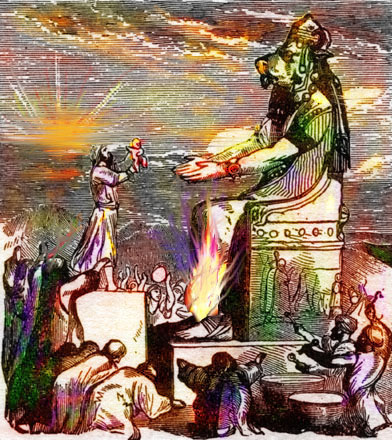
And the LORD spoke to Manasseh and his people, but they would not listen. Therefore the LORD brought upon them the captains of the army of the king of Assyria, who took Manasseh with hooks, bound him with bronze fetters, and carried him off to Babylon.

2 Chronicles 33:10-11

Assyria came knocking on Manasseh’s door. I think there was a certain mercy here, but also discipline. Manasseh had “hooks,” inserted through his jaw and out of his mouth. Like a fish he was led to Babylon, a trophy of the power of the army of Babylon.

It was from a dark dungeon that Manasseh cried out to the Lord and repented.

(2 Chronicles 33:12-13.)

There’s a Jewish fable that when Manasseh cried out to God the angels boarded up the windows in heaven. They wanted to block out his prayer so God wouldn’t be able to hear. But God, rich in mercy, bored a hole in front of His throne to hear Manasseh’s desperate cry.

The Lord’s intention was to forever show His kindness and grace given to the most awful repentant sinner.

I believe that Manasseh was the “Prodigal Son” of the Old Testament.

God is not at a loss when He moves to bring us back to Himself. He can woo or whip. He can draw or drive. He can work rapidly or slowly, as He pleases. In other words, He is free to be God! And in His own way, at His own pace, He brings us back.

     Tom Wells

God is wildly in love with you. Yes, the sin you’ve committed is awful, but the Lord wants you to come back. He may discipline you, but He forgives everything if you’ll turn and repent.

No matter how awful your sin, He forgives and restores. Manasseh is proof of that.

Sources:

2 Chronicles 33:1-20

2 Kings 21:1-18

Enduring Word commentary

alaskabibleteacher.com

Do You Belong in the Fellowship of Pain?

The hands of a leper

“In one of the villages, Jesus met a man with an advanced case of leprosy. When the man saw Jesus, he bowed with his face to the ground, begging to be healed. “Lord,” he said, “if you are willing, you can heal me and make me clean.”

Luke 5:12, NLT

The Bible text reveals a man who is desperate.  His leprosy has advanced; he is covered with it from ‘head-to-toe.’ He’s an outcast now, completely infected by something he never asked for; he is ‘unclean’ and completely without hope. There is no treatment, the doctors can do nothing.

The leper knows that without the touch of Jesus, he’ll never be healed. 

He knows it; he doesn’t need to be convinced by anyone over the complete hopelessness of his condition. He is lost. And yet he has heard that Jesus can do incredible miracles. Could it be that Jesus can heal his sickness? The leper comes and falls on his knees before the Lord, with his face in the dirt. This man is completely broken; he has no hope, except for Jesus. What else can he do?

Our diseases differ, but our lives have been completely changed by our pain. We all have this in common. 

Our pain and darkness vary. Some hurt more, some less. But we’ve all come to the place where we no longer have illusions of somehow being made whole. Whenever we meet, I think there should be a secret handshake or a password. We all share a comradeship— we’re all part of the same community.  We’re a broken club of tired and decidedly unclean misfits.

We belong to the fellowship of pain.

Lying in the dirt, we start to believe the unbelievable.  Our faith doesn’t activate our healing, as much as it simply guides us to Jesus. We can kneel, and perhaps that’s all we need to do. His presence drives away the fear, the doubt, and the pain. He’s come, and somehow we begin to hope for mercy. Only he can carry us through this.

In times past I’ve struggled with deep dark depression. I’ve had to take meds.  But when I come into Jesus’ presence, all my melancholy is driven out. He comes and I start to hope again.  Am I a stellar example of perfect discipleship?  I think not. But isn’t about us becoming “angels,” perhaps it’s more about us learning how to kneel, and to allow Jesus to touch our hearts.

You must do this, repeatedly.

“The power of the Church is not a parade of flawless people, but of a flawless Christ who embraces our flaws.”

“The Church is not made up of whole people, rather of the broken people who find wholeness in a Christ who was broken for us.”   

–Mike Yaconelli

alaskabibleteacher.com

Mixing Authority With His Mercy

On the next day, when they had come down from the mountain, a great crowd met him. 38 And behold, a man from the crowd cried out, “Teacher, I beg you to look at my son, for he is my only child. 39 And behold, a spirit seizes him, and he suddenly cries out. It convulses him so that he foams at the mouth, and shatters him, and will hardly leave him. 40 And I begged your disciples to cast it out, but they could not.” 

41 Jesus answered, “O faithless and twisted generation, how long am I to be with you and bear with you? Bring your son here.” 42 While he was coming, the demon threw him to the ground and convulsed him. But Jesus rebuked the unclean spirit and healed the boy, and gave him back to his father. 

43 And all were astonished at the majesty of God.”

Luke 9:37-43

All of this takes place immediately after Jesus’ transfiguration. He has shown Himself to be God, wrapped tightly into manhood–He’s fully and completely the Word made flesh. He is the Creator, and He is holding the universe together. Who really can fathom this?

Overflowing with immense strength, yet also enveloped in unfathomable kindness.

He meets this desperate man, a man who is carrying incredible weight, a burden that had taken over his life. Jesus steps into a theological circus, after all, the scribes had shown up, and the disciples were disputing with them. The terrible need of the demonized boy had been forgotten.

The disciples had tried to free him, they really had.

Let’s face it, between the gathering crowd and the arguing scribes, they were overwhelmed–completely out of their element. Defeated, they didn’t know what to do. (Isn’t this a description of much of today’s church?)

The father of the demonized boy was desperate. He watched the bizarre scene unfold with tears in his eyes, yet he knew he had no other answers. He despaired but continued to wait. What else could he do?

Sometimes we as the Church stress theological niceties, and look beyond the awful needs around us. We would rather debate than serve. We prefer to assert rather than meet the incredible pain around us. How sad is this? We constantly meet terrible pain, and we choose to reside in some strange theological bubble of our own making.

When Jesus comes down from glory on the mountain, He immediately faces off with a desperate man and a demonized son. This father is terribly overwhelmed–the disciples had made a try (or two or three) and yet couldn’t free the boy. The demons had ignored their efforts and laughed at attempts to free him. These particular demons decided to stay inside this boy. The disciples could do nothing about it.

But when Jesus shows up, all hell breaks loose. Literally.

There is amazing power here. Jesus, already shown to be God on the mountain top, now declares His authority over the ugliness of the darkness. He absolutely demolishes the works of Satan. He steps forward and they must retreat.

Jesus dismantles the evil and decisively frees the boy.

The passage ends with this, “And everyone was amazed by the greatness of God.” We can connect this power to what we observed on the mountain peak–His Words are strong enough to keep the world in its position! He is the All-Powerful One, full of intense mercy who has decided to walk by our side. He fights against darkness and liberates us. He loves us.

“But have we Holy Spirit power – power that restricts the devil’s power, pulls down strongholds and obtains promises? Daring delinquents will be damned if they are not delivered from the devil’s dominion. What has hell to fear other than a God-anointed, prayer-powered church?”

   Leonard Ravenhill

Going to War

13 Therefore take up the whole armor of God, that you may be able to withstand in the evil day and having done all, to stand firm. 14 Stand therefore, having fastened on the belt of truth and having put on the breastplate of righteousness, 15 and, as shoes for your feet, having put on the readiness given by the gospel of peace. 16 In all circumstances take up the shield of faith, with which you can extinguish all the flaming darts of the evil one; 17 and take the helmet of salvation, and the sword of the Spirit, which is the word of God,

Eph. 6:13-17, ESV

You’re called to be armor-plated. Ephesians is quite clear about this, and we DARE not live without spiritual protection, and as a matter of fact, we must wear each piece to survive spiritually. To be ‘naked’ is to invite disaster. Neglecting to dress appropriately brings cataclysmic disaster. We dare not minimize the need for armor.

Each piece listed must be worn. This is a scriptural mandate for every believer in Jesus.

“The whole armor of God” explains the equipment we need to survive spiritually. Here’s a list and a brief comment on the six:

  • The belt of truth–this pulls everything together and holds us and keeps us secure in the truth.
  • The breastplate of righteousness–our spiritual heart is protected by knowing we’re accepted by the Father. Being right with God is not a feeling nor is it a mere hopeful wish.
  • The shoes of the gospel (of peace)–the idea of standing in place (“to stand”) explain our ability to be fixed on grace. When we wear battle shoes we cannot be pushed back or lose our footing. Wearing gospel shoes brings us spiritual stability. We can stand in place, rooted and strong.
  • The shield of faith–is a vital way of protecting ourselves from the evil arrows shot by the enemy. Satan targets us when he thinks that we aren’t using faith to defend ourselves.
  • The helmet of salvation–this is the realization that our mind is protected. This vital piece brings us wholeness as we understand what Jesus has done. We know we are saved and wearing our helmet is our protection from demonic-inspired lies.
  • The sword of the Holy Spirit–the only offensive weapon we have, and it’s all we need. The Word of God will frighten the enemy and push him back. The Word slices and cuts down every obstacle and every lie.

Only those who are spiritual perceive the reality of the spiritual foe and hence engage in battle. Such warfare is not fought with arms of the flesh. Because the conflict is spiritual so must the weapons.

     Watchman Nee

I must stress that clothing yourself is vital. You dare not live spiritually naked wearing nothing. You will be totally vulnerable to the satanic wickedness that is swirling around you. I’m afraid it’s all very real and sobering and there is no escape clause until you finally arrive in heaven.

“We know [positively] that we are of God, and the whole world [around us] is under the power of the evil one.”

1 John 5:19, Amplified Bible

I’m afraid you haven’t been given an option in all of this. Our battle equipment in Ephesians 6 is not just some theological preference or concept. It’s real.

Over 40 years of following Jesus have taught me that most believers struggle because they won’t arm themselves for battle. They refuse to acknowledge the environment they’re in and don’t realize the spiritual battle they are facing. They like the sentiment behind this particular passage, (it stirs their heart) but the reality of the battle never fully sinks in.

They end up leaving their armor behind.

The good news is that we have already won because of what the Lord has done. Wearing the armor strengthens and stabilizes us. He pours out His grace, and there will be times of rest of that I am certain. “He leads me beside still waters.”

As obedient and faithful believers we need to realize we’re secure in Him. Yes, there is a terrible fight, but “The battle is the Lord’s.”

“For you equipped me with strength for the battle; you made those who rise against me sink under me.”

Psalm 18:39, ESV

David and Goliath, Reloaded

Physically there was no comparison. 

Goliath was almost 10 feet tall, a warrior since birth–we read of his armor–he was like a Sherman tank. And David was just a very small, skinny boy–nothing more.

Young David stood and looked at Goliath face-to-face. (If it’s been awhile, you can read of this encounter in 1 Samuel 17.) My guess is that Goliath preened and strutted into the field of battle, and the boy David was stepping up for his very first try at hand-to-hand combat. David is called a “youth” in Hebrew, which means anyone from infancy to adolescence.

And that’s when Goliath begins to blaspheme loudly. Perhaps that’s what giants do best.

He boasts. He mocks.  He believes he is superior, and his arrogance seems to know no bounds.  In his mind the center of the universe is the Philistine army, and he is their champion. He is contemptuous of everything else–physical or spiritual.

Essentially all you need to know is that Goliath is a human wood chipper. 

Everyone who has faced him has been destroyed.  No one has ever survived. But he has never met David before. And Goliath knows nothing of the living God. It amazes me, but David never backs down, his reaction to the ‘human mountain’ of Goliath was to run directly at him. 

“As the Philistine moved closer to attack him, David ran quickly toward the battle line to meet him.  Reaching into his bag and taking out a stone, he slung it and struck the Philistine on the forehead. The stone sank into his forehead, and he fell facedown on the ground”.

1 Sam. 17:48

Many of us face our giants. They come with many names, some are called guilt, pride, doubt, or despair and lust. And they come with many other names as well.

Satan our enemy has marched out on the field of battle, arrogant and supremely confident of his ultimate triumph over us. I suppose that should terrify us. Over the years we’ve been indoctrinated to accept sin’s control, and our inevitable slavery–with a spirit of timidity.

We’ve been rightly told that there are enemies that can destroy us.

As believers we are especially hated in the spiritual world of darkness. Our destruction is inevitable in the mind of the evil one.  Satan still expects to win over your soul, but Jesus stands as our advocate shielding you. I believe you are saved because He really did die for you.

Our own particular favorite demonic ‘monster’ is real and brutal. 

Yet so many believers are intimidated, listening, and then surrendering to the boasting of the giant.  The warfare dimension gets nullified, and soon becomes irrelevant.  Despair reaches us and has the full intention of taking total control. It’s never satisfied with just a little bit.

David ran to the battle–to face the giant who was standing right in front of him. 

He passed through the dark intimidation and influence to approach Goliath.  There was no doubt to cloud his mind.  David took a spiritually aggressive position, he took on the fear, and then ran directly at the giant Goliath.  His spirit was untouchable. This is the boy who wrote Psalm 23.

Some of us stare down our giants repeatedly, over and over.

As believers, we might struggle.  We can turn our hearts over to despair.  Sometimes we actually make ourselves available to the enemy’s workings. When we do this the enemy spreads his influence to others through us. And any confidence we might have through faith is dissolved into doubt and confusion. 

But the victory we have in Christ allows us liberty, through the Blood of Him who defeats our own Goliath of despair. We can run into the battle. We fight our giant, but we’re never defeated.

     Thomas Watson

“But thanks be to God, who gives us the victory through our Lord Jesus Christ.”

1 Corinthians 15:57, ESV

alaskabibleteacher.com