The School of the Prophets

The phrase “the School of the Prophets” has been identified as the ‘naioth’ or “dwellings” in Ramah in 1 Samuel 19:18-24 where the fellowship or “school of the prophets” assembled to worship, pray, and ask God for wisdom. The idea of ‘naioth’ described an idea of community. They seemed to live in a commune of sorts.

An older prophet became the teacher. They would be drilled into the Law. Much of the character of God was talked about, and this would become the core of these new prophets. They learned to seek His anointing, and also humility of heart and mind. The older prophet would emphasize these two things. He was understood as the foundation of any real ministry.

I wish there was more given to us. 

We can only emphasize and extrapolate out of a few verses. Even so, I must believe that the Holy Spirit was profoundly involved in speaking deliberately and honestly to the nations of Judea and Israel. These prophets would be sent out into ministry as needed.

I believe that there were many who spoke the heart of God. And yes, there were the majors: Isaiah, Jeremiah, Ezekiel, and Daniel. The minor prophets would carry a shorter ministry, at least in the written sense, but were not regarded as lesser ministries.

So what does this mean for you?

If your ministry is a specialized one, community becomes key. In this place you will learn about God, in a way that you’ll never ever learn on your own. A prophet is not a prophet unless he learns from a brother. When you fail (and you will) that dear-hearted brother will confront and teach you where you went wrong.

You must recognize the authority of God in the words of a true prophet. You must also understand the treacherous voice of the flesh and the demonic. You must discern, and as a believer that is paramount. You must listen, and hear the Voice of Jesus. “And many false prophets will appear and deceive many people.” Matthew 24:11.

David and Goliath, Reloaded

Physically there was no comparison. 

Goliath was almost 10 feet tall, a warrior since birth–we read of his armor–he was like a Sherman tank. And David was just a very small, skinny boy–nothing more.

Young David stood and looked at Goliath face-to-face. (If it’s been awhile, you can read of this encounter in 1 Samuel 17.) My guess is that Goliath preened and strutted into the field of battle, and the boy David was stepping up for his very first try at hand-to-hand combat. David is called a “youth” in Hebrew, which means anyone from infancy to adolescence.

And that’s when Goliath begins to blaspheme loudly. Perhaps that’s what giants do best.

He boasts. He mocks.  He believes he is superior, and his arrogance seems to know no bounds.  In his mind the center of the universe is the Philistine army, and he is their champion. He is contemptuous of everything else–physical or spiritual.

Essentially all you need to know is that Goliath is a human wood chipper. 

Everyone who has faced him has been destroyed.  No one has ever survived. But he has never met David before. And Goliath knows nothing of the living God. It amazes me, but David never backs down, his reaction to the ‘human mountain’ of Goliath was to run directly at him. 

“As the Philistine moved closer to attack him, David ran quickly toward the battle line to meet him.  Reaching into his bag and taking out a stone, he slung it and struck the Philistine on the forehead. The stone sank into his forehead, and he fell facedown on the ground”.

1 Sam. 17:48

Many of us face our giants. They come with many names, some are called guilt, pride, doubt, or despair and lust. And they come with many other names as well.

Satan our enemy has marched out on the field of battle, arrogant and supremely confident of his ultimate triumph over us. I suppose that should terrify us. Over the years we’ve been indoctrinated to accept sin’s control, and our inevitable slavery–with a spirit of timidity.

We’ve been rightly told that there are enemies that can destroy us.

As believers we are especially hated in the spiritual world of darkness. Our destruction is inevitable in the mind of the evil one.  Satan still expects to win over your soul, but Jesus stands as our advocate shielding you. I believe you are saved because He really did die for you.

Our own particular favorite demonic ‘monster’ is real and brutal. 

Yet so many believers are intimidated, listening, and then surrendering to the boasting of the giant.  The warfare dimension gets nullified, and soon becomes irrelevant.  Despair reaches us and has the full intention of taking total control. It’s never satisfied with just a little bit.

David ran to the battle–to face the giant who was standing right in front of him. 

He passed through the dark intimidation and influence to approach Goliath.  There was no doubt to cloud his mind.  David took a spiritually aggressive position, he took on the fear, and then ran directly at the giant Goliath.  His spirit was untouchable. This is the boy who wrote Psalm 23.

Some of us stare down our giants repeatedly, over and over.

As believers, we might struggle.  We can turn our hearts over to despair.  Sometimes we actually make ourselves available to the enemy’s workings. When we do this the enemy spreads his influence to others through us. And any confidence we might have through faith is dissolved into doubt and confusion. 

But the victory we have in Christ allows us liberty, through the Blood of Him who defeats our own Goliath of despair. We can run into the battle. We fight our giant, but we’re never defeated.

     Thomas Watson

“But thanks be to God, who gives us the victory through our Lord Jesus Christ.”

1 Corinthians 15:57, ESV

alaskabibleteacher.com

The Four Alls of Prayer

Praying at all times in the Spirit, with all prayer and supplication. To that end, keep alert with all perseverance, making supplication for all the saints, 

19 and also for me, that words may be given to me in opening my mouth boldly to proclaim the mystery of the gospel, 20 for which I am an ambassador in chains, that I may declare it boldly, as I ought to speak.”

Eph. 6:18-20, ESV

I am convinced that our most challenging work is learning to pray. Whenever we experience revival, whenever we rediscover our true calling and purpose for living, we do so by prayer. Prayer isn’t the way to get things, it’s how we change.

Prayer is the way we become like Jesus.

Satan’s primary focus is to destroy our prayer lives, he works to eliminate our communion with our Father. He detests that, and he and his demons (and the world system) work overtime to tear down our walk. The enemy concentrates everything on our prayer life.

This passage (v.v. 18-20) emphasizes several truths about prayer. If you take apart these you’ll discover how to shape and direct your ‘time on your knees.’ Notice the following.

  • All times
  • All prayer
  • All perseverance
  • All the saints

If we go further we see that the word “all” in Greek, (although it’s a simple adjective), gets used 1245 times in the Bible. It can mean:

  • all manner of
  • the whole or entirety
  • everything, or the totality of
  • completely

With this in mind we see that Paul stresses the complete effort of prayer and its focus. All the time, every kind, no matter what and for your brother and sisters in Christ need. It’s work, spiritual work. It seems that once we put the armor on (verses 10-17) we can stand in God’s own strength. It’s from that we start to learn prayer.

It’s not enough to wear your armor. There’s something you must do wearing it.

If we’re clothed in armor it’s pretty much for the exclusive purpose of prayer. Yes we must dress for war and protection, true, but its ultimate purpose is prayer and intercession. Don’t just wear it but pray out of it. It’ll be work, but you must do this, even if you sweat. You must strive in prayer, so much is counting on you.

You can make a difference.

The Church is counting on you. “Paul,” (symbolizing all pastors and elders, teachers and leaders), absolutely need your prayers. We need boldness, and we need grace and love, and only God can give it, if you’ll only intercede for us.

It will not be easy. The enemy wants to suppress your prayer life. He absolutely hates it. Satan wants to see you passive and dull and you cannot let him do this. You have a very critical part and place in God’s kingdom. Perhaps others are waiting for you, and perhaps you’re the only one who can step in the gap for them.

You’ve been given a part of God’s field to care for, you have your own sphere of influence. No one else has it, but you.

There many different ways to pray:

  • On your knees
  • walking
  • standing or sitting
  • vocally, or in your focused thoughts
  • with others, a group
  • using a prayer list, (very helpful).
  • “arrow” prayers, (those with 1-2 sentences that end up in His throne room).
  • using the Psalms or reading the many prayers in the Bible

(I know there are many more, but these are what comes to mind right now.)

There’s a “school” of prayer and the Holy Spirit intends to teach you.

Don’t play hooky. You’ll make mistakes or perhaps lose focus. The Spirit will teach you holy stamina. You might pray for one or two minutes at first, but it’ll grow and you’ll learn endurance. Remember though–you’re most like Jesus when you start to intercede for others.

Just maybe your sanctification will come when you start to pray?

-Brother Lawrence

alaskabibleteacher.com

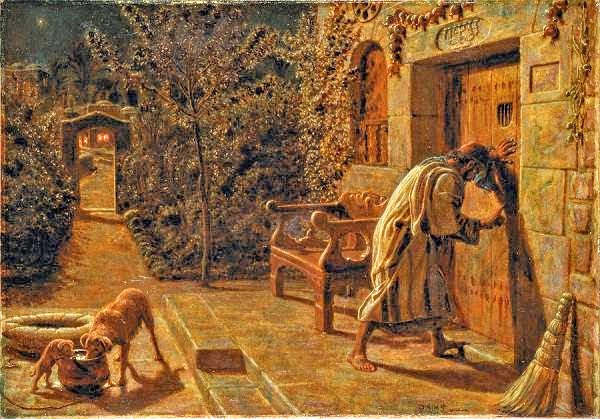
Breaking Down the Door

Luke 11:5-8

This parable is known by some as “the Importunate Neighbor.” That’s an excellent description. Importunate is defined as being persistent, especially to the point of annoyance or intrusion. It’s tenacious and stubborn–not giving up even when being ignored, and that describes what’s happening here.

What immediately proceeds this parable is Luke’s version of the Lord’s prayer, which the disciples requested. They wanted to understand the methods and mechanics of praying–perhaps the Pharisee’s prayers weren’t quite up to snuff–they wanted more; and they insisted that Jesus instruct them.

The disciples wanted to do prayer right.

A typical Jewish home had sleeping quarters (one room!) located on a raised platform. A ladder was used to access that level (which could be crowded, sometimes two to a bed.) Often their livestock were brought inside. And when it was time to get up, everyone got up. That explains the homeowner’s reluctance to give bread to his neighbor. To get up, light a lamp, wasn’t a solitary affair.

He’s obviously unenthusiastic to make that effort.

The word used here to explain the neighbor actions is ἀναίδεια “anaídeia,” which is only used once–it’s translated as impudence, shamelessness, audacity or chutzpah. It’s a Greek word that explains the knocker’s rudeness. He won’t stop. He knocks and pounds until he gets his bread. Not having bread for his guests is unheard of, for it violates all kinds of convention.

The unwritten law of Jewish hospitality demanded action. 

This is part of Jesus’ view on prayer. It means we must be inappropriate sometimes–even to the point were we are being rude.

Immediately following this parable (the very next thought) are the following instructions:

“So I say to you, ask, and it will be given to you. Seek, and you will find. Knock, and the door will be opened to you. 10 For everyone who asks receives, and the one who seeks finds, and to the one who knocks, the door will be opened.”

Luke 11:9-10

Perhaps it’s this intensity that’s lacking.

We “pray” but don’t insist. We desire but don’t demand. Maybe it takes a certain shamelessness to make prayer work. Jesus emphasizes a necessary attitude to praying God’s way. It’s never automatic, but in this parable we see words that move the Father’s heart, and loosen his hand. In Jesus’ teaching, prayer means effort.

It means spiritual work. He wants us to know this. It is important.

“There is neither encouragement nor room in Bible religion for feeble desires, listless efforts, lazy attitudes; all must be strenuous, urgent, ardent. Flamed desires, impassioned, unwearied insistence delight heaven. God would have His children incorrigibly in earnest and persistently bold in their efforts. Our whole being must be in our praying.”

    E.M. Bounds

f