His Love Persists, Psalm 136

Psalm 136

“Give thanks to the Lord, for he is good, for his steadfast love endures forever.”

Psalm 136:1, ESV

Repetition is when a single word or phrase is used multiple times in short succession for effect. It can help emphasize a point. This Psalm certainly does that.

Since this post is pretty much about repetition, I’m going to share some different versions that different translators have interpreted the last phrase of all 26 verses. Keep in mind the last phrase is used is repeating itself word for word in each translation.

Now here are seven different English translations of the end of every verse.

AMP: …for His lovingkindness (graciousness, mercy, compassion) endures forever.

NASB: …for His faithfulness is everlasting.

KJV: …for his mercy endureth for ever.

NCV: …His love continues forever.

CJB: …for his grace continues forever.

MSG: …His love never quits.

NET: …for his loyal love endures.

The word, translated in these different ways, is hesed” in Hebrew. It means a forever love, loyalty, faithfulness or kindness. It is something everlasting or eternal that’s based all on covenant. Yes, every translation is different, but the same.

I suppose this repeated phrase (26 times) may seem a bit redundant. I for one am prone to skip Psalms 136 because of that, I mean it seems boring. Just repeating this over and over I start to wonder if there’s something better to read.

But we dare not make this mistake.

If we respectfully dismantle this phrase we find it deals with seeing God as eternally steadfast. We are called to state out loud His love for us that never wavers or ends. A “steady” forever love that will not change, flicker, or diminish. It just goes on and on and on.

The phrase then moves even deeper than that. “Endures forever,” shapes the whole thought. You might say that these two words extend or amplify the complete verse and strengthen the entire Psalm.

O.K. Here’s another bone to chew on.

First, I need to point out that the first part of each verse states the unique circumstance that declares what exactly has been done. For instance notice the wonder and power of each verse. This is verse 15, for example,

“He overthrew Pharaoh and his host in the Red Sea, (the unique phrase)
    
for his steadfast love endures forever.”
(the repeated phrase)

The first part describes a miracle of deliverance from Egypt. The second is that same repeated phrase we find in all 26 verses. First the unique phrase, and but then comes the repeated one. But let’s add even more flavor. We must teach ourselves to remember. You must consider each event He has led you through to be a testimony to others.

You then must tell your children about your own personal experiences with God.

We forget these miracles unless we consciously recall what God has done. Miracles, healings, provisions, and His amazing grace. Never disremember these things. Bring them to mind, over and over again. You should never forget those “God-things.” They’re uniquely yours. He has done distinctive and tremendous things for you alone.

I guess the main point of this post is to emphasize to you to value those unique miracles that you’ve experienced in your own life.

In life it seems we remember what is important to us. What He has done for you is your own unique testimony. It’s yours, and yours alone. What you’ve experienced is completely your own testimony.

When we enter a forever kind of an endless eternity that each of us will have amazing stories to tell each other about God’s special touch, His miracles and all of the grace and forgiveness that He uniquely loved us with. We all will have our own unique and singular stories. What we share will be our evidence of His love.

That’s pretty amazing when you think about it.

“And they have conquered him by the blood of the Lamb and by the word of their testimony,”

Rev. 12:11, ESV

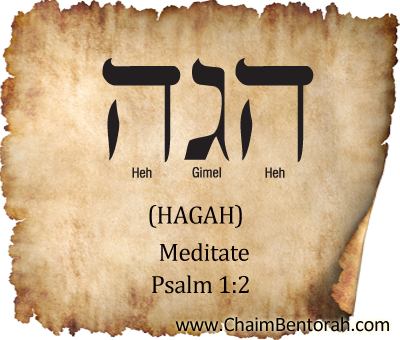
Hagah, To Meditate

Psalm 1:2

Meditation has gotten a bad rap among some Christians, largely due to a connection with Eastern mysticism. This is really unfortunate for it has a critical place in the development of your discipleship. I believe it’s vital (and maybe even mandatory?)

Hagah is the Hebrew word for ‘meditation’ and it fascinates me.

It literally means to “moan, growl, utter, muse, or mutter.” Some have suggested that it contains the idea of ‘rumination,’ like a cow who chews a cud. The grass goes in, and it’s regurgitated several times, extracting every bit of nutrients and vitamins.

Hagah, or to meditate is the way we assimilate God’s Word into our lives. It’s critical that we do this in our walk as disciples that belong to Jesus.

Joshua 1:8, ESV

It’s an interesting command isn’t it? Joshua’s ministry is to lead God’s people and requires his deep connection to God’s promises. He needs to hagah God’s words, to purposefully think about them over and over and over.

It’s interesting to me that when Joshua meditates and carefully responds to the Word then he will receive success in his life and ministry. The word ‘success’ means “wisdom, comprehension, insight with prosperity.” I need that desperately.

And if Joshua needed to do this, might not we?

Start small and simple. There are over 8,000 promises in the Bible–pick one and ruminate on it. Hagah on the Word and try to extract the spiritual nutrients that it contains. You will grow, bless others, and walk in victory, defeating your enemy.

“The amount of time we spend with Jesus – meditating on His Word and His majesty, seeking His face – establishes our fruitfulness in the kingdom.”

    Charles Stanley

Bryan Lowe

alaskabibleteacher.com

God’s Extravagant Love

Anointed by God

He predestined us to be adopted as sons through Jesus Christ for himself, according to the good pleasure of his will, to the praise of his glorious grace that he lavished on us in the Beloved One.

Ephesians 1:5-6

These particular verses establish the believer’s election. That involves being predestined or having a “pre-destiny” to be adopted as sons and daughters.

He predestined us to be adopted as sons. This is meant to be staggering. He’s made a profound move to bring the adopted (us) into a place of the family with this place of the divine. He chose us, and we simply accept this choice.

Sons. Not slaves. We’ve now included in this predestination that has made us His family. His own family!

For himself, according to the good pleasure of his will, What can we say? It’s what He wanted to do. He has willed our adoption. He wanted it, and because of this, we belong. We’re now part of His family tree.

To the praise of his glorious grace that he lavished on us in the Beloved One. “Praise” here is a strong word in the original text. It’s the highest level there is. It’s very intense.

“Glorious grace.” This glory is fully attached to grace and in a way it intensives it. Grace here is something undeserved and yet it’s given to us freely. It belongs exclusively to God, but it’s like a “Christmas present.” It’s now given to each of us to open up what God has given us.

The word “grace” is charis in Greek and it can be translated as a benefit, bounty, “that which affords joy, pleasure, delight, sweetness, charm, loveliness.” It’s a word with a lot of dimensions to it.

Lavished on us in the Beloved One. It’s extravagant and excessive and it’s poured out on one’s spirit without measure. When one first believes in Jesus, (the beloved one) it completely saturates us. This poured-out grace isn’t earned or deserved, rather He has made His decision to heap on us a powerful love.

B

The Five Crowns

In the New Testament crowns are given to certain believers. They’re more than a reward, they’re recognition of a Christian’s life and character. Keep in mind that each one given is pure grace. They are not rewards that we earn, but recognition of God’s blessing. We can do nothing unless He gives us His grace. You must understand this.

We find that there are five. But understand, these are not given as recompense or compensation. A crown is never earned, and it’s never given as an achievement for exceptional behavior. All are received by His grace and kindness. (And, we’re not in any competition on who can receive the most.)

Here’s a list which I hope is complete.

  • the Victor’s Crown
  • the Crown of Rejoicing
  • the Crown of Righteousness
  • the Crown of Life
  • the Crown of Glory 

The Victor’s Crown, which is also called the Martyr’s Crown. We can read it in James 1:12 and also in Revelation 2:10. The Church of Smyrna is promised by Jesus, Do not fear what you are about to suffer…the devil is about to throw some of you into prison…Be faithful unto death, and I will give you the crown of life.”

The Crown of Rejoicing, is described in 1 Thessalonians 2:19 and in Philippians 4:1. This crown is given to those dedicated to evangelism or the mission field. Paul receives this crown for his work with the Thessalonians. “Therefore, my brothers, whom I love and long for, my joy and crown, stand firm thus in the Lord, my beloved.”

The Crown of Righteousness, this is given to believers who steadfastly look for Jesus’ Second Coming. It seems it’s also given to those who seek after an intimacy with Jesus. We can read of this in 2 Timothy 4:8. “There is laid up for me the crown of righteousness, which the Lord, the righteous judge, will award to me on that day, and not only to me but also to all who have loved his appearing.”

The Crown of Life, this is given to those who have laid aside all the things this world offers and are committed to a life that is eternal. “Everyone who competes in the games goes into strict training. “They do it to get a crown that will not last, but we do it to get a crown that will last forever.” (1 Cor. 9:25.)

The Crown of Glory, given to the pastoral servants who have prayed and served the Church, “And when the chief Shepherd appears, you will receive the unfading crown of glory.” According to 1 Peter 5:2-4 this crown is given to those who have served the flock faithfully as His shepherds and teachers.

These five crowns are freely given, by grace, to each who deserves them. In each and every case it’s Jesus who coronates each believer. We’ll watch and we’ll agree with His decision. We will not vote to see who is worthy but we will understand His gracious wisdom of that person’s trials and challenges.

None of these crowns will not be worn very long. There will not be any reason to show them off to other believers, “Look at me, I’m wearing two, how many crowns are you wearing?” No. Rather, in love, we return each crown to Him who gave it to us.

A crown is temporary and is given back to Him who loved us so much. 

“The twenty-four elders fall down before him who is seated on the throne and worship him who lives forever and ever. They cast their crowns before the throne, saying,

“Worthy are you, our Lord and God,
    to receive glory and honor and power,
for you created all things,
    and by your will they existed and were created.”

Revelation 4:10-12

Willian Tiptaft

Singing From the Pit

“I waited patiently for the Lord to help me,
    and he turned to me and heard my cry.
He lifted me out of the pit of despair,
    out of the mud and the mire.
He set my feet on solid ground
    and steadied me as I walked along.”

3″He has given me a new song to sing,
    a hymn of praise to our God.
Many will see what he has done and be amazed.
    They will put their trust in the Lord.”

Psalms 40:1-3, NLT

Psalm 40 is jam packed with great and wonderful truth. It contains freedom for the Christian– a way out for the broken believer. We do well when we use it, and that’s what it’s there for. The deep pit has been used over many centuries as the way God teaches us to sing certain songs. But that doesn’t make it easier, does it?

Verse 1

“I waited patiently for the Lord to help me, and he turned to me and heard my cry.”

Waiting is a critical word, it should not be regarded as trivial. In our daily walk we must be patiently seeking the Lord, that comes first. Admitting you need help is the first step. And guess what? You need help. 😁

The word ‘wait’ is special, it’s kawvah in Hebrew. It can mean ‘to bind together by twisting.‘ It can be used with the idea of braiding strands of rope together. It is never a passive act that just happens. Waiting on God is to be done with intentional purpose.

Remember that the Lord is not some distant deity on a hill far away.

He’s not hiding from you. It’s really quite the opposite. He is closer to you than you think. He is responsive and aware. He hears your cries and wants to act; He is not deaf, but our patience is critical. Waiting on Him is crucial to being free. We must bind and twist our hearts and live our life to His desires.

Verse 2

He lifted me out of the pit of despair, out of the mud and the mire. He set my feet on solid ground and steadied me as I walked along.

The seeable terrain can be awful, with muddy paths and mucky pits. Things that pull you down and suck you in. They’ll trap the traveler. But the Holy Spirit is quite able to lift us out. He picks us up and secures us. He uses the rope of God’s Word.

He is way more willing to save us, than we are to being saved.

Solid ground is where we are meant to be. It’s become a place of firm standing and secure footing. He makes us steady and He keeps us safe. The Holy Spirit now has intimate care over your soul.

Verse 3-4

“He has given me a new song to sing, a hymn of praise to our God. Many will see what he has done and be amazed. They will put their trust in the Lord.

Some of the greatest songs are the ones that come from those just delivered from the pit. These are ‘pit songs,’ offered to God from sincere and true hearts that have once been trapped. There’s something solid heard from the hearts of those redeemed from disaster.

These songs no longer sound religious or contrived.

“YOU CAN SEE GOD FROM ANYWHERE IF YOUR MIND IS SET TO LOVE AND OBEY HIM.”

AW Tozer

From our deepest pits come our greatest praises.

There is a passionate quality that saturates these ‘pit praises’ that is highly treasured by God, and esteemed and valued by the Church– a sense of authenticity starts to be finally heard. We can finally start to see that our pits become ‘launching pads’ of true songs of deliverance.

How to Die Well

“Even though I walk through the valley of the shadow of death, I will fear no evil, for you are with me; your rod and your staff, they comfort me.”

Psalm 23:4, ESV

“Precious in the sight of the Lord is the death of his saints.”

Psalm 116:15

“Death is like my car. It takes me where I want to go.” 

Pastor John Piper

Our generation simply doesn’t know how to die well.  There are many conflicting messages and attitudes which have steered us away from the reality of dying.  Much of it is the natural development of unbelief.  Our pop culture develops this and gives it momentum.  We are trying to convince ourselves that “death is impossible, my life will not end.”  But we’re escaping into a delusion. And it only intensifies as we age. 

We are running from what is real.

There is a Latin phrase,  Ars moriendi  (“The Art of Dying”) which the Church practiced in past generations.  In the past, Christians would be buried as close as possible to a Church building.  Many would be interred within the very walls of the Church.  The understanding was that the dead were part of the congregation.  That there was only a thin veil that stood between the living and the dead.  

The dead didn’t just vanish. They still live. We just don’t see them.

Our generation is confused.  We have forced death to wear a mask.  We insist on a significant camouflage to hide the reality of sickness and death.  No one really ever talks about it, and so no instructions are given on how to die well. So we don’t, and we die poorly–often in ICUs. We die sedated, separated and unable to process dying. We never help our families process it. 

For many, the fear of dying is intense and paralyzing.  

It’s time for the Church to step up and guide us to our next step.  Our pastors and elders have got to prepare us to die well.  It is a part of being a disciple.  It is discipleship, and dying is inclusive.  We need somebody to prepare us for the inevitable and the certainty that is approaching us.  I need someone that will help me face my own death.

You know what?  No one escapes.  

And the reality of that drives some of us mad, or addicted, or psychotic.  The idea of filling a casket up for forever is incomprehensible.  We cannot live with this sick idea of dying.  It disturbs us on the deepest level possible.  It is completely evil.

Psalm 23 has been pure comfort and healing for generations.  And it is an excellent starting point for us.  Verse 4 develops the idea of traversing death.  The writer has incredible insight of passing through death.  This verse alone is worth billions of dollars in gold.

Psalm 23 has been pure comfort and healing for generations.  And it is an excellent starting point for us.  Verse 4 develops the idea of traversing death.  The writer has incredible insight of passing through death. Psalm 23 has made me a very wealthy man.  His Word has become my rich treasure.

“Some day you will read in the papers that D.L. Moody of East Northfield, is dead. Don’t you believe a word of it! At that moment I shall be more alive than I am now; I shall have gone up higher, that is all, out of this old clay tenement into a house that is immortal- a body that death cannot touch, that sin cannot taint; a body fashioned like unto His glorious body.”

    D.L. Moody

Suffering Well

“Dear brothers and sisters, when troubles of any kind come your way, consider it an opportunity for great joy.”

“For you know that when your faith is tested, your endurance has a chance to grow. So let it grow, for when your endurance is fully developed, you will be perfect and complete, needing nothing.”

James 1:2-4, NLT

There are many different points where our Lord connects to us through our desperation. Our sorrow and confusion can be how God ‘wires us’ for additional contact— in some kind of weird and cosmic way, my pain becomes His ‘copper wire.’ Often is how He touches my heart as He flows through it.

I think it’s helpful to see our issues in this way. 

There is a current that must work through us, making contact and ultimately creating a circuit. What I mean by this is that it seems we have to experience pain, in order to know His presence.  Only if you know that a brother has struggled, do you become aware that a pearl of tremendous wisdom (and love) is now accompanying him. Usually.

We must be aware that our distress allows us access to His ‘careful’ grace. Our trials, properly received, endow us with special and supplemental power.

When it gets dark, light becomes exceptional.  In a book by Stephen Lawhead, (I think it was “the Silver Hand.”) we see a man, the hero take up stones that have been infused with the creative power of the universe.  Standing on the walls of a besieged stronghold, the desperate hero throws the stones down on the attackers.  And as each stone smashes into the ground it releases a part of a song, which destroys the enemy and defeats those strong in the darkness. (Silly story.)

I know that His Spirit infuses Himself into our hearts. 

He has imparted something in us that is both precious and powerful.  He works through the pain and struggles that we encounter.  These are terribly ugly, no question.  But it is through these we plug into something real and eternal.

I suppose when the tragedy finally brings real life it’s a most precious thing. We treasure all this for it comes at such an exorbitant price.

Pain indeed has a purpose, but oh, so many times it seems to only hurt. But that’s the way it works.

But yet, that is our calling. I certainly know that life is seldom easy and our choices are even harder. I recently read that Queen Victoria, as just a teen fiercely opposed her future coronation as the sovereign of England. She grew sullen, and rebellious and would continually frustrate her teachers.

Once when Victoria was shown a lineage that showed her and revealed her place in England’s future as queen.  She became uncharacteristically quiet and she responded with an astonishing simple awareness, “I will be good.” From that moment everything changed for her.

flourish12 (1)

We want to avoid suffering, death, sin, ashes. But we live in a world crushed and broken and torn, a world God Himself visited to redeem. We receive his poured-out life, and being allowed the high privilege of suffering with Him, may then pour ourselves out for others.

Elizabeth Elliot

bry-signat (1)

Tzel, Shade

“The Lord is your keeper; the Lord is your shade on your right hand.”

Psalm 121:5, ESV

I once worked for my father-in-law who had to meet a deadline. We shoveled rock into 50# bags. It was unbelievably hot–104 F and we had no shade. The sky was clear and the sun was brutal. I recall praying for a cloud, even a little one, anything.

The Jews had a word, tzel. It’s translated “shade” in our English Bible. That word also meant shelter, covering and coolness. In the land of Israel it could get really hot, up to 120 F in the summer. Tzel was much appreciated.

There’s a promise that clearly speaks of this. The Lord guarantees us shade. I suppose figuratively we’ll go through times when life becomes unbearable, and yet the Father understands. He gives us tzel, relief from harsh and cruel conditions we encounter. Without the shade it gets miserable.

Tzel is when the Lord covers you.

We’re protected and given a real place of coolness and relief. This is a good promise for the born-again believer. You can easily appropriate and claim it–God gives it away to those who love Him. Come now and sit in the shade.

The Lord is your shade.

“The safest place in all the world is in the will of God, and the safest protection in all the world is the name of God.”

    Warren Wiersbe

alaskabibleteacher.com

A Rose in the Snow

Merry Christmas, dear ones! 

I’m looking at Christmas 1000 years from today, when He will bring us all together.  I think that we’ll all kick back, and we will try to remember Christmas, 2023.  We will most likely say, “But that was so long ago, it feels like a dream, I’m not so sure now…”

Like me, I trust your deepest hopes are pinned on an incredible grace. 

Under the tree there are gifts.  But we have been given a gift– of gifts.  It is something that ‘rocks our world’.  It’s called ‘eternal life’.  It has been given to us freely, and without any stipulations.  We’ve been ‘cut-loose’ from the tangled mass of sin.  We are now very much free.

I know I need to learn to live like a free man.

My physical and mental illnesses often trips me up. I’m saddened by my weaknesses.  But I reach out and touch this grace, I pull it in and take and make it my own.  Jesus has freed me, and I want to walk in truth, with Him—and with you.

I’m grateful for my doctors, they’re definitely a blessing. I must keep looking to my rose–my Jesus who is my Savior. I covet your prayers especially now.

Our Lord Jesus is truly a “rose in the snow.” He has come to this mean and hostile world, but He is precious and beautiful in the eyes of the faithful. I pray that you find Him flourishing in your heart.

Love to you from alaskabibleteacher!

Built On the Rock

“Everyone then who hears these words of mine and does them will be like a wise man who built his house on the rock. 25 And the rain fell, and the floods came, and the winds blew and beat on that house, but it did not fall, because it had been founded on the rock.” 

“And everyone who hears these words of mine and does not do them will be like a foolish man who built his house on the sand.”

Matthew 7:24-26, ESV

Embedded in Jesus’ Sermon on the Mount are these words: they absolutely penetrate any “religious” sensitivity we think we have. This parable Jesus taught carries the full weight of divine authority.

Up to now, Jesus’ listeners just might reduce his words to nice religious platitudes–something future, and maybe conceptual. I must warn you, this isn’t the case.

Obedience is the critical idea here.

If they’re wise, they are told to put all they’ve heard into practice. It’s really not enough to hear and respect what Jesus declares–they must do the words. Jesus isn’t simply a great moral teacher, all that he says is authoritative; and not just in a benevolent, superficial way–what he says are the very words of God to people, like you and I.

Pay attention: There are two builders in this parable. Two different men; the wise and the very foolish.

The each have their own strategies, their methods are quite different. Both listen; but one responds with careful planning. He understands the potential dangers–rain, floods and wind things that are going to happen. It’s funny, our Lord never “sugarcoats” life. Nasty things are going to get challenging.

Following Jesus never gives us any immunity; there are no special favors given to a believer. (Only comfort. Forgiveness. Eternal life.)

The other man is foolish. He decided to take a shortcut in all of this construction stuff. Maybe it takes too much time? But he decides to implement the work as soon as he can. Maybe his motive is just wanting to put Jesus’ words into practice? Maybe he’s got a noble reason for this?

Obedience is mentioned twice. Enthusiasm is never mentioned; and eagerness is not good spirituality it seems. Careful work (and planning) are critical issues.

I want to stress that you take your time laying down his words. Examine carefully what he’s telling you about your construction. He’s your true Architect–you’re only the only obedient builder. We read his plans and examine his blueprints. We really need to be faithful.

“Using the gift God gave me, I laid the foundation of that house like an expert builder. Others are building on that foundation, but all people should be careful how they build on it.”

1 Corinthians 3:10

Be diligent in these matters; give yourself wholly to them, so that everyone may see your progress.”

1 Timothy 4:15