Your Plow is Waiting

“No one who puts his hand to the plow and looks back is fit for the kingdom of God.”

Luke 9:62 (context, vv. 57-62)

Every disciple has his plow. Sometimes it’ll be obvious, everyone sees it; other times it’ll be buried deep inside, and no one knows. A plow is a perfect word to describe exactly what the Holy Spirit is doing–and its descriptive of the determination of a disciple who is slowly learning how to follow.

When you’re trying to grow-up you’ll grasp this foundational lesson. You have to be single-minded and really focused to stay moving ahead. You cannot look behind at what has been done. You can’t turn around to admire your work, rather we look at the tree that is keeping us lined up with Jesus.

You will sweat and get tired. Your full effort is needed to keep the plow in the hard earth. You aren’t pushing, the oxen is pulling, but you’re the one who weighs it down while keeping your furrow relatively straight. It’s harder than it looks. (Thank God for the modern tractor.)

In case the plowman starts to look back, his plow line would become crooked. If that happens, the field he is plowing will not yield a full harvest. A good plowman has learned he must hold on. In following Jesus, we are to keep our eyes on Him, and never let our minds and hearts wander away. (Hebrews 12:1-2.)

“To keep our hand on the plow while wiping away the tears–THAT is Christianity.”

-Watchman Nee

To follow means looking and moving forward. We must understand this–it’s the very essence of walking a path. We’re walking out the journey. Sometimes we feel Jesus’ joy as His follower, but occasionally we won’t. We’re learning to understand it more and more. But no matter what, we keep putting heel-to-toe. We are followers after all.

Jesus lived this; He steadfastly set His face to go to Jerusalem (Luke 9:51).

“To learn strong faith is to endure great trials. I have learned my faith by standing firm amid severe testings.”

-George Mueller

Repairing Your Nets

“Yet those who wait for the Lord
Will gain new strength;
They will mount up with wings like eagles,
They will run and not get tired,
They will walk and not become weary.”

Isaiah 40:31, NASB

The word “wait” used here is powerful. It’s an awesome word, never used casually in the Hebrew scriptures. It does not mean to be uncaring or idle. Sometimes we wait in line at the grocery store, or maybe we’re waiting for a phone call. We wait all the time, and often, we don’t even realize it.

The Hebrew word for ‘wait’ is special. It’s qāvâ. It means, ‘to bind together by twisting.’ It’s an active word.

It sometimes means to work like a fisherman repairing his nets to get them ready for tomorrow’s catch.

(There are always holes to mend after a long night’s efforts.)

When we wait spiritually, repairing our nets, the following should be used. Much of this can be done in prayer.

  • Calming ourselves, setting aside everything that doesn’t fit
  • Reading His word
  • Seeing His face
  • Hearing His voice
  • Keeping pace with Him, whether He moves (or doesn’t)

Fixing our nets is a cool way to describe our journey, right? Sometimes, when we think about waiting, we usually only think about it in English, and that can be annoying. It often stops us from truly understanding the true meaning of ‘wait’.

I strongly believe that the Holy Spirit wants us to understand the concept of being closely connected to Him. Sadly, we are often held back by our own definitions, rather than embracing the definitions found in God’s Word.

“The LORD is good to those who WAIT for him,
to the soul who seeks him.”

Psalm 27:14

Sometimes we are instructed by someone to “wait on the Lord.” This instruction can be challenging and we are unsure exactly how we should do it. It’s usual for us to simply show agreement through a smile and a nod. We never completely grasp the essence of that word.

He becomes my source of power that comes from waiting.

He is now the sturdy bond that I am intertwined with. (Maybe this is how He gives strength and power to His people?) We must listen to this, and the Lord is very enthusiastic about guiding us into this fresh form of closeness.

The promise in Isaiah 40:31 talks about receiving new strength, like an eagle’s wings, a holy energy. This verse is important for us, especially today; we need this kind of strength right now. We need to repair our nets as often as we can.

“Waiting for God is not laziness. Waiting for God is not going to sleep. Waiting for God is not the abandonment of effort. Waiting for God means, first, activity under command; second, readiness for any new command that may come; third, the ability to do nothing until the command is given.”

    G. Campbell Morgan

alaskabibleteacher.com

Under the Knife

John 15:2, ESV

 “Dead wood is worse than fruitlessness, for dead wood can harbor disease and decay…God removes the dead wood from his church and disciplines the life of the believer so that it is directed into fruitful activity.”

Merrill C. Tenney

It takes a sharp eye and a sharper knife to do the Father’s work of cutting.  He slices to the quick, and all that is not useful falls to the ground.  The vine must produce grapes, and every bit of “grape-energy” needs to be used productively. Fruitlessness will be cursed, sterility is condemned. This is a hard choice to make.

I want to encourage you though–fruitless believers can possibly become fruitful ones. 

Understand, the vine dresser isn’t attacking the vine with his knife.  He is not malicious or vengeful.  All that He does is for the good of the vine.  He is motivated to produce fruit.  That is what He thinks about as he cuts away the dead branches.

Pruning and fruit are concepts that we vacillate over, some days we understand and other days we don’t.  After over 40 years, I’ve heard every “John 15 sermon” known to man.  And most of the time I turn down my spiritual hearing aid. That is tragic–I listen, but I don’t listen.

I need to grapple with this imagery.  If I don’t, bad things are bound to happen.

For years I have asked God to “show me His ways.” I’d like to believe that this understanding of pruning has changed me.  I would like to think that I have attained a clearer view of wisdom.  This pruning business is all well and good.  But being sanctified by the knife is decidedly unattractive and uncomfortable.

I grew up in the northwoods of Wisconsin and wondered if the trees that were designated with a ‘red X’ understood that they were the ones to be cut down by the lumbermen. I wondered if these trees that were marked with spray paint understood what was up? (Maybe they felt special with their new found prestige?)

You will be pruned!

I completely and absolutely declare this to you. (It’s one of those “thus says the Lord” moments.) Pieces of your life are earmarked to be lopped off. You will probably not understand why and you will chafe at what is coming.

The Christian life is as much about subtraction as it’s about addition.

He will cut you and you’ll think you’re dying. But I assure you, Jesus loves you, and all that He does is for your good. He trims you to bring you true life.

There is simply no other way He can work.

“And if it be painful to bleed, it is worse to wither. Better be pruned to grow than cut up to burn.”

John Trapp

Are You Resting? נוח Nuach

Life can get out of hand sometimes, becoming hectic and frantic. It seems like we’ve got 1000 ‘irons in the fire.’ The anxiety of doing everything creates fear and worry. We cannot possibly keep up. There isn’t enough hours in the day.

We are not at rest with ourselves, or with the Lord.

And oh my, the news, the internet, and our cell phones create awful issues if we can’t manage them with the Holy Spirit’s direction and purposes. Our computers seem like a pipeline for darkness. Unless they’re “given” to God, they can destroy you.

What causes me anxiety? I’m quite sure you can add your own issues. But here’s a partial list:

  • ambition, self-promotion, pride, jockeying for position
  • family issues, marriage and children
  • my job and career, “keeping up with the Joneses”
  • religious ‘duties’
  • finances, bills
  • politics, media
  • unrepented sin, separation from God, peace is missing

But I assure you, there is rest.

The Old Testament uses a word, נוח or ‘nuach.’ It’s a Hebrew word. Both Moses and Jesus understood the implications. It means calming, to become quiet or still. To rest quietly.

This promise is given to Moses; frankly, he’s overwhelmed by his burden. In the “tent of the meeting” he battles with God, and it’s in that place Moses insists on the Lord’s active presence on him and on the people. He will not take another step unless God does this.

The Lord Jesus calls each of us to rest in Him. It seems we work hard and we carry awful heavy burdens. Jesus uses the word, “Come” which is typically a command or an imperative. (It can be used with an explanation mark!)

Jesus understands our hearts and our effort and “labor.” He fully grasps that we’re “heavy laden” much of the time. His invitation is to come and find the peace of a resting disciple. It is His gift to us, and only Jesus can give it to us.

 “‘Come’; he drives none away; he calls them to himself. His favorite word is ‘Come.’ Not, go to Moses – ‘Come unto me.’ To Jesus himself we must come, by a personal trust. Not to doctrine, ordinance, nor ministry are we to come first; but to the personal Saviour.”

CH Spurgeon

Breaking Down the Door

Luke 11:5-8

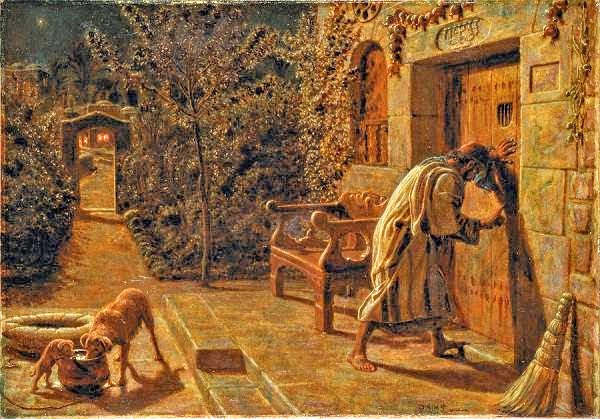
This parable is known by some as “the Importunate Neighbor.” That’s an excellent description. Importunate is defined as being persistent, especially to the point of annoyance or intrusion. It’s tenacious and stubborn–not giving up even when being ignored, and that describes what’s happening here.

What immediately proceeds this parable is Luke’s version of the Lord’s prayer, which the disciples requested. They wanted to understand the methods and mechanics of praying–perhaps the Pharisee’s prayers weren’t quite up to snuff–they wanted more; and they insisted that Jesus instruct them.

The disciples wanted to do prayer right.

A typical Jewish home had sleeping quarters (one room!) located on a raised platform. A ladder was used to access that level (which could be crowded, sometimes two to a bed.) Often their livestock were brought inside. And when it was time to get up, everyone got up. That explains the homeowner’s reluctance to give bread to his neighbor. To get up, light a lamp, wasn’t a solitary affair.

He’s obviously unenthusiastic to make that effort.

The word used here to explain the neighbor actions is ἀναίδεια “anaídeia,” which is only used once–it’s translated as impudence, shamelessness, audacity or chutzpah. It’s a Greek word that explains the knocker’s rudeness. He won’t stop. He knocks and pounds until he gets his bread. Not having bread for his guests is unheard of, for it violates all kinds of convention.

The unwritten law of Jewish hospitality demanded action. 

This is part of Jesus’ view on prayer. It means we must be inappropriate sometimes–even to the point were we are being rude.

Immediately following this parable (the very next thought) are the following instructions:

“So I say to you, ask, and it will be given to you. Seek, and you will find. Knock, and the door will be opened to you. 10 For everyone who asks receives, and the one who seeks finds, and to the one who knocks, the door will be opened.”

Luke 11:9-10

Perhaps it’s this intensity that’s lacking.

We “pray” but don’t insist. We desire but don’t demand. Maybe it takes a certain shamelessness to make prayer work. Jesus emphasizes a necessary attitude to praying God’s way. It’s never automatic, but in this parable we see words that move the Father’s heart, and loosen his hand. In Jesus’ teaching, prayer means effort.

It means spiritual work. He wants us to know this. It is important.

“There is neither encouragement nor room in Bible religion for feeble desires, listless efforts, lazy attitudes; all must be strenuous, urgent, ardent. Flamed desires, impassioned, unwearied insistence delight heaven. God would have His children incorrigibly in earnest and persistently bold in their efforts. Our whole being must be in our praying.”

    E.M. Bounds

f

Maximum Servanthood

“He came to Simon Peter, who said to him, “Lord, do you wash my feet?” Jesus answered him, “What I am doing you do not understand now, but afterward you will understand.” Peter said to him, “You shall never wash my feet.” Jesus answered him, “If I do not wash you, you have no share with me.”

John 13:6-8 (context vv. 3-17)

Chapter 13 always rocks my world. I visualize this, like a fly on-the-wall, watching it happen–and then I replay it over, and over in my mind. It always unravels me. Why does this have to happen? What does this passage tell me about Jesus, and his kingdom? (John 13).

Why can’t I just walk away from it, and leave it be?

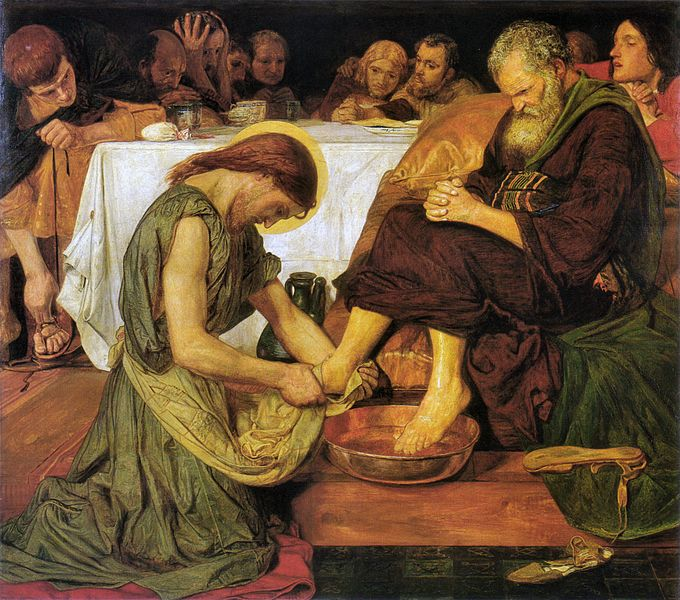
Jesus made himself a slave, (or perhaps he was always a slave all along, and we just didn’t realize it?) Foot-washers were pretty much regarded as sub-human, mindless drones who mechanically performed a necessary duty. The lowest of the low, the very least of the least.

But Jesus took that role on himself, he laid aside his garments, and his Godhood. (They landed in a pile in the corner of the room). When he knelt down to scrub feet (making sure he got between the toes), it was deity serving man. This God/rabbi intentionally did this, not reluctantly or halfheartedly–but carefully.

He was their teacher.

Custom demanded he enjoy the prerogatives of that position. But he wouldn’t, and didn’t. He mustn’t. As I stress over this, I must conclude he really was their “teacher,” but not in the way I expect. What he was doing on his knees, was instructing them in the art of loving each other. He showed us a leader in action.

Real disciples function best when they wash between the toes.

There was a point in Jewish history when the people actually demanded that God would give them a king, instead of a judge (1 Samuel 8:5-9). God warned them that this wasn’t in his plans–but they insisted. They had to have one, everyone else did. We still must have celebrities, and then we wonder why they short circuit on us. Who can resist the privilege, and the limelight?

Peter of course was classic Peter.

It seems that whenever he resists, he gets rebuked. He makes it quite clear that Jesus will never wash feet–that Jesus will never use a basin or towel and serve him like this. It was outrageous. It didn’t fit in Peter’s personal theology. He had no room for Jesus the slave. Perhaps Peter knew that to follow meant he would have to do the same thing?

Jesus still washes feet.

He sits us down and takes off our shoes and socks, and scrubs us clean. And we hate it. But to be washed by him is a condition of our discipleship. Every follower must be clean, and he continues his work to this day. We sin daily, even as his own, and he cleans us up–and yet somehow that really bothers us.

“Does God ask us to do what is beneath us? This question will never trouble us again if we consider the Lord of heaven taking a towel and washing feet.

 Elisabeth Elliot

alaskabibleteacher.com

Our Work is Our Worship, “Avad”

It’s interesting–the Hebrew word for worship is also used for work. I think that is pretty significant. Seeing and understanding this is a life-altering experience. It completely changes the way we look at discipleship. Worship and work/serve go together, and God sees them as one and the same.

To work [avad] as a “farmer”and serve as a worshiper [avad] overlap.

  • “The LORD God took the man and put him in the garden of Eden to work it [avad] and keep it.”
  • Serve [Avad] the Lord with gladness! Come into his presence with singing!”

Genesis 2:15 and Psalm 100:2

Notice that both work and worship use the same Hebrew word.

  • “Six days you shall labor, and do all your work, [avad].”
  • “When peoples gather together, and kingdoms, to worship [avad] the Lord.”

And wow! There are dozens of verses that link our work with our worship. The implications are profound–we’re to see our Sunday worship and our jobs as one and the same. Typically we don’t see it that way. Our Monday through Friday are in a separate category than what we do on Sunday.

Our work and our worship overlap. God intends it that way, and we grow in obedience if we also accept the fact that they’re not separate. Our occupation, whether we’re flipping burgers or being a brain surgeon, is to be an act of worship.

One small Hebrew word can mean so much.

Our whole paradigm shifts when we understand that our worship is far more than 20 minutes on a Sunday morning. It’s to extend to all we do throughout our week. Our Monday job is just as significant to God as our shared time with our brothers on Sunday.

This understanding gets used in the New Testament as we see our work and worship are connected.

“Whatever you do, work heartily, as for the Lord and not for men, 24 knowing that from the Lord you will receive the inheritance as your reward. You are serving the Lord Christ.”

Colossians 3: 23-24

“Not by the way of eye-service, as people-pleasers, but as bondservants of Christ, doing the will of God from the heart, rendering service with a good will as to the Lord and not to man.”

Ephesian 6:6-7

Lois Tverberg, En-Gedi Resources

alaskabibleteacher.com

The Four Ways We Grow

Then he told them many things in parables, saying, “Consider the sower who went out to sow. As he sowed, some seed fell along the path, and the birds came and devoured them. Other seed fell on rocky ground where it didn’t have much soil, and it grew up quickly since the soil wasn’t deep. But when the sun came up, it was scorched, and since it had no root, it withered away.  Other seed fell among thorns, and the thorns came up and choked it. 

Still other seed fell on good ground and produced fruit: some a hundred, some sixty, and some thirty times what was sown. Let anyone who has ears listen.”

Luke 8:5-9

Jesus loved to tell stories. Each of them was packed with truth, and the people loved them. In verse 2, we see the popularity of Jesus–the people were entranced by our Lord. They followed him throughout his earthly ministry. Just imagine a preacher doing this today.

If you were his disciple back then, you had better get used to crowds.

This is all about receptivity to the Kingdom of God. It’s all about seed that is sown indiscriminately–the work of the sower isn’t assessing the ground conditions. He just throws out the insignificant seed. That’s his job, and he seems to do a bang-up job of it. He “broadcasts” the seed, reaching in his bag and spreading it evenly, and quickly.

This parable, believed to be one of his first, begins with the word, “Consider,” and really, isn’t that the needed quality one must have? In the original language it simply means, “to see.” But it’s also in the imperative–a command. Seeing isn’t really an option–may be a good word today would be, “Look!” (And using an exclamation mark!)

In some places the ground had been packed down, things were too hard. Others landed on soil, but it was only the slightest skim of dirt, which wasn’t enough to support any growth. And yet the third scattering made it into the thorns. So there was three different possibilities, which none were ideal.

But wait! There was a fourth.

Seed that landed right where it should–good soil, fertile, tilled, and ready. The first three were all wrong, but the parable isn’t given to find fault–no one was to blame. And certainly not the sower, he was merely doing what was necessary.

The parable is clearly meant to explain how the Kingdom enters our hearts.

Our lives are the soil, and we all react to the seed differently. Sometimes, there’s no response at all, and “birds” get their breakfast. Sometimes, it’s all rocky, and nothing can grow there. Some tried to grow, but thorns and thistles essentially got in the way.

There are always four responses to the words of Jesus.

There was a lot of people sitting on the beach, and all were listening. But Jesus knew deep down that his words would only touch 1 out of 4, and yet he kept sowing. He hoped for good soil, but that wasn’t a given.

In verses 9-15, Jesus had to explain this story to his disciples, who always did seem out-of-touch with these sorts of things. But I’m glad he did–Jesus, by interpreting this parable, gave us the keys that would unlock every one of his others. The seed represents God’s words. The soil is the condition of our hearts. My own heart listens and when the Word comes my heart responds in different ways. At any given time, the soil can be hard as a rock, or thorny

Jesus was never mystical or otherworldly, he didn’t cloak his words in imponderable mysteries like every other teacher longs to do. (Ego, mainly.) He didn’t want things to be an enigma, rather he wanted people to understand the ways and nature of God’s kingdom.

He wanted even the little children to get it–there were to be no secrets, only receptive hearts.

     Augustine

alaskabibleteacher.com

We Were Born to Serve

We Were Born to Serve Others

“When a servant comes in from plowing or taking care of sheep, does his master say, ‘Come in and eat with me’? No, he says, ‘Prepare my meal, put on your apron, and serve me while I eat. Then you can eat later.’” 

And does the master thank the servant for doing what he was told to do? Of course not. 10 In the same way, when you obey me you should say, ‘We are unworthy servants who have simply done our duty.’”

Luke 17:7-10

After years of ministry— this particular passage has slowly become one of my favorites. The path I’ve walked has been challenging, and it seems to me that I haven’t done it very well at all. I’ve been a fool much of the time, and yet, if anything, God has held me firmly in place. I haven’t always been faithful. But He has.

I used to kill rattlesnakes when I lived in Mexico. (You might say it was my hobby.) But it demanded a certain cautiousness, and lesson #1 was this–you never, ever take your eyes off of the snake–no matter what. We must approach ourselves that carefully. Our hearts are desperately wicked. We must understand this.

“I am more afraid of my own heart than of the pope and all his cardinals. I have within me the great pope, self.

    Martin Luther

Please let me explain what I’m thinking.

The Lord Jesus tells us one of those stories of his. This parable is one of his best. It makes a lot of sense, and it resonates within me. It tells me that I must watch myself, lest I forget the idea behind this passage. I’m His slave and not deserving some kind of special treatment.

Jesus’ parable explains our duty as His servant.

It seems that after a hard day’s work, a slave still needed to prepare his master’s dinner. No matter how much he toiled out in the fields, he had a duty to serve his master in this way; and it does seem unfair–we live in a land “where all men are created equal.”

But this is how the God’s Kingdom works.

We get dirty, we toil hard, and we sweat under the hot sun. We dream of a glass of cold lemonade (with ice), and a cool shower when we quit the fields. But that isn’t the way it works. Yes, Jesus gives his laborers rest–but the work continues.

The work goes on, even when God buries his workers. Hopefully, the next generation will continue my almost humble efforts, and his work in his fields will continue. But, in the meantime I must “watch” myself carefully, and do his will out in his fields.

Just as a servant knows that he must first obey his master in all things, so the surrender to an implicit and unquestionable obedience must become the essential characteristic of our lives.

Andrew Murray

Yes, it’s a foreign concept, and we can’t really relate–we either skip its message, or apply it to others. Jesus uses it quite adroitly, the servant works for his master; completely, exclusively. A slave who has no rights of his own. We serve and obey our Master.

Any desire for promotion, pleasure, riches, or fame will quickly make one a servant of the Beast. And, I’m afraid, that is exactly what many of today’s pastors and preachers have become.

    Chuck Baldwin

Straining at Your Oars


“He saw the disciples straining at the oars because the wind was against them.”

Mark 6:48

It’s good to know that Jesus sees our labor and effort.  He truly understands all that concerns us, and He perceives every issue that matters most to us.  Attentive and keenly aware He comes to our boat.  It’s quite common for us to think that he isn’t aware, and we may feel that He’ll pass us by without a word.  But that is not the case at all.

The Greek word for “against them” is ἐναντίος, and it means “opposed as an adversary, hostile, antagonistic.” I suppose that explains much to a believer who sees the wind doing awful things; that which is savage and difficult and contrary.

But Jesus watches over us, all the time. He is completely aware of you. 

He knows all about our battle, the fight we have with our flesh, the difficulty we have with the challenging people in our lives. I often struggle to steer my boat. Jesus knows when and why I labor like I do.  And He doesn’t condemn me.

The disciples were straining very hard to keep the boat afloat. 

Every oar was being used and every man had his seat.  They must work together.  Some were frantically bailing, and a couple gripped the tiller. Considerable effort was being expended but to no avail.  The wind pushed harder against them.  This is perplexing.  If you remember, they’re simply trying to obey the command of Jesus to cross the sea. 

Why do things have to be so difficult?

I’m intrigued by believers who expect sunshine, blue sky, and red roses because they are doing God’s will.  They don’t seem to think through the issues of conflict and challenge, weakness and weariness.

“It is necessary to go through many hardships to enter the kingdom of God.”

Acts 14:22

To do God’s will often means that there will be a headwind directly at us.


The seas will become impossible, and we may even be driven back.  But special comfort comes when we realize we’re being watched.  Jesus is doing constant surveillance on us, and He sees our toil on the oars. He comes to us, walking on the water.

Even in our storm, our hearts can rejoice.

“Lo, I am with you always, even to the end of the age”

Matthew 28:20