“Who among us shall dwell with the devouring fire? Who among us shall dwell with everlasting burnings?”
Isaiah 33:14
Perhaps we can become too casual in our intimacy with God? Becoming close is obviously needed, but it must be done with certain precautions. (Bear with me as I try to explain.)
He asks for us to see Him with an awareness of His holiness. It’s important to Him, and it is vital for us. We must honor Him as the One who is supremely holy. But seeing that we can walk with God in a new way.
“For our God is a consuming fire.”
Hebrews 12:29, ESV
The closer we come, the more significant our response. I believe the Holy Spirit carefully monitors us to see what we will do after we confront the reality of Him. He insists that we should honor Him as ‘holy.’ He passionately desires and requests that we do what is appropriate and honorable as we meet Him.
Giving Jesus honor is critical to all we say or do.
It should be the first thought of every man or woman who presses in to know Him. Honoring Him as holy is not regarded as an option to be debated or brought out for consideration. It is essential to follow Him faithfully.
He is like a tiger whom we have grabbed by the tail, we have but a few options. One is to release our hold and face the consequences. The second is too hold on to Him with all our strength. He loves those who make the second choice. Grab hold of the Lord Jesus, and hang on for dear life!
He is dangerous, but in a good way. Intimacy is important, but so is having a healthy fear of Him.
We should anticipate Him coming and disrupting our Sunday services. Perhaps we need our ushers to hand-out ropes and life-jackets before the service starts? We should expect Him to explode in our congregations in a whirlwind of holy love. He wants us to anticipate His presence.
In Isaiah 33:14 there is something that is needful and mandatory for us to understand about our Father. Often we’ll discover that entering and abiding in His presence requires us to honor His holiness. When we do so, we find we will trigger a response from the Lord, which will it turn be a true blessing to our own souls.
“The moment you come to realize that only a holy God can make a man godly, you are left with no option but to find God, and to know God, and to let God be God in and through you.”
3 Then the scribes and the Pharisees brought a woman caught in adultery, making her stand in the center. 4 “Teacher,” they said to him, “this woman was caught in the act of committing adultery. 5 In the law Moses commanded us to stone such women. So what do you say?” 6 They asked this to trap him, in order that they might have evidence to accuse him.
Jesus stooped down and started writing on the ground with his finger. 7 When they persisted in questioning him, he stood up and said to them, “The one without sin among you should be the first to throw a stone at her.” 8 Then he stooped down again and continued writing on the ground. 9 When they heard this, they left one by one, starting with the older men. Only he was left, with the woman in the center. 10 When Jesus stood up, he said to her, “Woman, where are they? Has no one condemned you?”
11 “No one, Lord,” she answered.
I remember how Jesus defended me. I had been led through the crowds. The temple was filled with people who were there for the festival. It was a time of joy and feasting, but not for me. Definitely not for me.
The temple police escorted me to Jesus. I was now the focus of everyone’s attention. I felt dirty and ashamed. Standing there I could feel the lustful looks from the Pharisees; but there was something else as well, a look from Jesus that I had never seen before. There was compassion there, something quite extraordinary.
I’m ashamed, I committed adultery, I had slept with another man who wasn’t my husband.
I was to be stoned, to have hard rocks thrown at me by “holy” men. The Law had pronounced my guilt, and I knew how I was to be punished. And I deserved it. Yet the man who I slept with was never charged, he escaped and it was I that would be put to death. I didn’t blame him.
My shame was now public knowledge–everyone knew, the Pharisees made sure of that.
They only put me front and center to test Him.
These men who brought me had ulterior motives, they desperately hoped Jesus would stumble. I think they wanted to prove once and all to the crowds that were watching that Jesus really wasn’t the Messiah. They wanted to trap him.
Jesus seemed to understand the implications of this satanic effort.
Only Rome had the power of execution, and yet the Mosaic Law declared that I was to die. I stood waiting, expecting the worst. What else could I do?
It’s funny, but Jesus understood all of this. He seemed to look right through this theological trick, and He responded in a way that really shocked everyone. He never spoke, but bowed low and began to write in the dirt with his finger. Amidst their vicious accusations, they pressed their case.
Jesus bent down again, and he wrote some more.
I never knew what he wrote–but I had to believe it must have been something that revealed the sin in the hidden hearts of the men who were accusing me. In that moment, they quickly dropped the case against me. They all filed out, one by one, in dramatic fashion. I now stood alone with Jesus.
And Jesus looked directly at me.
I was still afraid, but it was strange, I felt a wave of peace as well. I quietly waited, not knowing what He was going to say to me. I suppose I half expected the worst.
Yes, he did confront me. But He wanted me to acknowledge that those accusing men had left. I saw it and understood. Jesus was asking me to believe that I was now really free. But then he wanted me to understand something that seemed quite crucial.
“Neither do I condemn you,” said Jesus. “Go, and from now on do not sin anymore.”
That dear one was a powerful moment. He set me free with the understanding that He did not condemn me. But my freedom from judgement came with a catch–sort of. I knew then that my sin must be renounced. My freedom came with a price. But knowing I was completely released, meant I was now a free woman.
At that moment I understood completely.
“God pardons like a mother, who kisses the offense into everlasting forgiveness.”
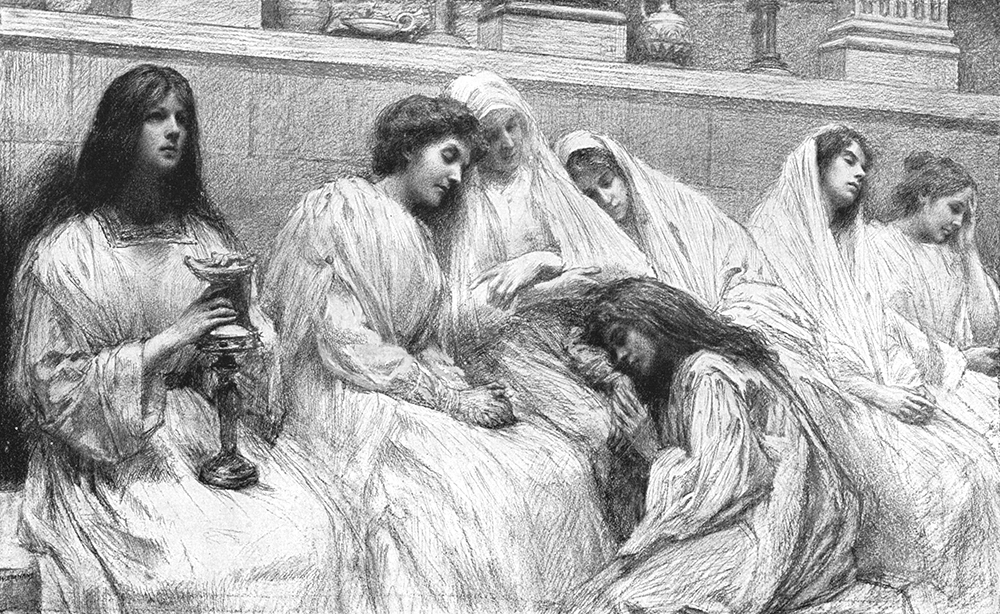
“At that time the kingdom of heaven will be like ten virgins who took their lamps and went out to meet the groom. 2 Five of them were foolish and five were wise. 3 When the foolish took their lamps, they didn’t take oil with them; 4 but the wise ones took oil in their flasks with their lamps. 5 When the groom was delayed, they all became drowsy and fell asleep.
6 “In the middle of the night there was a shout: ‘Here’s the groom! Come out to meet him.’
7 “Then all the virgins got up and trimmed their lamps. 8 The foolish ones said to the wise ones, ‘Give us some of your oil, because our lamps are going out.’
9 “The wise ones answered, ‘No, there won’t be enough for us and for you. Go instead to those who sell oil, and buy some for yourselves.’
10 “When they had gone to buy some, the groom arrived, and those who were ready went in with him to the wedding banquet, and the door was shut. 11 Later the rest of the virgins also came and said, ‘Master, master, open up for us!’“
12 “He replied, ‘Truly I tell you, I don’t know you!’“
13 “Therefore be alert, because you don’t know either the day or the hour.“
There were three stages in every ancient Jewish wedding.
Engagement–when fathers got together to make sure that it would be a good match.
Betrothal—a ceremony in which formal promises were made by the lovers.
Marriage—a surprise arrival, usually a year later, by the groom at the home of the woman.
Each was incredibly important. There couldn’t be any short-cuts; one just didn’t jump into this. It wasn’t a Las Vegas approach to just getting hitched. This parable was an extension of the previous verses in Matthew 24:36-51 and had to do with being prepared.
We can extract this from the third step of marriage. The groom would show up at night, and torches were used to light their way, (apparently the flashlight hadn’t been invented yet). Within Jesus’ parable was the idea of suddenness or surprise.
But no one knew exactly when the groom would show up.
Hence there is an emergency feel to this story. The text states in verse 5:
“Five of them were foolish and five were wise.”
The story hinges on this sentence. Readiness is the issue here. Everything of any significance must take on the sudden arrival of the groom’s entourage. The virgins, apparently, would go out to meet him—the torches mingling their light, and drive out any darkness. (It seems that 10 was the acceptable number for a proper rabbinical ceremony).
The problem was that only 1/2 of them were ready. It’s interesting to note that everyone was sleeping. Obviously, that didn’t mean anything for it was the availability of “oil” that would make the difference. The idea was a surprise visit.
The oil was the key. And for us, it represents the Holy Spirit.
Sleep is not the whole issue here, but being prepared is. Five girls were foolish, they were simply not ready. They realized their error and tried to finagle oil from the others, but ultimately that would short everyone in their group. There was an idea that a trip to the local oil merchant would work. It was an idea anyway.
But it was already too late!
The door was closed. The five simply missed it. They stood outside knocking and calling, but they didn’t enter in on time. Reading between the lines, I sense they were desperate. Verse 12 is meant to penetrate and reveal the price of tolerating spiritual sloth.
“He replied, ‘Truly I tell you, I don’t know you!’“
The purpose of this parable is the ending line that stresses alertness in a society that dulls everything. The temptation is to act like you’re spiritually aware when you’re not. It’s one of our greatest sins. We assume our lamps are lit when the reality is that our oil (the Holy Spirit) is running close to zero. When our sloth gets mixed with hypocrisy it’ll surely destroy us.
We’re snoring our way to spiritual death.
We must resist slumber and slothfulness. Jesus asserts that his virgins must be prepared and ready for his coming. We must be ready, we must—the price of our unreadiness is high indeed.
“Take care of giving up your first zeal; beware of cooling in the least degree. Ye were hot and earnest once; be hot and earnest still, and let the fire which once burnt within you still animate you. Be ye still men of might and vigor, men who serve their God with diligence and zeal.”
” “Let him who is without sin among you be the first to throw a stone at her.””
John 8:7, ESV
“None knows the weight of another’s burden.”
-George Herbert
Definitely, we must discern motives and false doctrine. We’re to be constantly aware of people and issues that swirl around us–of this, there is no doubt, we mustn’t be ignorant. This is a healthy “discernment.”
But we must learn that having discernment isn’t a way that passes out a ‘guilty’ penalty? We are ‘seeing’ things these things–not to pass judgment, but that we might pray clearly and earnestly, and grow into His love for the weak.
But ‘passing a guilty sentence’ is His exclusive jurisdiction.
It’s far beyond our ‘pay grade.’ He is the final judge in everything. He judges justly and lovingly. He alone knows and understands everything very clearly.
It becomes imperative that we understand this; that any real discernment given is only to intensify and escalate the calling of every ‘saint,’ intercessor, or pastor. We discern, not to pass judgment, but to pray more clearly and effectively.
What you see or sense is for the prayer closet, not before a judge’s bench.
Do we really have the ability to ascribe a penalty to someone else? Could it be when we decide to throw rocks at certain people we’re in terrible danger of forfeiting our own salvation?
Do we really have the ability to ascribe a penalty to someone else? Could it be when we decide to throw rocks at certain people we’re in terrible danger of forfeiting our own salvation?
How foolish we become.
“But if you do not forgive others their sins, your Father will not forgive your sins.” (Matt. 6:15.)
(If you have a ‘rock’ in your hand, you are in considerable danger. Please consider this–it’s never easy, is it?)
“Don’t judge others, or you will be judged. 2 You will be judged in the same way that you judge others, and the amount you give to others will be given to you.
“Why do you notice the little piece of dust in your friend’s eye, but you don’t notice the big piece of wood in your own eye?
Matthew 7:1-3
We are broken people. We struggle with many different things. Some of us are mentally or physically ill. We are not whole yet. Some of us must take meds to help us be ‘normal.’ We deal with issues that would devastate someone else. And we don’t have it anywhere near together.
And yet out of our ‘hot mess,’ do we think we can penalize someone else? Really?
We really don’t have a problem with worldly people. We understand that they are lost in their sins, terribly wrapped up in their own personal darkness, and that should definitely disturb us. We must point to the Blood of Christ that forgives us. We share the good news of true repentance and faith. His Spirit teaches us to be witnesses of His love to everyone we meet.
“The life of faith is a struggle enough in a broken world without us complicating it for other believers.”
–Jake Colsen
It just may come as a shock to some, but it’s extremely difficult to throw stones at someone when we are busy “washing” their feet.
Granted, “we are to be wise as serpents,” But that same verse instructs us “to be as harmless as doves.” (Matt. 10:16.) A loving meekness and gentleness, need to be combined with intense spiritual power. We must embody “the fruits of the Spirit.” These things are the characteristics of the Spirit-saturated believer.
“The nature and end of judgment or sentence must be corrective, never vindictive; it is always for healing, and never for destruction.”
–John Owen
Perhaps when we judge others, we reveal that we don’t understand what ‘real’ discipleship with Jesus is? Somehow it seems, we really aren’t quite grasping the immensity of His grace on guilty people? Do we really understand His profound love for the fallen? “God so loved the World…” Have we had any idea how patient He is with us? Do we doubt His ability to correct others? (Again, these are awfully hard questions.)
“Judge not lest you be judged.” (Jesus’ words really do scare me sometimes. )
Certainly, I intend to confront the darkness. “You are the light, a city set on a hill!” I am His salt and light and I do shine into this black night. But that is His doing, not mine. I do not generate light on my own. The Bible declares me as ‘self-righteous’ when I try. I am a broken person, who is just starting to understand the scope of my own brokenness and weaknesses. I’m starting to realize I’m not in the position to Judge someone else. I’m not quite healed myself yet and I must not think I can point to someone else as being worse than me.
Quite simply, I can’t throw ‘rocks’ at other believers anymore.
I can no longer pass out any condemnation from my own limited understanding. My chief concern right now is to be a humble, earnest Christian who is always ready to forgive those who, in their awful sin and confusion, are hurting others.
I’m beginning to see that my calling is to be; a simple servant to my brothers and sisters, nothing more, and nothing less.
Hidden in the Old Testament is the idea of the Cities of Refuge. They have incredible meaning for us today.
They speak profoundly to our situation and bring real hope to those who struggle. Six places of safety were given to protect those who accidentally killed another person— maybe an ax head flew and hit someone, and they died as a result.
God told Joshua to establish cities of protection where one could be safe from an avenger. There were six of them, three on the east side of the Jordan river, and three on the west. The cities covered Israel; each was spread out intentionally so they were always close.
That city became a place of asylum for those guilty of manslaughter.
As believers, we know that we’ve committed crimes against God and other people. The burden we carry threatens to undo us. Satan (and his minions) want to destroy us—and honestly, we deserve it. We are essentially spiritual ‘criminals’ who have hurt others and damaged ourselves in the process.
Outside the city, we’re vulnerable—but inside those walls we find safety.
Those who have killed others are protected. If we venture outside, we find our adversary who is waiting. Scripture tells us that we must stay cloistered there until the current high priest dies. Upon his death, we’re released and may leave the city walls.
For broken believers, the whole concept rings true.
The text speaks for itself, and there is spiritual logic in all of this. We see parallels here that speak to our condition. We’ve messed up big time. We also carry issues that the enemy can attack. Depression, bipolar, trauma, and even thoughts of committing suicide— can be a fundamental part of our lives.
I must tell you that safety is found only in the Savior.
Finding God and abiding in him is our place of safety. His walls protect us, Jesus is our high priest, who never dies; that means we need to stay with him, permanently. I like Hebrews 6:18, LB:
“Now all those who flee to him to save them can take new courage when they hear such assurances from God; now they can know without a doubt that he will give them the salvation he has promised them.”
For us especially, we often have problems with the doctrine of assurance of salvation. Our enemy works overtime to accuse us (Rev.12:10). We’re his targets and the lies of many demons assault us. We can, at times, wonder if we’re really saved. We wonder if we are really forgiven, and we doubt our salvation. Satan’s efforts can be constant and crippling.
I encourage you to think this over and pray about this.
“And Jesus said, “Father, forgive them, for they know not what they do.”
Luke 23:34
From the cross Jesus spoke this. He was being executed in an extreme way, crucifixion was a terrible way to die. Roman soldiers surrounded the cross, and yet Jesus asked the Father to forgive them. They would not be guilty, but forgiven for what they were doing to Him.
But what about Judas?
How broad was Jesus’ statement? Did Jesus grant Judas absolution from this sin of betrayal when He said this? There’s far too many questions, and it’s good to think these things through. Was there forgiveness for this man of treachery?
“Then Satan entered into Judas called Iscariot, who was of the number of the twelve.” (Luke 22:3, ESV.) Perhaps this verse should become our entry point. It’s apparent that Judas was being controlled by the evil one. Something (or someone) took possession of him at this point. It seems astonishing that this happened at the special moment of the Lord’s Supper.
At this point Judas sought out the chief priests.
Judas offered to turn Jesus in, and it seems that money was given, perhaps to encourage Judas to commit himself to follow through. We read that Jesus was “troubled in His spirit.” It seems that this had to do with the impending betrayal.
So what was the early Judas like? Was he an authentic disciple? It seems he was called like the others. He listened to Jesus’ teaching and saw most of the miracles. Later he was sent out to proclaim the “good news.” Apparently, he teamed up with another disciple, miracles were seen.
“Judas heard all of Christ’s sermons.”
Thomas Goodwin
I can’t verify this yet, but each of the 12 called Jesus “Lord,” but only Judas called Jesus “rabbi.” Perhaps this points to a problem Judas has identifying the ministry of Jesus. There would be a kiss commonly given by a disciple, but was it real?
Judas seemed to have problems with money. Apparently Jesus decided that he was to be the treasurer of His followers. This was a problem for Judas. It’s clear that he stole money from that was entrusted to Jesus’ ministry.
Yet I believe Judas would be forgiven of these things if he only asked.
There are a few other things we really must consider. Did Jesus forgive Judas? The Romans and the Jewish leaders were forgiven by Jesus from the cross. But there was never any indication that Judas was forgiven for his betrayal. It seems that Judas carried his sin which ended up in suicide.
Both Peter and Judas betrayed their Lord.
And yet I have to believe that they were not the same. Somehow Peter’s denial would find a way to be forgiven. And even though it seems very painful, Peter would be restored. But Judas took his own life. It was his choice. Simon Peter felt remorse. Judas was overcome with guilt and chose death instead of seeking forgiveness.
I’m completely convinced that we will not see Judas in heaven.
I say that cautiously. I hardly ever understand the mind and heart of God. His compassion is everlasting. Who am I to decide these things? But it seems to me that when he sold Jesus for 30 pieces of silver, he was really selling himself.
“While I was with them, I kept them in your name, which you have given me. I have guarded them, and not one of them has been lost except the son of destruction, that the Scripture might be fulfilled.”
John 17:12
This verse seems to clarify much about Judas. We understand Jesus’ care and love for each of His disciples; yet we see a pronouncement of judgement against the person who would betray Him. It seems that Judas convinced himself that he could not be forgiven. His awful suicide declared he was beyond grace. Judas decided he would hang himself, committing himself to the rope rather than accepting any kind of forgiveness.
Sobering, isn’t it?
“Judas Iscariot was not a greatly wicked person, just a common money-lover, and like most money-lovers, he did not understand Christ.”
“The heart is deceitful above all things And it is extremely sick; Who can understand it fully, and know its secret motives?”
Jeremiah 17:9, Amplified
“The Lord observed the extent of human wickedness on the earth, and he saw that everything they thought or imagined was consistently and totally evil.”
Genesis 6:5
The Bible in its tremendous insight, never once makes humans out to be wonderful creatures. I think we would all volunteer to be that way. But we are not. Rather the opposite is quite true. We are manipulators, rascals, liars and sinners.
There is not a single iota of evidence that we can become exceptionally kind, loving and holy people in any sense of the word.
Somehow we generate a lot of self-deceit.
We trick our own hearts into believing that we are such noble people. We ignore evidence that would convict us otherwise. The prophet spoke to his generation in Jeremiah 17. He would speak directly to people who thought they were true and good. Jeremiah called this a lie, a serious miscalculation, especially when the opposite was true!
This is not the way “to win friends and influence people.” So many pastors, priests, elders, and leaders have a desire deep down to be acceptable and relevant. But God says, we are rascals, tricksters, phonies. Something inside is sick. There can be no human remedy. We simply cannot become religious enough to surmount our profound sin. Pride and selfishness opposes God and harms others.
As a boy living in Northern Wisconsin, on a farm somewhat, we found one of our dogs killing chickens. He was a nice dog, quite friendly and very gentle. But when he started in on the chickens my dad decided to intervene. One of the dead chickens was recovered. My father wired that dead chicken to our dogs neck, nice and tight. That dog wore that rotting chicken for several weeks. Finally the dog laid down, foaming and tongue lolling, eyes rolled back. He was profoundly sick. So Dad cut off the decaying remains.
The SPCA would have a fit. But that dog would never again chase a chicken, or even think of killing one. But even so, our sin is disgusting to God. We just seem to do evil without considering Him or others we effect. It’s all about us, as we think we can just skate through this “problem” without any issues. But Jeremiah tells us we are rotting inside.
We all carry around a dead chicken. I must tell you the truth, you’re terminally ill. You are quite sick, in the most essential part of you.
But Jesus died to free you. He’s the only One who can.
“Our life is full of brokenness – broken relationships, broken promises, broken expectations. How can we live with that brokenness without becoming bitter and resentful except by returning again and again to God’s faithful presence in our lives.”
–Henri Nouwen
We are a broken lot of confused people, and we have never solved the mystery of our own iniquity. In those rare, fleeting times we step into clarity, we are ashamed and disturbed by what we see. Our awful sin needs a wonderful Savior. Jesus does what we could never do.
Jesus died to free us from death. He has come to cut us free from our spiritual evil.
He has died to destroy our sin. But there is much more. He gives us real life–eternal life. His life!
“Come now, let us reason together, says the Lord: though your sins are like scarlet, they shall be as white as snow; though they are red like crimson, they shall become like wool.”










 Alaska Bible Teacher
