O Lord, my heart is not lifted up; my eyes are not raised too high; I do not occupy myself with things too great and too marvelous for me. 2 But I have calmed and quieted my soul, like a weaned child with its mother; like a weaned child is my soul within me.
Psalm 131:1-2, ESV
To be humble [Hebrew, anavah] means that we recognize our boundaries. We will not advance by stepping beyond what God has ordained for us. We learn to be content with the present. Humility is not thinking less of yourself, but thinking of yourself less. It puts others first.
In Psalm 131 we begin the walk into “anavah.” We’re brought by God into a place where we understand who we really are. Our lives are not characterized by self-promotion, but rather serving God and advancing others before ourselves.
The image is one of being a weaned child resting on a mother’s chest. We have no agenda, there is nothing that we must do, but just relax on Him.
Seeing a weaned baby is one who no longer needs its mother’s milk. There’s no fussing or grasping for nourishment, rather he’s simply content to rest in his mother’s warm embrace.
To practice true humility, or the Hebrew word “anavah,” it is to renounce ambition in all its insidious forms. As Jesus’ disciples we follow Him with our cross. That cross puts the end of our old life. And we die daily. And it is obvious to all.
“And since I, your Lord and Teacher, have washed your feet, you ought to wash each other’s feet. I have given you an example to follow. Do as I have done to you.”
“We had long known the Lord without realizing that meekness and lowliness of heart should be the distinguishing feature of the disciple.”
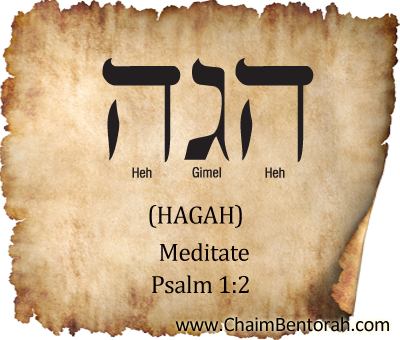
“But his delight is in the law of the Lord, and on his law he meditates day and night.”
Psalm 1:2
Meditation has gotten a bad rap among some Christians, largely due to a connection with Eastern mysticism. This is really unfortunate for it has a critical place in the development of your discipleship. I believe it’s vital (and maybe even mandatory?)
Hagah is the Hebrew word for ‘meditation’ and it fascinates me.
It literally means to “moan, growl, utter, muse, or mutter.” Some have suggested that it contains the idea of ‘rumination,’ like a cow who chews a cud. The grass goes in, and it’s regurgitated several times, extracting every bit of nutrients and vitamins.
Hagah, or to meditate is the way we assimilate God’s Word into our lives. It’s critical that we do this in our walk as disciples that belong to Jesus.
“This Book of the Law shall not depart from your mouth, but you shall meditate [hagah] on it day and night, so that you may be careful to do according to all that is written in it. For then you will make your way prosperous, and then you will have good success.”
Joshua 1:8, ESV
It’s an interesting command isn’t it? Joshua’s ministry is to lead God’s people and requires his deep connection to God’s promises. He needs to hagah God’s words, to purposefully think about them over and over and over.
It’s interesting to me that when Joshua meditates and carefully responds to the Word then he will receive success in his life and ministry. The word ‘success’ means “wisdom, comprehension, insight with prosperity.” I need that desperately.
And if Joshua needed to do this, might not we?
Start small and simple. There are over 8,000 promises in the Bible–pick one and ruminate on it. Hagah on the Word and try to extract the spiritual nutrients that it contains. You will grow, bless others, and walk in victory, defeating your enemy.
“The amount of time we spend with Jesus – meditating on His Word and His majesty, seeking His face – establishes our fruitfulness in the kingdom.”
Goliath was almost 10 feet tall, a warrior since birth–we read of his armor–he was like a Sherman tank. And David was just a very small, skinny boy–nothing more.
Young David stood and looked at Goliath face-to-face. (If it’s been awhile, you can read of this encounter in1 Samuel 17.) My guess is that Goliath preened and strutted into the field of battle, and the boy David was stepping up for his very first try at hand-to-hand combat. David is called a “youth” in Hebrew, which means anyone from infancy to adolescence.
And that’s when Goliath begins to blaspheme loudly. Perhaps that’s what giants do best.
He boasts. He mocks. He believes he is superior, and his arrogance seems to know no bounds. In his mind the center of the universe is the Philistine army, and he is their champion. He is contemptuous of everything else–physical or spiritual.
Essentially all you need to know is that Goliath is a human wood chipper.
Everyone who has faced him has been destroyed. No one has ever survived. But he has never met David before. And Goliath knows nothing of the living God. It amazes me, but David never backs down, his reaction to the ‘human mountain’ of Goliath was to run directly at him.
This is an astonishing faith!
“As the Philistine moved closer to attack him, David ran quickly toward the battle line to meet him. Reaching into his bag and taking out a stone, he slung it and struck the Philistine on the forehead. The stone sank into his forehead, and he fell facedown on the ground”.
1 Sam. 17:48
Many of us face our giants. They come with many names, some are called guilt, pride, doubt, or despair and lust. And they come with many other names as well.
Satan our enemy has marched out on the field of battle, arrogant and supremely confident of his ultimate triumph over us. I suppose that should terrify us. Over the years we’ve been indoctrinated to accept sin’s control, and our inevitable slavery–with a spirit of timidity.
We’ve been rightly told that there are enemies that can destroy us.
As believers we are especially hated in the spiritual world of darkness. Our destruction is inevitable in the mind of the evil one. Satan still expects to win over your soul, but Jesus stands as our advocate shielding you. I believe you are saved because He really did die for you.
Our own particular favorite demonic ‘monster’ is real and brutal.
Yet so many believers are intimidated, listening, and then surrendering to the boasting of the giant. The warfare dimension gets nullified, and soon becomes irrelevant. Despair reaches us and has the full intention of taking total control. It’s never satisfied with just a little bit.
He passed through the dark intimidation and influence to approach Goliath. There was no doubt to cloud his mind. David took a spiritually aggressive position, he took on the fear, and then ran directly at the giant Goliath. His spirit was untouchable. This is the boy who wrote Psalm 23.
Some of us stare down our giants repeatedly, over and over.
As believers, we might struggle. We can turn our hearts over to despair. Sometimes we actually make ourselves available to the enemy’s workings. When we do this the enemy spreads his influence to others through us. And any confidence we might have through faith is dissolved into doubt and confusion.
But the victory we have in Christ allows us liberty, through the Blood of Him who defeats our own Goliath of despair. We can run into the battle. We fight our giant, but we’re never defeated.
“Soon the battle will be over. It will not be long now before the day will come when Satan will no longer trouble us. There will be no more domination, temptation, accusation, or confrontation. Our warfare will be over and our commander, Jesus Christ, will call us away from the battlefield to receive the victor’s crown.”
Life can get out of hand sometimes, becoming hectic and frantic. It seems like we’ve got 1000 ‘irons in the fire.’ The anxiety of doing everything creates fear and worry. We cannot possibly keep up. There isn’t enough hours in the day.
We are not at rest with ourselves, or with the Lord.
And oh my, the news, the internet, and our cell phones create awful issues if we can’t manage them with the Holy Spirit’s direction and purposes. Our computers seem like a pipeline for darkness. Unless they’re “given” to God, they can destroy you.
What causes me anxiety? I’m quite sure you can add your own issues.But here’s a partial list:
ambition, self-promotion, pride, jockeying for position
family issues, marriage and children
my job and career, “keeping up with the Joneses”
religious ‘duties’
finances, bills
politics, media
unrepented sin, separation from God, peace is missing
But I assure you, there is rest.
The Old Testament uses a word, נוח or ‘nuach.’ It’s a Hebrew word. Both Moses and Jesus understood the implications. It means calming, to become quiet or still. To rest quietly.
“And He said, “My Presence will go with you, and I will give you rest.”
(Exodus 33:14)
This promise is given to Moses; frankly, he’s overwhelmed by his burden. In the “tent of the meeting” he battles with God, and it’s in that place Moses insists on the Lord’s active presence on him and on the people. He will not take another step unless God does this.
“Come to Me, all you who labor and are heavy laden, and I will give you rest.“
(Matthew 11:28)
The Lord Jesus calls each of us to rest in Him. It seems we work hard and we carry awful heavy burdens. Jesus uses the word, “Come” which is typically a command or an imperative. (It can be used with an explanation mark!)
Jesus understands our hearts and our effort and “labor.” He fully grasps that we’re “heavy laden” much of the time. His invitation is to come and find the peace of a resting disciple. It is His gift to us, and only Jesus can give it to us.
“‘Come’; he drives none away; he calls them to himself. His favorite word is ‘Come.’ Not, go to Moses – ‘Come unto me.’ To Jesus himself we must come, by a personal trust. Not to doctrine, ordinance, nor ministry are we to come first; but to the personal Saviour.”
“And don’t build an altar that requires steps; you might expose yourself when you climb up.”
Exodus 20:26
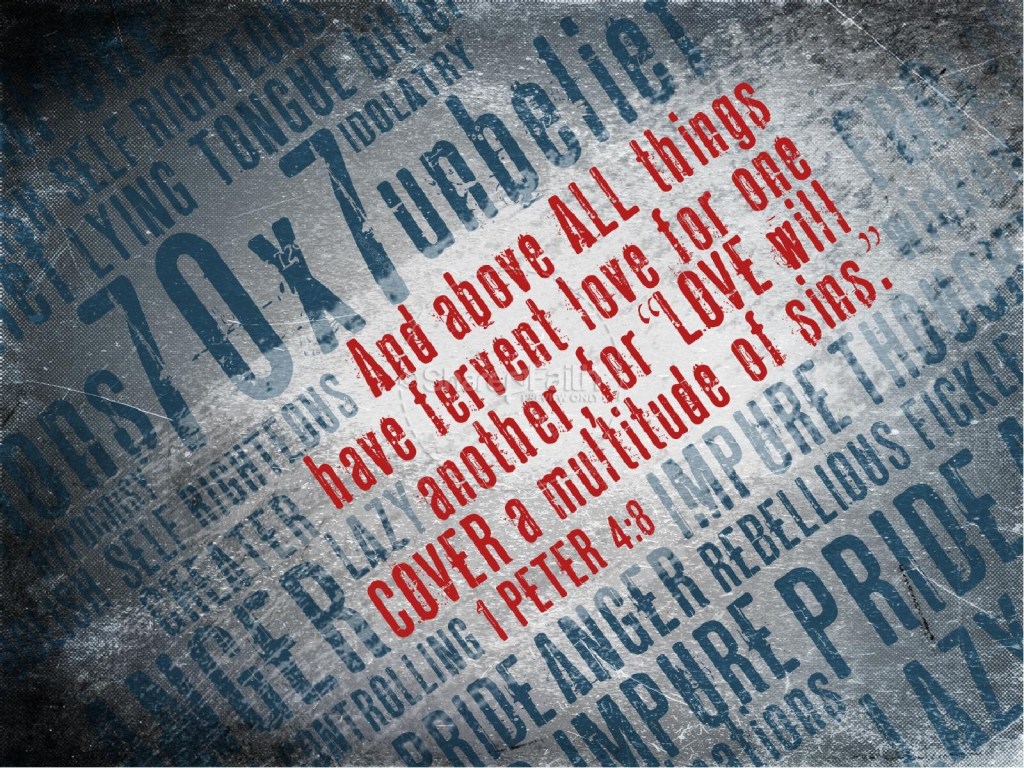
“Most important of all, continue to show deep love for each other, for love covers a multitude of sins.”
1 Peter 4:8
While I lived in the SOS Ministry house in the Mission District of San Francisco a dear brother taught me this principle. Living in a Christian community was wonderful, but it also could be a tremendous challenge at times. What Michael taught me allowed my understanding to grow into my own calling in the Kingdom.
The principle is this:
The Holy Spirit calls us to cover another brother’s nakedness.
Throughout the scripture “being naked, or nakedness” is always a shame. It comes welded to the concept of being vulnerable to the sight of those who are mature. It carries the idea of sin; it’s sin that some can see, it is hidden to most but causes terrible shame. Exposure of their nakedness seems like the worst thing that could happen.
For those who often sin, we latch onto the idea of keeping a lid on it, and being secretive about it. We believe that people will never know. Often sex sins, drugs, and alcohol sin, are kept hidden from the view of family and friends, and the Church. Hidden sin will never be healed by hiding it. (That’s a very common deception.)
Noah and his nakedness, Genesis 9
“Noah became a farmer and planted a vineyard. When he drank wine made from his grapes, he became drunk and lay naked in his tent. Ham, the father of Canaan, looked at his naked father and told his brothers outside. Then Shem and Japheth got a coat and, carrying it on both their shoulders, they walked backwards into the tent and covered their father.”
“They turned their faces away so that they did not see their father’s nakedness.”
Genesis 9:20-24, (See Lev. 18).
Granted, it’s hard to process this patriarch’s gross sin. However in all fairness, Noah had lost practically everything in the flood, so perhaps we should be gentle with him.
The Church needs people who cover up the nakedness of others, people who are gentle and humble. They would never, ever dream of making a scandal. They are trustworthy and understand to a great degree the things that make a man or woman of God.
Mature believers will protect the open areas of others.
They will refuse to judge or point out sins. Any discernment that’s given from God is for intercession, not for fault-finding. They stand in the gap, shielding and protecting. And praying. This is God’s heart, and they understand.
But the issues for leadership are quite clear.
The principle of spiritual responsibility and active sin requires definite action for the health of the Church. A pastor or teacher who practices evil cannot remain in their place of authority. The standard for them is different. They have been charged for care and oversight over God’s flock.
With the ordination vows comes scrutiny. I believe special grace is given to each leader, but with that comes the commitment to following Jesus faithfully. It’s a serious call and deliberate sin invalidates that. The man may be quite gifted but can no longer be trusted to serve in their office.
I’m convinced that Paul’s epistles support this.
God’s final word on nakedness is in Revelation 3:18, and perhaps this is a good place to end this post.
“I counsel you to buy from me gold refined by fire, so that you may be rich, and white garments so that you may clothe yourself and the shame of your nakedness may not be seen.”
“The Lord is your keeper; the Lord is your shade on your right hand.”
Psalm 121:5, ESV
I once worked for my father-in-law who had to meet a deadline. We shoveled rock into 50# bags. It was unbelievably hot–104 F and we had no shade. The sky was clear and the sun was brutal. I recall praying for a cloud, even a little one, anything.
The Jews had a word, tzel. It’s translated “shade” in our English Bible. That word also meant shelter, covering and coolness. In the land of Israel it could get really hot, up to 120 F in the summer. Tzel was much appreciated.
There’s a promise that clearly speaks of this. The Lord guarantees us shade. I suppose figuratively we’ll go through times when life becomes unbearable, and yet the Father understands. He gives us tzel, relief from harsh and cruel conditions we encounter. Without the shade it gets miserable.
Tzel is when the Lord covers you.
We’re protected and given a real place of coolness and relief. This is a good promise for the born-again believer. You can easily appropriate and claim it–God gives it away to those who love Him. Come now and sit in the shade.
The Lord is your shade.
“The safest place in all the world is in the will of God, and the safestprotection in all the world is the name of God.”
“And Samuel said, “Has the LORD as great delight in burnt offerings and sacrifices, as in obeying the voice of the LORD? Behold, to obey is better than sacrifice, and to listen than the fat of rams.”
1 Samuel 15:22, ESV
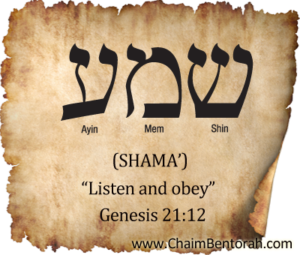
In Hebrew, the word ‘shama’ has a powerful meaning which is hard to translate into English. The word actually means “listening and doing.” Shama is a word that combines both ideas into one. To hear and obey is one word to the Hebrews.
It’s all about activity that’s a result of hearing.
Here, the word shama means to allow the words to sink in, to provide understanding that requires a response—it’s about becoming obedient when you hear His voice. In Hebrew, hearing and doing are the same thing. Obedience to these laws is not about legalism or trying to earn God’s favor—it’s about love and active listening.
We desperately need “shama” as disciples of Jesus.
We must understand that listening to God is needed, but obedience is required. Shama tells us this. We can’t just hear Him without obeying. I believe that obedience becomes easy when we are listening to Him.
And that’s a good thing.
“The willingness to obey every word from God is critical to hearing God speak.”
I have wondered about this. It strikes me that there are two giants that David encountered in his walk with God. Granted, there are many other events and people that he experienced, obviously. But there are these two that stick out:
The Goliath showdown, and the Bathsheba fiasco.
These seem to be hinges or pivot points that would change the entire course of king David’s life, and his faith in God. They’re to be an encouragement and warning to us, as both are incredibly significant.
Goliath, 1 Samuel 17
This is a powerful chapter, for it reveals David’s spectacular faith in God. When the boy David killed Goliath it changed the entire future of Israel. One stone from his sling was all it took. Israel routed the Philistine army. David’s faith was the spark that made victory real.
David became a hero that day, and quickly ascended into Saul’s favor. It was both a military and a political development that Israel needed and king Saul welcomed it, the kingdom thrived. The boy David became the man of the hour, a national hero which everyone talked about.
I’d like to point out that David had already been anointed by Samuel to be the next king. This, combined with David’s celebrity status pushed king Saul over the edge–Saul developed a deep resentment that became insanity. David handled this adroitly, fleeing into the wilderness (with his faith) for years.
Bathsheba, 2 Samuel 11
At this point David is now king and is fighting the Ammonites. The Israelites were besieging Rabbah, the capital city of that country, and it seems like it’s an intense battle. But interestingly enough, David remained in Jerusalem. (And I can’t figure out why.) David can’t sleep so he paces the rooftop and it’s then things get crazy.
David spies Bathsheba who is cleansing herself from her monthly cycle. She is a very beautiful woman, and king David inquires about her. He lusts after her which results in him more or less raping her, commiting adultery and then murdering her husband. This is all very disturbing.
Bathsheba is the wife of Uriah, one of David’s mighty men of proven valor. He has him murdered after committing adultery with her.
(2 Sam. 11:14-15.)
When David had sex with Bathsheba it set in motion the ugliest chain of events imaginable. It seems that up to now David has taken the intiative of events, and then, after this great evil, his story shifts and for the rest of his life he becomes acted upon, a “victim.” He reacts, but doesn’t act anymore.
For the rest of his life he will struggle. All because of lust.
In 2 Samuel 12 David is confronted by a prophet for these sins. Samuel speaks with a parable that penetrates David’s heart. The king responds, “he shall restore the lamb fourfold, because he did this thing, and because he had no pity,” (v. 6). And interestingly enough, David would indeed pay fourfold. There would be four major incidents after this that he would now face.
Summary
David faced two “giants” in his walk with God. They were very different but both life altering. He killed Goliath but was not able to destroy his lust with Bathsheba.
Sometimes one “giant” is not enough. It would be nice if that was the case. David walked in victory for a period of time, but failed both himself, his family and his kingdom. Lust always is an act of the will, a deliberate decision that destroys all that it touches. David would be forgiven, but the damage was already done.
There would be dire consequences for everyone.
I believe that our giants were meant to be slaughtered. That is their function and purpose for the faithful believer. There can be no compromise. They’ll take different forms and will often approach you in peculiar ways. Paul tells us to wear God’s armor in Ephesians 6:11-18. I don’t think that protection should be taken off–you dare not only wear it only on special occasions.
Brother, sister–you must be covered all the time.
King David is a lesson for us. There is tremendous pain for us if we deliberately choose to compromise with the giants in our lives. Some of you already understand this; others will. I promise you.
“Many of us suffer from temptations from which we have no business to suffer.”
…for I knew that you are a gracious God and merciful, slow to anger and abounding in steadfast love, and relenting from disaster.” (Jonah 4:2, ESV)
(“The LORD is gracious and merciful, slow to anger and abounding in steadfast love.”)
Psalm 145:8
This understanding of God’s character is used 13x in the Old Testament. It was first discerned by Moses, and was passed on to other men. It was stamped into the hearts of those who followed him. It was a description of who God was, and it became the strong foundation of their ministry.
Jonah understood who God really was.
And that was the reason Jonah refused to give the Ninevites a break. He didn’t want them to repent. He wanted no part of their salvation, which is rather disturbing. How can a prophet act this way? What was it that angered Jonah that he would resist God?
The book of Jonah contains question marks, especially chapter 4. Of the 14 questions that are asked, 11 are directed at Jonah.
God speaks loud and clear to His prophet. He asks Jonah to reconsider and evaluate his heart in the light of God’s loving character.
When we read it we can focus on the secondary ideas. We see Jonah and the whale. Maybe we think about his disobedience. Or maybe the storm or the plant that helped Jonah endure the heat of the sun. These are all good things to consider, but they are not the main theme.
God’s heart for even the Ninevites is the main purpose of the book of Jonah.
God is not the exclusive ‘property’ of the Hebrew nation! He very much cares for others outside of our own group. In John 3:16 we’re made aware of His passion for the whole earth.
“For God so loved the world, that he gave his only Son…”
The Great Commission has always been in effect. In the OT Israel was called to be a light to the Gentiles, Acts 13:46-48. The covenant given to Abraham was that Israel would be a blessing to every nation. This was God’s plan and His intention. (Genesis 17:1-8.)
Jonah’s anger and apparent prejudice is definitely a cause for concern.
But could the message of Jonah describe the reluctance of the Church today? Is God’s love for everyone? Does God even care?
“And should not I pity Nineveh, that great city, in which there are more than 120,000 persons who do not know their right hand from their left, and also much cattle?” Jonah 4:11
Yet those who wait for the Lord Will gain new strength; They will mount up with wings like eagles, They will run and not get tired, They will walk and not become weary.
Isaiah 40:31, NASB
The particular word for “wait” is a much more active word than we think.
It’s not a passive word in the original Hebrew. It does not mean being apathetic or lazy. Sometimes we wait in line at the grocery store, or maybe we’re waiting on a phone call. We regularly wait all the time, and usually, we don’t even realize it.
The Hebrew word for “wait” used in v. 31 is ‘qāvâ‘ which means, ‘to bind together by twisting.’
It literally means to “braid, or twist, using a rope.” It becomes an interesting word picture? Sometimes we only take the English idea of waiting and turn it turns into a frustrating delay. Often, this is why we lose out on what ‘wait’ is really about. I have to believe the Holy Spirit wants to teach this idea of becoming ‘braided up with God.’
All too often we are limited by our definitions, and not God’s Word.
For those of us who are ill— physically or mentally, just to be told simply, “wait on theLord” is a real challenge. Often, we will end up resenting this counsel (and the counselor) because we have misunderstood what it means to really ‘wait.’ We come tantalizing close to this critical idea, but we never quite make it through the doorway.
Yet when I truly wait on God, I’m actually braiding myself into Him.
He becomes my strength; He is now the strong cord I am braided into. (Perhaps this is how He imparts strength and might to His people?) We need this, and the Lord is quite eager to lead us into this new kind of intimacy.
The promise in Isaiah 40:31 tells us about new strength–the eagle’s wings, holy stamina. This verse is relevant to us today, and we need this kind of strength now. I only want to encourage you in your own prayer time, to see yourself intertwined with the Lord, and to recognize the good gift of the Holy Spirit freely given.
“Wait for the Lord; be strong, and let your heart take courage; wait for the Lord!”
















 Alaska Bible Teacher