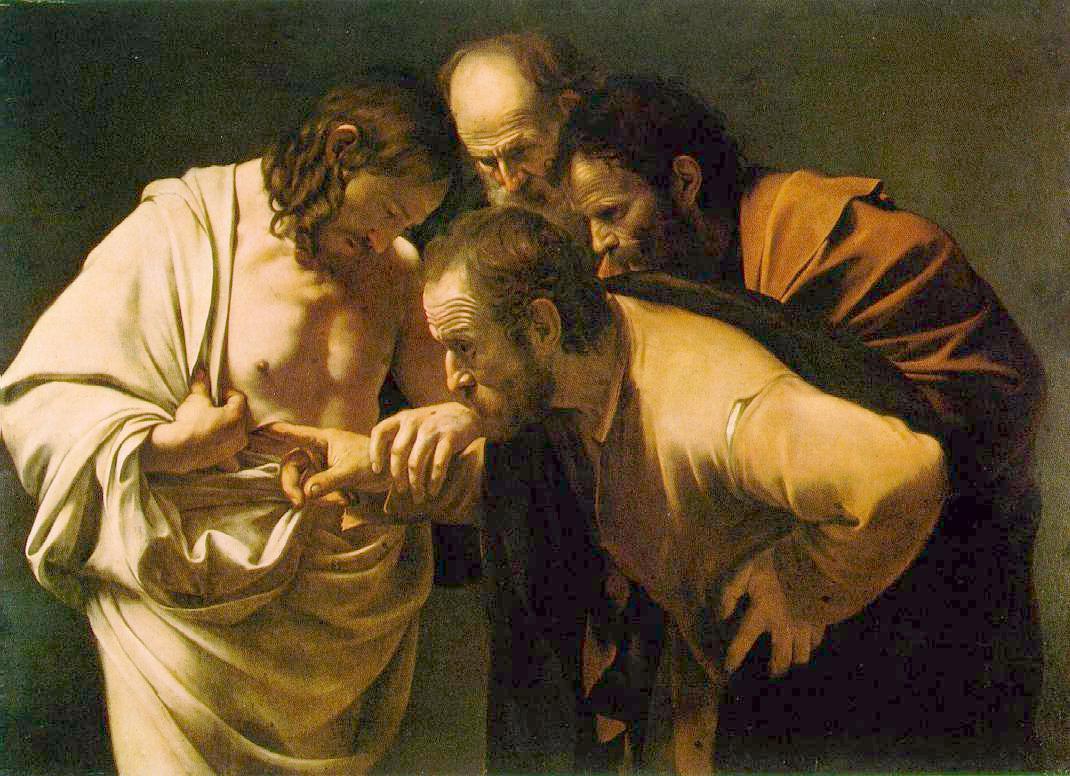
Walls Don’t Work Anymore

36 As they were talking about these things, Jesus himself stood among them, and said to them, “Peace to you!” 37 But they were startled and frightened and thought they saw a spirit. 

38 And he said to them, “Why are you troubled, and why do doubts arise in your hearts? 39 See my hands and my feet, that it is I myself. Touch me, and see. For a spirit does not have flesh and bones as you see that I have.” 

40 And when he had said this, he showed them his hands and his feet. 41 And while they still disbelieved for joy and were marveling, he said to them, “Have you anything here to eat?” 42 They gave him a piece of broiled fish, 43 and he took it and ate before them.

Luke 24:36-43, ESV

In the most thrilling moments of a story, there are instances when the true essence of the events becomes crystal clear. Luke’s narrative brilliantly captures that exhilarating sensation. Picture this: Jesus, triumphantly risen from the depths of death, enters the room with a burst of energy that electrifies everyone present. It must have been one of those extraordinary instances where words simply fall short, and experiencing it firsthand is the only way to truly grasp its profound impact.

“Frightened” and “terrified”–it seems it takes two words to describe this spooky experience. 

Everyone was terrified; they were convinced that Jesus must be a ghost. They all panicked and tried to run to the nearest exit, but then realized that the door was still locked!

Oh boy, Jesus must have had a good chuckle over this one! I mean, imagine being a human and seeing your disciples, all stooped and scared, trying to approach you like a bunch of timid puppies. It’s like trying to get a dog to come to you when it’s so terrified it’s peeing on the floor! I bet Jesus couldn’t help but smile and think, “What a hilarious sight!”

They slowly encircle Jesus and as they come, I have to believe He’s amused. He has survived a very brutal cross, and walked through hell. And, He has risen from the dead.

He is laughing from the pure joy of one who has endured the worst of a very real hell.

Jesus emerged unscathed on the opposite end, a testament to his invincibility. His arrival has undoubtedly filled him with undeniable joy, surrounded by beloved companions. In his triumphant resurrection, he defied all odds and accomplished the unimaginable, evoking a cascade of profound emotions, a mingling of laughter and tears.

I believe each of us has walls. 

Walls can provide a sense of security and protection, both physically and emotionally. People often feel the need for boundaries and walls to feel safe. This is similar to how disciples found safety in numbers and the walls around them. They were afraid, and so they hid themselves.

Jesus insists on penetrating our walls.  He’s overcoming much resistance and delusions. And then suddenly we come ‘face-to-face’ with the dead person who’s now alive. He is “The King of Kings and the Lord of Lords.

Behold, behold! Witness the magnificent display of unadulterated resurrection power—a force unparalleled in the vast expanse of the universe. Its brilliance eclipses the sun, its might surpasses that of the mightiest atomic bomb. Prepare to be astounded, for this power knows no bounds!

It’s funny, when Moses prostrated himself before the Lord’s glory, he changed.  Not only that, but he had to take precautions to cover his face when he returned to camp. These disciples however have just seen the glory of God first-hand.

As His disciples, we must be prepared for any eventuality.  Jesus can and will burst into our homes, and into our very lives.  Can you hear him laugh?  When he comes, nothing really is the same again.  He loves his disciples too much to leave them in a dark stuffy room.  They have work to do.

The resurrected Jesus is coming for you!

“Here I am! I stand at the door and knock. If you hear my voice and open the door, I will come in and eat with you, and you will eat with me.”

Revelation 3:20, NCV

alaskabibleteacher.com

What Does God Want From You?

I plead for you not to skip this post.

“He also told this parable to some who trusted in themselves that they were righteous and looked down on everyone else: 

“Two men went up to the temple to pray, one a Pharisee and the other a tax collector. 11 The Pharisee was standing and praying like this about himself: ‘God, I thank you that I’m not like other people—greedy, unrighteous, adulterers, or even like this tax collector. 12 I fast twice a week; I give a tenth of everything I get.’”

13 “But the tax collector, standing far off, would not even raise his eyes to heaven but kept striking his chest and saying, ‘God, have mercy on me, a sinner!’”

Luke 18:9-13

He despised others. As a Pharisee, he prided himself as a holy person; he thought he stood before God accepted and pure. He congratulated himself over this. I’m starting to see that self-righteousness has many levels. You can be blatant and obvious about it, or perhaps it might be more subtle and hidden. (Many believers like it hidden.)

We have to understand that God sees all and our hearts and minds are continuously inspected by the Holy Spirit. God sees our hearts as we see the faces of our friends. Any presence of pride or the absence of humility is automatically rejected by our heavenly Father.

In the Bible, it’s quite clear that being humble and admitting our sins and flaws are the best way to counteract any kind of puffed up pride. But for some reason, we often don’t realize when our selfishness and ego is getting in the way. It often comes very, very subtle. Tricky maybe.

Humility is a quality that cannot be acquired or maintained permanently.

Humility is not an accomplishment. There are no spiritual medals given for humility and brokenness. It’s not once you’re done. We must find humility every single day. Every morning, when my feet hit the floor, it’s something that requires my daily effort and practice. But it’s scary, because I’m starting to see that God’s precious grace is ultimately nullified by my pride.

The right kind of heart is broken and humble every single morning.

The Pharisee believes he is better than the tax-collector, and he now stands confidently before God. He thinks he is holy and superior to others. He really believes he has spiritually arrived.

But the tax-collector was brutally honest about himself. He understood the presence of God.

He didn’t need anyone to tell him how sinful he was–he knew his own wickedness. Jesus’ story reveals God’s love for those who know that they’re twisted up inside and lost. But let’s look closer at the heart of the tax-collector:

  • “He stood afar off,” which showed his awareness of his separation from God.
  • “He wouldn’t even raise his eyes to heaven,” which declared his humility in the presence of a holy God.
  • He kept “striking his chest,” which tells us of a deep pain over his sin against God.
  • He prayed, ‘God, have mercy on me, a sinner!’ This describes his desperate heart.

Both men came to pray, but to be really honest, that’s all they had in common.

The Pharisee came to the temple to declare his righteousness, the tax-collector came out of a terrible despair. It strikes me that the text in verse 11 says the Pharisee, “began praying to himself.” It seems that his prayer never really met God–all he was proud and showy, and he was only doing those things God hates (Prov. 29:23).

But it was the tax-man who became righteous in the eyes of God.

Humility is the foundation of the kingdom of Jesus. Matthew 5:3-4, makes a lot of sense to me. To be “poor in spirit” and to “mourn” has now become the solid bedrock of a Christian’s discipleship. To be justified (made right) is a gift. No one can earn salvation. The tax-man could only hold out his empty cup and hoped that God would fill it. Maybe that’s our beginning point.

But suddenly the tax collector is now considered righteous, while the Pharisee left the temple unchanged, and unforgiven.

“We had long known the Lord without realizing that meekness and lowliness of heart should be the distinguishing feature of the disciple.”

    Andrew Murray

When I crawl out of bed in the morning I start all over again. I realize I am nothing, I deserve nothing. I can only cling to the grace of my Father.

God wants us to have a broken heart and it’s apparent He rejects everything else. I suppose that there are questions I must ask myself: Am I really poor in spirit? Do I really mourn over my sin? Am I broken or am I subtly proud of myself? I must ask myself these questions.

“This is the Lord’s declaration. I will look favorably on this kind of person: one who is humble, submissive in spirit, and trembles at my word.”

Isaiah 66:2, CSB

Art by Eugène Burnand

alaskabibleteacher.com

The Whips of Jesus

John 2:14-17, NCV

 “In the Temple he found people selling cattle, sheep, and doves. He saw others sitting at tables, exchanging different kinds of money. 15 Jesus made a whip out of cords and forced all of them, both the sheep and cattle, to leave the Temple. He turned over the tables and scattered the money of those who were exchanging it. 16 Then he said to those who were selling pigeons, “Take these things out of here! Don’t make my Father’s house a place for buying and selling!”

17 When this happened, the followers remembered what was written in the Scriptures: “My strong love for your Temple completely controls me.”

He really did use a whip. The text tells us that Jesus carefully took some cords and made a whip by intertwining them. What can I say? I’m amazed at His response to what He saw happening in the Temple. Jesus saw deeply saddened Him to the point that there wasn’t anything else He could do.

It appears that there are three distinct whips in the N.T. that we should take into consideration.

  1. The one Jesus carefully braided to “cleanse the Temple.” (John 2:25.)
  2. The one used on Jesus’ back as part of our atonement. (Isaiah 53:4-6.)
  3. The one that believers experience in the ways God disciplines us as His children. (Heb. 12:6.)

All three are important to see. All three have their own meaning. The first one: The Temple is finally clean. The second one: He was punished for me. The third one: He intervenes in my life to make me a holy person.

The third whip is my focus here. He intends to sanctify us by correction. This discipline is the way Jesus separates us from our sin. We’re being disciplined in order to become holy people. Hebrews 12 explains the process.

“If ye endure chastening, God dealeth with you as with sons; for what son is he whom the father chasteneth not? But if ye be without chastisement, whereof all are partakers, then are ye bastards, and not sons.

Hebrews 12:7-8, KJV

God’s intention isn’t to inflict punishment upon us. His correction isn’t a way by which we make amends for our transgressions. It’s crucial to remember that Jesus has already taken upon Himself the full weight of our sins, fully satisfying any debt. He absorbed it all.

God, in His role as a loving father, corrects and guides us with deep affection.

It’s important to note that God’s methods of discipline do not involve any form of “spiritual child abuse” whatsoever. His love is extraordinarily good, it never wavers, never turns into something evil. He patiently works His will, using loving and healing hands.

“For the moment all discipline seems painful rather than pleasant, but later it yields the peaceful fruit of righteousness to those who have been trained by it.”

Hebrews 12:11, ESV

God has corrected me a 1000 times throughout my 40 years of following Him.

Not with a leather whip mind you, but a braided spiritual cord of correction. What He saw taking place in the marketplace of “me,” (my temple), brings Jesus grief and sorrow. I’m the temple of the Holy Spirit, and He fully intends to make me pure inside. Hebrews 12 tells me what to expect as a son. I need to be corrected.

It’s good to ponder this.

Isaiah 53:5, (context. 4-7)

Yes, a “whip” will be used, but cautiously, even though it may hurt us. Jesus will never intentionally correct you beyond what you can handle.

These three whips are vital, they educate us about the Lord’s efforts. They help us to comprehend and experience God’s workings. As much as we’re able, we must embrace them.

God’s corrections are our instructions; His lashes our lessons, and His scourges our schoolmasters.

     James H. Aughey

alaskabibleteacher.com

Instant Breakfast

“The message of the cross is foolish to those who are headed for destruction! But we who are being saved know it is the very power of God.”

1 Corinthians 1:18, NLT

Our salvation often comes like a sudden bolt of lightning. It happens very fast, a flash of true faith, and we move from darkness to glorious light in an instant. I am absolutely confident about this.

When someone genuinely believes in Jesus and in repentance seeks forgiveness, they receive everlasting life. It never ends. Our salvation occurs in the blink of an eye. It’s like a switch that gets flipped on.

But Peter and Paul clearly write that we are “being saved.” I believe that our salvation has three tenses:

I believe that our faith and transformation are also continuous processes, a lifetime of dedication and progress. It is important to see that following Christ is an ongoing journey. Additionally, it is essential to understand that accepting Christ as our Savior does not automatically result in an immediate ascent to heaven. We must “work out our salvation with fear and trembling.”

We prefer convenience. Microwaves, K-Mart shops, fast food, ATM machines, credit cards, and so on. We quickly grab our protein shake (or coffee?) and rush out the door to keep up with our day. Things become faster and more convenient. We practically demand it.

We want patience and we want it now!

Most people don’t like the idea of a daily (and slow) commitment. We want quick and easy solutions, but having faith doesn’t work like that. Even though we want to make progress quickly, becoming a follower of Jesus takes time. It’s called “discipleship.”

I’m sorry to be the bearer of bad news, but if you’re a true believer, you have a challenging journey ahead of you.

Here are Philippians 2:12 in four different translations.

  • Work out your own salvation with fear and trembling. (KJV, ESV)
  • Work hard to show the results of your salvation, obeying God with deep reverence and fear. (NLT)
  • Keep on working to complete your salvation with fear and trembling. (NCV)
  • Keep on working with fear and trembling to complete your salvation. (GNT)

Some believers will find a deeper understanding of a “discipleship effort” that’s necessary. Others may not be ready to accept it. But the writers of the New Testament epistles effectively communicate this idea of being on a journey.

“Instant Christianity tends to make the faith act deadly and so smothers the desire for spiritual advance. It fails to understand the true nature of the Christian life, which is not static but dynamic and expanding.

A.W. Tozer

alaskabibleteacher.com

Cross-Eyed Christians

In the book of Genesis we find the story of Leah and her sister Rachel. Let’s start by saying two daughters of Laban have become Jacob’s wives. We must step into Genesis 29 to see more.

Jacob longs for Rachel. She is his “soul mate” and because he’s in love, but the customs and technicalities of the day somehow get by him. Because of this, he will have to deal with Laban’s subtle trickery, where his daughters get swapped, and we must sort out the customs of that day to really understand.

Let’s just say that Laban’s deception creates a huge crisis for everyone. 

Throughout his life deception has been Jacob’s besetting sin. But now he’s the recipient. When we see a deceiver like Jacob gets deceived, that can’t be all bad. Call it karma, kismet, fate; he deals with it. “As you sow, so will you reap.

Jacob is so in love with Rachel that he works for seven years for the right to marry her. This may be a bit outrageous. But we really must weigh these issues. I believe Jacob really is a monogamist at heart and he has no real love for Leah. 

He can only see that one girl that he is crazy about, his true love, Rachel.

But you know, it’s Leah that I tend to think about. Her own issues are unique. Genesis 29 explains it a bit cryptically,

“Leah’s eyes were weak, but Rachel was beautiful in form and appearance.” 

Genesis 29:17

You need to know that there is some confusion by commentators about the “weak eyes.” Others who look at the original Hebrew find the words to be vague. Some take it as she is very near-sighted, or even cross-eyed. Others think that this is a polite way of saying she really wasn’t pretty. I think I can gain from these different interpretations.

But to be honest, I think I might understand Leah.

She is wounded, and life requires that she live as unwanted. She is a woman of tragedy and broken hopes and dreams. She will always live as a reject. At best, she will always be a distant second, and perhaps scorned and neglected for this.

I conclude that Leah is the champion for the second best, those challenged by weakness.

Her life seems a long tragedy and very full of sadness. For the next 30-40 years she will always be a cast-off, someone who has been broken by life’s bitter vagaries. She’s a fellow struggler and a survivor.

Her sad life is similar to us who have to fight so hard over our own illness or handicaps. For some, addiction is an issue. We never choose this path. I believe darkness has many forms.

But I have no idea what her problem was.

I do know but she must’ve been challenged by this weakness. I understand this. My own life has been topsy turvy and a hard struggle at times. I survived a massive brain tumor and I have a paralyzed right arm. I have no balance and must use a cane. I can no longer drive.

For those who are confined to a wheelchair, or must use a cane, or who deal with a physical or mental illness, Leah should be our hero. For those who have been betrayed by addiction, or who have felt rejected through a bitter divorce, Leah speaks to us.

She is for every loser and for failures of all stripes. But through all of our setbacks and messes, we must realize that God does love us– even as we weep.

Our pain always has a purpose in God’s kingdom. Always.

“One of the main ways we move from abstract knowledge about God to a personal encounter with him as a living reality is through the furnace of affliction.”  


Tim Keeler

Trials Will Come, They’re Inevitable

“Count it all joy, my brothers, when you meet trials of various kinds, for you know that the testing of your faith produces steadfastness.”

James 1:2-3, ESV

“There is no circumstance, no trouble, no testing, that can ever touch me until, first of all, it has gone past God and past Christ, right through to me. If it has come that far, it has come with a great purpose.” 

 Alan Redpath

“All joy,” (verse 2) is a fantastic thought. It stresses a joy that becomes militant, something powerful and significant. “All joy,” surpasses “some joy” or even “occasional joy.” Instead it’s a joy that remains joy even when tired and weak. It will only shine brighter in the darkness.

Jewels, diamonds, and pearls are typically displayed on a black background.

This reveals their brilliance and value. In the same way darkness should only encourage us to be deliberately brighter than our surroundings. We must understand that we shine only because He makes us shine. There is a divine incandescence that awaits every believer who feels the need or desire for more of God.

God’s special nearness is available to each believer, especially those in the heat of the furnace. He is close to those who want Him, and there is nothing will stand in His way. The Lord cherishes and treasures the seeking heart. There is nothing that can detour the believer’s yearning after their Father. Your faith must be purified, and this is never optional.

Name your trial, then turn it to God in prayer.

Leave it alone and refuse to carry it no further. It’s now the Lord’s concern. Simply watch for the deliverance to come. When God sees your heart, He will lavish Himself out on you. He delights to see your faith becoming solid and real.

We never choose to suffer, rather we choose His will. We must do so whether we suffer or not.

Trust Him.

“God, who foresaw your tribulation, has specially armed you to go through it, not without pain but without stain.”

    C.S. Lewis

To Eat Yourself

A heart at peace gives life to the body, but envy rots the bones.

Proverbs 14:30

“Of the Seven Deadly Sins, anger [envy] is possibly the most fun. To lick your wounds, to smack your lips over grievances long past … to savor to the last toothsome morsel both the pain you are given and the pain you are giving back — in many ways it is a feast fit for a king. The chief drawback is that what you are wolfing down is yourself. The skeleton at the feast is you.”

Frederick Buechner

Some churches designate seven deadly sins that people practice. They are pride, greed, wrath, envy, lust, gluttony and sloth. These are also known as the “cardinal” sins. Now this type of classification or grouping seems important and useful to some. I want to examine “envy.”

Envy is a sin that each of us understands.

Envy can be defined as “a feeling of discontented or resentful longing by someone else’s possessions, or qualities.”

(Wikipedia)

It made its entrance with Cain and Abel and the first murder. We see that Cain’s offering was rejected by God, (apparently He doesn’t like veggies). Also, keep in mind that part of Adam’s sin was that the ground was cursed. And Cain had tilled and planted from a field that had been cursed already. (Genesis 4)

But Abel offered up a “blood sacrifice” which God saw as acceptable. That drove Cain nuts. He was so envious that he murdered Abel. He couldn’t handle rejection, and seeing that his brother was extolled and honored was more that he could handle.

Envy became anger which led to murder.

It might come as a surprise to you but envy is why the Pharisees murdered Jesus, “For he knew that it was out of envy that they had delivered him up.” Matthew 27:18

We’re warned repeatedly by New Testament writers to renounce the sin of envy.

“But if you harbor bitter envy and selfish ambition in your hearts, do not boast about it or deny the truth. For where you have envy and selfish ambition, there you find disorder and every evil practice. Let us not become conceited, provoking one another, envying one another.”

James 3:14, 16

I realize I can easily become an envier. (That’s a word, I looked it up.)

Selfish ambition is directly linked in the book of James to envy.

The Greek phrase for selfish ambition is often used to describe one who is full of envy. Incidentally, the word is also used as one “who is deceitfully promoting himself for public office.” (Too often I see myself as “President Bryan.”)

A Prayer for Freedom

Holy Father, I want to bind that spirit of envy that’s attempting to eat up my life. I curse it out completely in the name of Jesus, for it is more than cruelty and overwhelming fury.

I renounce it completely.You are all I want and need. I only want to be your child. I renounce envy.

Please remove it now, mighty God, along with the hatred, anger, fear, and insecurities that fuel it. In Jesus’ mighty name, Amen.

“Whenever you attempt a good work you will find other men doing the same kind of work, and probably doing it better. Envy them not.”

     Henry Drummond
    

Will You Give It Up?

Today I’m thinking about the rich young ruler in Matthew 19:16-26. The passage is tragic and disturbing. These verses detail an encounter with Jesus by a man who couldn’t give up his wealth. He could not become a disciple.

“When the young man heard this he went away sorrowful, for he had great possessions.”

I would like to suggest something.

Perhaps riches aren’t the real point? Yes, I definitely believe that having wealth is inherently dangerous to wannabe disciples; it’s what this passage is all about. And it’s obvious that this man couldn’t give up his money to follow Jesus. But what if the issue for us isn’t about personal wealth; what if it’s envy, lust, selfishness or pride?

Sinful behavior of any kind effectively blocks the call and purpose of our lives.

No matter what it is. No matter what sin that stands in the way of true discipleship. Yes, it could be wealth. But it may be 1000 other sins (take your pick, there’s plenty). Hebrews 12 tells us that there is “the sin that so easily ensnares us.” Perhaps there is that one particular sin is one that traps us, over and over?

Jesus puts His hand on our lives, He calls us to love Him supremely. I like to think that loving Jesus is our energy source–He’s the nuclear core of our discipleship. His presence gives us the power to live and love. A sustained first love for Jesus propels us into the true reason of a disciple’s existence.

Perhaps it’s a daily surrender? Sin must be renounced every day. Jesus must always be the disciple’s first choice.

My most cherished sin would destroy me if it wasn’t for His grace and kindness.

Wealth, of course was this rich, young ruler’s sin. But don’t forget that there are many issues we could add. Lots of different sins that are getting in the way of being an actual follower. It’s a choice, and God’s power is always ready for you.

So who or what do we love most?

Whoever loves father or mother more than me is not worthy of me, and whoever loves son or daughter more than me is not worthy of me.”

Matthew 10:37, ESV

Organized Evil

“Finally, be strong in the Lord and in the strength of his might. 11 Put on the whole armor of God, that you may be able to stand against the schemes of the devil.” 

12 “For we do not wrestle against flesh and blood, but against the rulers, against the authorities, against the cosmic powers over this present darkness, against the spiritual forces of evil in the heavenly places.”

Ephesians 6:10-12, ESV

This is the last final doctrinal passage of the book of Ephesians. In it Paul tells us we must be very conscious of an ongoing battle which swirls around every person.

Understand, the war is hardly an elective. We can’t drop this, thinking it’s optional or non-compulsory. We might think it’s just an emphasis for some of our brothers and sisters who are more charismatic than us.

We were born for battle. Every one of us. No exceptions.

We look around and see those whose ‘reality’ is different than others. We see politics, psychology, biology, religion, entertainment or science. Ephesians 6 tells us what we’re up against. Humans have a terrible knack for being manipulated by evil.

Believe me, it’s all pretty frightening and dangerous.

We must wear the armor that God assigns to us.

Ephesians 6 declares that we’re in a world where every individual is now a battleground. This passage clearly tells us that the only place of safety is to be “strong” in God and to find that the only place of any safety is pressing into His presence. To survive we must push everything else aside to be into His very being. Intimacy always gives power.

But remember, everything above is only found in first-love intimacy. You must come to him humbly and holy, and sit before Him and learn and love. And that is a major step in true holiness. Not legalism, it’s love.

Is it a playground or a battleground?

Which is it? The passage stresses that there is an organized force of evil darkness arrayed against us. This passage unveils the government of wickedness. I’ve learned that without the humble closeness that vitalizes prayer and Bible reading, we will be spiritually destroyed. We desperately need protection.

Our only hope of spiritual survival is appropriating Jesus’ strength.

We must “step” into it. We become strong through being close to Him. He shields us from the spiritual corruption that swirls all around us. As we draw to Him we become truly mighty, and as we listen closely to the Holy Spirit, we’ll walk in true discipleship with Jesus.

You need to do this. I believe when you do come close you will hear Him speak–especially when you push past the powers of evil. You are born for battle.

You have the spiritual DNA to stand.

“The Christian life is a battle against Satan.”

 Zac Poonen

We Were Born to Serve

We Were Born to Serve Others

“When a servant comes in from plowing or taking care of sheep, does his master say, ‘Come in and eat with me’? No, he says, ‘Prepare my meal, put on your apron, and serve me while I eat. Then you can eat later.’” 

And does the master thank the servant for doing what he was told to do? Of course not. 10 In the same way, when you obey me you should say, ‘We are unworthy servants who have simply done our duty.’”

Luke 17:7-10

After years of ministry— this particular passage has slowly become one of my favorites. The path I’ve walked has been challenging, and it seems to me that I haven’t done it very well at all. I’ve been a fool much of the time, and yet, if anything, God has held me firmly in place. I haven’t always been faithful. But He has.

I used to kill rattlesnakes when I lived in Mexico. (You might say it was my hobby.) But it demanded a certain cautiousness, and lesson #1 was this–you never, ever take your eyes off of the snake–no matter what. We must approach ourselves that carefully. Our hearts are desperately wicked. We must understand this.

“I am more afraid of my own heart than of the pope and all his cardinals. I have within me the great pope, self.

    Martin Luther

Please let me explain what I’m thinking.

The Lord Jesus tells us one of those stories of his. This parable is one of his best. It makes a lot of sense, and it resonates within me. It tells me that I must watch myself, lest I forget the idea behind this passage. I’m His slave and not deserving some kind of special treatment.

Jesus’ parable explains our duty as His servant.

It seems that after a hard day’s work, a slave still needed to prepare his master’s dinner. No matter how much he toiled out in the fields, he had a duty to serve his master in this way; and it does seem unfair–we live in a land “where all men are created equal.”

But this is how the God’s Kingdom works.

We get dirty, we toil hard, and we sweat under the hot sun. We dream of a glass of cold lemonade (with ice), and a cool shower when we quit the fields. But that isn’t the way it works. Yes, Jesus gives his laborers rest–but the work continues.

The work goes on, even when God buries his workers. Hopefully, the next generation will continue my almost humble efforts, and his work in his fields will continue. But, in the meantime I must “watch” myself carefully, and do his will out in his fields.

Just as a servant knows that he must first obey his master in all things, so the surrender to an implicit and unquestionable obedience must become the essential characteristic of our lives.

Andrew Murray

Yes, it’s a foreign concept, and we can’t really relate–we either skip its message, or apply it to others. Jesus uses it quite adroitly, the servant works for his master; completely, exclusively. A slave who has no rights of his own. We serve and obey our Master.

Any desire for promotion, pleasure, riches, or fame will quickly make one a servant of the Beast. And, I’m afraid, that is exactly what many of today’s pastors and preachers have become.

    Chuck Baldwin