When There’s Too Much Pain

“You have given me many troubles and bad times, but you will give me life again. When I am almost dead, You will keep me alive.”

Psalm 71:20, NCV

“He was despised and forsaken of men, A man of sorrows and acquainted with grief.”

Isaiah 53:3, NASB


I have never spoken out like this, but my wife and I had a daughter who died in a terribly vicious way–she was stillborn, dead at birth, in November 1999. She was doing great, up to a week before Lynnie’s due date. We knew that in a few days, we would be able to see her– face-to-face. What a joy that was going to be!

But yet that’s not what happened.

Elizabeth Grace Lowe died from strangulation from her own umbilical cord. Nothing could have been done. My wife had noticed a moment of very frantic activity, as Elizabeth fought for her life. We plummeted from ecstatic joy to devastating sorrow in just seconds. It came “out of the blue,” totally unexpected. Who could prepare us?

We were completely undone. 

“For the Lord will not reject forever,
For if He causes grief,
Then He will have compassion
According to Him there is abundant lovingkindness.
For He does not afflict willingly
Or grieve the sons of men.”

Lamentations 3:32-33, NASB

Yes, there can be horrifying pain, but there are also solid promises.

There can be brutal sadness, but there are those specious Psalms. There is a blessing for all those who grieve. This topic deserves far more attention than this simple post. (If you’re in the thick of things, I’m trusting the Holy Spirit will help you to your next step.)

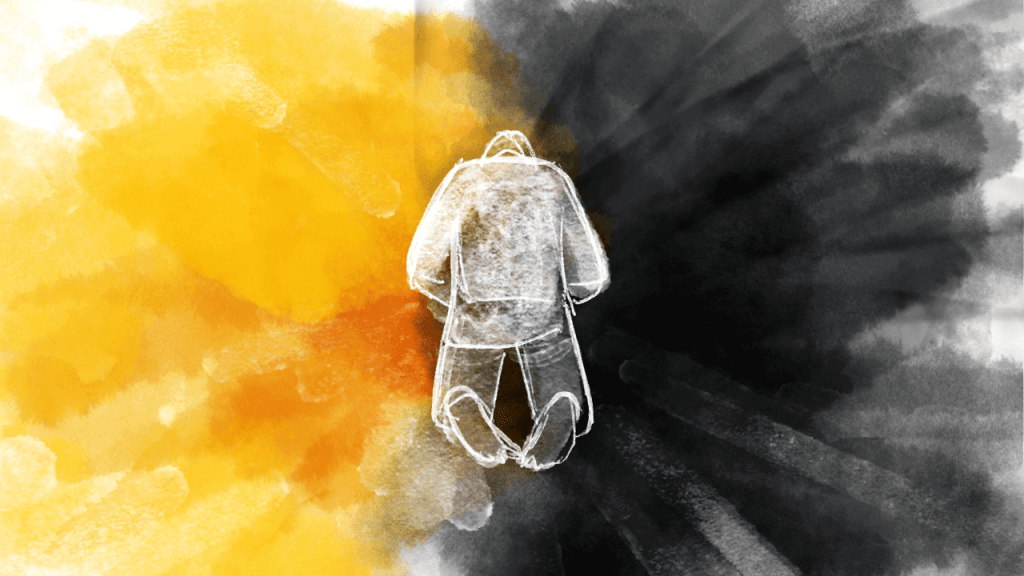
There can be such sorrow in this life, far much more than the human heart can possibly contain. But our Savior has a title (one of many). He is called the “Man of Sorrows.” He is the one who is “on point.” He leads us through such intense hostility and mind-numbing pain. He is there when the switch is flipped on us and it becomes instantly dark. He can’t, won’t, and will not leave you to face your pain alone. He knows.

There are a few things that I want to communicate to you.

These have come out of great darkness. I have tried awfully hard to be a disciple, even though I’m doing the worst job of it. These may be right, or wrong, or just okay–you decide. I don’t really know anymore.

  1. God amazingly takes the full weight of our pain and sorrow (Isa. 45:6-7, NLT). He doesn’t shift the blame or deny His work in the life of people. He’s fully sovereign. (Sometimes we need to adjust our theology.) Maybe it’s hard to trust Him right now–that’s more than understandable. In eternity, I believe, it’ll make perfect sense. Sometimes, we need to wait.
  2. Jesus has fully entered into our sorrows. All that you are feeling right now, He feels. If you feel you are at a minus 10, then He does as well. As you suffer, He is closer than your shadow. He knows us. He feels it all. Please don’t short-circuit over this.
  3. Nothing is ever wasted. We really shouldn’t treat these moments of sorrow as a waste. Have you ever wondered at Jesus’ ‘economy’ after the 5000 were fed?  He assigns value to the leftovers. The disciples pick up their baskets and collect everything again. Nothing will go to waste.  I strongly suspect that His kingdom works this way.
  4. This pain, this sorrow, is the intensive crash course in becoming a person of mercy. You now will always walk with a limp. At times the scars will be quite visible to those who can really see. This pain will become forever a “healed wound,” (but a wound nevertheless). It helps to seek out others who have walked this same path. And yet, to be honest, I don’t think I will ever fully trust a person (or a pastor even) who doesn’t walk with a limp.
  5. You will need (but maybe not accept) the transformation of your suffering into glory. This will take some time, and it almost feels like you’re not progressing at all. I encourage you to re-think each of these simple points. The Holy Spirit may be working, perhaps behind the scenes.
  6. Finally remember this: God is not a monster, stomping on us like a boy crushes ants. He has carried all of our pain and illness. He clearly comes alongside every suffering believer. It is Satan who would suggest to you that God is a Celestial Menace, not worthy of our love. I will be very blunt with you, that idea has to be implicitly rejected. Its origins are truly satanic.

“The LORD is close to the brokenhearted; he rescues those whose spirits are crushed.”

Psalm 147:3

“The Spirit of the Sovereign LORD is upon me, for the LORD has anointed me to bring good news to the poor. He has sent me to comfort the brokenhearted and to proclaim that captives will be released and prisoners will be freed.”

Isaiah 61:1

“He heals the wounds of every shattered heart.”

Psalm 147:3, TPT
 
I’m pretty much convinced that this post is a bit much for some. But please hold it close, maybe it’ll matter later on? (But I hope not.)
 

“A teardrop on earth summons the King of heaven.”

    Chuck Swindoll

*


Hagah, To Meditate

Psalm 1:2

Meditation has gotten a bad rap among some Christians, largely due to a connection with Eastern mysticism. This is really unfortunate for it has a critical place in the development of your discipleship. I believe it’s vital (and maybe even mandatory?)

Hagah is the Hebrew word for ‘meditation’ and it fascinates me.

It literally means to “moan, growl, utter, muse, or mutter.” Some have suggested that it contains the idea of ‘rumination,’ like a cow who chews a cud. The grass goes in, and it’s regurgitated several times, extracting every bit of nutrients and vitamins.

Hagah, or to meditate is the way we assimilate God’s Word into our lives. It’s critical that we do this in our walk as disciples that belong to Jesus.

Joshua 1:8, ESV

It’s an interesting command isn’t it? Joshua’s ministry is to lead God’s people and requires his deep connection to God’s promises. He needs to hagah God’s words, to purposefully think about them over and over and over.

It’s interesting to me that when Joshua meditates and carefully responds to the Word then he will receive success in his life and ministry. The word ‘success’ means “wisdom, comprehension, insight with prosperity.” I need that desperately.

And if Joshua needed to do this, might not we?

Start small and simple. There are over 8,000 promises in the Bible–pick one and ruminate on it. Hagah on the Word and try to extract the spiritual nutrients that it contains. You will grow, bless others, and walk in victory, defeating your enemy.

“The amount of time we spend with Jesus – meditating on His Word and His majesty, seeking His face – establishes our fruitfulness in the kingdom.”

    Charles Stanley

Bryan Lowe

alaskabibleteacher.com

You Need to Understand This

Finally, be strong in the Lord and in the strength of his might. 11 Put on the whole armor of God, that you may be able to stand against the schemes of the devil. 

For we do not wrestle against flesh and blood, but against the rulers, against the authorities, against the cosmic powers over this present darkness, against the spiritual forces of evil in the heavenly places.

Eph. 6:10-12, ESV 

Often in Scripture we’ll understand something which will shake us. Dismissing its truth as optional would be a grave oversight. Instead of perceiving it as a mere emphasis reserved for those more inclined towards “charisma,” we must insist on its relevance for each and every believer.

We face a battle. Every one of us.

We look around and see others whose ‘reality’ is different from ours. We see politics, psychology, biology or cosmology, religion or philosophy, entertainment or science that are blind to reality. But Ephesians 6 tells us what we’re up against. We’re starting to realize that humans have a terrible knack for being manipulated by evil powers.

1 John 5:19, Amplified

Ephesians 6 declares that we’re in a world where every individual is in a war.

This passage clearly tells us that the only place of safety is to be strong in God and to find that the only safety is pressing into His presence. To survive we must push everything else aside to be in His presence. He gives us His strength to overcome all evil.

The above passage stresses that there is an organized force of darkness focused on us. These verses in Ephesians 6 unveil a government of wickedness that’s everywhere. Without the humble intimacy that needs prayer and Bible reading, we will be spiritually destroyed.

C.S. Lewis

We need protection. Our only hope is Jesus’ strength. But we must actively step into this spiritual intensity.

We’re only strong through our intimacy with Him. He shields us from the spiritual corruption that swirls all around us. As we draw to Him we become mighty, as we listen closely to the Holy Spirit, we will walk in true discipleship with Jesus.

Watchman Nee

alaskabibleteacher.com

The Giant Goliath, and Sexy Bathsheba

I have wondered about this. It strikes me that there are two giants that David encountered in his walk with God. Granted, there are many other events and people that he experienced, obviously. But there are these two that stick out:

The Goliath showdown, and the Bathsheba fiasco.

These seem to be hinges or pivot points that would change the entire course of king David’s life, and his faith in God. They’re to be an encouragement and warning to us, as both are incredibly significant.

This is a powerful chapter, for it reveals David’s spectacular faith in God. When the boy David killed Goliath it changed the entire future of Israel. One stone from his sling was all it took. Israel routed the Philistine army. David’s faith was the spark that made victory real.

David became a hero that day, and quickly ascended into Saul’s favor. It was both a military and a political development that Israel needed and king Saul welcomed it, the kingdom thrived. The boy David became the man of the hour, a national hero which everyone talked about.

I’d like to point out that David had already been anointed by Samuel to be the next king. This, combined with David’s celebrity status pushed king Saul over the edge–Saul developed a deep resentment that became insanity. David handled this adroitly, fleeing into the wilderness (with his faith) for years.

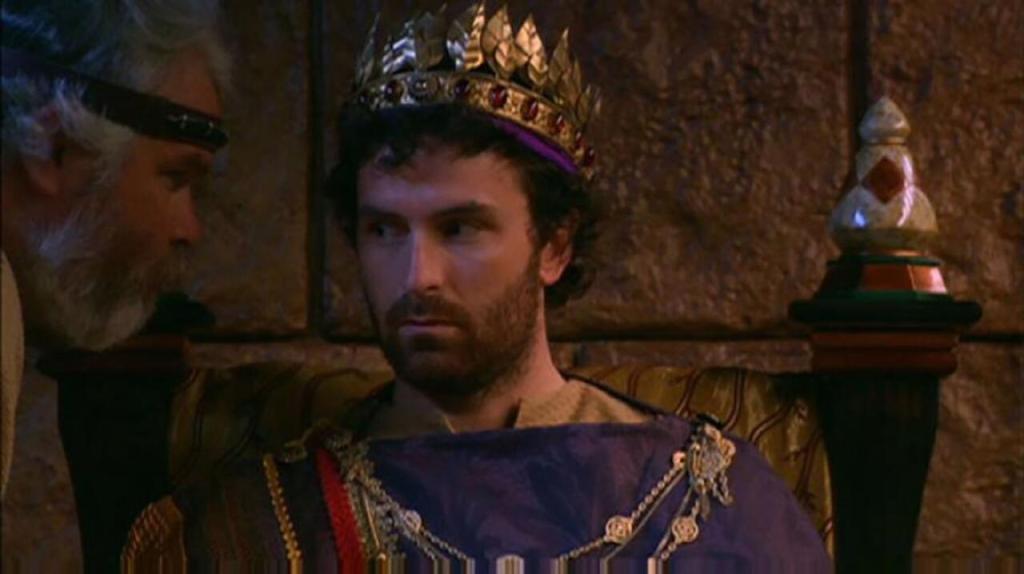
At this point David is now king and is fighting the Ammonites. The Israelites were besieging Rabbah, the capital city of that country, and it seems like it’s an intense battle. But interestingly enough, David remained in Jerusalem. (And I can’t figure out why.) David can’t sleep so he paces the rooftop and it’s then things get crazy.

David spies Bathsheba who is cleansing herself from her monthly cycle. She is a very beautiful woman, and king David inquires about her. He lusts after her which results in him more or less raping her, commiting adultery and then murdering her husband. This is all very disturbing.

When David had sex with Bathsheba it set in motion the ugliest chain of events imaginable. It seems that up to now David has taken the intiative of events, and then, after this great evil, his story shifts and for the rest of his life he becomes acted upon, a “victim.” He reacts, but doesn’t act anymore.

For the rest of his life he will struggle. All because of lust.

In 2 Samuel 12 David is confronted by a prophet for these sins. Samuel speaks with a parable that penetrates David’s heart. The king responds, “he shall restore the lamb fourfold, because he did this thing, and because he had no pity,” (v. 6). And interestingly enough, David would indeed pay fourfold. There would be four major incidents after this that he would now face.

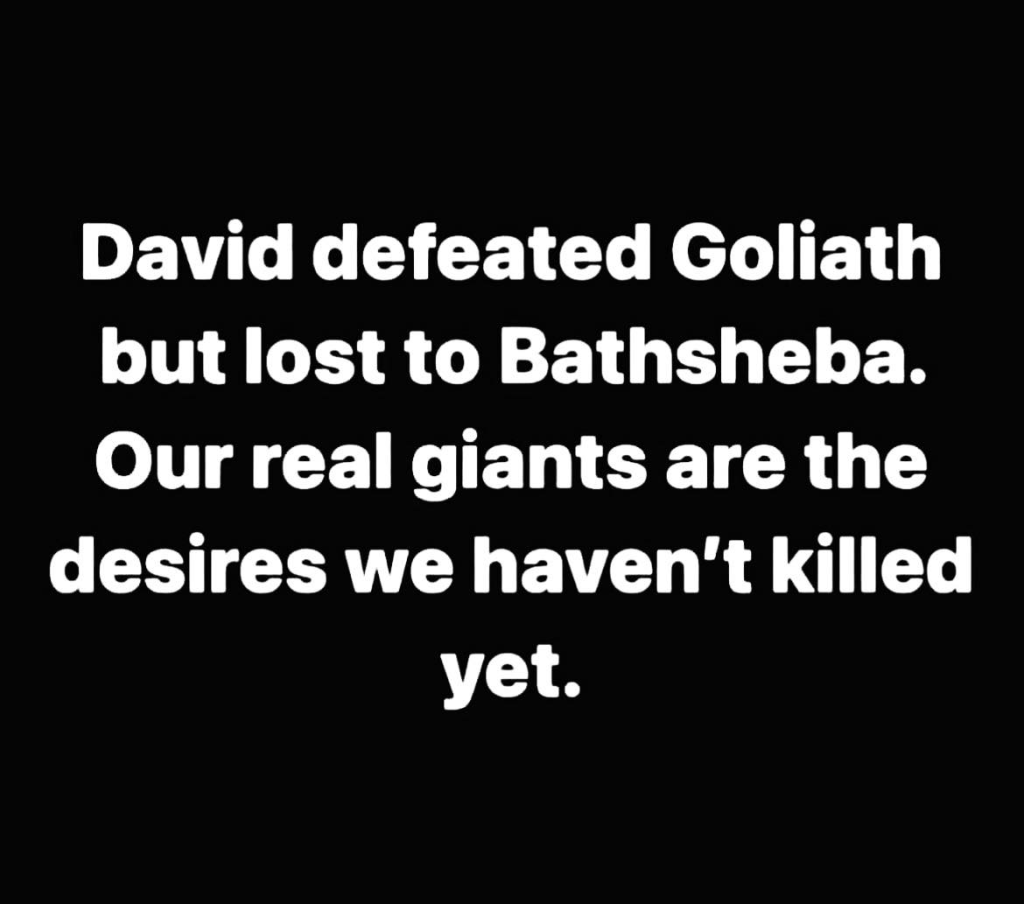
David faced two “giants” in his walk with God. They were very different but both life altering. He killed Goliath but was not able to destroy his lust with Bathsheba.

Sometimes one “giant” is not enough. It would be nice if that was the case. David walked in victory for a period of time, but failed both himself, his family and his kingdom. Lust always is an act of the will, a deliberate decision that destroys all that it touches. David would be forgiven, but the damage was already done.

There would be dire consequences for everyone.

I believe that our giants were meant to be slaughtered. That is their function and purpose for the faithful believer. There can be no compromise. They’ll take different forms and will often approach you in peculiar ways. Paul tells us to wear God’s armor in Ephesians 6:11-18. I don’t think that protection should be taken off–you dare not only wear it only on special occasions.

Brother, sister–you must be covered all the time.

King David is a lesson for us. There is tremendous pain for us if we deliberately choose to compromise with the giants in our lives. Some of you already understand this; others will. I promise you.

    Oswald Chambers

Bryan Lowe

alaskabibleteacher.com

Restore the Sparkle or I Will Die

Trials are hard, at times they seem to suffocate us and weaken our walk with God. David shares with us his own difficulty in these six verses.

Buckle your seat belt folks!


Commentary, Psalm 13

For the choir director: A psalm of David.
 

Lord, how long will you forget me? Forever?
    How long will you look the other way?
How long must I struggle with anguish in my soul,
    with sorrow in my heart every day?
    How long will my enemy have the upper hand?

V. 1-2, David believes that he has been forgotten. A phrase is repeated an astounding four times, “How long?”  It seems that impatience is a significant issue for him. Often when it gets this bad, we desperately look around to find anything to fill the gap. Anything.

Something else struck me. Within these two verses, you’ll find five hard questions. Whenever you find a question in the psalms especially, you must stop reading and take a closer look–why is he asking this?

V. 2, “Anguish…sorrow, every day.” Somehow David is alert enough to recognize (and admit) that his life is saturated with real difficulty. It seems it comes and when it comes there’s  no relief– it’s a constant, gnawing, challenging pain which can be physical, emotional, or spiritual (or all three).

Turn and answer me, O Lord my God!
    Restore the sparkle to my eyes, or I will die.
Don’t let my enemies gloat, saying, “We have defeated him!” Don’t let them rejoice at my downfall.

V. 3,  Turn and answer me, O Lord my God! Restore the sparkle to my eyes, or I will die.” (I love this version–“sparkle). David knew that life could be exceptional, it was meant to gleam and shine. There is much more than just breathing in life. He speaks of being restored. He looks toward God to change his world again.

V. 4, Also, he is quite aware that his life is being threatened. The word, “gloat” is an interesting translation. It has the idea of relishing someone else’s failure. The dark prince savors your defeat. He has been looking forward to this desperate moment. The enemy rejoices at his failures.

But I trust in your unfailing love.
    I will rejoice because you have rescued me.
I will sing to the Lord
    because he is good to me.

V. 5,  But I trust in your unfailing love. I will rejoice because you have rescued me.” The Lord has covered David with His hand. His life has been saved by a love that never falters or weakens. Never! He knows that God has rescued him.

Notice how David responds to the wonderful goodness of God.

  • I trust. 
  • I rejoice.
  • I sing.

V. 6,  Tremendous verse; it is really wonderful. When we finally get to this last verse, we see that we have “run the gauntlet” with David. And we have learned how to sing.

Often good jewelers display their diamond necklaces on a black background. The darkness intensifies the brightness of the jewels. They become even more beautiful to look at. David is singing and praising the Lord in His nearness. The darkness has only strengthened his faith.

I truly believe that this is what we were made to do.