Repairing Your Nets

“Yet those who wait for the Lord
Will gain new strength;
They will mount up with wings like eagles,
They will run and not get tired,
They will walk and not become weary.”

Isaiah 40:31, NASB

The word “wait” used here is powerful. It’s an awesome word, never used casually in the Hebrew scriptures. It does not mean to be uncaring or idle. Sometimes we wait in line at the grocery store, or maybe we’re waiting for a phone call. We wait all the time, and often, we don’t even realize it.

The Hebrew word for ‘wait’ is special. It’s qāvâ. It means, ‘to bind together by twisting.’ It’s an active word.

It sometimes means to work like a fisherman repairing his nets to get them ready for tomorrow’s catch.

(There are always holes to mend after a long night’s efforts.)

When we wait spiritually, repairing our nets, the following should be used. Much of this can be done in prayer.

  • Calming ourselves, setting aside everything that doesn’t fit
  • Reading His word
  • Seeing His face
  • Hearing His voice
  • Keeping pace with Him, whether He moves (or doesn’t)

Fixing our nets is a cool way to describe our journey, right? Sometimes, when we think about waiting, we usually only think about it in English, and that can be annoying. It often stops us from truly understanding the true meaning of ‘wait’.

I strongly believe that the Holy Spirit wants us to understand the concept of being closely connected to Him. Sadly, we are often held back by our own definitions, rather than embracing the definitions found in God’s Word.

“The LORD is good to those who WAIT for him,
to the soul who seeks him.”

Psalm 27:14

Sometimes we are instructed by someone to “wait on the Lord.” This instruction can be challenging and we are unsure exactly how we should do it. It’s usual for us to simply show agreement through a smile and a nod. We never completely grasp the essence of that word.

He becomes my source of power that comes from waiting.

He is now the sturdy bond that I am intertwined with. (Maybe this is how He gives strength and power to His people?) We must listen to this, and the Lord is very enthusiastic about guiding us into this fresh form of closeness.

The promise in Isaiah 40:31 talks about receiving new strength, like an eagle’s wings, a holy energy. This verse is important for us, especially today; we need this kind of strength right now. We need to repair our nets as often as we can.

“Waiting for God is not laziness. Waiting for God is not going to sleep. Waiting for God is not the abandonment of effort. Waiting for God means, first, activity under command; second, readiness for any new command that may come; third, the ability to do nothing until the command is given.”

    G. Campbell Morgan

alaskabibleteacher.com

The Holy Club

John 8:31

Being a disciple of Jesus is serious business. We’re learning to walk in His footsteps, and we do this through God’s grace and mercy. It takes discipline, and that can be hard. In 1729 a group of Christian believers started meeting at Oxford University with the intention of becoming more accountable in their walk.

They became known as the “Holy Club.”

Here are 22 questions they asked themselves in their private times with Jesus.

  1. Am I consciously or unconsciously creating the impression that I am better than I really am? In other words, am I a hypocrite?
  2. Am I honest in all my acts and words, or do I exaggerate?
  3. Do I confidentially pass on to another what was told to me in confidence?
  4. Can I be trusted?
  5. Am I a slave to dress, friends, work, or habits?
  6. Am I self-conscious, self-pitying, or self-justifying?
  7. Did the Bible live in me today?
  8. Do I give it time to speak to me everyday?
  9. Am I enjoying prayer?
  10. When did I last speak to someone else about my faith?
  11. Do I pray about the money I spend?
  12. Do I get to bed on time and get up on time?
  13. Do I disobey God in anything?
  14. Do I insist upon doing something about which my conscience is uneasy?
  15. Am I defeated in any part of my life?
  16. Am I jealous, impure, critical, irritable, touchy, or distrustful?
  17. How do I spend my spare time?
  18. Am I proud?
  19. Do I thank God that I am not as other people, especially as the Pharisees who despised the publican?
  20. Is there anyone whom I fear, dislike, disown, criticize, hold a resentment toward or disregard? If so, what am I doing about it?
  21. Do I grumble or complain constantly?
  22. Is Christ real to me?

“We have suffered from the preaching of cheap grace. Grace is free, but it is not cheap. People will take anything that is free, but they are not interested in discipleship. They will take Christ as Savior but not as Lord.”

    Vance Havner

I sincerely hope that this blesses you.

The Five Crowns

In the New Testament crowns are given to certain believers. They’re more than a reward, they’re recognition of a Christian’s life and character. Keep in mind that each one given is pure grace. They are not rewards that we earn, but recognition of God’s blessing. We can do nothing unless He gives us His grace. You must understand this.

We find that there are five. But understand, these are not given as recompense or compensation. A crown is never earned, and it’s never given as an achievement for exceptional behavior. All are received by His grace and kindness. (And, we’re not in any competition on who can receive the most.)

Here’s a list which I hope is complete.

  • the Victor’s Crown
  • the Crown of Rejoicing
  • the Crown of Righteousness
  • the Crown of Life
  • the Crown of Glory 

The Victor’s Crown, which is also called the Martyr’s Crown. We can read it in James 1:12 and also in Revelation 2:10. The Church of Smyrna is promised by Jesus, Do not fear what you are about to suffer…the devil is about to throw some of you into prison…Be faithful unto death, and I will give you the crown of life.”

The Crown of Rejoicing, is described in 1 Thessalonians 2:19 and in Philippians 4:1. This crown is given to those dedicated to evangelism or the mission field. Paul receives this crown for his work with the Thessalonians. “Therefore, my brothers, whom I love and long for, my joy and crown, stand firm thus in the Lord, my beloved.”

The Crown of Righteousness, this is given to believers who steadfastly look for Jesus’ Second Coming. It seems it’s also given to those who seek after an intimacy with Jesus. We can read of this in 2 Timothy 4:8. “There is laid up for me the crown of righteousness, which the Lord, the righteous judge, will award to me on that day, and not only to me but also to all who have loved his appearing.”

The Crown of Life, this is given to those who have laid aside all the things this world offers and are committed to a life that is eternal. “Everyone who competes in the games goes into strict training. “They do it to get a crown that will not last, but we do it to get a crown that will last forever.” (1 Cor. 9:25.)

The Crown of Glory, given to the pastoral servants who have prayed and served the Church, “And when the chief Shepherd appears, you will receive the unfading crown of glory.” According to 1 Peter 5:2-4 this crown is given to those who have served the flock faithfully as His shepherds and teachers.

These five crowns are freely given, by grace, to each who deserves them. In each and every case it’s Jesus who coronates each believer. We’ll watch and we’ll agree with His decision. We will not vote to see who is worthy but we will understand His gracious wisdom of that person’s trials and challenges.

None of these crowns will not be worn very long. There will not be any reason to show them off to other believers, “Look at me, I’m wearing two, how many crowns are you wearing?” No. Rather, in love, we return each crown to Him who gave it to us.

A crown is temporary and is given back to Him who loved us so much. 

“The twenty-four elders fall down before him who is seated on the throne and worship him who lives forever and ever. They cast their crowns before the throne, saying,

“Worthy are you, our Lord and God,
    to receive glory and honor and power,
for you created all things,
    and by your will they existed and were created.”

Revelation 4:10-12

Willian Tiptaft

Deer Feet for the Believer

“He made my feet like the feet of a deer
    and set me secure on the heights.
35 He trains my hands for war,
    so that my arms can bend a bow of bronze.”

2 Samuel 22:34-35

David’s Song of Deliverance

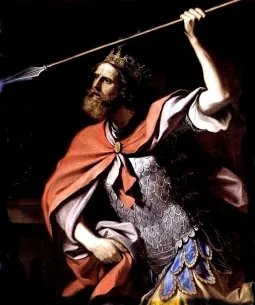
This entire psalm was written after David was delivered from the hand of Saul. David had been a fugitive for years and had experienced extreme difficulties. He had been pushed to the brink many times, yet maintained a close walk with God.

This verse in 2 Samuel has always blessed me. The image of a deer who has been put on a mountaintop through the direct action of the Lord–it’s a place of safety, a position of victory. It comes as a decisive maneuver of the Holy Spirit.

Psalm 18:33

David had learned things in the wilderness that he would never have otherwise. At times life got pretty extreme for him. When he struggled it was understandable. He followed the path that God laid out. It wasn’t easy for David, but he walked in faith and not by sight.

Danger surrounded David on every side – physically, spiritually, emotionally, socially. It would come from enemies, and even from his dearest friends.

God’s people are not immune from trials. It’s good to know that these are now orchestrated by our Father, and they’re purposeful and planned.

The prophet Isaiah extends the imagery of a deer in his prophetic ministry, but adds other ideas as well. The lame, mute and the desperately thirsty are descriptive of people who are given a special grace and touch. They’re promised something. They receive the promise of the Lord Jesus Christ.

“Then shall the lame man leap like a deer,
    and the tongue of the mute sing for joy.
For waters break forth in the wilderness,
    and streams in the desert;”

Isaiah 35:6

“David thought of how deer seem to skip from place to place and never lose their footing. God gave him the same kind of skill in working through the challenges brought by his enemies.”

David Guzak

alaskabibleteacher.com

He’s Inside of You

Ephesians 3:14-18

Prayer often does what preaching can’t. Some need a reminder. This idea of being “rooted and grounded in love” is crucial to growing up Christians. And it most often happens when the preacher is driven to his knees by a sticky situation.

After over 30 years I’m starting to see that my teaching has certain limits, but prayer on the other hand, always drives discipleship home.

You must settle on this spiritual fact, only a disciple can make a disciple. Too many preachers are believers themselves who don’t have a real prayer life. They end up using the pulpit (and the worship) as their sole ‘means of support.’ I can guess you can see how tragic this becomes.

A prayer meeting is almost unheard of lately, but I still believe that there are small groups of Christians who believe that both doctrine and prayer are God’s way of growing us up into His image. These two must be blended before real growth can begin.

“Strengthened with power through his Spirit in your inner being.”

Prayer is Paul’s way of building up the Ephesian church. In my personal opinion, he was locked up in a Roman prison for a couple of good reasons–the first is that he would discover he could disciple at a distance. And second that his prayer was an exceptional way to build the Church. Paul starts to understand this, and he rediscovers a new way to pray.

Paul’s prayer becomes a tool of considerable force.

Ephesians 3 papyrus from c. 275 A.D.

from wikipedia.org

The “inner being” is what he’s aiming at, and it’s Paul’s way of touching the heart of anyone the Holy Spirit is dealing with. Mr. Dry Eyes will never reach  the hearts that the Father is working in. Rather Mr. Crying Tears does the Father’s work. It’s not impeccable logic or great theology that completes the work, but the deep, deep cry of the heart.

So that Christ may dwell in your hearts through faith—that you, being rooted and grounded in love,

The immense power is Jesus living inside of us. Faith is God’s own key that He gives. Love is our root; it helps us grow. It gives us stability which is critical living in a confused and fallen world.

 Sadhu Sundar Singh

The Jealous Heart of God

Ezekiel 6:9, NLT

Hollywood talks about “the force,” but the Bible reveals something far more than that. The Holy Spirit is personal, not something but Someone. Even though He is a Spirit and has all the attributes of God, He also has a personality and can be offended.

  • He grieves, Ephesians 4:30
  • We can quench His Spirit, 1 Thessalonians 5:19
  • He is outraged (some translations say insulted), Hebrews 10:29

It’s also critically important to understand the jealousy of God. Twelve times in the OT we read this about God. (To be jealous can be good, and it can be bad.) Here’s just one verse:

Zechariah 8:2

in the Hebrew the word for jealous means “to become intensely red.” It has the thought of a face becoming flushed with deep emotion. This shows that God truly loves His covenant people. He’s concerned for them.

We find that the Holy Spirit is disturbed by faithlessness.

We can insult Him. We can grieve Him.

God can be hurt by our decision to ignore Him and sin. He’s disturbed by our commitment to anything but Him. This is the essence of idolatry and that hurts Him. God insists that we turn to Him first, and by faith and the power of the Holy Spirit, live under the control of the King.

We can become traitors. Does God weep for us?

     Charles Spurgeon

Purity in an Impure World

First, let’s start off with a definition. Purity describes something that is not mixed with anything else. It’s not 80% of something, or even 99.9%, rather it’s fully and completely one thing. Purity also means to be solely without any additive, contamination or pollution.

Purity of heart is to be exclusively focused on one thing.

This verse, 5:8, “strikes the very center of the target as he says, not ‘Blessed are the pure in language, or the pure in action,’ much less ‘Blessed are the pure in ceremonies, or in raiment, or in food;’ but ‘Blessed are the pure in heart.’” (C.H. Spurgeon)

We really must see this world as God sees it. 

We find that scripture is not very kind to us. It seems that mankind defiles everything he touches. (I wish it wasn’t so.)

“The human mind is the most deceitful of all things. It is incurable. No one can understand how deceitful it is.” Jeremiah 17:9

Consider the following areas that are affected by out “fallenness:

  • Entertainment, movies, the internet 
  • Politics, local, national and world 
  • Religion, philosophy, theology and spirituality
  • Culture and art, literature and music
  • Education
  • Science and technology, medicine and psychology
  • Economics, wealth and poverty
  • Sexuality

The above list is hardly complete, and as I compiled it I got a little heavy-hearted. I had to ask myself, are we really this bad? Again the Christian must look at the Bible for wisdom and direction.

 “All have sinned and continually fall short of the glory of God.” Romans 3:23

“The heart of the sons of men is full of evil, and madness is in their heart while they live.” Ecclesiates 9:3

As Christians who spiritually understand the work and the love of Jesus Christ. We are called to know and love God, must continually reacquaint ourselves to the absolutely depraved condition of this world. No one, and nothing is exempt.

There is another verse I want to consider, it mentions purity twice!

“Having purified your souls by your obedience to the truth for a sincere brotherly love, love one another earnestly from a pure heart,” 1 Peter 1:22

Notice. The verse stresses that we have to take the initiative. Now I suspect that being pure is our responsibility. “Obedience to the truth” must lead to “brotherly love.” It’s not really a surprise that that’s where we end up. 

To really see God, and to truly love others, requires purity. 

When it comes to being pure we must become humble–that’s our starting point. Humility keeps purity from becoming false. We dare not become “holier-than-thou.” We can easily become hard, religious and judgemental. Becoming a “Pharisee” is easy and always possible.

Lower Seat Christians

Luke 14:7-11

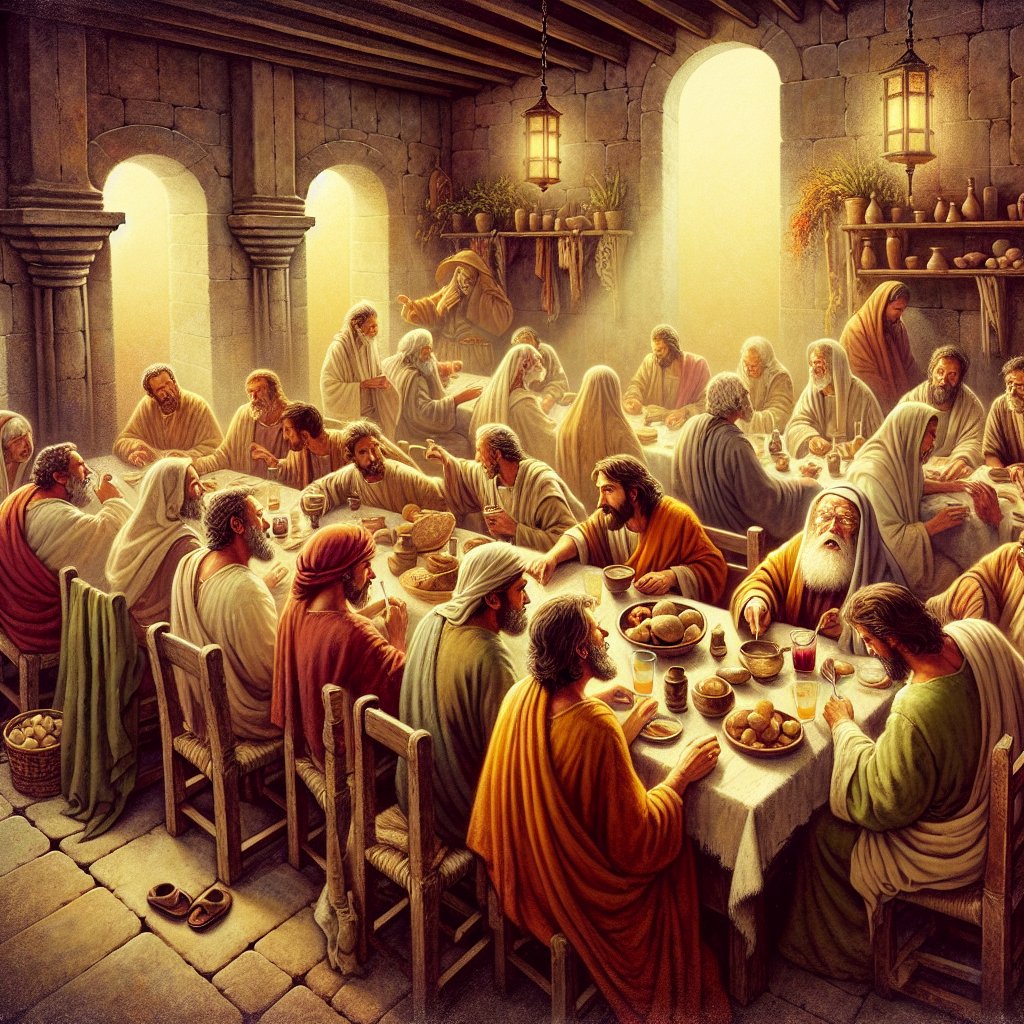
Choose your seat carefully. In Jesus’ day, there was a definite seating order to a wedding feast. It wasn’t first come, first served. There was a strict protocol, where one’s importance mattered. Honored people got honorable seats–close to the front as possible. Average people got average spots; but no one wanted be at the bottom, having to sit at the “kids table.”

Jesus was watching, and what he saw was a spiritual principle of His Kingdom.

Jesus often teaches out of the things we encounter–real life events. Spiritual truth often hits us from those things we actually see. If you want to know what God is doing in your life, all you need to do is look around at the “practical” things, and start to see the spiritual lessons inside them. We learn from real-life. That’s how he often teaches us, he combines the Word with what we’re experiencing.

Our natural inclination is to move higher up.

We often think that we’re deserving, and so we take our “rightful” positions. That’s the way humans think. We all want to sit in the best possible place, and so we end up wheedling our way up front. We can fall into the subtle trap of self-promotion. But that’s not how discipleship works.

Jesus corrects, advising us to take the lowest place. I think verse 11 is the key to figuring out this seating arrangement. We’re starting to see a physical situation become a spiritual lesson. There’s much to learn. Here’s verse 11 in the Amplified version:

“For everyone who exalts himself will be humbled [before others], and he who habitually humbles himself (keeps a realistic self-view) will be exalted.”

Verse 14, Amplified Bible

This translation injects some realism into our lives, especially in how we see ourselves. It’s something quite foundational. It lays down a principle that is always true in his Kingdom (1 Peter 5:6). If we don’t accept and implement this, we’ll suffer a definite deficiency in our discipleship. It stunts the growth of many believers. And that is tragic.

The whole scene lays out how life in the spirit really works, and it seems terribly paradoxical.

Our human logic asserts that deliberately choosing the lesser is foolish, things really don’t work that way. We think (falsely), that we’ll only advance by asserting ourselves. But Jesus, quite aptly, clarifies the ways of the Kingdom–true maturity will only come if we decide to take the lowest place.

“Humble yourselves before the Lord, and he will exalt you.”

James 4:10

The Snare: Psalm 91

caged-bird

Whoever dwells in the shelter of the Most High
    will rest in the shadow of the Almighty.
I will say of the Lord, “He is my refuge and my fortress,
    my God, in whom I trust.” 

Psalm 91:1-2, NIV

This psalm focuses on being intimate with our heavenly Father.

Throughout the entire chapter, we see personal pronouns used. In contrast to other psalms that are directed to the nation, this one is written to an individual. This personal focus makes this a favorite psalm for many.

Shelter and shadow, refuge and fortress.

These are the opening ‘word pictures’ and they’re used very adeptly.  The psalmist writes what he knows, and it is apparent that he understands deeply the needs of the human spirit, and its protection. Each of these four words creates a common link between believers. Each of us needs a working understanding of all four protections.

I should ‘dwell’ in God’s sheltered care. All too often, I wander out past the security of the Lord (or maybe I’m lured out?) But there is safety in having God so close to us. His proximity is for my protection.

“Surely he will save you
    from the fowler’s snare
    and from the deadly pestilence.
He will cover you with his feathers,
    and under his wings you will find refuge;
    his faithfulness will be your shield and rampart.”

Psalm 91:3-4

silhouette-bird-on-branch-granger

V.v. 3-4, maintains its personal tone. ‘Save you’ (salvation) is far more than a theological term.  The psalmist is not speaking ‘doctrine’ as much as the psalm describes a loving embrace. He is rescued from a deadly trap, and jumping from metaphor to metaphor, he engages our imaginations to ‘see’ God’s salvation. The writer knows his stuff.

The Lord is pictured as a protective bird that covers his chicks.

We have a sure confidence as we gather together in that warm and safe spot under His wing. Whatever is after us has to go through God first. His presence is formidable. In His company is found our only safety.

“What, then, shall we say in response to these things? If God is for us, who can be against us? Who will bring any charge against those whom God has chosen? It is God who justifies.”

Romans 8:31, 33

All of heaven is rallying for your well-being. You are sure of this based on your faith in God’s own word. He has ‘busted us’ out of a dark cage, and now defends you against all your enemies.

And that is a very good thing.


The Church is Collecting Sinners

The following excerpt is from the devotional book, “Living the Message,” by Eugene H. Peterson.  This pastor-professor is probably the person I want to grow up to be like; he has a gentleness and eloquence that is seldom seen–and highly respected.
Dr. Peterson died in 2018.

***********

“When Christian believers gather in churches, everything that can go wrong sooner or later does.  Outsiders, on observing this, conclude there is nothing to this religious business, except perhaps, business…and a distant one at that.  Insiders see it much differently.”

“Just as a hospital gathers the sick under one roof and labels them as such, the Church collects sinners.” 

“Many people outside are just as sick as the ones inside, but their illnesses are either undiagnosed or disguised.  It is similar with sinners outside the church.”

“One way to define spiritual life is getting so tired and fed up with yourself you go on to something better, which is following Jesus.”

Some other quotes by Eugene Peterson:

  • “All the persons of faith I know are sinners, doubters, uneven performers. We are secure not because we are sure of ourselves but because we trust that God is sure of us.”
  • “Suffering attracts fixers the way road-kills attract vultures.”
  • “When we sin and mess up our lives, we find that God doesn’t go off and leave us- he enters into our trouble and saves us.”
  • “That’s the whole spiritual life. It’s learning how to die. And as you learn how to die, you start losing all your illusions, and you start being capable now of true intimacy and love.”
  • “American religion is conspicuous for its messianically pretentious energy, its embarrassingly banal prose, and its impatiently hustling ambition.”

More Eugene Peterson Quotes…