Thorns for the Whore

“Therefore I will hedge up her way with thorns,
    and I will build a wall against her,
    so that she cannot find her paths.”

Hosea 2:6

A holy prophet is told to marry a prostitute–sounds crazy I know, but this union was intentionally commanded by God. It served to announce to Israel the present condition of their hearts, (1:2). In God’s eyes, Israel was nothing more than a spiritual whore. They would now be forced to grapple with this truth.

Her name was Gomer, and the prophet was Hosea.

The truth is sometimes a very hard thing. God has a bellyful of Israel’s prostitution, the nation has repeatedly went astray, they’re full of sin and idolatry. What else can God do to break this ‘spell’ and get their attention?

O.K. So why this hedge of thorns?

  • This hedge was initiated by God Himself
  • It was not vindictive; it wasn’t meant to destroy
  • Sin will never satisfy those in a covenant relationship with Him
  • Repentance was the goal God wanted to see
  • It’s function was to resist their sin and idolatry
  • This hedge was to bring Israel back into a right relationship with Himself

Imagine being restrained by the Lord in this way. Spiritual handcuffs and fetters and anything else that would restrict you from sin. He loves you and as a believer you belong to Him exclusively. He will discipline you if you persist in your sin. (But that is a good thing.)

He does this out of an everlasting love that’s forever loyal to you.

The very next verse (v. 7) is the response of Israel to being hedged in. It seems to be doing what He intends it to do. The ‘block’ seems to be working. (This sounds a bit like the “prodigal son.”)


“She shall pursue her lovers
    but not overtake them,
and she shall seek them
    but shall not find them.
Then she shall say,
    ‘I will go and return to my first husband,
    for it was better for me then than now.’

Hosea 2:7

When you receive Jesus as your Savior you now belong exclusively to Him. That covenant is far more than eternal life. It also means that He is fully and irrevocably committed Himself to making you a holy person. He disciplines when you persist in sin. But it’s done out of love.

Some have suggested praying the hedge of thorns over straying children or family. Perhaps that’s what is necessary. Pastors and elders could intercede for wandering believers using the same example found in Hosea 2. I believe God hears us as we pray.

“We often learn more of God under the rod that strikes us than under the staff that comforts us.”

   Stephen Charnock

Leaders Who Wash Between the Toes

drsunil.com, art by Takla

He came to Simon Peter, who said to him, “Lord, do you wash my feet?” Jesus answered him, “What I am doing you do not understand now, but afterward you will understand.” Peter said to him, “You shall never wash my feet.” Jesus answered him, “If I do not wash you, you have no share with me.”

John 13:6-8 (verses 3-17)

Chapter 13 always rocks my world. I visualize this, like a fly on the wall, watching it happen–and then I replay it over, and over in my mind. It always unravels me. Why does this have to happen? What does this passage tell me about Jesus and his kingdom? (John 13). Why can’t I just walk away from it, and leave it be?

Jesus made himself a slave on purpose.

Or perhaps he was always a slave all along, and we just didn’t realize it? Foot-washers were pretty much regarded as sub-human, mindless drones who mechanically performed a necessary duty. The lowest of the low, the very least of the least. (Today they’re the burger flippers and the pool cleaners.)

But Jesus took that role on himself, he laid aside his garments and his Godhood. (They landed in a pile in the corner of the room). When he knelt down to scrub feet (making sure he got between the toes), it was Deity serving man. This God/rabbi intentionally did this, not reluctantly or halfheartedly–but carefully. Brilliantly.

He was their teacher, and custom demanded he enjoys the prerogatives of that position. But he wouldn’t, and didn’t. He mustn’t. As I stress over this, I must conclude he really was their “teacher,” but not in the way I expect. What he was doing on his knees, was instructing them in the art of loving each other.

He showed us a real leader in action.

And isn’t making disciples all about loving (and washing) someone else more than ourselves?

We get things turned around sometimes–we think that spiritual authority is moving up when it’s all about going down. We elevate our pastors and elders, maybe subconsciously–and human nature lets it happen, and then we’re amazed why our leaders struggle so.

Leaders function best when they wash between the toes.

There was a point in Jewish history when the people actually demanded that God would give them a king, instead of a judge (1 Samuel 8:5-9). God warned them that this wasn’t in his plans–but they insisted.

They had to have one, everyone else did. We still must have celebrities, and then we wonder why they short-circuit on us. Who can resist the privilege, and the limelight of the platform?

The Church was never meant to operate like this.

That’s what Jesus said. Instead, it’s we who’ve turned it upside down. It’s we who insist on turning our pastors into minor celebrities. We assert that they take on the role of a “king” (albeit, a little one maybe). Perhaps leaders who stumble and fall do so because we want them to be front and center? Who can handle the privilege and the adulation? I know I can’t.

Peter was classic Peter.

It seems that whenever he resists, he gets rebuked. He makes it quite clear that Jesus will never wash feet–that Jesus will never use a basin or towel and serve him like this. It was outrageous. Unacceptable. It didn’t fit in Peter’s personal theology. He had no room for Jesus the slave. (Perhaps he knew that to follow meant he would have to do the same thing? IDK).

Jesus still washes His people. He has not changed.

He sits us down and takes off our shoes and socks, and scrubs us clean. And we hate it. But to be washed by him is a condition of our discipleship. Every follower must be clean, and he continues his work to this day. We sin daily, even as his own, and he cleans us up–and somehow that really bothers us.

The gifts of leadership are one way of washing feet. At least that’s what our leaders were designed to do. That’s Jesus’ way of doing things. But it seems we’ve adopted Peter’s attitude, and embraced the ‘pre-king’ thinking of Israel. We need our celebrities, we want our kings. We simply can’t imagine it any other way.

“The very first thing which needs to be said about Christian ministers of all kinds is that they are “under” people as their servants rather than “over” them. Jesus made this absolutely plain. The chief characteristic of Christian leaders, he insisted, is humility not authority, and gentleness not power.”

 John Stott

Choosing a Pierced Ear

Body piercing has become pretty much acceptable just in the last ten years. 

Studs are placed in a hole or piercing to make a permanent decoration.  I have seen a fair amount of it, and I think that a stud in the tongue has got to be the most intrusive.  (I recently read of a young girl who died after her tongue was pierced from an infection).

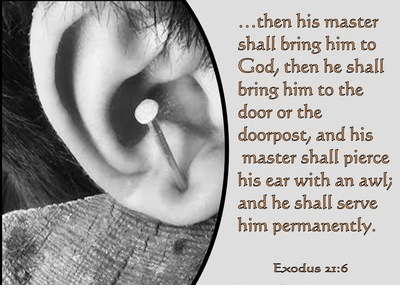
There is “body piercing” in scripture.  In Deuteronomy 15:12-18, slaves who are being set free by their master after six years of service, could, if they loved and were loved by their master, could choose to remain a slave to him.

“But if your slave says to you, “I don’t want to leave you,” because he loves you and your family and has a good life with you,17 stick an awl through his ear into the door; he will be your slave for life. Also do this to a female slave.”

Deuteronomy 15:12-18

This was a decision that required elders to act as witnesses.  It was significant as well as completely binding.  I like to think of the ceremony to be kind of a cross between a wedding and a circumcision. (Sounds fun, huh?!)

The slave would be led to a doorpost and the master would take an awl, and push it through his ear lobe.  This designated the slave to be forever “owned” by a specific master.  Herein lies a picture of the Christian.

Many times in the New Testament we are called to be servants (slaves) of Christ.

Peter, Paul, James, and Jude referred to themselves as “bond servants of Jesus Christ” in their epistles. This is not a forced servitude. It’s a choice made in love!

There are many believers who have done the same, they have fallen in love with their Savior.  They do not plan on a life apart from Him.  So spiritually they have gone to the doorpost, the awl is pushed through their ear, and they are marked from that point on.

Although the ear was pierced physically in the Old Testament, a different kind of piercing takes place in the New.  In Romans 6:16 we read,

“Surely you know that when you give yourselves like slaves to obey someone, then you are really slaves of that person. The person you obey is your master. You can follow sin, which brings spiritual death, or you can obey God, which makes you right with him.”

Romans 6:16, (NCV)

When the prodigal son returned home from the far country he fell before his father and humbly ask,make me your servant.” (Luke 15:19,21) He, in essence, was saying to the father, “pierce my ear.” The father made him a son, but the attitude of the son’s heart had changed to the heart of a servant. So it must be with us. Only then will we live a “pierced ear” life, revealing to all that we are servants of Jesus Christ!

“Savior, I know Thou hast allowed me absolute liberty, to serve Thee, or to go my own way. I would serve Thee forever, for I love my Master. I will not go out free. Mark my ear, Lord, that it might respond only to Thy voice.”

— Jim Elliot, Missionary and Martyr


alaskabibleteacher.com

A Legion of Demons

Mark 5:1-15

They came to the other side of the sea, to the region of the Gerasenes. As soon as he got out of the boat, a man with an unclean spirit came out of the tombs and met him. He lived in the tombs, and no one was able to restrain him anymore—not even with a chain— because he often had been bound with shackles and chains, but had torn the chains apart and smashed the shackles. No one was strong enough to subdue him. Night and day among the tombs and on the mountains, he was always crying out and cutting himself with stones.

6 When he saw Jesus from a distance, he ran and knelt down before him. And he cried out with a loud voice, “What do you have to do with me, Jesus, Son of the Most High God? I beg you before God, don’t torment me!” For he had told him, “Come out of the man, you unclean spirit!”

“What is your name?” he asked him.

“My name is Legion,” he answered him, “because we are many.” 10 And he begged him earnestly not to send them out of the region.

11 A large herd of pigs was there, feeding on the hillside. 12 The demons begged him, “Send us to the pigs, so that we may enter them.” 13 So he gave them permission, and the unclean spirits came out and entered the pigs. The herd of about two thousand rushed down the steep bank into the sea and drowned there.

14 The men who tended them ran off and reported it in the town and the countryside, and people went to see what had happened. 15 They came to Jesus and saw the man who had been demon-possessed, sitting there, dressed and in his right mind; and they were afraid.

I had so many demons inside me, people called me Legion. I ruled the spiritual world of the Garasenes. People were afraid of me, of what I would do to them. Believe me, they knew. I was a living nightmare, their boogeyman. My days was filled with awful confusion and terror.

And I was completely insane.

I can recall little through my darkness, and I suppose that was for the best. My madness permeated everything. My life had become completely saturated with evil. What little I know I will tell you.

Try to imagine the condensed insanity of a mental hospital crammed into one’s little brain.

That day, I was on the Gerasenes’ “welcoming committee.” I ran to greet Jesus before he even got out of the boat. I remember falling at His feet. I knew instinctively who He was. He was the Lord over my darkness. I suppose that deep down I knew that only He could free me.

The authority of Jesus enabled him to speak directly to my demons. I remember how they tried to negotiate their way out, but with His total authority over darkness, He calmly sent them into a herd of swine nearby.

There were about 2,000 pigs, and when my evil spirits left me, they entered them. The pigs went berserk, squealing and running. I was told later that they destroyed themselves. They couldn’t handle all the evil that I had ‘bottled up’ inside me.

With Jesus’ firm and decisive command, the darkness immediately left me alone.

Suddenly, I could no longer hear the demon’s vile words. I knew that I would no longer have to carry out their disgusting will. There were no longer voices in my head. I stood up as a free man, now walking in the light. Jesus Christ had decisively intervened.

Someone gave me a robe to cover up my nakedness. I sat at Jesus’ feet in a wonderful daze at what had just happened, and it didn’t take long for the townspeople to arrive. They came and found me clothed and completely sane. I suppose it was out of fear that they asked Jesus to leave the region immediately.

I only wish they understood who He really was.

When Jesus was getting into the boat I wanted to join Him. I simply had to be close to Him. But Jesus told me no. He told me that I needed to go home to my family, and I must tell them everything. “Tell them all of the power and mercy I have had on you.” As I watched them sail away I knew that I wanted to do what He asked.

I would now be Jesus’ ambassador to the Ten Towns.

I explained to them everything that had happened to me and all that Jesus could do. I was now His very visible witness. I shared about the power and authority of the Lord Jesus Christ over my incredible darkness. I was now a source of His light to my people.

I had to witness to the others, and it would be my joy to do so.

Lord Jesus, You completely rule the spiritual forces of darkness. Help me to remember this and assist me with my own dark issues. I want to be free from all that opposes You. I must tell others of what you’ve done for me. Amen.

alaskabibleteacher.com

We Were Born to Serve

We Were Born to Serve Others

“When a servant comes in from plowing or taking care of sheep, does his master say, ‘Come in and eat with me’? No, he says, ‘Prepare my meal, put on your apron, and serve me while I eat. Then you can eat later.’” 

And does the master thank the servant for doing what he was told to do? Of course not. 10 In the same way, when you obey me you should say, ‘We are unworthy servants who have simply done our duty.’”

Luke 17:7-10

After years of ministry— this particular passage has slowly become one of my favorites. The path I’ve walked has been challenging, and it seems to me that I haven’t done it very well at all. I’ve been a fool much of the time, and yet, if anything, God has held me firmly in place. I haven’t always been faithful. But He has.

I used to kill rattlesnakes when I lived in Mexico. (You might say it was my hobby.) But it demanded a certain cautiousness, and lesson #1 was this–you never, ever take your eyes off of the snake–no matter what. We must approach ourselves that carefully. Our hearts are desperately wicked. We must understand this.

“I am more afraid of my own heart than of the pope and all his cardinals. I have within me the great pope, self.

    Martin Luther

Please let me explain what I’m thinking.

The Lord Jesus tells us one of those stories of his. This parable is one of his best. It makes a lot of sense, and it resonates within me. It tells me that I must watch myself, lest I forget the idea behind this passage. I’m His slave and not deserving some kind of special treatment.

Jesus’ parable explains our duty as His servant.

It seems that after a hard day’s work, a slave still needed to prepare his master’s dinner. No matter how much he toiled out in the fields, he had a duty to serve his master in this way; and it does seem unfair–we live in a land “where all men are created equal.”

But this is how the God’s Kingdom works.

We get dirty, we toil hard, and we sweat under the hot sun. We dream of a glass of cold lemonade (with ice), and a cool shower when we quit the fields. But that isn’t the way it works. Yes, Jesus gives his laborers rest–but the work continues.

The work goes on, even when God buries his workers. Hopefully, the next generation will continue my almost humble efforts, and his work in his fields will continue. But, in the meantime I must “watch” myself carefully, and do his will out in his fields.

Just as a servant knows that he must first obey his master in all things, so the surrender to an implicit and unquestionable obedience must become the essential characteristic of our lives.

Andrew Murray

Yes, it’s a foreign concept, and we can’t really relate–we either skip its message, or apply it to others. Jesus uses it quite adroitly, the servant works for his master; completely, exclusively. A slave who has no rights of his own. We serve and obey our Master.

Any desire for promotion, pleasure, riches, or fame will quickly make one a servant of the Beast. And, I’m afraid, that is exactly what many of today’s pastors and preachers have become.

    Chuck Baldwin

Learning to Love Prodigals

Learning how to forgive

Once I was punched in the face while preaching. I served as a full-time evangelist with SOS Ministries in 1987. I was leading a group to Haight/Ashbury St. in San Francisco. I remember it was really busy, and the it was a good team, and they were excited to take their church to the streets.

Haight/Ashbury was the place the “summer of love” kicked off, it peaked in 1968. It has a certain sense of notoriety, and even in 1983 it still had a dubious reputation as a center of the counter-culture. “A cult a day is born in San Francisco,” a pastor friend once shared with me.

Normally the neighborhood where I took a team would direct me on how to preach. Tonight I focused on God’s love for sinful people.

That message seemed appropriate for this place, and especially on this street. God loves these people very much.

A young man came forward. He told me that he was a backslidden Christian, and his father was an Assembly of God pastor. He had run away from home. Suddenly he began to weep. The entire team seemed to lean forward and I know they were praying earnestly for him. It seemed to me that he was teetering on the brink.

The punch came unexpectedly.

His fist hit me square in the nose. My eyes began to water. Oddly enough he took a step back and began to really cry out. My team wasn’t quite sure how to respond, but I hoped they prayed even harder. I sort of gasped and tried to shake it off. Someone must have called the police.

The Holy Spirit was very much present, both convicting and comforting each of us.

One or two minutes went by and suddenly he stopped sobbing and he became really angry. He took a step and then tried to kick me in the stomach, but I dropped the mic and caught his foot. I was ready for him this time.

About 20 minutes went by before SFPD showed up and asked if I wanted to press charges. I thought for a bit, but deep down I knew that wasn’t the will of my Father. Maybe I should of, I don’t know. But I thought about my own sin and couldn’t judge no one.

The Father was reaching him while teaching me!

God loves His prodigal children very much, He understands the guilt and shame (and frustration) they feel. The Father however is always watching and waiting. He works through life’s circumstances to lead them home. Each belongs to Him. He continues far past what we think is possible. He will never give up.

“We know what real love is because Jesus gave up his life for us. So we also ought to give up our lives for our brothers and sisters.”

1 John 3:16

I suddenly saw a “wounded” brother, very confused and quite angry. Not with me, the team, or the music–but with God who created him, and died for him.

At that moment I just happened to be God’s love for this prodigal.

“How did Jesus expect His disciples to react under persecution? (In Matthew 5:12 He said), “Rejoice and be glad!” We are not to retaliate like an unbeliever, nor sulk like a child, nor lick our wound in self-pity like a dog, nor just grin a bear it like a Stoic, still less pretend we enjoy it like a masochist. What then? We are to rejoice as a Christian should even “leap for joy” (Lk. 6:23).”

     John Stott

“How did Jesus expect His disciples to react under persecution? (In Matthew 5:12 He said), “Rejoice and be glad!” We are not to retaliate like an unbeliever, nor sulk like a child, nor lick our wound in self-pity like a dog, nor just grin a bear it like a Stoic, still less pretend we enjoy it like a masochist. What then? We are to rejoice as a Christian should and even “leap for joy” (Lk. 6:23).”


The Older Brother Syndrome

Luke 15:25-32

25-27 “All this time his older son was out in the field. When the day’s work was done he came in. As he approached the house, he heard the music and dancing. Calling over one of the houseboys, he asked what was going on. He told him, ‘Your brother came home. Your father has ordered a feast—barbecued beef!—because he has him home safe and sound.’

28-30 “The older brother stomped off in an angry sulk and refused to join in. His father came out and tried to talk to him, but he wouldn’t listen. The son said, ‘Look how many years I’ve stayed here serving you, never giving you one moment of grief, but have you ever thrown a party for me and my friends? Then this son of yours who has thrown away your money on whores shows up and you go all out with a feast!’

31-32 “His father said, ‘Son, you don’t understand. You’re with me all the time, and everything that is mine is yours—but this is a wonderful time, and we had to celebrate. This brother of yours was dead, and he’s alive! He was lost, and he’s found!’”

I hated him. I know I shouldn’t but I did. He betrayed all of us with his nonsense. It all started when he demanded that our father immediately divide up our inheritance. Strange I know. It was a shock, like a punch in the stomach. No one knew what to say, it was so bizarre. I have no idea where this idea came from.

He insisted that we divide things up right this instant. He didn’t have the decency to wait for our father’s funeral. It was such a shameful thing that I couldn’t begin to tell you how mortified I was. No one ever heard of anything happening like this before. Even now, after these many years, I can hardly talk about it.

My father simply did what was asked, there was no argument, no resistance.

The property was appraised, and the money was divided up according to custom. We sat at the kitchen table, and the ass watched to make sure that he received every penny that was coming to him. His hungry greed was beyond belief. He oozed arrogance–it was then I really began to hate him.

Never ever had I been so angry and ashamed.

My younger brother never even batted an eye and my father simply did what was asked. My brother didn’t even have the decency to say “thank you.” I desperately wanted to leave, and I couldn’t. I had to be there, and I felt like I was going to throw up.

Enough of that. Let’s move on.

That ass, that brother of mine, suddenly packed up and left. Oh, occasionally I heard of his escapades. There were awful reports of his drunkenness and whoring. He was spending our father’s money as if it would never going to run out. Even talking about it now makes me angry.

The last I had heard was he was now feeding pigs. He had spent every last dime and now it seems he was getting what he deserved. I didn’t shed a tear, I felt no pity. Good, he was getting what he should have gotten all along. I only wished that things would get even worse.

Coming in from the fields I heard a raucous party coming from the house.

I asked one of the servants what was going on. When they told me I was even more shocked. Our father had arranged a celebration, all because my brother had returned. The fatted calf had been killed, the one that was saved for parties, and I heard shouts of joy and dancing. They were celebrating, and that made no sense to me at all.

I had served the estate faithfully, I had sweated to make things work, and I never got a party like this.

My father came out to find me, I had hidden out in a shed–I didn’t want to be a part of this awful charade. When he found me he said that the party had to happen. It seems the scoundrel had the audacity to return–the money was spent, and apparently, he came home in rags–it served him right. He got what he deserved.

He told me that this celebration must happen.

My mind reeled. Could things get even crazier? Never had I heard of anything so bizarre. It was beyond belief. My father wanted me to come in and join them; I’d rather die. You have no idea.

He kept telling me that this had to happen–apparently he was given a new robe, and worst of all he was given the family ring, the ring that declared that he was now a full-fledged son, someone who could have all of the privilege and authority of a son. I had never heard of such foolishness.

My father said this was necessary, that my brother who I hoped was dead, was now alive.

How bad could things get? Perhaps my father had lost his mind.

“Just so, I tell you, there will be more joy in heaven over one sinner who repents than over ninety-nine righteous persons who need no repentance.”

Luke 15:7

Painting: “The Return of the Prodigal Son by Rembrandt, c. 1667, oil on canvas. This picture shown is a small part. Scripture is The Message, a translation by Eugene Peterson.

alaskabibleteacher.com

How to Hear God Clearly

In Deuteronomy 15:12-18, slaves who are being set free by their master after six years of service, could, if they loved and were loved by their master, could choose to remain a slave to him forever.

“But if your slave says to you, “I don’t want to leave you,” because he loves you and your family and has a good life with you, stick an awl through his ear into the door; he will be your slave for life. Also, do this to a female slave.”

Deuteronomy 15:12-18, (Exodus 21:6)

This was a decision that required elders to act as witnesses.  It was significant as well as entirely binding.  I like to think of the ceremony as a cross between a wedding and circumcision. (Sounds like fun!)

The slave would be led to a doorpost and the master would take an awl, and push it through his ear lobe.  This designated the slave to be forever “owned” by a specific master.  The slave would then wear an earring to remind everyone who they were. Herein lies a picture of the consecrated Christian.

Many times in the New Testament people called themselves bondservants of Christ.

Peter, Paul, James, and Jude each referred to themselves as “bondservants of Jesus Christ” to open up their epistles. An example:

(“Paul, a bond-servant of Christ Jesus, called as an apostle, set apart for the gospel of God.”)

This is not a forced servitude. This a choice made from love!

There are many believers who have done the same, they have fallen in love with their Savior.  They do not plan on a life apart from Him. They’ve decided they won’t serve anyone else. So spiritually they have gone to the doorpost, the awl is pushed through their ear, and they are marked from that point on.

Although the ear was pierced physically in the Old Testament, a spiritual kind of piercing takes place in the New. We see glimmers of that decision,

“Surely you know that when you give yourselves like slaves to obey someone, then you are really slaves of that person. The person you obey is your master. You can follow sin, which brings spiritual death, or you can obey God, which makes you right with him.”

Romans 6:16, (NCV)

Just a thought. When the prodigal son returned home from the far country he fell before his father and humbly asked,make me your servant” (Luke 15:19, 21). He, in essence, was saying to the father, “pierce my ear.” The father made him a son, but the attitude of the son’s heart had changed into the heart of a bondservant. So it must be with us.

We each will have a chance to live out a “pierced ear life.

Perhaps it’s then will we’ll truly hear His voice in a new and clearer way. Maybe this is the next step we should take. It’s not demanded, or required. Sometimes hearing Him can be a challenge, but the Father delights in this. He will share with you what’s on His heart.

“Savior, I know Thou hast allowed me absolute liberty, to serve Thee, or to go my own way. I would serve Thee forever, for I love my Master. I will not go out free. Mark my ear, Lord, that it might respond only to Thy voice.”

— Jim Elliot, Missionary, and Martyr

alaskabibleteacher.com