The Stomach Churning Sin of Manasseh

God’s temple was now filled with an evil darkness. King Manasseh made the Lord’s holy place a fountain of sin and filth. Instead of holiness, it was an evil place.

He brought in dark things that were twisted, perverted and clearly forbidden.

“Manasseh led Judah and the inhabitants of Jerusalem astray, to do more evil than the nations whom the Lord destroyed before the people of Israel.”

2 Chronicles 33:9, ESV

His own darkness was now encouraged by others, it became accessible, available and promoted:

  • The high places were rebuilt throughout the land.
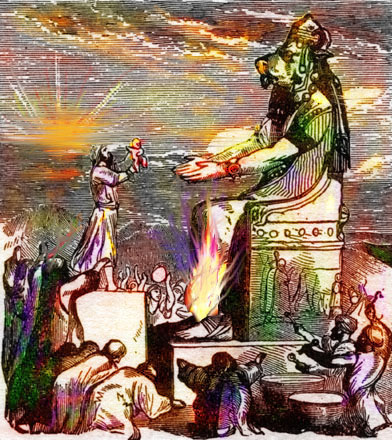
  • Altars to Baal rebuilt, using images of wood.
  • In the holy temple, altars to the “starry host,” astrology, plain and simple.
  • Human sacrifice of his own sons to Molech, a false god. Murder.
  • He practiced soothsaying, used witchcraft and sorcery, and consulted mediums and spiritists.

Evil was being encouraged and something wicked was replacing all that was good and true. The analysis of Manasseh’s policies was way beyond disturbing. Of all the kings of Judah, he was the most sinful and the most corrupt. He was at the bottom of the barrel.

The Hebrew word for “led astray” can be translated seduced.

Manasseh was an incredibly immoral man, a king who ruled for 40 years. “He did all he could to pervert the national character, and totally destroy the worship of the true God; and he succeeded.” (Clarke)

It’s believed that he put Isaiah to death by cutting him in two.

Moreover Manasseh shed very much innocent blood, till he had filled Jerusalem from one end to another, besides his sin by which he made Judah sin, in doing evil in the sight of the LORD.

1 Kings 21:16

But then something happened.

And the LORD spoke to Manasseh and his people, but they would not listen. Therefore the LORD brought upon them the captains of the army of the king of Assyria, who took Manasseh with hooks, bound him with bronze fetters, and carried him off to Babylon.

2 Chronicles 33:10-11

Assyria came knocking on Manasseh’s door. I think there was a certain mercy here, but also discipline. Manasseh had “hooks,” inserted through his jaw and out of his mouth. Like a fish he was led to Babylon, a trophy of the power of the army of Babylon.

It was from a dark dungeon that Manasseh cried out to the Lord and repented.

(2 Chronicles 33:12-13.)

There’s a Jewish fable that when Manasseh cried out to God the angels boarded up the windows in heaven. They wanted to block out his prayer so God wouldn’t be able to hear. But God, rich in mercy, bored a hole in front of His throne to hear Manasseh’s desperate cry.

The Lord’s intention was to forever show His kindness and grace given to the most awful repentant sinner.

I believe that Manasseh was the “Prodigal Son” of the Old Testament.

God is not at a loss when He moves to bring us back to Himself. He can woo or whip. He can draw or drive. He can work rapidly or slowly, as He pleases. In other words, He is free to be God! And in His own way, at His own pace, He brings us back.

     Tom Wells

God is wildly in love with you. Yes, the sin you’ve committed is awful, but the Lord wants you to come back. He may discipline you, but He forgives everything if you’ll turn and repent.

No matter how awful your sin, He forgives and restores. Manasseh is proof of that.

Sources:

2 Chronicles 33:1-20

2 Kings 21:1-18

Enduring Word commentary

alaskabibleteacher.com

The Giant Goliath, and Sexy Bathsheba

I have wondered about this. It strikes me that there are two giants that David encountered in his walk with God. Granted, there are many other events and people that he experienced, obviously. But there are these two that stick out:

The Goliath showdown, and the Bathsheba fiasco.

These seem to be hinges or pivot points that would change the entire course of king David’s life, and his faith in God. They’re to be an encouragement and warning to us, as both are incredibly significant.

This is a powerful chapter, for it reveals David’s spectacular faith in God. When the boy David killed Goliath it changed the entire future of Israel. One stone from his sling was all it took. Israel routed the Philistine army. David’s faith was the spark that made victory real.

David became a hero that day, and quickly ascended into Saul’s favor. It was both a military and a political development that Israel needed and king Saul welcomed it, the kingdom thrived. The boy David became the man of the hour, a national hero which everyone talked about.

I’d like to point out that David had already been anointed by Samuel to be the next king. This, combined with David’s celebrity status pushed king Saul over the edge–Saul developed a deep resentment that became insanity. David handled this adroitly, fleeing into the wilderness (with his faith) for years.

At this point David is now king and is fighting the Ammonites. The Israelites were besieging Rabbah, the capital city of that country, and it seems like it’s an intense battle. But interestingly enough, David remained in Jerusalem. (And I can’t figure out why.) David can’t sleep so he paces the rooftop and it’s then things get crazy.

David spies Bathsheba who is cleansing herself from her monthly cycle. She is a very beautiful woman, and king David inquires about her. He lusts after her which results in him more or less raping her, commiting adultery and then murdering her husband. This is all very disturbing.

When David had sex with Bathsheba it set in motion the ugliest chain of events imaginable. It seems that up to now David has taken the intiative of events, and then, after this great evil, his story shifts and for the rest of his life he becomes acted upon, a “victim.” He reacts, but doesn’t act anymore.

For the rest of his life he will struggle. All because of lust.

In 2 Samuel 12 David is confronted by a prophet for these sins. Samuel speaks with a parable that penetrates David’s heart. The king responds, “he shall restore the lamb fourfold, because he did this thing, and because he had no pity,” (v. 6). And interestingly enough, David would indeed pay fourfold. There would be four major incidents after this that he would now face.

David faced two “giants” in his walk with God. They were very different but both life altering. He killed Goliath but was not able to destroy his lust with Bathsheba.

Sometimes one “giant” is not enough. It would be nice if that was the case. David walked in victory for a period of time, but failed both himself, his family and his kingdom. Lust always is an act of the will, a deliberate decision that destroys all that it touches. David would be forgiven, but the damage was already done.

There would be dire consequences for everyone.

I believe that our giants were meant to be slaughtered. That is their function and purpose for the faithful believer. There can be no compromise. They’ll take different forms and will often approach you in peculiar ways. Paul tells us to wear God’s armor in Ephesians 6:11-18. I don’t think that protection should be taken off–you dare not only wear it only on special occasions.

Brother, sister–you must be covered all the time.

King David is a lesson for us. There is tremendous pain for us if we deliberately choose to compromise with the giants in our lives. Some of you already understand this; others will. I promise you.

    Oswald Chambers

Bryan Lowe

alaskabibleteacher.com

Rooted Firmly and Deeply

“But I am like a green olive tree
    in the house of God.
I trust in the steadfast love of God
    forever and ever.”

Psalm 52:8

In Psalm 52 we read of David’s run-in with Doeg, a very bad man, (a mass murderer actually). But David, hearing about the slaughter of 85 innocent priests doesn’t respond in hatred, rather he sits down and writes this song of contemplation which we know as Psalm 52.

It isn’t something written out of wrath and vengeance rather the word that begins his writing is “maskil” which implies– enlightenment, or something reflective, thoughtful, discerning. He sat down and considered Doeg’s awful evil, and by doing this was able to understand own heart as well.

Psalm 52 has two distinct parts.

The first is Doeg’s vicious atrocity, and the condemnation that it incurs, (v.v. 1-7). The second was David’s own commitment to following God, and understanding his own place in a very evil world, (v.v. 8-9).

Rather than castigate himself for being discovered in Nob–a circumstance which directly led to the mass murder of these priests (and their families). We find that David does not blame himself. He could have, but he didn’t. Rather he thoughtfully, and carefully, detailed his own “observations” of the whole sordid matter.

David could easily have destroyed himself with guilt and grief. He didn’t.

He chose not to play the losing game of ‘what if.’ He instead would be like a green olive tree rooted himself in the holy temple and into the protective presence of God. David knew he would destroy himself if he didn’t place himself there. It was a deliberate decision.

It would keep himself sane.

It seems to me that trees work heavily into David’s own theology and that this is how he sees his relationship with God. He’s planted and therefore able to survive terrible trials. He shows us how to survive and thrive.

His roots would need to go very deep though.

David’s thoughtful imagery is himself as an olive tree planted in God’s presence.

I believe knowing this is the antidote to the poison of guilt. Perhaps we should follow his example?


“They are like trees planted along a riverbank,
    with roots that reach deep into the water.
Such trees are not bothered by the heat
    or worried by long months of drought.
Their leaves stay green,
    and they never stop producing fruit.”

Jeremiah 17:8

To Eat Yourself

A heart at peace gives life to the body, but envy rots the bones.

Proverbs 14:30

“Of the Seven Deadly Sins, anger [envy] is possibly the most fun. To lick your wounds, to smack your lips over grievances long past … to savor to the last toothsome morsel both the pain you are given and the pain you are giving back — in many ways it is a feast fit for a king. The chief drawback is that what you are wolfing down is yourself. The skeleton at the feast is you.”

Frederick Buechner

Some churches designate seven deadly sins that people practice. They are pride, greed, wrath, envy, lust, gluttony and sloth. These are also known as the “cardinal” sins. Now this type of classification or grouping seems important and useful to some. I want to examine “envy.”

Envy is a sin that each of us understands.

Envy can be defined as “a feeling of discontented or resentful longing by someone else’s possessions, or qualities.”

(Wikipedia)

It made its entrance with Cain and Abel and the first murder. We see that Cain’s offering was rejected by God, (apparently He doesn’t like veggies). Also, keep in mind that part of Adam’s sin was that the ground was cursed. And Cain had tilled and planted from a field that had been cursed already. (Genesis 4)

But Abel offered up a “blood sacrifice” which God saw as acceptable. That drove Cain nuts. He was so envious that he murdered Abel. He couldn’t handle rejection, and seeing that his brother was extolled and honored was more that he could handle.

Envy became anger which led to murder.

It might come as a surprise to you but envy is why the Pharisees murdered Jesus, “For he knew that it was out of envy that they had delivered him up.” Matthew 27:18

We’re warned repeatedly by New Testament writers to renounce the sin of envy.

“But if you harbor bitter envy and selfish ambition in your hearts, do not boast about it or deny the truth. For where you have envy and selfish ambition, there you find disorder and every evil practice. Let us not become conceited, provoking one another, envying one another.”

James 3:14, 16

I realize I can easily become an envier. (That’s a word, I looked it up.)

Selfish ambition is directly linked in the book of James to envy.

The Greek phrase for selfish ambition is often used to describe one who is full of envy. Incidentally, the word is also used as one “who is deceitfully promoting himself for public office.” (Too often I see myself as “President Bryan.”)

A Prayer for Freedom

Holy Father, I want to bind that spirit of envy that’s attempting to eat up my life. I curse it out completely in the name of Jesus, for it is more than cruelty and overwhelming fury.

I renounce it completely.You are all I want and need. I only want to be your child. I renounce envy.

Please remove it now, mighty God, along with the hatred, anger, fear, and insecurities that fuel it. In Jesus’ mighty name, Amen.

“Whenever you attempt a good work you will find other men doing the same kind of work, and probably doing it better. Envy them not.”

     Henry Drummond