We Serve, First of All

servant-king

“But it is not this way among you, but whoever wishes to become great among you shall be your servant.”

Mark 10:44

I admit that I’m processing something right now, and it isn’t easy.

I suppose its implications could turn everything ‘upside down,’ at least for me anyway. Some scientists have postulated that our planet is due for a complete magnetic switchover. This is when the north becomes south and vice versa. My issues at this moment are not quite that cosmic.

There are 7,000,000,000+ people now alive on this planet.

Sometimes I wonder if many of my issues come from not seeing this. It seems that there’s an intoxication of success when we become increasingly confused over ‘who’ we are. We think it’s about our efforts, our giftedness. Pride drives us, even among supposedly mature Christian believers.

3 “Don’t be selfish; don’t try to impress others. Be humble, thinking of others as better than yourselves. Don’t look out only for your own interests, but take an interest in others, too. You must have the same attitude that Christ Jesus had.”

Philippians 2

Jesus was not driven like we seem to be.

We, on the other hand, think we need to be assertive, (at least the Christian version of it) and push our way forward. However, Jesus’ message and teaching were all about emptying Himself of being God and becoming a servant of servants. This is the arresting fact we fail to consider–

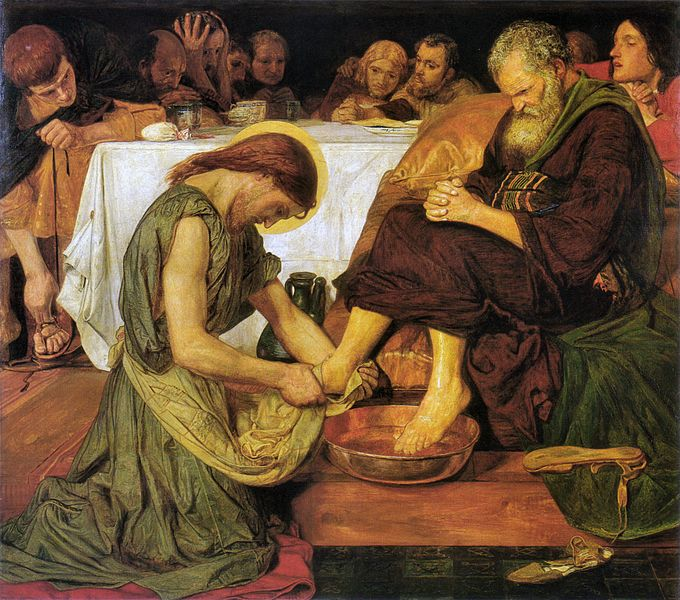
Jesus did all of this while wearing a towel, not a crown.

John 13:3-5

He could have done a ‘teaching’ on servanthood, or maybe direct a symposium on “slave theory” and I’m certain it would have been more than sufficient. But instead, Jesus put ‘skin on His words’ and actually got down on His knees to wash dirty feet. His disciples freaked out when they saw him do this. You and I, witnesses of this, would pretty much do the same.

It was something they could never unsee, nor ever forget.

6 “Though he was God,
    he did not think of equality with God
    as something to cling to.

Instead, he gave up his divine privileges;
    he took the humble position of a slave
    and was born as a human being.
When he appeared in human form,

 he humbled himself in obedience to God
   and died a criminal’s death on a cross.”

How can we not do this, and why is seeing Him serving like this so brain-flipping?

This is a hard question to ask, but to be perfectly honest, does our discipleship include emptying ourselves daily? Can we find peace and fulfillment by becoming an unknown? Is this what we’re missing in becoming Christlike? These are very hard questions.


“Humility is perfect quietness of heart, It is to expect nothing, to wonder at nothing that is done to me, to feel nothing done against me.”

“It is to be at rest when nobody praises me, and when I am blamed or despised. It is to have a blessed home in the Lord, where I can go in and shut the door, and kneel to my Father in secret, and am at peace as in a deep sea of calmness, when all around and above is trouble.”   

Andrew Murray

(All verses in this post are from Philippians 2, NLT, unless noted.)

alaskabibleteacher.com

Anavah, (or Humility)

       Charles Spurgeon

O Lord, my heart is not lifted up;
    my eyes are not raised too high;
I do not occupy myself with things
    too great and too marvelous for me.
But I have calmed and quieted my soul,
    like a weaned child with its mother;
    like a weaned child is my soul within me.

Psalm 131:1-2, ESV

To be humble [Hebrew, anavah] means that we recognize our boundaries. We will not advance by stepping beyond what God has ordained for us. We learn to be content with the present. Humility is not thinking less of yourself, but thinking of yourself less. It puts others first.

In Psalm 131 we begin the walk into “anavah.” We’re brought by God into a place where we understand who we really are. Our lives are not characterized by self-promotion, but rather serving God and advancing others before ourselves.

The image is one of being a weaned child resting on a mother’s chest. We have no agenda, there is nothing that we must do, but just relax on Him.

Seeing a weaned baby is one who no longer needs its mother’s milk. There’s no fussing or grasping for nourishment, rather he’s simply content to rest in his mother’s warm embrace.

To practice true humility, or the Hebrew word “anavah,” it is to renounce ambition in all its insidious forms. As Jesus’ disciples we follow Him with our cross. That cross puts the end of our old life. And we die daily. And it is obvious to all.

“And since I, your Lord and Teacher, have washed your feet, you ought to wash each other’s feet.  I have given you an example to follow. Do as I have done to you.”

Andrew Murray

alaskabibleteacher.com

Do You Speak His Language?

Peter Warms Himself

“The girl asked Peter, “Aren’t you one of Jesus’ disciples?”

“No,” he said, “I am not!”

“The police and the household servants were standing around a fire they had made, for it was cold. And Peter stood there with them, warming himself.”

John 18:17-18, Living Bible

The Galileans had a distinct accent. Just as we easily identify someone from Boston just by the tone and cadence of their speech, Peter had that distinct drawl that told everyone that he came from that same province as Jesus. It was something he couldn’t conceal.

Peter was a very different man in his three years of being with Jesus. And you might say that had transformed him–you might even say that he was now a marked man, the enemy was now quite aware of him. He was no longer a captain of a small fishing boat looking for a catch. He was now the leader of Jesus’ disciples.

The entire text (18:15-18) reveals a confrontation that Peter had with a servant girl, and we hear him making a bold-faced lie. At this very moment Peter was fulfilling the “promise” that Jesus had predicted (Matthew 26:31-32).

What was going through Peter’s head at that moment?

She was a simple servant girl, perhaps one who ministered at the gate of the high priest’s home. It’s interesting that she is the first one to question Peter’s duplicity. Most likely she was just doing her job, watching and listening. She was probably quite alert.

It’s easy to point our finger at Peter. He was a coward, and when he was put on the spot he bailed. People hate cowards–we extol those who take a definite stand against evil. But he was frightened, scared of being connected with Jesus–the man on trial. There was much at stake here.

We also speak with an accent. I know it might be a stretch–but being with Jesus has fundamentally changed us. Our lives now have a specific dialect that others hear, we’re not the same people that we once were.

We open our mouths and others can hear the Kingdom of God. We can’t hide that dialect.

Sometimes I try to pretend that I haven’t been with Jesus, and I’m very ashamed of that. Like Peter, I stand with the others and choose to warm myself by their fire, and I try very hard to make myself inconspicuous. But all I have to do is open my mouth, and I betray who I really am.

It’s really funny, but even servant girls know that I belong to him. He has fundamentally touched me.

“To stand before the Holy One of eternity is to change.”

Richard Foster

Loving His Throne

“A Christian is not a person who believes in his head the teachings of the Bible. Satan believes in his head the teachings of the Bible! A Christian is a person who has died with Christ, whose stiff neck has been broken, whose brazen forehead has been shattered, whose stony heart has been crushed, whose pride has been slain, and whose life is now mastered by Jesus Christ.” 

-John Piper

Philippians 3:20, MSG

It seems to me that the purpose of our life is not to find our freedom. It’s really meant to find our Master.


But the idea of being a slave to anyone is repugnant. We chafe at this, and yet man was never meant to be separated from the Lordship of Jesus. We’re instructed repeatedly with the New Testament idea that “our life is not our own”  Over and over God proclaims Himself as the King.


That troubles us somewhat.

Not so much when life is fairly good, granted, but in those hard moments when a decision must be made between enjoying the titillating “lusts of the flesh,” or accepting the fruits of the Spirit. This is one of those “lordship moments.” They come and go, and they show us exactly who we are.


If you’re really going to be authentic–a legitimate and real disciple, then you must determine who is going to be in charge, and this isn’t one of those casual decisions. Your decision must become a settled issue.


You must securely fix the throne in your heart and spirit.

The thief on the cross knew salvation, he was promised an eternity with God simply by faith. But I submit to you that he had put himself under the Lordship of Jesus, simply by recognizing the sign, “the King of the Jews.” I believe he saw and understood its implications. Jesus was King! He knew and understood.


This is a very hard word for some, but so many of our personal issues hinge on this.


I know this first-hand. It is a monumental struggle. You must admit to not only having Jesus as your Savior, but you also must put your life under His total Lordship.  You need to pick up your cross daily in order to follow.  You need to learn how to kneel.


I’ve chosen a depiction of Jesus on His throne to open up this post–it’s done on purpose, even if it’s an artist’s take.  I simply want you to understand the supreme call He has on your life. Here’s Bob Dylan, and he nails this idea down:


But you’re gonna have to serve somebody, yes indeed
You’re gonna have to serve somebody
Well, it may be the devil or it may be the Lord
But you’re gonna have to serve somebody


You must learn, here and now, how to kneel before the Sovereign King

Maximum Servanthood

“He came to Simon Peter, who said to him, “Lord, do you wash my feet?” Jesus answered him, “What I am doing you do not understand now, but afterward you will understand.” Peter said to him, “You shall never wash my feet.” Jesus answered him, “If I do not wash you, you have no share with me.”

John 13:6-8 (context vv. 3-17)

Chapter 13 always rocks my world. I visualize this, like a fly on-the-wall, watching it happen–and then I replay it over, and over in my mind. It always unravels me. Why does this have to happen? What does this passage tell me about Jesus, and his kingdom? (John 13).

Why can’t I just walk away from it, and leave it be?

Jesus made himself a slave, (or perhaps he was always a slave all along, and we just didn’t realize it?) Foot-washers were pretty much regarded as sub-human, mindless drones who mechanically performed a necessary duty. The lowest of the low, the very least of the least.

But Jesus took that role on himself, he laid aside his garments, and his Godhood. (They landed in a pile in the corner of the room). When he knelt down to scrub feet (making sure he got between the toes), it was deity serving man. This God/rabbi intentionally did this, not reluctantly or halfheartedly–but carefully.

He was their teacher.

Custom demanded he enjoy the prerogatives of that position. But he wouldn’t, and didn’t. He mustn’t. As I stress over this, I must conclude he really was their “teacher,” but not in the way I expect. What he was doing on his knees, was instructing them in the art of loving each other. He showed us a leader in action.

Real disciples function best when they wash between the toes.

There was a point in Jewish history when the people actually demanded that God would give them a king, instead of a judge (1 Samuel 8:5-9). God warned them that this wasn’t in his plans–but they insisted. They had to have one, everyone else did. We still must have celebrities, and then we wonder why they short circuit on us. Who can resist the privilege, and the limelight?

Peter of course was classic Peter.

It seems that whenever he resists, he gets rebuked. He makes it quite clear that Jesus will never wash feet–that Jesus will never use a basin or towel and serve him like this. It was outrageous. It didn’t fit in Peter’s personal theology. He had no room for Jesus the slave. Perhaps Peter knew that to follow meant he would have to do the same thing?

Jesus still washes feet.

He sits us down and takes off our shoes and socks, and scrubs us clean. And we hate it. But to be washed by him is a condition of our discipleship. Every follower must be clean, and he continues his work to this day. We sin daily, even as his own, and he cleans us up–and yet somehow that really bothers us.

“Does God ask us to do what is beneath us? This question will never trouble us again if we consider the Lord of heaven taking a towel and washing feet.

 Elisabeth Elliot

alaskabibleteacher.com

The Shepherd’s Own Voice

John 10:1-5, ESV

 “Truly, truly, I say to you, he who does not enter the sheepfold by the door but climbs in by another way, that man is a thief and a robber. But he who enters by the door is the shepherd of the sheep. To him the gatekeeper opens. The sheep hear his voice, and he calls his own sheep by name and leads them out. When he has brought out all his own, he goes before them, and the sheep follow him, for they know his voice. A stranger they will not follow, but they will flee from him, for they do not know the voice of strangers.”

What joy can be found in the Shepherd’s care, and to hear his voice. Nothing really can match this wonder. We follow as he leads us. The voice is an integral part of this passage and the foundation of discipleship that is real.

Please understand: You really can’t walk with him unless you hear him. We belong to him. We’re his flock that he keeps and provides for.

And He knows our name!

That’s the intimacy found in these verses. We’re never forgotten and he will never overlook us. To think otherwise is slander and an attack on his present-day ministry. Jesus is our good shepherd. He always will be.

“Intimacy with God comes in whispers, not shouts.”

     Woodrow Kroll

He sometimes whispers, and yet this world can’t hear him (or they refuse to). To be perfectly honest, my ‘busy-ness’ silences Him. I suppose that the real issue isn’t with Him, but with myself.

“And after the earthquake, there was a fire, but the Lord was not in the fire. And after the fire, there was the sound of a gentle whisper.”

1 Kings 19:12

He doesn’t speak through a windstorm, earthquake, or fire. He chooses to speak very quietly, and that’s a problem for me. In the original Hebrew, the word “whisper” can be translated as “calm, something gentle.” He speaks this way if only we shut up for a little while.

If we are to recognize God’s voice, we must belong to Him. We hear His voice best when we spend time in Bible study and quiet prayer. The more time we spend intimately with God and His Word, the easier it is to recognize His voice and His leading in our lives. He’s always speaking, and we’re seldom listening.

The flock hears the shepherd, and it’s that voice that breaks through our cluttered-up life. We can hear, and it’s that communication that encourages us to walk through life—one day at a time. Just today. That’s all you must do.

There are so many other voices. Please dear one, you must ignore them.

So many are speaking, and so many want us to hear and follow them. But in reality, they want us to leave the Shepherd and his flock behind. But we can’t allow this, we must learn to listen to him alone.

alaskabibleteacher.com

Art by Eugène Burnan

Choosing a Pierced Ear

Body piercing has become pretty much acceptable just in the last ten years. 

Studs are placed in a hole or piercing to make a permanent decoration.  I have seen a fair amount of it, and I think that a stud in the tongue has got to be the most intrusive.  (I recently read of a young girl who died after her tongue was pierced from an infection).

There is “body piercing” in scripture.  In Deuteronomy 15:12-18, slaves who are being set free by their master after six years of service, could, if they loved and were loved by their master, could choose to remain a slave to him.

“But if your slave says to you, “I don’t want to leave you,” because he loves you and your family and has a good life with you,17 stick an awl through his ear into the door; he will be your slave for life. Also do this to a female slave.”

Deuteronomy 15:12-18

This was a decision that required elders to act as witnesses.  It was significant as well as completely binding.  I like to think of the ceremony to be kind of a cross between a wedding and a circumcision. (Sounds fun, huh?!)

The slave would be led to a doorpost and the master would take an awl, and push it through his ear lobe.  This designated the slave to be forever “owned” by a specific master.  Herein lies a picture of the Christian.

Many times in the New Testament we are called to be servants (slaves) of Christ.

Peter, Paul, James, and Jude referred to themselves as “bond servants of Jesus Christ” in their epistles. This is not a forced servitude. It’s a choice made in love!

There are many believers who have done the same, they have fallen in love with their Savior.  They do not plan on a life apart from Him.  So spiritually they have gone to the doorpost, the awl is pushed through their ear, and they are marked from that point on.

Although the ear was pierced physically in the Old Testament, a different kind of piercing takes place in the New.  In Romans 6:16 we read,

“Surely you know that when you give yourselves like slaves to obey someone, then you are really slaves of that person. The person you obey is your master. You can follow sin, which brings spiritual death, or you can obey God, which makes you right with him.”

Romans 6:16, (NCV)

When the prodigal son returned home from the far country he fell before his father and humbly ask,make me your servant.” (Luke 15:19,21) He, in essence, was saying to the father, “pierce my ear.” The father made him a son, but the attitude of the son’s heart had changed to the heart of a servant. So it must be with us. Only then will we live a “pierced ear” life, revealing to all that we are servants of Jesus Christ!

“Savior, I know Thou hast allowed me absolute liberty, to serve Thee, or to go my own way. I would serve Thee forever, for I love my Master. I will not go out free. Mark my ear, Lord, that it might respond only to Thy voice.”

— Jim Elliot, Missionary and Martyr


alaskabibleteacher.com

A Prayer of a Minor Prophet

by A.W. Tozer

His Ordination Prayer as a Pastor, serving in the Christian and Missionary Alliance

August 18, 1920

O Lord, I have heard Thy voice and was afraid. Thou has called me to an awesome task in a grave and perilous hour. Thou art about to shake all nations and the earth and also heaven, that the things that cannot be shaken may remain. O Lord, my Lord, Thou has stooped to honor me to be Thy servant. No man taketh this honor upon himself save he that is called of God as was Aaron. Thou has ordained me Thy messenger to them that are stubborn of heart and hard of hearing. They have rejected Thee, the Master, and it is not to be expected that they will receive me, the servant.

My God, I shall not waste time deploring my weakness nor my unfittedness for the work. The responsibility is not mine, but Thine. Thou has said, “I knew thee – I ordained thee – I sanctified thee,” and Thou hast also said, “Thou shalt go to all that I shall send thee, and whatsoever I command thee thou shalt speak.” Who am I to argue with Thee or to call into question Thy sovereign choice? The decision is not mine but Thine.

So be it, Lord. Thy will, not mine, be done.

Well do I know, Thou God of the prophets and the apostles, that as long as I honor Thee Thou will honor me. Help me therefore to take this solemn vow to honor Thee in all my future life and labors, whether by gain or by loss, by life or by death, and then to keep that vow unbroken while I live.

It is time, O God, for Thee to work, for the enemy has entered into Thy pastures and the sheep are torn and scattered. And false shepherds abound who deny the danger and laugh at the perils which surround Thy flock. The sheep are deceived by these hirelings and follow them with touching loyalty while the wolf closes in to kill and destroy. I beseech Thee, give me sharp eyes to detect the presence of the enemy; give me understanding to see and courage to report what I see faithfully. Make my voice so like Thine own that even the sick sheep will recognize it and follow Thee.

Lord Jesus, I come to Thee for spiritual preparation.

Lay Thy hand upon me. Anoint me with the oil of the New Testament prophet. Forbid that I should be come a religious scribe and thus lose my prophetic calling. Save me from the curse that lies dark across the modern clergy, the curse of compromise, of imitation, of professionalism. Save me from the error of judging a church by its size, its popularity or the amount of its yearly offering. Help me to remember that I am a prophet – not a promoter, not a religious manager, but a prophet. Let me never become a slave to crowds. Heal my soul of carnal ambitions and deliver me from the itch for publicity.

Save me from bondage to things. Let me not waste my days puttering around the house. Lay Thy terror upon me, O God, and drive me to the place of prayer where I may wrestle with principalities and powers and the rulers of the darkness of this world. Deliver me from overeating and late sleeping. Teach me self-discipline that I may be a good soldier of Jesus Christ.

I accept hard work and small rewards in this life.

I ask for no easy place. I shall try to be blind to the little ways that could make life easier. If others seek the smoother path I shall try to take the hard way without judging them too harshly. I shall expect opposition and try to take it quietly when it comes. Or if, as sometimes it falleth out to Thy servants, I should have grateful gifts pressed upon me by Thy kindly people, stand by me then and save me from the blight that often follows. Teach me to use whatever I receive in such manner that will not injure my soul nor diminish my spiritual power. And if in Thy permissive providence honor should come to me from Thy church, let me not forget in that hour that I am unworthy of the least of Thy mercies, and that if men knew me as intimately as I know myself they would withhold their honors or bestow them upon others more worthy to receive them.

And now, O Lord of heaven and earth, I consecrate my remaining days to Thee; let them be many or few, as Thou wilt. Let me stand before the great or minister to the poor and lowly; that choice is not mine, and I would not influence it if I could. I am Thy servant to do Thy will, and that will is sweeter to me than position or riches or fame.

I choose it above all things on earth or in heaven.

Though I am chosen of Thee and honored by a high and holy calling, let me never forget that I am but a man of dust and ashes, a man with all the natural faults and passions that plague the race of men. I pray Thee, therefore, my Lord and Redeemer, save me from myself and from all the injuries I may do myself while trying to be a blessing to others. Fill me with Thy power by the Holy Spirit, and I will go in Thy strength and tell of Thy righteousness, even Thine only. I will spread abroad the message of redeeming love while my normal powers endure.

Then, dear Lord, when I am old and weary and too tired to go on, have a place ready for me above, and make me to be numbered with Thy saints in glory everlasting. Amen. AMEN.

AlaskaBibleTeacher.com

Our King and Our Master

A Kings Crown and the Crown of Thorns


A Christian is a person who has died with Christ, whose stiff neck has been broken, whose brazen forehead has been shattered, whose stony heart has been crushed, whose pride has been slain, and whose life is now mastered by Jesus Christ.”

–John Piper

No longer do I call you servants, for a servant does not know what his master is doing; but I have called you friends, for all things that I heard from My Father I have made known to you.”

John 15:15

It seems that the purpose of life is not to find our freedom. It’s really meant to find our Master.

Yes, the idea of being a slave to anyone is repugnant. We chafe at this, and yet man was never meant to be separated from the Lordship of Jesus. We’re instructed repeatedly with the New Testament idea that “our life is not our own”  Over and over God proclaims Himself as the King.

That troubles us somewhat.

Not so much when life is fairly good, granted, but in those hard moments when a decision must be made between enjoying the titillating “lusts of the flesh,” or accepting the fruits of the Spirit. This is one of those “lordship moments.” They come and go, and they show us exactly who we are.

If you’re really going to be authentic–a legitimate and real disciple, then you must determine who is going to be in charge, and this isn’t one of those casual decisions. Your decision must become a settled issue.

You must securely fix it in your heart.

The thief on the cross knew salvation, he was promised an eternity with God simply by faith. But I submit to you that he had put himself under the Lordship of Jesus, simply by recognizing the sign, “the King of the Jews.” I believe he saw and understood its implications. Jesus was King! He knew and understood.

This is a very hard word for some, but so many of our personal issues hinge on this.

I know this first-hand. It is a monumental struggle. You must admit to not only having Jesus as your Savior, but you also must put your life under His total Lordship.  You need to pick up your cross daily in order to follow.  You need to learn how to kneel.

I’ve chosen a crown to open up this post–it’s done on purpose.  I simply want you to understand the supreme call He has on your life. Here’s Bob Dylan, and he nails this idea down:

But you’re gonna have to serve somebody, yes indeed
You’re gonna have to serve somebody
Well, it may be the devil or it may be the Lord
But you’re gonna have to serve somebody


You must learn here and now how to kneel before the Sovereign King


alaskabibleteacher.com

We Were Born to Serve

We Were Born to Serve Others

“When a servant comes in from plowing or taking care of sheep, does his master say, ‘Come in and eat with me’? No, he says, ‘Prepare my meal, put on your apron, and serve me while I eat. Then you can eat later.’” 

And does the master thank the servant for doing what he was told to do? Of course not. 10 In the same way, when you obey me you should say, ‘We are unworthy servants who have simply done our duty.’”

Luke 17:7-10

After years of ministry— this particular passage has slowly become one of my favorites. The path I’ve walked has been challenging, and it seems to me that I haven’t done it very well at all. I’ve been a fool much of the time, and yet, if anything, God has held me firmly in place. I haven’t always been faithful. But He has.

I used to kill rattlesnakes when I lived in Mexico. (You might say it was my hobby.) But it demanded a certain cautiousness, and lesson #1 was this–you never, ever take your eyes off of the snake–no matter what. We must approach ourselves that carefully. Our hearts are desperately wicked. We must understand this.

“I am more afraid of my own heart than of the pope and all his cardinals. I have within me the great pope, self.

    Martin Luther

Please let me explain what I’m thinking.

The Lord Jesus tells us one of those stories of his. This parable is one of his best. It makes a lot of sense, and it resonates within me. It tells me that I must watch myself, lest I forget the idea behind this passage. I’m His slave and not deserving some kind of special treatment.

Jesus’ parable explains our duty as His servant.

It seems that after a hard day’s work, a slave still needed to prepare his master’s dinner. No matter how much he toiled out in the fields, he had a duty to serve his master in this way; and it does seem unfair–we live in a land “where all men are created equal.”

But this is how the God’s Kingdom works.

We get dirty, we toil hard, and we sweat under the hot sun. We dream of a glass of cold lemonade (with ice), and a cool shower when we quit the fields. But that isn’t the way it works. Yes, Jesus gives his laborers rest–but the work continues.

The work goes on, even when God buries his workers. Hopefully, the next generation will continue my almost humble efforts, and his work in his fields will continue. But, in the meantime I must “watch” myself carefully, and do his will out in his fields.

Just as a servant knows that he must first obey his master in all things, so the surrender to an implicit and unquestionable obedience must become the essential characteristic of our lives.

Andrew Murray

Yes, it’s a foreign concept, and we can’t really relate–we either skip its message, or apply it to others. Jesus uses it quite adroitly, the servant works for his master; completely, exclusively. A slave who has no rights of his own. We serve and obey our Master.

Any desire for promotion, pleasure, riches, or fame will quickly make one a servant of the Beast. And, I’m afraid, that is exactly what many of today’s pastors and preachers have become.

    Chuck Baldwin