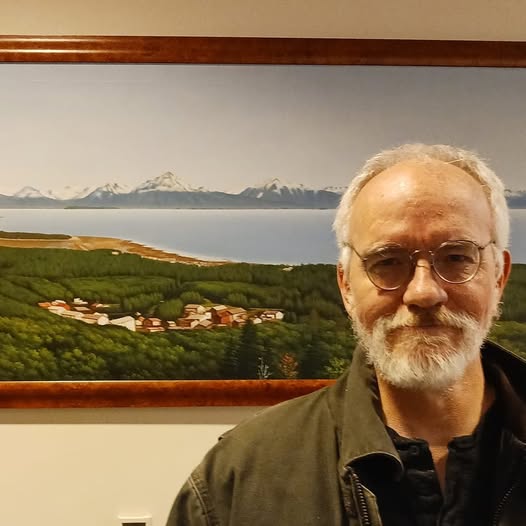
Studying God's Word is my joy. I want you to understand that there is nothing greater than a life given to Him. I'm an ordained pastor who lives in Alaska.
“The central miracle asserted by Christians is the incarnation. They say that God became man.”
C.S. Lewis
Incarnation, the central Christian doctrine that God became flesh, that God assumed a human nature and became a man in the form of Jesus Christ, the Son of God and the second person of the Trinity.
Christ was completely God and fully man at the same time. This teaching is clear and I honestly can’t wrap my mind around it. Becoming man did not diminish God–if anything it was an addition and not a subtraction.
Now it’s true that Jesus voluntary set aside all of the prerogative of being God–He chose to lay His deity aside. Please think these verses through–let them sink deeply into your hearts. It really is an awesome passage.
Though he was in the form of God, did not count equality with God a thing to be grasped, 7 but emptied himself, by taking the form of a servant, being born in the likeness of men. 8 And being found in human form, he humbled himself by becoming obedient to the point of death, even death on a cross.
Philippians 2:6-8, ESV
Have a blessed Christmas. Know deep down that He has come for you, He holds you and cares for you. He will never, ever leave you!
Who understands this mystery? Even the angels are baffled!
The Maker of the universe As Man, for man was made a curse. The claims of law which He had made, Unto the uttermost He paid.
2
His holy fingers made the bough Which grew the thorns that crowned His brow. The nails that pierced His hands were mined In secret places He designed.
3
He made the forest whence there sprung The tree on which His body hung. He died upon a cross of wood, Yet made the hill on which it stood.
4
The sky that darkened o’er His head By Him above the earth was spread. The sun that hid from Him its face By His decree was poised in space.
5
The spear which spilled His precious blood Was tempered in the fires of God. The grave in which His form was laid, Was hewn in rocks His hands had made.
6
The throne on which He now appears Was His from everlasting years. But a new glory crowns His brow. And every knee to Him shall bow.
“The Maker of the Universe,” lyrics by Phil Keaggy, 1986
One of my favorite places to fish in Alaska is Kodiak Island, where I tried to catch silver salmon with some friends. Just as we were setting up camp, the sun disappeared, and the temperature dropped quickly. While we struggled with our tents, the wind joined in. Then, it started pouring rain—like someone dumped a bucket of water on us! I woke up at midnight to strong winds flattening my tent, making me wonder if fishing Kodiak was really worth it. 😁
But in the morning, the storm had moved on. The sky transformed into something gold! The sun shone brightly, making the world come alive. The night gracefully stepped aside, allowing the darkness to fade away and make room for a new, vibrant day.
I realized then that’s the way of Christmas.
We have an Advent hope. The light doesn’t negotiate with darkness; there’s no struggle. The darkness retreats when the light arrives. Plain and simple.
Advent hope seems slow, but honestly, it’s unstoppable.
When Jesus came into the world, nothing could stop Him. His birth is recognized during Advent. His arrival was predicted in the scriptures. Jesus came to take away our sins and offer us eternal life.
The Bible teaches us that Jesus is God in the flesh, fully divine and fully man, who came to save us from our sin. This is basic Christianity.
“In the beginning” reminds us of Genesis, where God created everything (Genesis 1:1). Through the Spirit, he shows that he has taken an important step towards us with the arrival of Jesus. He is dedicated to saving us.
God created us to know and enjoy him (Gen 3:8). We must understand that sin entered the world and screwed everything up. Jesus came to sacrifice Himself to secure our salvation, restoring his image in those who trust him.
Jesus Christ restores all that we lost because of our sin.
In the beginning was the Word. The Word did not come into existence in Mary’s womb but He always was. The Word is eternal. Before it all began, he was there, and he was coming for us.
The phrase “the word was also with God” indicates that the Word is from God but is closely connected to Him (Mk 6:3; 11:4; 2 Cor 5:8; 1 John 1:2). The Word is also God and represents the eternal Son of God, who is both with God and is God. He is the Word and the Son, distinct yet unified with God.
Everything we see was made through Jesus, and nothing exists without him (see Col 1:16-17). The Old Testament says that God created the heavens and the earth, while the New Testament shows that the Word is the true Creator. This highlights Christ’s key role in creation and his divine nature. Both Testaments emphasize the relationship between God the Father and Jesus, confirming that all existence is intentional and meaningful.
Recognizing Jesus as the Creator enhances our understanding of his authority, showing us that all things were created through him and find their purpose in him.
We must understand that we’re born spiritually dead and blind. But that can change.
Jesus is the light and every one of us is spiritually blind to truth and beauty and glory (John 17:24). Jesus overcomes our darkness and now gives life. Jesus does for us what we cannot do for ourselves. His love is seeking us.
The word, the gospel, brings forth life and light so that we are born again, literally born from above, and so we see (John 3:3). The light shines into our darkness and the darkness leaves us.
From a sermon given at Community Christian Church, December 7, 2025
David Taylor has been a follower of Christ since 1983 and a pastor since 1988. He moved from Los Angeles to Homer, Alaska in 2004.
Our walk with Jesus should be strengthened by Christmas. Sometimes we might shelf our discipleship during the holidays. This can be something we’re not even aware that we’re doing. But I definitely believe that our discipleship needs Christmas. This isn’t really an option.
Maybe our faith should actually be intensified by the grandeur and splendor of Christmas?
After all, when we mull over this tremendous mystery of the incarnation our faith and praise can only grow. To think that God Himself came for us like He did is pretty potent stuff. God became a helpless baby, and needed breast milk and a change of diapers. That should rattle us if we really understand.
“The Almighty appeared on earth as a helpless human baby, needing to be fed and changed and taught to talk like any other child. The more you think about it, the more staggering it gets. Nothing in fiction is so fantastic as this truth of the Incarnation.”
J.I. Packer
Prayer is one of the best ways I know to incorporate this. I imagine that the Holy Spirit is pretty active right now as many believers meditate on what really happened in that manger in Bethlehem.
A CHRISTMAS PRAYER
Dear Father, it’s Christmas time again. Help me this year to season the celebration with reason. Teach me to plan with my family. May I avoid the clutter that dims my vision and burdens my time.
Keep me mindful of my budget. and help me to remember that a gift selected with love tugs forever at the heartstrings. Forgive me for past extravagance.
Remind me to decorate in good taste, treasuring all of the past blending it with the new, but holding steadfast to reason. Keep me, dear Father, from strain lest I stray from all thy teachings.
Guide me to the light of Christmas. Help me keep a candle’s flame of that light as a constant reminder of my goal . . . eternity.
I pray for thy love and help, in the name of thy beloved Son whose birthday we are observing.
“Therefore take up the whole armor of God, that you may be able to withstand in the evil day and having done all, to stand firm. 14 Stand therefore, having fastened on the belt of truth and having put on the breastplate of righteousness, 15 and, as shoes for your feet, having put on the readiness given by the gospel of peace. 16 In all circumstances take up the shield of faith, with which you can extinguish all the flaming darts of the evil one; 17 and take the helmet of salvation, and the sword of the Spirit, which is the word of God,“
Eph. 6:13-17, ESV
You’re called to be armor-plated.
Ephesians is quite clear about this, and we dare not live without spiritual protection, and as a matter of fact, we must wear each piece to survive spiritually. To be ‘naked’ is catastrophic. Neglecting to dress appropriately brings cataclysmic disorder. We dare not minimize our need for wearing our armor.
Each piece listed must be worn. This is a scriptural mandate for every believer in Jesus.
“The whole armor of God” explains the equipment we need to survive spiritually. Here’s a list of the six:
The belt of truth–this pulls everything together and holds us and keeps us secure in the truth.
The breastplate of righteousness–our spiritual heart is protected by knowing we’re accepted by the Father. Being right with God is not a feeling nor is it a mere hopeful wish. We wear what is real.
The shoes of the gospel (of peace)–the idea of standing in place (“to stand”) explain our ability to be fixed on grace. When we wear battle shoes we cannot be pushed back or lose our footing. Wearing gospel shoes brings us spiritual stability. We can stand in place, rooted and strong.
The shield of faith–is a vital way of protecting ourselves from the evil arrows shot by the enemy. Satan targets us when he thinks that we aren’t using faith to defend ourselves.
The helmet of salvation–this is the realization that our mind is protected. This vital piece brings us wholeness as we understand what Jesus has done. We know we are saved and wearing our helmet is our protection from demonic-inspired lies.
The sword of the Holy Spirit–the only offensive weapon we have, and it’s all we need. The Word of God will frighten the enemy and push him back. The Word slices and cuts down every obstacle and every lie.
“Only those who are spiritual perceive the reality of the spiritual foe and hence engage in battle. Such warfare is not fought with arms of the flesh. Because the conflict is spiritual so must the weapons.“
I must stress that clothing yourself is vital. You dare not live spiritually naked wearing nothing. You will be totally vulnerable to the satanic wickedness that is swirling around you. I’m afraid it’s all very real and sobering and there is no escape clause until you finally arrive in heaven.
“We know [positively] that we are of God, and the whole world [around us] is under the power of the evil one.”
1 John 5:19, Amplified Bible
I’m afraid you haven’t been given an option in all of this. Our battle equipment in Ephesians 6 is not just some theological preference or concept. It’s real.
Over 40 years of following Jesus have taught me that most believers struggle because they won’t arm themselves for battle. They refuse to acknowledge the environment they’re in and don’t realize the spiritual battle they are facing. They like the sentiment behind this particular passage, (it stirs their heart) but the reality of the battle never fully sinks in.
They end up leaving their armor behind.
The good news is that we have already won because of what the Lord has done. Wearing the armor strengthens and stabilizes us. He pours out His grace, and there will be times of rest of that I am certain. “He leads me beside still waters.”
As obedient and faithful believers we need to realize we’re secure in Him. Yes, there is a terrible fight, but “The battle is the Lord’s.”
“For you equipped me with strength for the battle; you made those who rise against me sink under me.”
“Now when they saw the boldness of Peter and John, and perceived that they were uneducated, common men, they were astonished. And they recognized that they had been with Jesus.”
Acts 4:13
“God created the world out of nothing, and so long as we are nothing, He can make something out of us.”
—Martin Luther
Consider this: the jawbone of a donkey, a sling shot. and barley loaves, a woman’s tears, a young boy’s lunch, a young colt, and a talking donkey, they all suggest that God touches the common and the insignificant. He uses what we consider of minor importance.
We often turn to the talented and gifted far too readily.
Peter and John are being seen by the Sanhedrin (the Jewish “Supreme Court”). They are to give account of themselves before the highest court of the land. There had been a healing, and there was the matter of preaching as well. Both Peter and John exude a confidence that these religious leaders couldn’t deny. Their perception was that they were ignorant men. Uneducated and common. But. They also knew they had been with Jesus.
In the minds of the leadership, they were nothing more than religious white trash.
God loves to use what we consider common. His revealed history has been to take anything at His disposal and utilize it to redeem lost souls. A staff or a sling-shot are used with an adroitness that seems extraordinary among men. The things we think are simple and common are used to further God’s work among mankind.
But the message always returns back to the preachers. The Sanhedrin knew of the disciples preaching. They had absorbed the fact of a miracle; a crippled man had just been healed. (This they couldn’t deny.) But they were troubled. And they didn’t really know what to do.
What more could this be, but a direct intervention of God? And yet, God is working through “common people.” Then look…
“…if we are being examined today concerning a good deed done to a crippled man, by what means this man has been healed,”
Acts 4:9
Within this preaching was woven this healing. The Holy Spirit was ‘rocking their world.’ The people who came in contact with these disciples would never be the same. Paul tells the Corinthian church that:
“Instead, God chose things the world considers foolish in order to shame those who think they are wise. And he chose things that are powerless to shame those who are powerful.”
1 Corinthians 1:27, NLT
If God has a specialty it would be this. He desires all the glory. He goes out of the way to use the broken and weak. He shows His strength through insignificant and minor things and people.
Please dear heart, think through the following:
“We are all wounded. But wounds are necessary for his healing light to enter into our beings. Without wounds and failure and frustrations and defeats, there will be no opening for his brilliance to trickle in and invade our lives.”
“Now when they saw the boldness of Peter and John, and perceived that they were uneducated, common men, they were astonished. And they recognized that they had been with Jesus.”
Acts 4:13
“God created the world out of nothing, and so long as we are nothing, He can make something out of us.”
“Now when they saw the boldness of Peter and John, and perceived that they were uneducated, common men, they were astonished. And they recognized that they had been with Jesus.”
Acts 4:13
“God created the world out of nothing, and so long as we are nothing, He can make something out of us.”
—Martin Luther
Consider this: the jawbone of a donkey, a sling shot. and barley loaves, a woman’s tears, a young boy’s lunch, a young colt, and a talking donkey, they all suggest that God touches the common and the insignificant. He uses what we consider of minor importance. We often turn to the talented and gifted far too readily.
Peter and John are being seen by the Sanhedrin (the Jewish “Supreme Court”). They are to give account of themselves before the highest court of the land. There had been a healing, and there was the matter of preaching as well. Both Peter and John exude a confidence that these religious leaders couldn’t deny. Their perception was that they were ignorant men. Uneducated and common. But. They also knew they had been with Jesus.
In the minds of the leadership, they were nothing more than religious white trash.
God loves to use what we consider common. His revealed history has been to take anything at His disposal and utilize it to redeem lost souls. A staff or a sling-shot are used with an adroitness that seems extraordinary among men. The things we think are simple and common are used to further God’s work among mankind.
But the message always returns back to the preachers. The Sanhedrin knew of the disciples preaching. They had absorbed the fact of a miracle; a crippled man had just been healed. (This they couldn’t deny.) But they were troubled. And they didn’t really know what to do.
What more could this be, but a direct intervention of God? And yet, God is working through “common people.” Then look…
“…if we are being examined today concerning a good deed done to a crippled man, by what means this man has been healed,”
Acts 4:9
Within this preaching was woven this healing. The Holy Spirit was ‘rocking their world.’ The people who came in contact with these disciples would never be the same. Paul tells the Corinthian church that:
“Instead, God chose things the world considers foolish in order to shame those who think they are wise. And he chose things that are powerless to shame those who are powerful.”
1 Corinthians 1:27, NLT
If God has a specialty it would be this. He desires all the glory. He goes out of the way to use the broken and weak. He shows His strength through insignificant and minor things and people.
“We are all wounded. But wounds are necessary for his healing light to enter into our beings. Without wounds and failure and frustrations and defeats, there will be no opening for his brilliance to trickle in and invade our lives.”
“Failures in life are courses with very high tuition fees, so I don’t cut classes and miss my lessons: on humility, on patience, on hope, on asking others for help, on listening to God, on trying again and again and again.”
Bo Sanchez
Consider this: the jawbone of a donkey, a sling shot. and barley loaves, a woman’s tears, a young boy’s lunch, a young colt, and a talking donkey, they all suggest that God touches the common and the insignificant. He uses what we consider of minor importance. We often turn to the talented and gifted far too readily.
Peter and John are being seen by the Sanhedrin (the Jewish “Supreme Court”). They are to give account of themselves before the highest court of the land. There had been a healing, and there was the matter of preaching as well. Both Peter and John exude a confidence that these religious leaders couldn’t deny. Their perception was that they were ignorant men. Uneducated and common. But. They also knew they had been with Jesus.
In the minds of the leadership, they were nothing more than religious white trash.
God loves to use what we consider common. His revealed history has been to take anything at His disposal and utilize it to redeem lost souls. A staff or a sling-shot are used with an adroitness that seems extraordinary among men. The things we think are simple and common are used to further God’s work among mankind.
But the message always returns back to the preachers. The Sanhedrin knew of the disciples preaching. They had absorbed the fact of a miracle; a crippled man had just been healed. (This they couldn’t deny.) But they were troubled. And they didn’t really know what to do.
What more could this be, but a direct intervention of God? And yet, God is working through “common people.” Then look…
“…if we are being examined today concerning a good deed done to a crippled man, by what means this man has been healed,”
Acts 4:9
Within this preaching was woven this healing. The Holy Spirit was ‘rocking their world.’ The people who came in contact with these disciples would never be the same. Paul tells the Corinthian church that:
“Instead, God chose things the world considers foolish in order to shame those who think they are wise. And he chose things that are powerless to shame those who are powerful.”
1 Corinthians 1:27, NLT
If God has a specialty it would be this. He desires all the glory. He goes out of the way to use the broken and weak. He shows His strength through insignificant and minor things and people.
“We are all wounded. But wounds are necessary for his healing light to enter into our beings. Without wounds and failure and frustrations and defeats, there will be no opening for his brilliance to trickle in and invade our lives.Failures in life are courses with very high tuition fees, so I don’t cut classes and miss my lessons: on humility, on patience, on hope, on asking others for help, on listening to God, on trying again and again and again.”
“His intent was that now, through the church, the manifold wisdom of God should be made known to the rulers and authorities in the heavenly realms, according to his eternal purpose that he accomplished in Christ Jesus our Lord.”
Ephesians 3:10-11
“Now Israel loved Joseph more than all his children because he was the son of his old age. Also, he made him a tunic of manycolors.“
Genesis 37:3
The word “manifold” is a very curious word. In the Old Testament, this particular word is used to describe Joseph’s coat of many colors. I can only imagine that it was striped like a rainbow, (or maybe even tied-dyed?) Whatever it was, Joseph was quite distinctive as he wore his colorful coat.
Joseph’s coat
Paul in Ephesians 3, intentionally borrows this word to explain “the manifold wisdom of God.”
Paul uses this dramatic imagery of Joseph’s coat to describe God’s wonderful wisdom that has saturated the Church. There is something variegated in this wisdom (balance, comprehension, understanding) that infuses His Church.
First of all, we are people of diverse colors. There is a wisdom given to each believer. This defines us and portrays us to a color-starved world. God’s own wisdom, defined quite incredibly in our hearts and spirits, describes our coloration and hue.
Some are merciful, and other believers are bold. Some are kind, others are discerning.
Some are gentle, and others are prophetic and sharp. Some are artists, while others know how to roof a house properly. A few are discerning, and others can endure much. But our personal coloring should never threaten another. Those who see only blue– should never be shaken when another sees yellow.
Our fleshly attitudes would militate against this understanding. We seem to insist that everyone be green, or yellow even. But this isn’t how God through the Holy Spirit comes to our spirits. We should receive each brother and sister, in the wisdom that God has chosen, to flow and grow and give. It seems we are each a prism that reflects a certain light.
We can see the “gifts of the Holy Spirit” in 1 Corinthians 12:4-11.
They are carefully distributed, but definitely never dumped. They come out in many ways through many different personalities and backgrounds. But it seems we are slowly learning that each believer has a definite place and purpose.
I suppose that pride confines us into something that is restrictive. We prefer ideas and proclivities we can control (or maybe label). Perhaps, it is we that need to be adjusted. We should see the incredible broadness of God’s grace, and how each one is touched and shaped.
The Church is now God’s unique reservoir of wisdom and grace for the world.
We gleam with the certain light of His presence and goodness. Each believer radiates an aspect of grace from the heart of God to others. We are indeed the “Church of many colors.”
“The complaint that church is boring is never made by people in awe.”
There is an old French fable about Jesus. It’s pretty interesting. I came across it several years ago and I’ve been considering it since. Now, it’s a legend of course–a story, a simple folk tale. But maybe it will speak to your heart like it did mine.
It’s said that wherever Jesus walked, flowers would grow in His footprints.
We experience moments of fleeting joy as we travel through life. Do you remember how life was before knowing Jesus? It was dull and empty. But now, as His followers, we walk on His beautiful path, learning to be obedient, grateful, and devoted in prayer and worship. It can be challenging, but can you sense the wonderful presence of Jesus? Do you notice the beauty around you?
Discipleship can be tough, but even in the hard times, it’s eternally worth it.
Perhaps we’ll see the flowers blooming as we follow in His steps.
And sometimes you must be patient, just a little while longer.
I’m beginning to see His flowers flourish in His steps through my difficulties. Jesus is close. Don’t be alarmed if your own walk takes you through this awful valley. Very often there are tears, but pay attention, our path is full of flowers, and even when we are hurt. Especially when we hurt.
“Can we follow the Savior far, who have no wound or scar?”
Amy Carmichael
– Amy Carmichael
In life’s journey, amidst challenges and awareness of sin, it is important to remember to raise our heads, appreciate the beauty around us, and find joy in the presence of Jesus. He is there, even when it seems like we’re all alone.
Worship out of affliction becomes a special sacrifice that God values highly.
When we come with tears into His presence it means something special to our Father. The combination of pain and praise is a potent spiritual mixture. I don’t think I’ve fully grasped this. But there are blossoms and flowers, even if I can’t fully see them yet.
I guess that he patriarch Job is a prime example of this. One of themes of the book is that his life is wrecked and his faith when almost is totalled. The writings of this ultimate sufferer are pretty profound.
“Though he slay me, I will hope in him.”
Job 13:15, ESV
Dear one, keep on the flowered path with Jesus. Don’t look at this present and physical life, your gaze needs to be on eternity. Good things are about to happen, but it may take some time. Remember that when times get rough.
“He will wipe away every tear from their eyes, and death shall be no more, neither shall there be mourning, nor crying, nor pain anymore, for the former things have passed away.”
“But it is not this way among you, but whoever wishes to become great among you shall be your servant.”
Mark 10:44
I admit that I’m processing something right now, and it isn’t easy.
I suppose its implications could turn everything ‘upside down,’ at least for me anyway. Some scientists have postulated that our planet is due for a complete magnetic switchover. This is when the north becomes south and vice versa. My issues at this moment are not quite that cosmic.
There are 7,000,000,000+ people now alive on this planet.
Sometimes I wonder if many of my issues come from not seeing this. It seems that there’s an intoxication of success when we become increasingly confused over ‘who’ we are. We think it’s about our efforts, our giftedness. Pride drives us, even among supposedly mature Christian believers.
3 “Don’t be selfish; don’t try to impress others. Be humble, thinking of others as better than yourselves. 4 Don’t look out only for your own interests, but take an interest in others, too. 5 You must have the same attitude that Christ Jesus had.”
Philippians 2
Jesus was not driven like we seem to be.
We, on the other hand, think we need to be assertive, (at least the Christian version of it) and push our way forward. However, Jesus’ message and teaching were all about emptying Himself of being God and becoming a servant of servants. This is the arresting fact we fail to consider–
Jesus did all of this while wearing a towel, not a crown.
John 13:3-5
He could have done a ‘teaching’ on servanthood, or maybe direct a symposium on “slave theory” and I’m certain it would have been more than sufficient. But instead, Jesus put ‘skin on His words’ and actually got down on His knees to wash dirty feet. His disciples freaked out when they saw him do this. You and I, witnesses of this, would pretty much do the same.
It was something they could never unsee, nor ever forget.
6 “Though he was God, he did not think of equality with God as something to cling to.
7 Instead, he gave up his divine privileges; he took the humble position of a slave and was born as a human being. When he appeared in human form,
8 he humbled himself in obedience to God and died a criminal’s death on a cross.”
How can we not do this, and why is seeing Him serving like this so brain-flipping?
This is a hard question to ask, but to be perfectly honest, does our discipleship include emptying ourselves daily? Can we find peace and fulfillment by becoming an unknown? Is this what we’re missing in becoming Christlike? These are very hard questions.
“Humility is perfect quietness of heart, It is to expect nothing, to wonder at nothing that is done to me, to feel nothing done against me.”
“It is to be at rest when nobody praises me, and when I am blamed or despised. It is to have a blessed home in the Lord, where I can go in and shut the door, and kneel to my Father in secret, and am at peace as in a deep sea of calmness, when all around and above is trouble.”
“Some Christians are called to endure a disproportionate amount of suffering. Such Christians are a spectacle of grace to the church, like flaming bushes unconsumed, and cause us to ask, like Moses: ‘Why is this bush not burned up?’” (Exodus 3:2-3)
“The strength and stability of these believers can be explained only by the miracle of God’s sustaining grace. The God who sustains Christians in unceasing pain is the same God — with the same grace — who sustains me in my smaller sufferings. We marvel at God’s persevering grace and grow in our confidence in Him as He governs our lives.”
— John Newton, author of “Amazing Grace
We all know a brother or sister who seems to be a target of an undue amount of suffering. It looks like they’re always in the furnace. All we can do really is to shake our heads and then give them double honor for their faith in God’s grace and providence.
Ministering to these sufferers can be a challenge.
What can we say to those who seem to be on “God’s anvil?” How can we bless those who are in pain?
Perhaps a simple word of calm encouragement is the most effective. In the midst of some awful difficulties, I once had a dear brother who gently and carefully quoted Philippians 1:6 to me over and over, whenever we met and whenever we parted:
“And I am certain that God, who began the good work within you, will continue his work until it is finally finished on the day when Christ Jesus returns.”
Philippians 1:6
It was a precious thing that he did. I didn’t mind it all, as a matter of fact, I grew to like it. At first, I’ll admit it was strange, but my faith began to ‘mix’ with the Word and I began to believe it. It’s now my favorite verse in the Bible.
Fred refused to preach to me.
He had the maturity to see what God was doing and to make himself available to God on my behalf. Perhaps that patience he showed should be for us the method of choice? I look forward to seeing him someday, someway.
“We can rejoice, too, when we run into problems and trials, for we know that they help us develop endurance.”
Romans 5:3
A keyword in this verse is “rejoice.”
It’s a good reminder that the pain we feel is not the end. These trials have a limited duration (although it seems far away). There’s a day when we can navigate through these issues and come out on the other side. “We will shine like the stars” (Daniel 12:3).
Much wisdom is needed in our ministry to disproportionate sufferers. We should have a fear of intruding on the work the Lord is doing. We must be patient and humble in this matter. There is no rushing God, after all, it’s His work. Most importantly we must be very much ‘present’ for our friend.
“But not only that! We even take pride in our problems, because we know that trouble produces endurance”
Romans 5:3
A “word” spoken out of place can cause even more heartache for the sufferer. Let’s be careful. At times it’s better not to say anything, and that’s alright. Job’s friends were best sitting in the ash heap, saying no word.
“The Lord God gives me the right words to encourage the weary. Each morning he awakens me eager to learn his teaching.”
Isaiah 50:4, CEB
Trust Jesus to show you how to love, and serve those who seem to struggle so very much. Ask the Father to give you the right words–He will if you only ask.












 Alaska Bible Teacher