…for I knew that you are a gracious God and merciful, slow to anger and abounding in steadfast love, and relenting from disaster.” (Jonah 4:2, ESV)
(“The LORD is gracious and merciful, slow to anger and abounding in steadfast love.”)
Psalm 145:8
This understanding of God’s character is used 13x in the Old Testament. It was first discerned by Moses, and was passed on to other men. It was stamped into the hearts of those who followed him. It was a description of who God was, and it became the strong foundation of their ministry.
Jonah understood who God really was.
And that was the reason Jonah refused to give the Ninevites a break. He didn’t want them to repent. He wanted no part of their salvation, which is rather disturbing. How can a prophet act this way? What was it that angered Jonah that he would resist God?
The book of Jonah contains question marks, especially chapter 4. Of the 14 questions that are asked, 11 are directed at Jonah.
God speaks loud and clear to His prophet. He asks Jonah to reconsider and evaluate his heart in the light of God’s loving character.
When we read it we can focus on the secondary ideas. We see Jonah and the whale. Maybe we think about his disobedience. Or maybe the storm or the plant that helped Jonah endure the heat of the sun. These are all good things to consider, but they are not the main theme.
God’s heart for even the Ninevites is the main purpose of the book of Jonah.
God is not the exclusive ‘property’ of the Hebrew nation! He very much cares for others outside of our own group. In John 3:16 we’re made aware of His passion for the whole earth.
“For God so loved the world, that he gave his only Son…”
The Great Commission has always been in effect. In the OT Israel was called to be a light to the Gentiles, Acts 13:46-48. The covenant given to Abraham was that Israel would be a blessing to every nation. This was God’s plan and His intention. (Genesis 17:1-8.)
Jonah’s anger and apparent prejudice is definitely a cause for concern.
But could the message of Jonah describe the reluctance of the Church today? Is God’s love for everyone? Does God even care?
“And should not I pity Nineveh, that great city, in which there are more than 120,000 persons who do not know their right hand from their left, and also much cattle?” Jonah 4:11
Prayer can often be just a nice religious duty, that makes us feel warm and fuzzy. But such prayer does not suit a disciple who is tired of religion and is seeking authenticity. There are few models who can be our guides.
That is one of the reasons why we need elders in our fellowships; they have been through so much, they can anchor us to all that is real. As elders, they probably had lessons in prayer.
We often will theologically play on the periphery, and cleverly deceive others and ourselves. My own heart gets pretty creative as I display self-righteousness. (I should win an Academy Award as ‘best actor.’) But Jesus insists on us becoming real. You might say that really is the prayer that touches his heart.
When you talk with Jesus, do you truly talk to Him?
Do you have a real awareness that you are really talking with Him?
Is it the real you that fellowships with the ‘real’ God?
The following is an excerpt from A Diary of Private Prayer, by the Scottish theologian, John Baillie, 1886-1960:
Eternal Father of my soul, let my first thought today be of You, let my first impulse be to worship You, let my first speech be Your name, let my first action be to kneel before You in prayer.
For Your perfect wisdom and perfect goodness:
For the love with which You love mankind:
For the love with which You love me:
For the great and mysterious opportunity of my life:
For the indwelling of your Spirit in my heart:
For the sevenfold gifts of your Spirit:
I praise and worship You, O Lord.
Yet let me not, when this morning prayer is said, think my worship ended and spend the day in forgetfulness of You. Rather from these moments of quietness let light go forth, and joy, and power, that will remain with me through all the hours of the day;
Keeping me chaste in thought:
Keeping me temperate and truthful in speech:
Keeping me faithful and diligent in my work:
Keeping me humble in my estimation of myself:
Keeping me honorable and generous in my dealings with others:
Keeping me loyal to every hallowed memory of the past:
Keeping me mindful of my eternal destiny as a child of Yours.
His Ordination Prayer as a Pastor, serving in the Christian and Missionary Alliance
August 18, 1920
O Lord, I have heard Thy voice and was afraid. Thou has called me to an awesome task in a grave and perilous hour. Thou art about to shake all nations and the earth and also heaven, that the things that cannot be shaken may remain. O Lord, my Lord, Thou has stooped to honor me to be Thy servant. No man taketh this honor upon himself save he that is called of God as was Aaron. Thou has ordained me Thy messenger to them that are stubborn of heart and hard of hearing. They have rejected Thee, the Master, and it is not to be expected that they will receive me, the servant.
My God, I shall not waste time deploring my weakness nor my unfittedness for the work. The responsibility is not mine, but Thine. Thou has said, “I knew thee – I ordained thee – I sanctified thee,” and Thou hast also said, “Thou shalt go to all that I shall send thee, and whatsoever I command thee thou shalt speak.” Who am I to argue with Thee or to call into question Thy sovereign choice? The decision is not mine but Thine.
So be it, Lord. Thy will, not mine, be done.
Well do I know, Thou God of the prophets and the apostles, that as long as I honor Thee Thou will honor me. Help me therefore to take this solemn vow to honor Thee in all my future life and labors, whether by gain or by loss, by life or by death, and then to keep that vow unbroken while I live.
It is time, O God, for Thee to work, for the enemy has entered into Thy pastures and the sheep are torn and scattered. And false shepherds abound who deny the danger and laugh at the perils which surround Thy flock. The sheep are deceived by these hirelings and follow them with touching loyalty while the wolf closes in to kill and destroy. I beseech Thee, give me sharp eyes to detect the presence of the enemy; give me understanding to see and courage to report what I see faithfully. Make my voice so like Thine own that even the sick sheep will recognize it and follow Thee.
Lord Jesus, I come to Thee for spiritual preparation.
Lay Thy hand upon me. Anoint me with the oil of the New Testament prophet. Forbid that I should be come a religious scribe and thus lose my prophetic calling. Save me from the curse that lies dark across the modern clergy, the curse of compromise, of imitation, of professionalism. Save me from the error of judging a church by its size, its popularity or the amount of its yearly offering. Help me to remember that I am a prophet – not a promoter, not a religious manager, but a prophet. Let me never become a slave to crowds. Heal my soul of carnal ambitions and deliver me from the itch for publicity.
Save me from bondage to things. Let me not waste my days puttering around the house. Lay Thy terror upon me, O God, and drive me to the place of prayer where I may wrestle with principalities and powers and the rulers of the darkness of this world. Deliver me from overeating and late sleeping. Teach me self-discipline that I may be a good soldier of Jesus Christ.
I accept hard work and small rewards in this life.
I ask for no easy place. I shall try to be blind to the little ways that could make life easier. If others seek the smoother path I shall try to take the hard way without judging them too harshly. I shall expect opposition and try to take it quietly when it comes. Or if, as sometimes it falleth out to Thy servants, I should have grateful gifts pressed upon me by Thy kindly people, stand by me then and save me from the blight that often follows. Teach me to use whatever I receive in such manner that will not injure my soul nor diminish my spiritual power. And if in Thy permissive providence honor should come to me from Thy church, let me not forget in that hour that I am unworthy of the least of Thy mercies, and that if men knew me as intimately as I know myself they would withhold their honors or bestow them upon others more worthy to receive them.
And now, O Lord of heaven and earth, I consecrate my remaining days to Thee; let them be many or few, as Thou wilt. Let me stand before the great or minister to the poor and lowly; that choice is not mine, and I would not influence it if I could. I am Thy servant to do Thy will, and that will is sweeter to me than position or riches or fame.
I choose it above all things on earth or in heaven.
Though I am chosen of Thee and honored by a high and holy calling, let me never forget that I am but a man of dust and ashes, a man with all the natural faults and passions that plague the race of men. I pray Thee, therefore, my Lord and Redeemer, save me from myself and from all the injuries I may do myself while trying to be a blessing to others. Fill me with Thy power by the Holy Spirit, and I will go in Thy strength and tell of Thy righteousness, even Thine only. I will spread abroad the message of redeeming love while my normal powers endure.
Then, dear Lord, when I am old and weary and too tired to go on, have a place ready for me above, and make me to be numbered with Thy saints in glory everlasting. Amen. AMEN.
It’s interesting–the Hebrew word for worship is also used for work. I think that is pretty significant. Seeing and understanding this is a life-altering experience. It completely changes the way we look at discipleship. Worship and work/serve go together, and God sees them as one and the same.
To work [avad] as a “farmer”and serve as a worshiper [avad] overlap.
“The LORD God took the man and put him in the garden of Eden to work it [avad] and keep it.”
“Serve [Avad] the Lord with gladness! Come into his presence with singing!”
Genesis 2:15 and Psalm 100:2
Notice that both work and worship use the same Hebrew word.
“Six days you shall labor, and do all your work, [avad].”
“When peoples gather together, and kingdoms, to worship [avad] the Lord.”
Exodus 20:9 and Psalm 2:11
And wow! There are dozens of verses that link our work with our worship. The implications are profound–we’re to see our Sunday worship and our jobs as one and the same. Typically we don’t see it that way. Our Monday through Friday are in a separate category than what we do on Sunday.
Our work and our worship overlap. God intends it that way, and we grow in obedience if we also accept the fact that they’re not separate. Our occupation, whether we’re flipping burgers or being a brain surgeon, is to be an act of worship.
One small Hebrew word can mean so much.
Our whole paradigm shifts when we understand that our worship is far more than 20 minutes on a Sunday morning. It’s to extend to all we do throughout our week. Our Monday job is just as significant to God as our shared time with our brothers on Sunday.
This understanding gets used in the New Testament as we see our work and worship are connected.
“Whatever you do, work heartily, as for the Lord and not for men, 24 knowing that from the Lord you will receive the inheritance as your reward. You are serving the Lord Christ.”
Colossians 3: 23-24
“Not by the way of eye-service, as people-pleasers, but as bondservants of Christ, doing the will of God from the heart, 7 rendering service with a good will as to the Lord and not to man.”
Ephesian 6:6-7
“We also should be thinking about how we use our working lives for serving God. Every aspect of our lives at work is a witness to the God we serve. Are we dedicated employees? Patient with our co-workers? Honest with company money? Do we share our faith when it is appropriate? Our worship of God on one day of the week should be just a small reflection of our worship of him the rest of the time.”
Jacob was a scoundrel, a cheat and a swindler. It seems that his life was built on defrauding others. I see no integrity, no goodness in his early life. He plotted and tricked everyone he could in order to advance his own status.
Yes, Jacob was tricked also, which I suppose was a “good” thing. It seems that when men like Jacob get deceived themselves we tend to gloat a bit. After all, they are finally getting what they deserve.
But no bad man is outside of God’s grace and mercy.
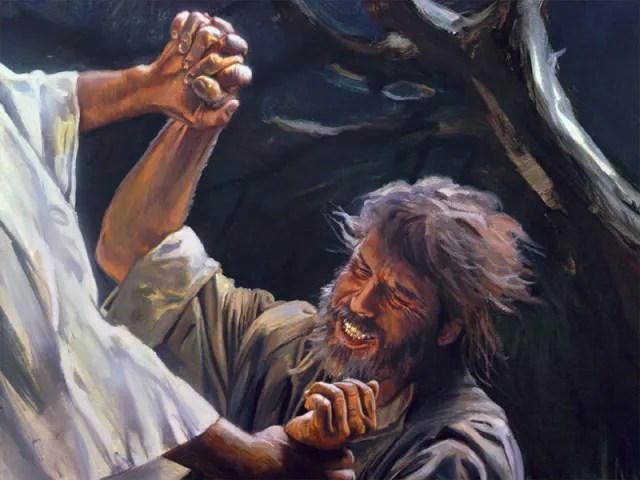
The story of Jacob wrestling with God is definitely worthwhile. We see him colliding with the Lord on the shore of the river Jabbok. Body on body they each try to gain the advantage. The text tells us that the match goes long into the night. (For background, see Genesis 32:24-32.)
Jacob is a grifter. He has built his life around a selfish deception. But again, he is still on God’s radar, and the Father isn’t finished with him yet.
A night of wrestling with God is really something we all will do at least once in our life. We each have a “Jabbok” and each will go body to body with the Holy One. Some of us will learn how to surrender, others will not. But sometimes, our dealings with God are silent, and unobservable.
It fascinates me to see Jacob wounded. “When the man saw that he would not win the match, he touched Jacob’s hip and wrenched it out of its socket” (v. 25). Jacob will limp for the rest of his life. Every morning as he got out of bed, he would groan from the stiffness and be reminded of that fight by the river.
So dear one, how should we process all of this?
No man is too far gone for God’s dealings.
Each of us, whether we realize it or not, will have our encounter with God. (Our personal “Jabbok.”)
God loves us too much to let us remain in our sin and darkness.
And sometimes, from that encounter we’ll walk with a limp.
My own experience. I was not in a good place 8 years ago, I was wrestling with God, and having some issues, but the Holy Spirit had no intention of letting me go. I had a very bad fall. Needless to say I laid on the ground with my right arm pinned beneath me for some time. That injury is known as “compartment syndrome.” I went into surgery immediately.
My right forearm/hand is now paralyzed. about 80% of the muscle tissue and nerves had to be removed. The doctors considered taking my arm off, but I’m glad they didn’t.
Like Jacob, I now have a tangible reminder of my fight with the Lord. There are times when I hurt. I’ve had to relearn and adjust to using my left hand. It has not been easy. Jacob would limp for the rest of his life, I can relate having just one arm.
“God has no pleasure in afflicting us, but He will not keep back even the most painful chastisement if He can but thereby guide His beloved child to come home and abide in the beloved Son.”
“He saw the disciples straining at the oars because the wind was against them.”
Mark 6:48
It’s good to know that Jesus sees our labor and effort. He truly understands all that concerns us, and He perceives every issue that matters most to us. Attentive and keenly aware He comes to our boat. It’s quite common for us to think that he isn’t aware, and we may feel that He’ll pass us by without a word. But that is not the case at all.
The Greek word for “against them” is ἐναντίος, and it means “opposed as an adversary, hostile, antagonistic.” I suppose that explains much to a believer who sees the wind doing awful things; that which is savage and difficult and contrary.
But Jesus watches over us, all the time. He is completely aware of you.
He knows all about our battle, the fight we have with our flesh, the difficulty we have with the challenging people in our lives. I often struggle to steer my boat. Jesus knows when and why I labor like I do. And He doesn’t condemn me.
The disciples were straining very hard to keep the boat afloat.
Every oar was being used and every man had his seat. They must work together. Some were frantically bailing, and a couple gripped the tiller. Considerable effort was being expended but to no avail. The wind pushed harder against them. This is perplexing. If you remember, they’re simply trying to obey the command of Jesus to cross the sea.
Why do things have to be so difficult?
I’m intrigued by believers who expect sunshine, blue sky, and red roses because they are doing God’s will. They don’t seem to think through the issues of conflict and challenge, weakness and weariness.
“It is necessary to go through many hardships to enter the kingdom of God.”
Acts 14:22
To do God’s will often means that there will be a headwind directly at us.
The seas will become impossible, and we may even be driven back. But special comfort comes when we realize we’re being watched. Jesus is doing constant surveillance on us, and He sees our toil on the oars. He comes to us, walking on the water.
Even in our storm, our hearts can rejoice.
“Lo, I am with you always, even to the end of the age”
Body piercing has become pretty much acceptable just in the last ten years. Studs are placed in a hole or piercing to make a permanent decoration. I have seen a fair amount of it, and I think that a stud in the tongue has got to be the most intrusive. (I recently read of a young girl who died after her tongue was pierced from an infection).
There is “body piercing” in scripture. In Deuteronomy 15:12-18, slaves who are set free by their master after six years of service, if they loved and were loved by their master, could choose to remain a slave to him.
“But if your slave says to you, “I don’t want to leave you,” because he loves you and your family and has a good life with you,17 stick an awl through his ear into the door; he will be your slave for life. Also do this to a female slave.”
Deuteronomy 15:12-18
This was a decision that required elders to act as witnesses. It was significant as well as completely binding. I like to think of the ceremony to be kind of a cross between a wedding and a circumcision. (Sounds fun, huh?!)
The slave would be led to a doorpost and the master would take an awl, and push it through his ear lobe. This designated the slave to be forever “owned” by a specific master. Herein lies a picture of the Christian.
Many times in the New Testament we are called to be servants (slaves) of Christ.
Peter, Paul, James, and Jude referred to themselves as “bond servants of Jesus Christ” in their epistles. This is not a forced servitude. It’s a choice made in love!
There are many believers who have done the same, they have fallen in love with their Savior. They do not plan on a life apart from Him. So spiritually they have gone to the doorpost, the awl is pushed through their ear, and they are marked from that point on.
Although the ear was pierced physically in the Old Testament, a different kind of piercing takes place in the New. In Romans 6:16 we read,
“Surely you know that when you give yourselves like slaves to obey someone, then you are really slaves of that person. The person you obey is your master. You can follow sin, which brings spiritual death, or you can obey God, which makes you right with him.”
Romans 6:16, NCV
When the prodigal son returned home from the far country he fell before his father and humbly ask, “make me your servant.” (Luke 15:19,21) He, in essence, was saying to the father, “pierce my ear.” The father made him a son, but the attitude of the son’s heart had changed to the heart of a servant. So it must be with us. Only then will we live a “pierced ear” life, revealing to all that we are servants of Jesus Christ!
“Savior, I know Thou hast allowed me absolute liberty, to serve Thee, or to go my own way. I would serve Thee forever, for I love my Master. I will not go out free. Mark my ear, Lord, that it might respond only to Thy voice.”
A long time ago there lived a young islander named Johnny Lingo. He lived on Nurabandi, not far from the island Kiniwata in the Pacific. Johnny was one of the brightest strongest and richest men in the islands, but people shook their heads and smiled about a business deal he had made with a man on Kiniwata. He had paid the unheard-of-price of eight cows for a wife, who was by any standards unattractive. As one fellow explained, “It would be kindness to call her plain. She was skinny. She walked with her shoulders hunched and her head ducked. She was scared of her own shadow.”
The amazing fact was in those days, two or three cows could buy an average wife, and four or five a highly satisfactory one. Why would Johnny pay eight? Everyone figured Sarita’s father, Sam Karoo, had taken young Johnny for a ride, and that’s why they smiled whenever they discussed the deal.
The teller of the story finally met Johnny for herself and inquired about his eight-cow purchase of Sarita. She assumed he had done it for his own vanity and reputation—at least she thought that until she saw Sarita: “She was the most beautiful woman I have ever seen. The lift of her shoulders, the tilt of her chin, the sparkle of her eyes all spelled a pride to which no one could deny her the right.” Sarita was not the plain girl she had expected, and the explanation lay with Johnny Lingo.
“Do you ever think,” he asked, “what it must mean to a woman to know that her husband settled on the lowest price for which she can be bought? And then later, when the women talk, they boast of what their husbands paid for them. One says four cows, another maybe six. How does she feel, the woman who was sold for one or two? This could not happen to my Sarita.”
“Then you did this just to make your wife happy?”
“I wanted Sarita to be happy, yes. But I wanted more than that. This is true. Many things can change a woman. Things that happen inside, things that happen outside. But the thing that matters most is what she thinks about herself. In Kiniwata, Sarita believed she was worth nothing. Now she knows she is worth more than any other woman in the islands.”
“Then you wanted—“
“I wanted to marry Sarita. I loved her and no other woman.”
“But—she said, close to understanding.
“But,” he finished softly, “I wanted an eight-cow wife.”
“She is more precious than jewels, and nothing you desire can compare with her.”
As he was starting out on a trip, a man came running to him and knelt down, and asked, “Good Teacher, what must I do to get to heaven?”
18 “Why do you call me good?” Jesus asked. “Only God is truly good! 19 But as for your question—you know the commandments: don’t kill, don’t commit adultery, don’t steal, don’t lie, don’t cheat, respect your father and mother.”
20 “Teacher,” the man replied, “I’ve never once broken a single one of those laws.”
21 Jesus felt genuine love for this man as he looked at him. “You lack only one thing,” he told him; “go and sell all you have and give the money to the poor—and you shall have treasure in heaven—and come, follow me.”
22 Then the man’s face fell, and he went sadly away, for he was very rich.
My name is inconsequential. I suppose all you must know of me is I tried to keep God’s Law and that I was very wealthy. Many believed that being rich was evidence that God approved of me. Of that, I wasn’t too sure. I kept the Law out of fear I suppose, and at times I just knew it wasn’t quite enough.
As I studied I began to realize that riches weren’t going to make me righteous. There was enough Scripture in me to let me know that it wasn’t enough. The prophets, especially Isaiah spoke about the deadliness of wealth, but there was that one verse in Proverbs that really disturbed me:
“Your riches won’t help you on Judgment Day; only righteousness counts then.”
(Proverbs 11:4.)
This verse (and all of the others) were the cause of many a sleepless night.
I was tormented by the reality of standing before God with nothing but my money to cover me. Coming under God’s righteous judgment haunted me. I thought of it day and night. I was terrified of being damned. My own righteousness wasn’t enough, and I knew it.
I heard about Jesus (and who hasn’t), and some were boldly claiming that he was the Messiah. He was at least a wonderful teacher and many said he worked powerful miracles, and perhaps he had answers for me. I hoped so, but I needed to know. It was my questions that drove me to find him.
And finding him was easy–I just followed the crowd.
I got ahead of everybody. I knelt in his path and waited. I must know what he thought I should do. When he stood before me I asked the question that had haunted me my whole life–“Good Teacher, what must I do to get eternal life?”
Jesus looked right at me. I knew deep down that he loved me.
But oh those words, his words really disturbed me. He told me that I only lacked one thing, that I must sell everything and distribute the money to the poor. Only by doing that would I discover riches in heaven. And only then could I truly follow him.
But that was the thing I couldn’t do.
It was my idol, my golden calf, and it was a sacrifice that I could never make.
I’ve come to realize now, over my many years, that when I do finally stand before God, I will have nothing to save me. Jesus invited me to follow, and I couldn’t and I didn’t.I won’t.
And that my friend, means I will die unforgiven.
“For what shall it profit a man, if he shall gain the whole world, and lose his own soul?”
Here are several quotes written by Brennan Manning. They’re definitely thought-provoking and should be prayed through. I think they’re worth considering. If you like them great, if not that’s ok too.
“The gospel declares that no matter how dutiful or prayerful we are, we can’t save ourselves. What Jesus did was sufficient.”
“When we wallow in guilt, remorse, and shame over real or imagined sins of the past, we are disdaining God’s gift of grace.”
“God loves you unconditionally, as you are, and not as you should be because nobody is as they should be.”
“I could more easily contain Niagara Falls in a teacup than I can comprehend the wild, uncontainable love of God.”
“In my experience, self-hatred is the dominant malaise crippling Christians and stifling their growth in the Holy Spirit.”
“The splendor of a human heart that trusts it is loved unconditionally gives God more pleasure than Westminster Cathedral, the Sistine Chapel, Beethoven’s “Ninth Symphony”, Van Gogh’s “Sunflowers”, the sight of 10,000 butterflies in flight, or the scent of a million orchids in bloom. Trust is our gift back to God, and he finds it so enchanting that Jesus died for love of it.”
“Those who have the disease called Jesus will never be cured.”
“The men and women who are truly filled with light are those who have gazed deeply into the darkness of their own imperfect existence.”
“God loves us as we are…not as we ought to be, because we are never going to be as we ought to be.”
“The ragamuffin gospel reveals that Jesus forgives sins, including the sins of the flesh; that He is comfortable with sinners who remember how to show compassion; but that He cannot and will not have a relationship with pretenders in the Spirit.”
“The North American Church is at a critical juncture. The gospel of grace is being confused and compromised by silence, seduction, and outright subversion. The vitality of the faith is being jeopardized. The lying slogans of the fixers who carry religion like a sword of judgment pile up with impunity. Let ragamuffins everywhere gather as a confessing Church to cry out in protest. Revoke the licenses of religious leaders who falsify the idea of God. Sentence them to three years in solitude with the Bible as their only companion.”
“When I get honest, I admit I am a bundle of paradoxes. I believe and I doubt, I hope and get discouraged, I love and I hate, I feel bad about feeling good, I feel guilty about not feeling guilty. I am trusting and suspicious. I am honest and I still play games. Aristotle said I am a rational animal; I say I am an angel with an incredible capacity for beer.”