Trying to Make Sense of the Incarnation

“The central miracle asserted by Christians is the incarnation. They say that God became man.”

C.S. Lewis

Incarnation, the central Christian doctrine that God became flesh, that God assumed a human nature and became a man in the form of Jesus Christ, the Son of God and the second person of the Trinity.

Now it’s true that Jesus voluntarily set aside all of the prerogatives of being God; He made the choice to lay His deity aside. Please think this verse through–let it sink into your hearts. It should be a mystery to you. It is to me.

“Though he was God,
    he did not think of equality with God
    as something to cling to.
7 Instead, he gave up his divine privileges;
    he took the humble position of a slave
    and was born as a human being.
When he appeared in human form,
8     he humbled himself in obedience to God
    and died a criminal’s death on a cross.”

Philippians 2:6-8

God, Himself decided to make the manger His home. The woman who carried the baby in her womb was created by Him (that should rattle your teeth)!

When we see the implications of all of this–we can only worship, just like the shepherds did. We can only gift Him, just like the wise men. The Christmas story itself becomes our example of acknowledging what He’s done. We are now the worshippers and givers.

All of this is a profound miracle, and can only be accepted by a simple faith, a “Christmas faith.” There is so much I need to learn about all of this, but that’s alright.

Have a blessed Christmas dear one. Know deep down that He has come for you, He holds you and cares for you. He will never ever leave you!

Photo by Pixabay on Pexels.com


Simeon, In His Own Words

Luke 2:25-35

“There was a man in Jerusalem whose name was Simeon. This man was righteous and devout, looking forward to Israel’s consolation, and the Holy Spirit was on him. 26 It had been revealed to him by the Holy Spirit that he would not see death before he saw the Lord’s Messiah. 27 Guided by the Spirit, he entered the temple. When the parents brought in the child Jesus to perform for him what was customary under the law, 28 Simeon took him up in his arms, praised God, and said,

29 Now, Master,
you can dismiss your servant in peace,
as you promised.
30 For my eyes have seen your salvation.
31 You have prepared it
in the presence of all peoples—
32 a light for revelation to the Gentiles
and glory to your people Israel.

His father and mother were amazed at what was being said about him. 34 Then Simeon blessed them and told his mother Mary, “Indeed, this child is destined to cause the fall and rise of many in Israel and to be a sign that will be opposed— 35 and a sword will pierce your own soul—that the thoughts of many hearts may be revealed.”

Yes, there were rumors. The priest Zechariah had declared that his son would become the Messiah’s forerunner. And apparently, angels had visited shepherds in their fields. Each encounter had come exactly how it was foretold.

I’m convinced that the Holy Spirit led me there that day.

I have no doubt that He was guiding me to the Temple. God had promised me that I would see with my own eyes the coming Messiah. This One would be salvation and be a light to the Gentiles which would bring glory and honor to the Jewish nation.

If these were of God, there needed to be collaborating witnesses that would foretell His work. One or two might be a mere coincidence, but three were a definite declaration. Plus I knew that my own eyes would see Him face-to-face.

To be perfectly honest, I really didn’t know what I expected to see. But I knew God’s heart, and I wanted to do His will. Some might say I was a devout believer in Israel’s prophetic purpose. I knew and believed that.

I had God’s promise that I would see Him.

Something or someone was prompting me to the Temple. I guess I had a divine appointment to keep. God had given me His promise, and I knew I was where I was supposed to be. It seemed like I was always on the lookout for that fulfillment.

It was then I saw the Child.

His parents stood out like something fluorescent. It seemed as if they were color in a black-and-white world, and they held the baby who was going to change the world. When I saw them I knew that everything had fallen into place. I saw the promise and He had come to save the world.

I took Jesus and held Him in my arms.

I was holding the Savior! This baby was to save the entire world from their sins. The Law required me to dedicate Him to God. Who can say what that means? I was to devote Him to God’s purpose and plan. Who had this honor, and who can say that this was their privilege? I had been chosen to insert Him into the purposes of God.

Who can say that?

When I laid my hands on Him it was like touching lightning. I spoke the blessing, but I understood that there was something more. I looked at His mother and spoke. It was both a blessing and a warning. I understood what God wanted to say, and it was a word that Israel’s hope would also have a sting that His mother needed to understand.

When I left the three of them in the Temple courts I began to grasp the reality of it all. I spoke God’s heart to His mother Mary. She had to know and understand who this Child really was. For me my task was complete.

I had spoken, and now it was time to leave.

“In the last days the mountain of the Lord’s Temple
    will be the highest of all mountains.
It will be raised higher than the hills.
    There will be a steady stream of people from all nations going there.”

Isaiah 2:2

Art: “Simeon holding Jesus,” by Andrey Shishkin, painted in 2012, Oil on canvas © Andrey Shishkin. Verses used: Christian Standard Bible

The Lightning of the Almighty

“He also said to them, 

“This is what is written: The Messiah will suffer and rise from the dead the third day, 47 and repentance for forgiveness of sins will be proclaimed in his name to all the nations, beginning at Jerusalem. 

48 You are witnesses of these things. 49 And look, I am sending you what my Father promised. As for you, stay in the city until you are empowered from on high.”

Luke 24:46-49, CSB (vv. 44-49)

Having His power is critical. These verses are packed full of really strong things. You can’t minimize any issue in this passage without damaging something that matters. I don’t intend to do that. For me, everything he says is crucial. I hope I won’t diminish anything that he has spoken to us.

  • There’s the issue of Jesus’ death and resurrection. We can’t minimize this. It’s the most astonishing event in history. It becomes our message.
  • There’s a critical need for repentance and forgiveness of sins. This is something that needs to be heard. The whole world must understand what has happened, and how they must respond.
  • The disciples of Jesus know this, they understand, and they’re the witnesses of everything Jesus did. All that they saw and learned, isn’t for them, but for others.

But the real significance only comes when these men are empowered by God. They must operate out of what God has promised to them. There’s power coming, God’s electricity is going to meet every circumstance they’ll face. People are going to be shocked by what’s going to happen.

They need to wait for Him though.

Power is coming–they need to hold on. They will witness, and testify about Jesus. They’re being sent, but not in their own strength or effort–but with the father’s power. The gift isn’t given for their enjoyment, but for his work.

The Holy Spirit is the electricity that gives the kingdom its power. Any substitute will mean failure and weakness.

We operate only when we are filled with his Spirit. There are going to be incredible obstacles, but we’ll have insurmountable power. The Word we preach must be done with his power, orders, and authority. The message is one of repentance and forgiveness, a proclamation of spiritual deliverance. And it begins in an upper room in Jerusalem.

What will happen there will be forever known as Pentecost.

The Holy Spirit is about to change the world!

Member of Faithful Bloggers

Learning to Love Prodigals

Learning how to forgive

Once I was punched in the face while preaching. I served as a full-time evangelist with SOS Ministries in 1987. I was leading a group to Haight/Ashbury St. in San Francisco. I remember it was really busy, and the it was a good team, and they were excited to take their church to the streets.

Haight/Ashbury was the place the “summer of love” kicked off, it peaked in 1968. It has a certain sense of notoriety, and even in 1983 it still had a dubious reputation as a center of the counter-culture. “A cult a day is born in San Francisco,” a pastor friend once shared with me.

Normally the neighborhood where I took a team would direct me on how to preach. Tonight I focused on God’s love for sinful people.

That message seemed appropriate for this place, and especially on this street. God loves these people very much.

A young man came forward. He told me that he was a backslidden Christian, and his father was an Assembly of God pastor. He had run away from home. Suddenly he began to weep. The entire team seemed to lean forward and I know they were praying earnestly for him. It seemed to me that he was teetering on the brink.

The punch came unexpectedly.

His fist hit me square in the nose. My eyes began to water. Oddly enough he took a step back and began to really cry out. My team wasn’t quite sure how to respond, but I hoped they prayed even harder. I sort of gasped and tried to shake it off. Someone must have called the police.

The Holy Spirit was very much present, both convicting and comforting each of us.

One or two minutes went by and suddenly he stopped sobbing and he became really angry. He took a step and then tried to kick me in the stomach, but I dropped the mic and caught his foot. I was ready for him this time.

About 20 minutes went by before SFPD showed up and asked if I wanted to press charges. I thought for a bit, but deep down I knew that wasn’t the will of my Father. Maybe I should of, I don’t know. But I thought about my own sin and couldn’t judge no one.

The Father was reaching him while teaching me!

God loves His prodigal children very much, He understands the guilt and shame (and frustration) they feel. The Father however is always watching and waiting. He works through life’s circumstances to lead them home. Each belongs to Him. He continues far past what we think is possible. He will never give up.

“We know what real love is because Jesus gave up his life for us. So we also ought to give up our lives for our brothers and sisters.”

1 John 3:16

I suddenly saw a “wounded” brother, very confused and quite angry. Not with me, the team, or the music–but with God who created him, and died for him.

At that moment I just happened to be God’s love for this prodigal.

“How did Jesus expect His disciples to react under persecution? (In Matthew 5:12 He said), “Rejoice and be glad!” We are not to retaliate like an unbeliever, nor sulk like a child, nor lick our wound in self-pity like a dog, nor just grin a bear it like a Stoic, still less pretend we enjoy it like a masochist. What then? We are to rejoice as a Christian should even “leap for joy” (Lk. 6:23).”

     John Stott

“How did Jesus expect His disciples to react under persecution? (In Matthew 5:12 He said), “Rejoice and be glad!” We are not to retaliate like an unbeliever, nor sulk like a child, nor lick our wound in self-pity like a dog, nor just grin a bear it like a Stoic, still less pretend we enjoy it like a masochist. What then? We are to rejoice as a Christian should and even “leap for joy” (Lk. 6:23).”


Lost & Found

On a warm afternoon, a lamb takes a peek at a visitor while eating hay at Fat Rooster Farm in Royalton, Vt., on April 27, 2003. (Photo by Geoff Hansen)

 “All the tax collectors and sinners were approaching to listen to him. 2 And the Pharisees and scribes were complaining, “This man welcomes sinners and eats with them.”

3 “So he told them this parable: 4 “What man of you, having a hundred sheep, if he has lost one of them, does not leave the ninety-nine in the open country, and go after the one that is lost, until he finds it? 5 And when he has found it, he lays it on his shoulders, rejoicing. 6 And when he comes home, he calls together his friends and his neighbors, saying to them, ‘Rejoice with me, for I have found my sheep that was lost.’ 7 Just so, I tell you, there will be more joy in heaven over one sinner who repents than over ninety-nine righteous persons who need no repentance.“

Luke 15:1-7

What does it mean to be lost? Some have that much figured out by now, (and if not, we will.) The Bible nails us with this story, and it rings true of the human condition. You don’t need a Ph.D. in Psychology to understand this. The heart and soul of a man and a woman are in an awful state of separation from God, and some are beginning to understand this.

The three stories reveal that the Pharisees and the scribes have issues.

Their whole belief system–the idea of who’s righteous and who’s not, is being rocked. The sinners are coming to listen to Jesus (maybe for the stories, maybe for something else?) The religious regime is mystified, and maybe a bit jealous. Perhaps they were irked at the grace of God they see in Jesus?

Jesus tells His first story, (and he loves to tell stories I’ve found.) Anyway, the parable he shares is 100 words (more or less) and it describes the condition of every man, woman, and child–everyone who has ever existed. He clearly cuts through “religion” like a hot knife through cold butter. He quite succinctly describes us. And wow, these stories are eye-openers.

We’re all lost sheep–wandering, and sometimes very confused.

The paths we’ve taken to get out of our “lost-ness” have only confused us even more. We’ve had to deal with thorns and vultures; it hasn’t been easy, and we’ve never been able to reconnect to safety. Some become “smart” people, others buy fast cars, and some kill their lost-ness with booze or drugs. We find many different ways to keep us from feeling this separation from God.

A very lost sheep.

In Luke 15, we find three parables that all deal with lost things–sheep, coins, and sons. Essentially, they each explain what now has happened to us. Most of us know that the religion of the Pharisees hasn’t worked. Even the sinners understand that much. Sometimes even the very lost have figured that much out, even before the so-called righteous do.

Jesus tracks us down–our confusion has finally lifted enough to see his outstretched arm. The Father has this odd preference for those who know they’ve lost, and these three parables come in a deliberate succession–that should make things pretty clear.

So dear one, will you insist on wandering? Is that what you really want?

alaskabibleteacher.com

w

Calibrating Your Heart to His

scalingchart1080tf3
A chart used to calibrate video

“May the patience and encouragement that come from God allow you to live in harmony with each other the way Christ Jesus wants.”

Romans 15:5

“Now make me completely happy! Live in harmony by showing love for each other. Be united in what you think, as if you were only one person.”

Philippians 2:2

The science and method of calibration provide us with a way to bring two, or more things into harmony.  It’s done frequently on diverse things such as scientific instruments, avionics, or music.  Without this need for ‘blending’ things degrade into a symphony of confusion.

A piano is tuned, and the worship leader then tunes into that piano.   

The worship team is blending simultaneous sounds of different pitch or qualities, making chords. This takes practice and a gift. This principle is enhanced when we think of several gears that mesh and turn together.  There is a certain congruity or symmetry that makes it successful. Beautiful music can happen only if the musicians have been calibrated with each other.

We need a calibration of our spirit with God’s Holy Spirit.  We tune in to Him.  His Word is a little bit like a tech manual, showing us, and helping us.  He helps us adjust so that we are harmoniously flowing with Him and with others. Sometimes this takes time.

Have you ever met a believer and they were no longer in harmony? 

I bet you have. They may have a belief that is out of balance.  It may be health or sickness.  That is quite common today.  A common issue is the area of politics. Lately, it’s become a danger for many believers. Be very careful.

I served in San Francisco in the 1980s with SOS Ministries.  There was a small church down in Pacifica that would drive up to ‘worship on the street’ with us.  They were incredible.  They had a sensitivity and anointing that other groups didn’t have.  They loved Jesus very much and loved each other, and it showed.

Within six months they disbanded and went their own ways.  I was told that their meetings were essentially gutted out.  They became fanatical about the ‘anti-abortion’ message to such an extreme they didn’t even have a church service anymore.  It was now nothing more than a political rally, and they were not even reading the Word or worshiping together. 

They were no longer calibrated to the Spirit or the Church. They were no longer aligned with the truth.

I have to be regularly adjusted to harmony with the promises of God.  I need my gauges to be consistent with the Word.  Not to be ‘heavy’ on certain things or ‘light’ on others. I can easily err on emphasis. That’s a real possibility. If I’m not calibrated, I become a spiritual danger to others, my family, and to myself.

“Finally, all of you, have unity of mind, sympathy, brotherly love, a tender heart, and a humble mind.”

1 Peter 3:8

alaskabibleteacher.com

When God Puts You Into a Quarantine

quarantine

Quarantines are a real possibility, even to this day. A quarantine is imposed when a disease is contagious enough that it would harm a society: Measles, Smallpox, and the recent COVID-19 are just a few physical diseases where isolation must be imposed.

It can be severe— an epidemic, with desperate consequences if not adhered to; in some rare cases, the use of deadly force has been authorized to maintain a quarantine until the disease is no longer communicable.

This may surprise you, but there are examples of ‘quarantines’ in the Bible.

The term ‘unclean’ was used for ‘leprosy.’ Those afflicted had to isolate themselves; they had to ‘announce’ their presence when in contact with society. Lepers lived in groups away from the general populace, as a result of their disease.

In Paul’s epistle to the Corinthians, he addresses another kind of ‘quarantine.’ The situation was dire; the church had advocated a Christian living with his father’s wife.

“I have already passed judgment on this man 4 in the name of the Lord Jesus. You must call a meeting of the church. I will be present with you in spirit, and so will the power of our Lord Jesus. 5 Then you must throw this man out and hand him over to Satan so that his sinful nature will be destroyed and he himself will be saved on the day the Lord returns.”

1 Corinthians 5:3-5, NLT

Understanding the Principle of Usefulness

“Now in a large house, there are not only gold and silver vessels, but also vessels of wood and of earthenware, and some to honor and some to dishonor.”

2 Timothy 2:20, NASB

Found in God’s pantry are lots of pots and pans of various uses.  Paul writes Timothy about the ‘large house’ which is the Church inclusive. Look around Timothy, there are gold ones, and there are silver ones. They have a noble purpose fitting for such a great house. These are the ones the guests will use; they befit the significance of the Lord himself. These vessels have great value for they are made of precious metals.

There are vessels of different categories. These are the ones made of wood, and of clay. These are part of the household, make no mistake about it. But their use is one of function, they’re utilized in common and ignoble ways. (A clay ‘bed-pan’ perhaps?!)

21 “Therefore, if anyone cleanses himself from these things, he will be a vessel for honor, sanctified, useful to the Master, prepared for every good work.”

2 Timothy 2:21

Paul, the author of the New Testament doctrine of grace emphasizes the place of personal holiness. We are to ‘cleanse’ ourselves to become a vessel of honor. There is good news here:

  • All are vessels in the Father’s house. Each of us belongs to Him. He alone determines their use.
  • Things are not yet in their final state. Changes in status can be experienced. In God’s economy, clay pots can become ‘golden.’ Silver can become ‘wood.’

Some sin is contagious.

It affects believers, and the Church becomes compromised by what we’ve done. And then sometimes we are quarantined by the Holy Spirit–until the contagion passes. This spiritual disease must not be permitted.

I have experienced this several times in my own discipleship. These are not pleasant times, but there is no condemnation. I’m still His servant, His love for me stays outrageously constant. He has never turned away a sinning child who repents of their sin.

“Yes, I am His servant, but I must wait out in the hall. I haven’t been faithful. So I sit in His waiting room, waiting for His call. This is for my good. And my Father knows what is best.” 

alaskabibleteacher.com

You’re a Steward of Your Pain

Some time ago I came across a story that connected. A visiting speaker stood in front of a congregation and shared a painful incident from his childhood. He wanted to bring healing. After he spoke, an elder came and spoke to him–

“You have learned how to become a proper steward of your pain.”

The visiting speaker was profoundly touched by this. Finally, something came together in his heart and soul. Yes, he did learn how to deal scripturally with those ugly things from his past. He was becoming a proper steward of his pain.

The word for steward in the original Greek is oikonomos. It literally means “a keeper of a home.” It describes a manager, a superintendent to whom the head of the house or proprietor has entrusted the management of his affairs, the diligent care of receipts and expenditures.

The issue seems to be of management, how can God use these awful things for building His Kingdom?

No question about it, we live in a world of darkness. Each of us has been touched by hard things. Scars are part of our lives. When we come to Christ they come with us. All of these grim things are a real piece of us, we have been hurt (or maybe we’ve wounded others?)

Are you a good steward of who you are? Whether you’ve experienced trauma–something physical, sexual, or perhaps a mental illness. It could be any scar you carry from your past, and no one is immune from them it seems. You’ll find freedom if you can use these things for Him and his Kingdom.

We must see and understand that Jesus has taken everything and redeems it all for His glory.

He understands us fully–our past, present, and future. He ‘knows’ us–the real and hidden us. The challenge I suppose is to take these sad events to the throne. He alone can heal and then use that which has devastated us. What was intended to destroy is now meant to build.

Satan has afflicted you in his dark attempt to destroy you.

Jesus intervenes to save. As we grow to accept this, the Holy Spirit comes as our comforter and guide. He starts to teach us true redemption, and the incredible healing that he brings with him. It really is his work, not ours. We finally understand. It’s then we become broken healers that God can use.

The light has truly overcome the dark.

We’re being taught (sometimes very slowly) to carry all of these things and plead the blood of Jesus over our past. He covers us completely. He has redeemed us. Luke 1:68 explains much clearer than I can:

“Blessed is the Lord, the God of Israel because he has visited and provided redemption for his people.”

Becoming a steward of our pain is his doing. We’re able to touch others with these things that would cripple and destroy others. He has made us “managers” of these things, and we are taught to teach others, declaring that God has completely saved us. He works miracles!

“Therefore, if anyone is in Christ, he is a new creation; the old has passed away, and see, the new has come!”

2 Corinthians 5:17

We’ll sovereignly meet those who need to hear our story. We’re being transformed into authentic witnesses. Yes, at times these awful things still hurt, and I suppose that’s to be expected. But we’re learning to manage them. We’ve become real-life stewards of our pain.

“That’s why we can be so sure that every detail in our lives of love for God is worked into something good.”

Romans 8:28, Message

alaskabibleteacher.com

How to Hear God Clearly

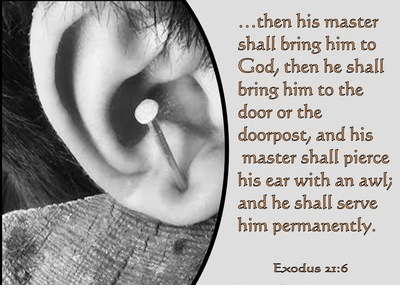
In Deuteronomy 15:12-18, slaves who are being set free by their master after six years of service, could, if they loved and were loved by their master, could choose to remain a slave to him forever.

“But if your slave says to you, “I don’t want to leave you,” because he loves you and your family and has a good life with you, stick an awl through his ear into the door; he will be your slave for life. Also, do this to a female slave.”

Deuteronomy 15:12-18, (Exodus 21:6)

This was a decision that required elders to act as witnesses.  It was significant as well as entirely binding.  I like to think of the ceremony as a cross between a wedding and circumcision. (Sounds like fun!)

The slave would be led to a doorpost and the master would take an awl, and push it through his ear lobe.  This designated the slave to be forever “owned” by a specific master.  The slave would then wear an earring to remind everyone who they were. Herein lies a picture of the consecrated Christian.

Many times in the New Testament people called themselves bondservants of Christ.

Peter, Paul, James, and Jude each referred to themselves as “bondservants of Jesus Christ” to open up their epistles. An example:

(“Paul, a bond-servant of Christ Jesus, called as an apostle, set apart for the gospel of God.”)

This is not a forced servitude. This a choice made from love!

There are many believers who have done the same, they have fallen in love with their Savior.  They do not plan on a life apart from Him. They’ve decided they won’t serve anyone else. So spiritually they have gone to the doorpost, the awl is pushed through their ear, and they are marked from that point on.

Although the ear was pierced physically in the Old Testament, a spiritual kind of piercing takes place in the New. We see glimmers of that decision,

“Surely you know that when you give yourselves like slaves to obey someone, then you are really slaves of that person. The person you obey is your master. You can follow sin, which brings spiritual death, or you can obey God, which makes you right with him.”

Romans 6:16, (NCV)

Just a thought. When the prodigal son returned home from the far country he fell before his father and humbly asked, “make me your servant” (Luke 15:19, 21). He, in essence, was saying to the father, “pierce my ear.” The father made him a son, but the attitude of the son’s heart had changed into the heart of a bondservant. So it must be with us.

We each will have a chance to live out a “pierced ear life.“

Perhaps it’s then will we’ll truly hear His voice in a new and clearer way. Maybe this is the next step we should take. It’s not demanded, or required. Sometimes hearing Him can be a challenge, but the Father delights in this. He will share with you what’s on His heart.

“Savior, I know Thou hast allowed me absolute liberty, to serve Thee, or to go my own way. I would serve Thee forever, for I love my Master. I will not go out free. Mark my ear, Lord, that it might respond only to Thy voice.”

— Jim Elliot, Missionary, and Martyr

alaskabibleteacher.com

Are You Carrying a Heavy Burden?

“Come to me, all who labor and are heavy laden, and I will give you rest. 29 Take my yoke upon you, and learn from me, for I am gentle and lowly in heart, and you will find rest for your souls. 30 For my yoke is easy, and my burden is light.”

Matthew 11:28-30, ESV

To be honest, this passage has yet to be fully processed by me. Sometimes I understand, but then I forget. Because of this, this post is preaching to me, and if you decide to bail on reading this that’s ok. I write because I truly believe that these things are possible. I don’t always put this passage in action. I ask for your forgiveness.

Jesus issues an invitation to His listeners that’s earth-shaking. He sets Himself is far above the rule of the Pharisees; these declarations can’t be explained away. Jesus puts Himself as the only one that brings true peace. That’s pretty arrogant, especially if it’s wrong.

But it’s really a false statement. Jesus bursts though this confusion, and life eternal is what He carries to each believer.

The Pharaeses have long ago decided the Law was the the Mosaic yoke that kept the people in line. Jesus taught otherwise.

“Come to Me.”

I suppose the operative word here is “Me.” Jesus Christ is the exclusive giver of peace and strength. He must be acknowledged as the believer’s complete focus–He is a man, not a religious set of rules and regulations. When we decide to follow Jesus it puts us at odds with legalism.

“All who labor and are heavy laden, and I will give you rest.“

Interesting, the Greek word for labor means “exhausted or toiling.” The word for heavy laden has the idea of someone who is fully loaded, carrying a pile, it also has the implication of having spiritual anxiety.

All means everyone–not a select few, nor those who think that they’re doing all right on their own. “Labor and heavy laden”. Both words describe those who carry burdens, and who have backs that are bending because of a difficult load. I believe that they’re those who struggle with defeat and failure.

The rest He gives is profound. And notice the word “give.” His desire is to free us, and that dear one is a gift, it’s not earned or achieved. The word “rest” means to refresh or to make calm.

“Take my yoke upon you, and learn from me,“

We lay down our cares, concern, and all spiritual anxiety and to receive another kind of weight–His yoke. Jesus also calls us to another burden. We are called to “learn” from Him.

In training oxen, a wise farmer has the new, weaker one to be yoked with the one who is older. They are to be trained properly pull the plow. The older one teaches the younger.

Two things I ask that you consider:

  • We are learners. A student discovers that his teacher’s lessons can be challenging. I remember trying to grasp Geometry. I went around and around trying to understand. The teacher was patient, and she made an effort to communicate. In the same way the Holy Spirit works to share heavenly truths to me. One of His titles is “Teacher.”
  • The Lord deeply desires to release me from my “spiritual anxiety.” Perhaps I offend Him everytime I pick my sinful burden up. I do this fairly often. But He promises us we’ll have we’ll have a spiritual victory if we choose to follow Him.

“For I am gentle and lowly in heart, and you will find rest for your souls.”

“Gentle.” and “Lowly in heart.” This is how He explains Himself to us, which is pretty much opposite of what we think Jesus is. Somehow when we forget the yoke, sin and Satan muddles our thinking, and we often walk out our spiritual anxiety. This is incredibly exhausting, and our fear grows and we try hide it.

I suppose to be yoke-less opens us up to everything religious effort has to offer.

The Greek for “rest” is defined as an intermission or cessation of any activity, rest or recreation. It’s good word rhat when we become quiet; outward and inward. That seems to be opposite of what we think we must do. Often we ratchet up our activity to somehow show the Father that we deserve His love.

“For my yoke is easy, and my burden is light.”

What Jesus offers us is His own yoke of unconditional love. He replaces out heavy burden with His gentle weight. The yoke of Jesus replaces the burden of legalism. What He gives is of no comparison to what we think we might understand.

The yoke of Jesus is fairly easy. It’s meaning in the original is wonderful. It means something that’s mild or pleasant. Jesus’ gift of a yoke replaces our spiritual anxiety. We don’t walk in the constant fear of our failure to measure up.

“Easy” and “light” is the very nature of His yoke of discipleship.

Following Him shouldn’t be grueling or hard, and yet we stilldon’t grasp this .What Jesus offers is our chance to become real. He wants us to share His yoke, but it’s not hard. Yes, we must forsake everything to be one of His followers, but Jesus offers us far more than we ever dreamed.

alskabibleteacher.com