I Couldn’t Follow Him

Mark 10:17-22

As he was starting out on a trip, a man came running to him and knelt down, and asked, “Good Teacher, what must I do to get to heaven?”

18 “Why do you call me good?” Jesus asked. “Only God is truly good! 19 But as for your question—you know the commandments: don’t kill, don’t commit adultery, don’t steal, don’t lie, don’t cheat, respect your father and mother.”

20 “Teacher,” the man replied, “I’ve never once broken a single one of those laws.”

21 Jesus felt genuine love for this man as he looked at him. “You lack only one thing,” he told him; “go and sell all you have and give the money to the poor—and you shall have treasure in heaven—and come, follow me.”

22 Then the man’s face fell, and he went sadly away, for he was very rich.

My name is inconsequential. I suppose all you must know of me is I tried to keep God’s Law and that I was very wealthy. Many believed that being rich was evidence that God approved of me. Of that, I wasn’t too sure. I kept the Law out of fear I suppose, and at times I just knew it wasn’t quite enough.

As I studied I began to realize that riches weren’t going to make me righteous. There was enough Scripture in me to let me know that it wasn’t enough. The prophets, especially Isaiah spoke about the deadliness of wealth, but there was that one verse in Proverbs that really disturbed me:

“Your riches won’t help you on Judgment Day; only righteousness counts then.”

(Proverbs 11:4.)

This verse (and all of the others) were the cause of many a sleepless night.

I was tormented by the reality of standing before God with nothing but my money to cover me. Coming under God’s righteous judgment haunted me. I thought of it day and night. I was terrified of being damned. My own righteousness wasn’t enough, and I knew it.

I heard about Jesus (and who hasn’t), and some were boldly claiming that he was the Messiah. He was at least a wonderful teacher and many said he worked powerful miracles, and perhaps he had answers for me. I hoped so, but I needed to know. It was my questions that drove me to find him.

And finding him was easy–I just followed the crowd.

I got ahead of everybody. I knelt in his path and waited. I must know what he thought I should do. When he stood before me I asked the question that had haunted me my whole life–“Good Teacher, what must I do to get eternal life?”

Jesus looked right at me. I knew deep down that he loved me.

But oh those words, his words really disturbed me. He told me that I only lacked one thing, that I must sell everything and distribute the money to the poor. Only by doing that would I discover riches in heaven. And only then could I truly follow him.

But that was the thing I couldn’t do.

It was my idol, my golden calf, and it was a sacrifice that I could never make.

I’ve come to realize now, over my many years, that when I do finally stand before God, I will have nothing to save me. Jesus invited me to follow, and I couldn’t and I didn’t.

And that my friend meant I would die in my sin.

“For what shall it profit a man, if he shall gain the whole world, and lose his own soul?”

Mark 8:36, KJV

alaskabibleteacher.com

A Prayer of a Minor Prophet

by A.W. Tozer

His Ordination Prayer as a Pastor, serving in the Christian and Missionary Alliance

August 18, 1920

O Lord, I have heard Thy voice and was afraid. Thou has called me to an awesome task in a grave and perilous hour. Thou art about to shake all nations and the earth and also heaven, that the things that cannot be shaken may remain. O Lord, my Lord, Thou has stooped to honor me to be Thy servant. No man taketh this honor upon himself save he that is called of God as was Aaron. Thou has ordained me Thy messenger to them that are stubborn of heart and hard of hearing. They have rejected Thee, the Master, and it is not to be expected that they will receive me, the servant.

My God, I shall not waste time deploring my weakness nor my unfittedness for the work. The responsibility is not mine, but Thine. Thou has said, “I knew thee – I ordained thee – I sanctified thee,” and Thou hast also said, “Thou shalt go to all that I shall send thee, and whatsoever I command thee thou shalt speak.” Who am I to argue with Thee or to call into question Thy sovereign choice? The decision is not mine but Thine.

So be it, Lord. Thy will, not mine, be done.

Well do I know, Thou God of the prophets and the apostles, that as long as I honor Thee Thou will honor me. Help me therefore to take this solemn vow to honor Thee in all my future life and labors, whether by gain or by loss, by life or by death, and then to keep that vow unbroken while I live.

It is time, O God, for Thee to work, for the enemy has entered into Thy pastures and the sheep are torn and scattered. And false shepherds abound who deny the danger and laugh at the perils which surround Thy flock. The sheep are deceived by these hirelings and follow them with touching loyalty while the wolf closes in to kill and destroy. I beseech Thee, give me sharp eyes to detect the presence of the enemy; give me understanding to see and courage to report what I see faithfully. Make my voice so like Thine own that even the sick sheep will recognize it and follow Thee.

Lord Jesus, I come to Thee for spiritual preparation.

Lay Thy hand upon me. Anoint me with the oil of the New Testament prophet. Forbid that I should be come a religious scribe and thus lose my prophetic calling. Save me from the curse that lies dark across the modern clergy, the curse of compromise, of imitation, of professionalism. Save me from the error of judging a church by its size, its popularity or the amount of its yearly offering. Help me to remember that I am a prophet – not a promoter, not a religious manager, but a prophet. Let me never become a slave to crowds. Heal my soul of carnal ambitions and deliver me from the itch for publicity.

Save me from bondage to things. Let me not waste my days puttering around the house. Lay Thy terror upon me, O God, and drive me to the place of prayer where I may wrestle with principalities and powers and the rulers of the darkness of this world. Deliver me from overeating and late sleeping. Teach me self-discipline that I may be a good soldier of Jesus Christ.

I accept hard work and small rewards in this life.

I ask for no easy place. I shall try to be blind to the little ways that could make life easier. If others seek the smoother path I shall try to take the hard way without judging them too harshly. I shall expect opposition and try to take it quietly when it comes. Or if, as sometimes it falleth out to Thy servants, I should have grateful gifts pressed upon me by Thy kindly people, stand by me then and save me from the blight that often follows. Teach me to use whatever I receive in such manner that will not injure my soul nor diminish my spiritual power. And if in Thy permissive providence honor should come to me from Thy church, let me not forget in that hour that I am unworthy of the least of Thy mercies, and that if men knew me as intimately as I know myself they would withhold their honors or bestow them upon others more worthy to receive them.

And now, O Lord of heaven and earth, I consecrate my remaining days to Thee; let them be many or few, as Thou wilt. Let me stand before the great or minister to the poor and lowly; that choice is not mine, and I would not influence it if I could. I am Thy servant to do Thy will, and that will is sweeter to me than position or riches or fame.

I choose it above all things on earth or in heaven.

Though I am chosen of Thee and honored by a high and holy calling, let me never forget that I am but a man of dust and ashes, a man with all the natural faults and passions that plague the race of men. I pray Thee, therefore, my Lord and Redeemer, save me from myself and from all the injuries I may do myself while trying to be a blessing to others. Fill me with Thy power by the Holy Spirit, and I will go in Thy strength and tell of Thy righteousness, even Thine only. I will spread abroad the message of redeeming love while my normal powers endure.

Then, dear Lord, when I am old and weary and too tired to go on, have a place ready for me above, and make me to be numbered with Thy saints in glory everlasting. Amen. AMEN.

AlaskaBibleTeacher.com

Built On the Rock

“Everyone then who hears these words of mine and does them will be like a wise man who built his house on the rock. 25 And the rain fell, and the floods came, and the winds blew and beat on that house, but it did not fall, because it had been founded on the rock.” 

“And everyone who hears these words of mine and does not do them will be like a foolish man who built his house on the sand.”

Matthew 7:24-26, ESV

Embedded in Jesus’ Sermon on the Mount are these words: they absolutely penetrate any “religious” sensitivity we think we have. This parable Jesus taught carries the full weight of divine authority.

Up to now, Jesus’ listeners just might reduce his words to nice religious platitudes–something future, and maybe conceptual. I must warn you, this isn’t the case.

Obedience is the critical idea here.

If they’re wise, they are told to put all they’ve heard into practice. It’s really not enough to hear and respect what Jesus declares–they must do the words. Jesus isn’t simply a great moral teacher, all that he says is authoritative; and not just in a benevolent, superficial way–what he says are the very words of God to people, like you and I.

Pay attention: There are two builders in this parable. Two different men; the wise and the very foolish.

The each have their own strategies, their methods are quite different. Both listen; but one responds with careful planning. He understands the potential dangers–rain, floods and wind things that are going to happen. It’s funny, our Lord never “sugarcoats” life. Nasty things are going to get challenging.

Following Jesus never gives us any immunity; there are no special favors given to a believer. (Only comfort. Forgiveness. Eternal life.)

The other man is foolish. He decided to take a shortcut in all of this construction stuff. Maybe it takes too much time? But he decides to implement the work as soon as he can. Maybe his motive is just wanting to put Jesus’ words into practice? Maybe he’s got a noble reason for this?

Obedience is mentioned twice. Enthusiasm is never mentioned; and eagerness is not good spirituality it seems. Careful work (and planning) are critical issues.

I want to stress that you take your time laying down his words. Examine carefully what he’s telling you about your construction. He’s your true Architect–you’re only the only obedient builder. We read his plans and examine his blueprints. We really need to be faithful.

“Using the gift God gave me, I laid the foundation of that house like an expert builder. Others are building on that foundation, but all people should be careful how they build on it.”

1 Corinthians 3:10

Be diligent in these matters; give yourself wholly to them, so that everyone may see your progress.”

1 Timothy 4:15

The Real Glory of the Real Jesus

Mark 9:2-8, ESV

“And after six days Jesus took with him Peter and James and John, and led them up a high mountain by themselves. And he was transfigured before them, and his clothes became radiant, intensely white, as no one on earth could bleach them. And there appeared to them Elijah with Moses, and they were talking with Jesus. 

“And Peter said to Jesus, “Rabbi, it is good that we are here. Let us make three tents, one for you and one for Moses and one for Elijah.” For he did not know what to say, for they were terrified.” 

And a cloud overshadowed them, and a voice came out of the cloud, “This is my beloved Son; listen to him.” And suddenly, looking around, they no longer saw anyone with them but Jesus only.”

I could go a hundred different ways with this passage. After much thought (disorganized most of the time) I’ve decided to go with the following. I know deep down how deficient it is, and I know you have much to add to it, which is very good.

But what I do understand I give to you.

The more I try to process Mark 9 the more I see things that are wildly significant. What happened there was radical, and I realize that I still don’t have a solid grip on it, and if I did I know deep down it’d change my life.

  • James, John, and Peter. Why these three? Some have suggested that these particular disciples were the ones who desperately needed to see what was going to happen. That’s very possible. Perhaps they were the weakest, and maybe they needed to see the real Jesus in His glory. My personal view is that these three wrote books, epistles. Maybe Jesus understood this, and gave them this earth-shaking experience?
  • The impact on Peter was profound. “”For we did not follow cleverly devised stories when we told you about the coming of our Lord Jesus Christ in power, but we were eyewitnesses of his majesty. 17 He received honor and glory from God the Father when the voice came to him from the Majestic Glory, saying, “This is my Son, whom I love; with Him, I am well pleased.”  We ourselves heard this voice that came from heaven when we were with him on the sacred mountain.” (2 Peter 1:16-18).
  • Toward the end of Peter’s life he couldn’t shake the Transfiguration and what he witnessed there. He recalled the “glory” but it seems it was the voice that was the most profound. It was that voice that completely altered his life and ministry. (Notice that he mentions it twice in verse 18.)
  • The Greek word for “transfigured” is metamorphosis. (Like a butterfly coming out of a cocoon.) Jesus wasn’t put in some spiritual “spotlight,” rather the glory that was seen was coming from inside Him. We see that He was God and Jesus revealed Himself clearly as God. The three disciples who were witnesses seem to struggle with exactly what took place. They use human analogies and images to try to explain to us what they saw.
  • The word “terrified” is the word phobia. Could it be that our encounter with God could go to that extreme? Could we be that we could be terrified in His presence? Does that fit into our theology? You need to decide if it’s significant or not.
  • And what about Moses and Elijah? Most feel that each represented the Law and the Prophets. I must point out that both had ministered from the top of mountains before? But notice, even though Jesus emanated extreme glory, these two did not. Also, the arrival of these two reinforces the real world of life after death. Both Moses and Elijah were very much alive!
  • The “human” part of Jesus was temporarily set aside. We know that Jesus was fully man, but here we see Him as He really is–fully and completely God. What a revelation! The three disciples were profoundly touched. Seeing the power and glory of the Creator of the universe on the top of the mountain altered their lives and changed their ministry.
  • John would write his Gospel and three letters. James wrote the first book in the NT. Peter is credited with the Gospel of Mark and his two books. They “knew” exactly who Jesus was! They had become fully convinced and needed no theological explanation. They finally understood!

So much more should be considered.

What I’ve written today is so incomplete–I feel a little foolish putting this down in this post. But yet I’m actively praying for you that this might add to your understanding. The Transfiguration is profound. It certainly needs to be internally processed by every real believer. And for those who don’t know Jesus yet, I hope you can understand exactly who He is to us who believe.

“In the beginning was the Word, and the Word was with God, and the Word was God.  He was with God in the beginning.  Through him all things were made; without him, nothing was made that has been made.  In him was life, and that life was the light of all mankind.  The light shines in the darkness, and the darkness has not overcome it.”

John 1:1-4, NIV

alaskabibleteacher.com

Nothing More Than a Child

A song for going up to worship. Of David.

Psalm 131

The Christian who is struggling should become a reader of the Psalms. We must remind ourself of this need to study through them, repeatedly. For believers, Psalm 131 is mandatory, and this is a great place to start.

This particular psalm is unique, and incredibly insightful.  It begins its work in us right at the start; the superscription.  “A song for going up to worship,” and it strikes me that a work must happen inside of my heart.  It is a preparation that will take me higher, and it helps me see God more clearly from a new vantage point. 

Verse 1 states the certain issue we have; it is called ‘pride.’  What David says seems to be a very arrogant and audacious thing to say.  There is a truism that you think you’re humble, you’re not.  To claim you are suddenly liberated from pride, knowing ears perk up.  It is almost always a sign of danger.

😁

Take it at face value, David states that he has a real contentment with his limitations and weaknesses.  It appears that he has been freed from the vicious cycle of needing to be the center of everything. He sings of his ignorance, and weakness. David goes public with his self-flattery. He knows that if he really wants to ascend he must descend.

And it must happen continuously.

Some make themselves spiritually sick by the deep dark quest to be important.  In verse 2, we connect with some astonishing imagery.  A baby!  I am like a little child being held by my mom. It’s not an issue of sophistication, but simplicity. You must choose to do this.

The word for weaned isn’t a newborn here. Rather in Hebrew it denotes a small toddler.

A weaned child no longer needs his mom’s milk. He doesn’t fuss, or nuzzle his mother’s breast, demanding his food.  The child no longer receives his nourishment this way. 

This is a significant step into maturity. To me, verse 2 is the centerpiece of Psalm 131.  OK, let’s apply this spiritually.  There was a time when it was necessary for me to have my mother’s milk. I screamed and would throw a terrible tantrum if she didn’t feed me from her breast.  I would starve if she didn’t give me her milk.

For all practical purposes, it seems we use God to get what we need.  But we grow, and become mature. David is saying that we need to emulate his example. 

Now we can come into God’s presence– just to be with Him.

That’s all.  So simple.  As a child, we just want to be where He is at.  We have no ulterior motives, there is no manipulation.  We seek His face, not what is in His hands. If we rightly connect the dots, we find that we land right back to that opening superscription

“A song for going up to worship.

This is an amazing concept of true adoration– the real kind.  As a struggler, more a rascal than Christlike, I must start at the beginning– again, and again, and again. I can only do this if I become a little boy again. 

I finally start to realize that I must renounce my selfish ambition and silly pride. Polished people won’t understand, they never will.

Matthew 11:25

alaskabibleteacher.com

Our Servant King Teaches Us

servant-king

Mark 10:44

I’m processing something right now.

I suppose its implications could turn everything upside down,’ at least for me anyway. Some scientists have postulated that our planet is due for a complete magnetic switchover. This is when the north becomes south and vice versa. My issues at this moment are not quite that cosmic.

At this moment there are over 7,000,000,000 people living on planet earth.

(That’s seven billion.)

Sometimes I wonder if many of my issues come from not seeing this. I’m merely one drop in a vast sea of people. It also seems that there’s an intoxication of success when we become increasingly confused over ‘who’ we really are.

We think it’s about our efforts, maybe our giftedness. Perhaps it’s pride that drives us, even among mature Christian believers. But this is not the way of our Master. It’s unbecoming of a disciple.

3 “Don’t be selfish; don’t try to impress others. Be humble, thinking of others as better than yourselves. Don’t look out only for your own interests, but take an interest in others, too. You must have the same attitude that Christ Jesus had.”

Philippians 2:3-5

Jesus wasn’t driven like we seem to be.

We think we need to be more assertive, at least the Christian version of it, and push our way to the front. However, Jesus’ message and teaching were all about emptying Himself of being God and becoming a servant of servants. This is the arresting fact we fail to consider–

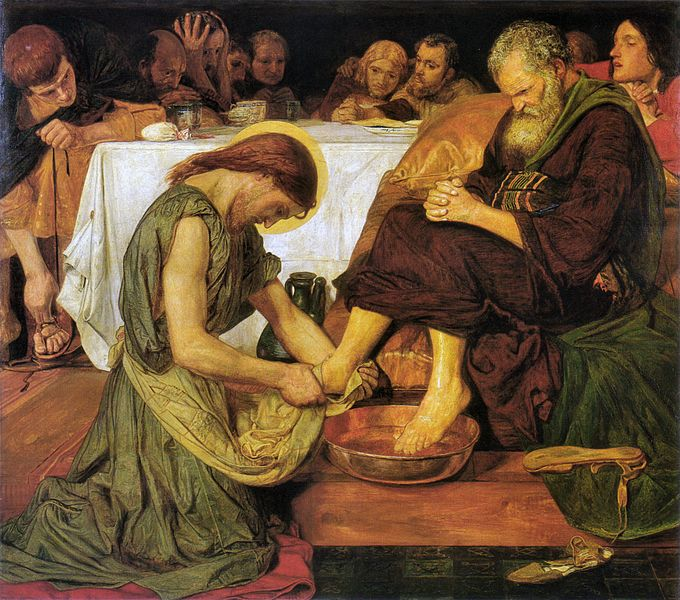
Jesus did all of this while wearing a towel, not a crown.

“Jesus, knowing that the Father had given all things into His hands, and that He had come from God and was going to God, rose from supper and laid aside His garments, took a towel and girded Himself. After that, He poured water into a basin and began to wash the disciples’ feet.”  

John 13:3-5

He could have just done a ‘teaching’ on servanthood and I’m reasonably certain it would have been more than sufficient. But instead, Jesus put ‘skin on His words’ and actually got down on His knees to wash dirty feet. His disciples freaked out when they saw him do this.

It was something they could never forget.

“You must have the same attitude that Christ Jesus had.

Though he was God,
    he did not think of equality with God
    as something to cling to.
Instead, he gave up his divine privileges;
    he took the humble position of a slave
    and was born as a human being.
When he appeared in human form,
    he humbled himself in obedience to God
    and died a criminal’s death on a cross.

Philippians 2:5-8, ESV

How can we not do this? This is a hard question to ask, but to be perfectly honest, does our discipleship include emptying ourselves daily? Can we find peace and fulfillment by becoming an unknown believer? An unknown, but only to God? Is this what we’re missing in becoming Christlike? These are very hard questions.

“Humility is perfect quietness of heart, It is to expect nothing, to wonder at nothing that is done to me, to feel nothing done against me. It is to be at rest when nobody praises me, and when I am blamed or despised.”

It is to have a blessed home in the Lord, where I can go in and shut the door, and kneel to my Father in secret, and am at peace as in a deep sea of calmness, when all around and above is trouble.”   

Andrew Murray

Our discipleship will always short-circuit itself in the presence of pride.

Please Let the Children Come

Luke 18:15-17, ESV

We were wrong. I suppose we were trying to maximize Jesus’ ministry. We were there to give Him some much ‘needed’ organization. We simply felt that Jesus’ time was our concern, and we as His disciples wanted Him to connect with those who really mattered. We kept people out and let others in.

But the parents were bringing their children to be blessed by Jesus.

“It was the custom for mothers to bring their children to some distinguished Rabbi on the first birthday that he might bless them.”

William Barclay

We had far more important stuff that needed to be done.

Jesus’ ministry was for adults. There were lepers, demon-possessed, paralyzed, tax-collectors all waiting for His ministry. Somehow we overlooked the needs of little children. Again, we were wrong, misguided, and ignorant of the walk of the true believer.

Jesus made it clear that these children needed to be the focus of our ministry. Our efforts were not to be centered on adults, rather it was misguided thinking on our part to let this happen. We wanted to focus on Jesus’ ministry on those we thought were important.

These little ones kept getting in the way.

And sure enough, Jesus explained to us what we were missing. Children were to become our focus. They were the ones who we were to emulate and esteem. The radical thing to us was understanding that these ‘little ones’ were that significant. This was a powerful jolt, and not at all what we expected.

“Let these children alone. Don’t get between them and me. These children are the kingdom’s pride and joy. Mark this: Unless you accept God’s kingdom in the simplicity of a child, you’ll never get in.”

Luke 18:16-17, The Message

This rocked our world! It was nothing less than another strange thought from our Teacher. Accepting this wasn’t easy, but Jesus was crystal clear. We dare not think otherwise, and yet it was against all we thought we understood.

Jesus understood that childlikeness was the only way we could enter His Kingdom.

Up to now, we assumed that maturity meant something like sophistication. It was all about right thinking and good theology. That was what God was looking for. We assumed that being simple wasn’t quite what Jesus wanted from us. Rather we believed the opposite.

Children were now to be our examples. Their simpleness was to be our guide–it was the Kingdom of God’s doorway into true discipleship.

Who would have guessed?

Beth Moore

alaskabibleteacher.com

What Does God Want From You?

I plead for you not to skip this post.

“He also told this parable to some who trusted in themselves that they were righteous and looked down on everyone else: 

“Two men went up to the temple to pray, one a Pharisee and the other a tax collector. 11 The Pharisee was standing and praying like this about himself: ‘God, I thank you that I’m not like other people—greedy, unrighteous, adulterers, or even like this tax collector. 12 I fast twice a week; I give a tenth of everything I get.’”

13 “But the tax collector, standing far off, would not even raise his eyes to heaven but kept striking his chest and saying, ‘God, have mercy on me, a sinner!’”

Luke 18:9-13

He despised others. As a Pharisee, he prided himself as a holy person; he thought he stood before God accepted and pure. He congratulated himself over this. I’m starting to see that self-righteousness has many levels. You can be blatant and obvious about it, or perhaps it might be more subtle and hidden. (Many believers like it hidden.)

We have to understand that God sees all and our hearts and minds are continuously inspected by the Holy Spirit. God sees our hearts as we see the faces of our friends. Any presence of pride or the absence of humility is automatically rejected by our heavenly Father.

In the Bible, it’s quite clear that being humble and admitting our sins and flaws are the best way to counteract any kind of puffed up pride. But for some reason, we often don’t realize when our selfishness and ego is getting in the way. It often comes very, very subtle. Tricky maybe.

Humility is a quality that cannot be acquired or maintained permanently.

Humility is not an accomplishment. There are no spiritual medals given for humility and brokenness. It’s not once you’re done. We must find humility every single day. Every morning, when my feet hit the floor, it’s something that requires my daily effort and practice. But it’s scary, because I’m starting to see that God’s precious grace is ultimately nullified by my pride.

The right kind of heart is broken and humble every single morning.

The Pharisee believes he is better than the tax-collector, and he now stands confidently before God. He thinks he is holy and superior to others. He really believes he has spiritually arrived.

But the tax-collector was brutally honest about himself. He understood the presence of God.

He didn’t need anyone to tell him how sinful he was–he knew his own wickedness. Jesus’ story reveals God’s love for those who know that they’re twisted up inside and lost. But let’s look closer at the heart of the tax-collector:

  • “He stood afar off,” which showed his awareness of his separation from God.
  • “He wouldn’t even raise his eyes to heaven,” which declared his humility in the presence of a holy God.
  • He kept “striking his chest,” which tells us of a deep pain over his sin against God.
  • He prayed, ‘God, have mercy on me, a sinner!’ This describes his desperate heart.

Both men came to pray, but to be really honest, that’s all they had in common.

The Pharisee came to the temple to declare his righteousness, the tax-collector came out of a terrible despair. It strikes me that the text in verse 11 says the Pharisee, “began praying to himself.” It seems that his prayer never really met God–all he was proud and showy, and he was only doing those things God hates (Prov. 29:23).

But it was the tax-man who became righteous in the eyes of God.

Humility is the foundation of the kingdom of Jesus. Matthew 5:3-4, makes a lot of sense to me. To be “poor in spirit” and to “mourn” has now become the solid bedrock of a Christian’s discipleship. To be justified (made right) is a gift. No one can earn salvation. The tax-man could only hold out his empty cup and hoped that God would fill it. Maybe that’s our beginning point.

But suddenly the tax collector is now considered righteous, while the Pharisee left the temple unchanged, and unforgiven.

“We had long known the Lord without realizing that meekness and lowliness of heart should be the distinguishing feature of the disciple.”

    Andrew Murray

When I crawl out of bed in the morning I start all over again. I realize I am nothing, I deserve nothing. I can only cling to the grace of my Father.

God wants us to have a broken heart and it’s apparent He rejects everything else. I suppose that there are questions I must ask myself: Am I really poor in spirit? Do I really mourn over my sin? Am I broken or am I subtly proud of myself? I must ask myself these questions.

“This is the Lord’s declaration. I will look favorably on this kind of person: one who is humble, submissive in spirit, and trembles at my word.”

Isaiah 66:2, CSB

Art by Eugène Burnand

alaskabibleteacher.com

Was Judas Forgiven?

And Jesus said, “Father, forgive them, for they know not what they do.”

Luke 23:34

From the cross Jesus spoke this. He was being executed in an extreme way, crucifixion was a terrible way to die. Roman soldiers surrounded the cross, and yet Jesus asked the Father to forgive them. They would not be guilty, but forgiven for what they were doing to Him.

But what about Judas?

How broad was Jesus’ statement? Did Jesus grant Judas absolution from this sin of betrayal when He said this? There’s far too many questions, and it’s good to think these things through. Was there forgiveness for this man of treachery?

“Then Satan entered into Judas called Iscariot, who was of the number of the twelve.” (Luke 22:3, ESV.) Perhaps this verse should become our entry point. It’s apparent that Judas was being controlled by the evil one. Something (or someone) took possession of him at this point. It seems astonishing that this happened at the special moment of the Lord’s Supper.

At this point Judas sought out the chief priests.

Judas offered to turn Jesus in, and it seems that money was given, perhaps to encourage Judas to commit himself to follow through. We read that Jesus was “troubled in His spirit.” It seems that this had to do with the impending betrayal.

So what was the early Judas like? Was he an authentic disciple? It seems he was called like the others. He listened to Jesus’ teaching and saw most of the miracles. Later he was sent out to proclaim the “good news.” Apparently, he teamed up with another disciple, miracles were seen.

“Judas heard all of Christ’s sermons.”

Thomas Goodwin

I can’t verify this yet, but each of the 12 called Jesus “Lord,” but only Judas called Jesus “rabbi.” Perhaps this points to a problem Judas has identifying the ministry of Jesus. There would be a kiss commonly given by a disciple, but was it real?

Judas seemed to have problems with money. Apparently Jesus decided that he was to be the treasurer of His followers. This was a problem for Judas. It’s clear that he stole money from that was entrusted to Jesus’ ministry.

Yet I believe Judas would be forgiven of these things if he only asked.

There are a few other things we really must consider. Did Jesus forgive Judas? The Romans and the Jewish leaders were forgiven by Jesus from the cross. But there was never any indication that Judas was forgiven for his betrayal. It seems that Judas carried his sin which ended up in suicide.

Both Peter and Judas betrayed their Lord.

And yet I have to believe that they were not the same. Somehow Peter’s denial would find a way to be forgiven. And even though it seems very painful, Peter would be restored. But Judas took his own life. It was his choice. Simon Peter felt remorse. Judas was overcome with guilt and chose death instead of seeking forgiveness.

I’m completely convinced that we will not see Judas in heaven.

I say that cautiously. I hardly ever understand the mind and heart of God. His compassion is everlasting. Who am I to decide these things? But it seems to me that when he sold Jesus for 30 pieces of silver, he was really selling himself.

“While I was with them, I kept them in your name, which you have given me. I have guarded them, and not one of them has been lost except the son of destruction, that the Scripture might be fulfilled.”

John 17:12

This verse seems to clarify much about Judas. We understand Jesus’ care and love for each of His disciples; yet we see a pronouncement of judgement against the person who would betray Him. It seems that Judas convinced himself that he could not be forgiven. His awful suicide declared he was beyond grace. Judas decided he would hang himself, committing himself to the rope rather than accepting any kind of forgiveness.

Sobering, isn’t it?

“Judas Iscariot was not a greatly wicked person, just a common money-lover, and like most money-lovers, he did not understand Christ.”

A.W. Tozer

To Eat Yourself

A heart at peace gives life to the body, but envy rots the bones.

Proverbs 14:30

“Of the Seven Deadly Sins, anger [envy] is possibly the most fun. To lick your wounds, to smack your lips over grievances long past … to savor to the last toothsome morsel both the pain you are given and the pain you are giving back — in many ways it is a feast fit for a king. The chief drawback is that what you are wolfing down is yourself. The skeleton at the feast is you.”

Frederick Buechner

Some churches designate seven deadly sins that people practice. They are pride, greed, wrath, envy, lust, gluttony and sloth. These are also known as the “cardinal” sins. Now this type of classification or grouping seems important and useful to some. I want to examine “envy.”

Envy is a sin that each of us understands.

Envy can be defined as “a feeling of discontented or resentful longing by someone else’s possessions, or qualities.”

(Wikipedia)

It made its entrance with Cain and Abel and the first murder. We see that Cain’s offering was rejected by God, (apparently He doesn’t like veggies). Also, keep in mind that part of Adam’s sin was that the ground was cursed. And Cain had tilled and planted from a field that had been cursed already. (Genesis 4)

But Abel offered up a “blood sacrifice” which God saw as acceptable. That drove Cain nuts. He was so envious that he murdered Abel. He couldn’t handle rejection, and seeing that his brother was extolled and honored was more that he could handle.

Envy became anger which led to murder.

It might come as a surprise to you but envy is why the Pharisees murdered Jesus, “For he knew that it was out of envy that they had delivered him up.” Matthew 27:18

We’re warned repeatedly by New Testament writers to renounce the sin of envy.

“But if you harbor bitter envy and selfish ambition in your hearts, do not boast about it or deny the truth. For where you have envy and selfish ambition, there you find disorder and every evil practice. Let us not become conceited, provoking one another, envying one another.”

James 3:14, 16

I realize I can easily become an envier. (That’s a word, I looked it up.)

Selfish ambition is directly linked in the book of James to envy.

The Greek phrase for selfish ambition is often used to describe one who is full of envy. Incidentally, the word is also used as one “who is deceitfully promoting himself for public office.” (Too often I see myself as “President Bryan.”)

A Prayer for Freedom

Holy Father, I want to bind that spirit of envy that’s attempting to eat up my life. I curse it out completely in the name of Jesus, for it is more than cruelty and overwhelming fury.

I renounce it completely.You are all I want and need. I only want to be your child. I renounce envy.

Please remove it now, mighty God, along with the hatred, anger, fear, and insecurities that fuel it. In Jesus’ mighty name, Amen.

“Whenever you attempt a good work you will find other men doing the same kind of work, and probably doing it better. Envy them not.”

     Henry Drummond