He Came for Us!

by Pastor David Taylor

“The central miracle asserted by Christians is the incarnation. They say that God became man.” 

CS Lewis

One of my favorite places to fish in Alaska is Kodiak Island, where I tried to catch silver salmon with some friends. Just as we were setting up camp, the sun disappeared, and the temperature dropped quickly. While we struggled with our tents, the wind joined in. Then, it started pouring rain—like someone dumped a bucket of water on us! I woke up at midnight to strong winds flattening my tent, making me wonder if fishing Kodiak was really worth it. 😁

But in the morning, the storm had moved on. The sky transformed into something gold! The sun shone brightly, making the world come alive. The night gracefully stepped aside, allowing the darkness to fade away and make room for a new, vibrant day.

I realized then that’s the way of Christmas. 

We have an Advent hope. The light doesn’t negotiate with darkness; there’s no struggle. The darkness retreats when the light arrives. Plain and simple.

Advent hope seems slow, but honestly, it’s unstoppable.

When Jesus came into the world, nothing could stop Him. His birth is recognized during Advent. His arrival was predicted in the scriptures. Jesus came to take away our sins and offer us eternal life.

The Bible teaches us that Jesus is God in the flesh, fully divine and fully man, who came to save us from our sin. This is basic Christianity.

One: The Word Who Always Was, (vv. 1-2)

“In the beginning” reminds us of Genesis, where God created everything (Genesis 1:1). Through the Spirit, he shows that he has taken an important step towards us with the arrival of Jesus. He is dedicated to saving us.

God created us to know and enjoy him (Gen 3:8). We must understand that sin entered the world and screwed everything up. Jesus came to sacrifice Himself to secure our salvation, restoring his image in those who trust him. 

Jesus Christ restores all that we lost because of our sin.

In the beginning was the Word. The Word did not come into existence in Mary’s womb but He always was. The Word is eternal. Before it all began, he was there, and he was coming for us.

The phrase “the word was also with God” indicates that the Word is from God but is closely connected to Him (Mk 6:3; 11:4; 2 Cor 5:8; 1 John 1:2). The Word is also God and represents the eternal Son of God, who is both with God and is God. He is the Word and the Son, distinct yet unified with God.

Two: The Word Who is the Creator, (v. 3)

Everything we see was made through Jesus, and nothing exists without him (see Col 1:16-17). The Old Testament says that God created the heavens and the earth, while the New Testament shows that the Word is the true Creator. This highlights Christ’s key role in creation and his divine nature. Both Testaments emphasize the relationship between God the Father and Jesus, confirming that all existence is intentional and meaningful. 

Recognizing Jesus as the Creator enhances our understanding of his authority, showing us that all things were created through him and find their purpose in him.

Three: The Word Who is the Light, (vs. 4-5). 

We must understand that we’re born spiritually dead and blind. But that can change.

Jesus is the light and every one of us is spiritually blind to truth and beauty and glory (John 17:24). Jesus overcomes our darkness and now gives life. Jesus does for us what we cannot do for ourselves. His love is seeking us.

The word, the gospel, brings forth life and light so that we are born again, literally born from above, and so we see (John 3:3). The light shines into our darkness and the darkness leaves us.

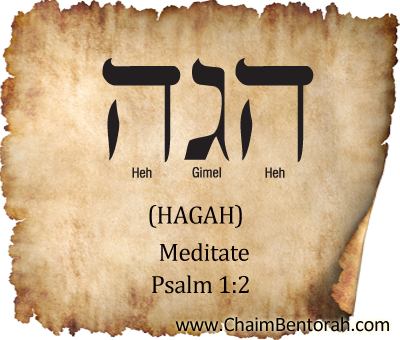
Hagah, To Meditate

Psalm 1:2

Meditation has gotten a bad rap among some Christians, largely due to a connection with Eastern mysticism. This is really unfortunate for it has a critical place in the development of your discipleship. I believe it’s vital (and maybe even mandatory?)

Hagah is the Hebrew word for ‘meditation’ and it fascinates me.

It literally means to “moan, growl, utter, muse, or mutter.” Some have suggested that it contains the idea of ‘rumination,’ like a cow who chews a cud. The grass goes in, and it’s regurgitated several times, extracting every bit of nutrients and vitamins.

Hagah, or to meditate is the way we assimilate God’s Word into our lives. It’s critical that we do this in our walk as disciples that belong to Jesus.

Joshua 1:8, ESV

It’s an interesting command isn’t it? Joshua’s ministry is to lead God’s people and requires his deep connection to God’s promises. He needs to hagah God’s words, to purposefully think about them over and over and over.

It’s interesting to me that when Joshua meditates and carefully responds to the Word then he will receive success in his life and ministry. The word ‘success’ means “wisdom, comprehension, insight with prosperity.” I need that desperately.

And if Joshua needed to do this, might not we?

Start small and simple. There are over 8,000 promises in the Bible–pick one and ruminate on it. Hagah on the Word and try to extract the spiritual nutrients that it contains. You will grow, bless others, and walk in victory, defeating your enemy.

“The amount of time we spend with Jesus – meditating on His Word and His majesty, seeking His face – establishes our fruitfulness in the kingdom.”

    Charles Stanley

Bryan Lowe

alaskabibleteacher.com

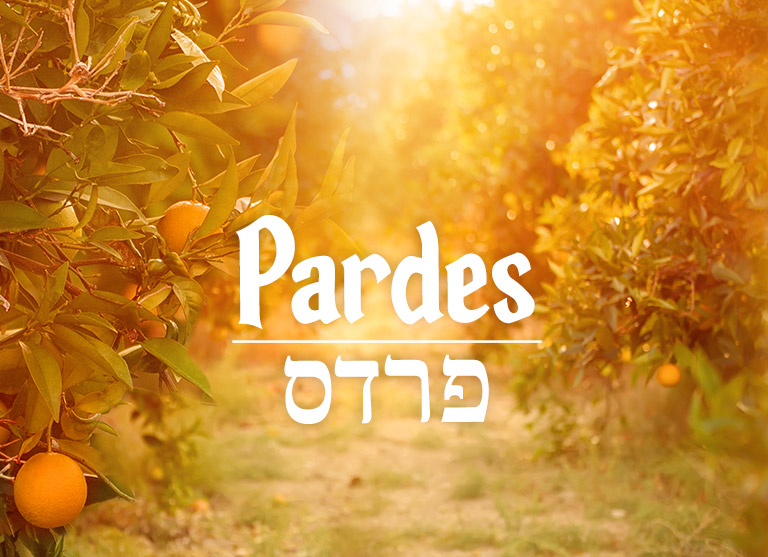
Walking With Him in The Garden

This image has an empty alt attribute; its file name is pardes-hebrew-yellow-1.jpg

“When the cool evening breezes were blowing, the man and his wife heard the Lord God walking about in the garden. So they hid from the Lord God among the trees.”

Genesis 3:8

I honestly have never had the wonderful experience of strolling a lush garden with my Father. At least not totally. But when I’m engaging the Word, pressing in to comprehend a passage, it’s as if I’m truly walking in His orchard with Jesus.

But there is something more to this.

This word “pardes” is also an acronym. The rabbis taught that there are four levels of understanding as we peer into a passage.

  • P’shat–the surface or literal meaning of a verse or passage.
  • Remez– the symbolic or applied reason of the Word. How it connects with my daily life.
  • Drash–how it fits into other parts of the Bible, forming a purposeful teaching.
  • Sod–a hidden meaning that resides “underneath” the verse. This seems when the Holy Spirit gets really involved in the way I live. (Some would say “mystical.)

Now I’m not sure that every passage reaches the “sod” level. (Maybe we’re not really aware?)

When we truly study God’s Word it’s as we walk in the garden. He reveals Himself to us. The Genesis story shows us where we can find Him. The important thing I suppose is trying to hide from God’s presence. We can’t.

We must come to our Father, and learn to walk with Him. The Bible is the best way to fellowship with Him.

The Absolute Danger in Exalting Yourself

Now he told a parable to those who were invited, when he noticed how they chose the places of honor, saying to them, “When you are invited by someone to a wedding feast, do not sit down in a place of honor, lest someone more distinguished than you be invited by him, and he who invited you both will come and say to you, ‘Give your place to this person,’ and then you will begin with shame to take the lowest place. 

10 But when you are invited, go and sit in the lowest place, so that when your host comes he may say to you, ‘Friend, move up higher.’ Then you will be honored in the presence of all who sit at table with you. 11 For everyone who exalts himself will be humbled, and he who humbles himself will be exalted.”

Luke 14:7-11, ESV

Choose your seat carefully. In Jesus’ day, there was a definite seating order to a wedding feast. It wasn’t first come, first served. There was a strict protocol, where one’s importance mattered.

Honored people got honorable seats–close to the front as possible. Average people got average spots; but no one wanted be at the bottom, having to sit at the “kids table.”

Jesus was watching, and he what he saw was a spiritual principle of his Kingdom.

Jesus often teaches us out of the things we encounter.

Truth often hits us from those things we actually see. If you want to know what God is doing in your life, all you need to do is look around at the practical things, and start to see the spiritual lessons inside them. We learn from real-life. That’s how he often teaches us, he combines the Word with what we’re experiencing.

Our natural inclination is to move higher up.

We think that we’re deserving, and so we take our rightful positions. That’s the way humans think. We all want to sit in the best possible place, and so we end up wheedling our way up front. We can fall into the subtle trap of self-promotion. But that’s not how discipleship works.

Jesus corrects, advising us to take the lowest place.

I think verse 11 is the key to figuring out this seating arrangement. We’re starting to see a physical situation become a spiritual lesson. There’s much to learn. Here’s verse 11 in the Amplified version:

For everyone who exalts himself will be humbled [before others], and he who habitually humbles himself (keeps a realistic self-view) will be exalted.”

Luke 14:11

This particular translation injects some realism into our lives, especially in how we see ourselves. It’s quite foundational. It lays down a principle that is always true in his Kingdom (1 Peter 5:6). If we don’t accept and implement this, we’ll suffer a definite weakness in our discipleship. It stunts the growth of many believers. And that is tragic.

The whole scene lays out how life in the spirit really works, and it seems paradoxical.

Our human logic asserts that deliberately choosing the lesser is foolish, things really don’t work that way. We think, (falsely,) that we’ll only advance by asserting ourselves. But Jesus, quite aptly, clarifies the ways of the Kingdom.

True maturity will only come if we decide to take the lowest place.

James 4:10

alaskabibleteacher.com

Ponder the Word

“But his delight is in the law of the Lord, and on his law he meditates day and night.”

Psalm 1:2

In Psalm 1:2 the Hebrew word for meditation is hagah. In this Psalm we have a contrast between the blessed and the “not-so-blessed,” and it commands that as Jesus’ followers that we process the reality of this to become blessed by our Father.

In Psalm 1:1 the word blessed is used, and actually just in the book is Psalms alone blessed is used 51 times. The word has a very simple and concise meaning: “to be happy.” I really don’t think we can minimize how important it is to be happy.

In 1:2 we read hagah or meditate. That Hebrew word is a little bit more complicated and it seems more nuanced than “blessed.”

Hagah, or meditate means:

  • to chew a cud like a cow
  • to growl like a lion who is eating an antelope
  • to moan or groan
  • to talk to oneself, or mutter or whisper
  • finally, it can mean to muse or imagine

Yeah, it’s an interesting word and I suppose all of these meanings are to be factored into meditation [hagah]. It seems that these five definitions shape the different meanings that go into our understanding.

Using the above definitions, this is how it might look:

  1. sometimes I regurgitate the word like a cow chewing its cud
  2. at times I attack it like a lion
  3. I moan and groan as I wrestle with it, seeking for a handhold
  4. thinking about the passage I talk to myself about its meaning
  5. I imagine being there, sometimes it’s like I’m a “fly-on-the-wall”

When we come to God’s words, the Bible, we are required to assimilate all that the Holy Spirit graciously gives. When He gives us something from the Word we must apply it to ourselves. You can do this through any of the 5 definitions I’ve given.

The Holy Spirit is the One who ignites His Word into our hearts.

Joshua 1:8, ESV

alaskabibleteacher.com

Braided Up With Him, Isaiah 40:31

wait_bench_ocean

Yet those who wait for the Lord
Will gain new strength;
They will mount up with wings like eagles,
They will run and not get tired,
They will walk and not become weary.

Isaiah 40:31, NASB

The particular word for “wait” is a much more active word than we think.

It’s not a passive word in the original Hebrew.  It does not mean being apathetic or lazy. Sometimes we wait in line at the grocery store, or maybe we’re waiting on a phone call. We regularly wait all the time, and usually, we don’t even realize it.

The Hebrew word for “wait” used in v. 31 is qāvâ which means, ‘to bind together by twisting.’

It literally means to “braid, or twist, using a rope.” It becomes an interesting word picture? Sometimes we only take the English idea of waiting and turn it turns into a frustrating delay. Often, this is why we lose out on what ‘wait’ is really about. I have to believe the Holy Spirit wants to teach this idea of becoming ‘braided up with God.’

All too often we are limited by our definitions, and not God’s Word. 

For those of us who are ill— physically or mentally, just to be told simply, “wait on the Lord” is a real challenge. Often, we will end up resenting this counsel (and the counselor) because we have misunderstood what it means to really ‘wait.’ We come tantalizing close to this critical idea, but we never quite make it through the doorway.

Yet when I truly wait on God, I’m actually braiding myself into Him.

He becomes my strength; He is now the strong cord I am braided into. (Perhaps this is how He imparts strength and might to His people?) We need this, and the Lord is quite eager to lead us into this new kind of intimacy.

The promise in Isaiah 40:31 tells us about new strength–the eagle’s wings, holy stamina. This verse is relevant to us today, and we need this kind of strength now. I only want to encourage you in your own prayer time, to see yourself intertwined with the Lord, and to recognize the good gift of the Holy Spirit freely given.

“Wait for the Lord;
be strong, and let your heart take courage;
wait for the Lord!”

Psalm 27:14

alaskabibleteacher.com

The Hidden Power of the Kingdom

Mix it up and watch out!

 “He told them another parable.” 

“The kingdom of heaven is like leaven that a woman took and hid in three measures of flour, till it was all leavened.”

Matthew 13:33

One version says 50 lbs (or 40 liters for your metric fiends) of flour. Crazy, why that much is beyond me–some figured it out and it would be enough bread for 100 people at least. Far more flour and yeast that was close to normal use. The parable that Jesus taught would certainly be humorous to the listeners. I suppose their imaginations were in overdrive.

What Jesus taught in these stories was incredibly practical and it engaged the listeners. They would leave and the stories would stick. Whether they realized it or not, His truth would impact them.

These stories were like bombs that would eventually explode in the hearts of the people.

Sooner or later, maybe when they least expected it, these parables would suddenly make sense. A lightning strike. Very seldom did they connect immediately. We can see this by the disciples’ desire to have them explained. They didn’t get it at first. But when Jesus illuminated them, they understood.

I believe that the Kingdom of God is hidden in us and it has outrageous power.

It works secretly, it’s not visible to anyone. It just does its stuff. The yeast, combined with the flour is a hidden process–something that isn’t observable. Perhaps that’s the way God’s kingdom comes, quietly, secretly but powerfully. Once the flour and yeast combine it’s pretty difficult to stop it.

That kingdom is working in our lives.

And most of the time it’s a hidden work. We can’t understand the process or grasp how it’s happening. We seldom know what God is doing. We may concentrate on being a witness to our neighbor, (which is a good thing, please do) but perhaps the Holy Spirit is working instead on our patience or love.

Usually, what we think is going on isn’t.

I’ve been in ministry for almost 40 years now, and I’ve tried to be faithful and worked on my discernment. But it seems I don’t quite grasp yet what the Father is doing inside of me. And I admit, I’m not really sure what’s going on in the lives of those I teach and counsel. Most of the time, I have no idea what he’s doing.

And that’s alright. I know he loves me very much and I trust him to work in me.

“And I am sure of this, that he who began a good work in you will bring it to completion at the day of Jesus Christ.”

Philippians 1:6

alaskabibleteacher.com