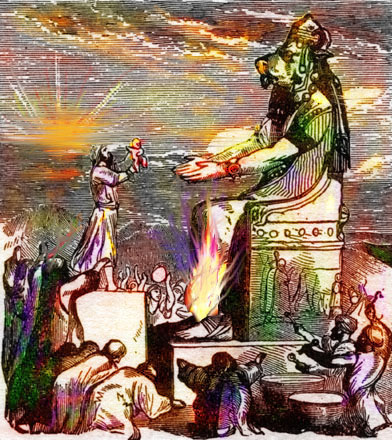
The Stomach Churning Sin of Manasseh

God’s temple was now filled with an evil darkness. King Manasseh made the Lord’s holy place a fountain of sin and filth. Instead of holiness, it was an evil place.

He brought in dark things that were twisted, perverted and clearly forbidden.

“Manasseh led Judah and the inhabitants of Jerusalem astray, to do more evil than the nations whom the Lord destroyed before the people of Israel.”

2 Chronicles 33:9, ESV

His own darkness was now encouraged by others, it became accessible, available and promoted:

  • The high places were rebuilt throughout the land.
  • Altars to Baal rebuilt, using images of wood.
  • In the holy temple, altars to the “starry host,” astrology, plain and simple.
  • Human sacrifice of his own sons to Molech, a false god. Murder.
  • He practiced soothsaying, used witchcraft and sorcery, and consulted mediums and spiritists.

Evil was being encouraged and something wicked was replacing all that was good and true. The analysis of Manasseh’s policies was way beyond disturbing. Of all the kings of Judah, he was the most sinful and the most corrupt. He was at the bottom of the barrel.

The Hebrew word for “led astray” can be translated seduced.

Manasseh was an incredibly immoral man, a king who ruled for 40 years. “He did all he could to pervert the national character, and totally destroy the worship of the true God; and he succeeded.” (Clarke)

It’s believed that he put Isaiah to death by cutting him in two.

Moreover Manasseh shed very much innocent blood, till he had filled Jerusalem from one end to another, besides his sin by which he made Judah sin, in doing evil in the sight of the LORD.

1 Kings 21:16

But then something happened.

And the LORD spoke to Manasseh and his people, but they would not listen. Therefore the LORD brought upon them the captains of the army of the king of Assyria, who took Manasseh with hooks, bound him with bronze fetters, and carried him off to Babylon.

2 Chronicles 33:10-11

Assyria came knocking on Manasseh’s door. I think there was a certain mercy here, but also discipline. Manasseh had “hooks,” inserted through his jaw and out of his mouth. Like a fish he was led to Babylon, a trophy of the power of the army of Babylon.

It was from a dark dungeon that Manasseh cried out to the Lord and repented.

(2 Chronicles 33:12-13.)

There’s a Jewish fable that when Manasseh cried out to God the angels boarded up the windows in heaven. They wanted to block out his prayer so God wouldn’t be able to hear. But God, rich in mercy, bored a hole in front of His throne to hear Manasseh’s desperate cry.

The Lord’s intention was to forever show His kindness and grace given to the most awful repentant sinner.

I believe that Manasseh was the “Prodigal Son” of the Old Testament.

God is not at a loss when He moves to bring us back to Himself. He can woo or whip. He can draw or drive. He can work rapidly or slowly, as He pleases. In other words, He is free to be God! And in His own way, at His own pace, He brings us back.

     Tom Wells

God is wildly in love with you. Yes, the sin you’ve committed is awful, but the Lord wants you to come back. He may discipline you, but He forgives everything if you’ll turn and repent.

No matter how awful your sin, He forgives and restores. Manasseh is proof of that.

Sources:

2 Chronicles 33:1-20

2 Kings 21:1-18

Enduring Word commentary

alaskabibleteacher.com

Deepen Your Repentance

Two Psalms followed David’s return to God after his sin with Bathsheba, and murdering Uriah. The sins of adultery and murder are terrible and yet David finds forgiveness from God for both. He responds properly to Nathan’s hard word. King David was a warrior of renown and a talented Psalm writer and he put together two Psalms that would guide others.

Many years ago I used an overhead projector in a class. I had two transparencies, the first projected a map on a screen showing boundaries–the second laid over the top showed the movements of an invading army. They complimented each other to show a point. One laid on top of the other to make it clear what happened. (I realized I just dated myself–I’m old.)

You might say that’s how I want to teach Psalm 51 and Psalm 32. Both are David’s serious remarks on his repentance. They’re the same incident, but incredibly different. They both explain his repentance in contrasting ways.

You see that one is a psalm; the other is a maskil.

A psalm is a guide for worship, something musical sung from the knees—an acclamation of a joyful song. The other type is different; it’s called a maskil, which is something wise and reflective, thoughtful and understanding. To write a maskil takes time to pull one’s thoughts together and share seasoned instruction.

I’ve chosen v.v. 1-2 (both due to obvious constraints of brevity.)

Psalm 51

__________

Psalm 32

Reading the two Psalms together like this, laid on top of each other, or, like two sides of a coin, gives us an idea of David’s repentance–an clear understanding and a real depth. How did he respond to God’s message from the prophet? How can we answer others when the Holy Spirit convicts us of sin?

Both a “subjective” psalm, and an “objective” maskil is necessary I think. They both are to become the daily practice of a believer, both communicate what is needful. One sings–the other teaches, but both should be done carefully.

Perhaps another way is to see the art and the science of it all. But a caveat here. Psalm 32 blends with the autobiographical theme just like Psalm 53 does. (See 32:2-5). It even seems the objective takes on a tear or two! I guess that’s how truth in God’s kingdom works?

Our theology needs tears, and our tears need theology.

(I hope this isn’t confusing.)

I want to encourage you to take your repentance even deeper. I want to see you stir up this beautiful gift. I will want to hear your song, and then to understand your reasons for singing so beautifully.

“The Christian who has stopped repenting has stopped growing.”

    A.W. Pink

alaskabibleteacher.com

Rooted Firmly and Deeply

“But I am like a green olive tree
    in the house of God.
I trust in the steadfast love of God
    forever and ever.”

Psalm 52:8

In Psalm 52 we read of David’s run-in with Doeg, a very bad man, (a mass murderer actually). But David, hearing about the slaughter of 85 innocent priests doesn’t respond in hatred, rather he sits down and writes this song of contemplation which we know as Psalm 52.

It isn’t something written out of wrath and vengeance rather the word that begins his writing is “maskil” which implies– enlightenment, or something reflective, thoughtful, discerning. He sat down and considered Doeg’s awful evil, and by doing this was able to understand own heart as well.

Psalm 52 has two distinct parts.

The first is Doeg’s vicious atrocity, and the condemnation that it incurs, (v.v. 1-7). The second was David’s own commitment to following God, and understanding his own place in a very evil world, (v.v. 8-9).

Rather than castigate himself for being discovered in Nob–a circumstance which directly led to the mass murder of these priests (and their families). We find that David does not blame himself. He could have, but he didn’t. Rather he thoughtfully, and carefully, detailed his own “observations” of the whole sordid matter.

David could easily have destroyed himself with guilt and grief. He didn’t.

He chose not to play the losing game of ‘what if.’ He instead would be like a green olive tree rooted himself in the holy temple and into the protective presence of God. David knew he would destroy himself if he didn’t place himself there. It was a deliberate decision.

It would keep himself sane.

It seems to me that trees work heavily into David’s own theology and that this is how he sees his relationship with God. He’s planted and therefore able to survive terrible trials. He shows us how to survive and thrive.

His roots would need to go very deep though.

David’s thoughtful imagery is himself as an olive tree planted in God’s presence.

I believe knowing this is the antidote to the poison of guilt. Perhaps we should follow his example?


“They are like trees planted along a riverbank,
    with roots that reach deep into the water.
Such trees are not bothered by the heat
    or worried by long months of drought.
Their leaves stay green,
    and they never stop producing fruit.”

Jeremiah 17:8
