That Which is Far Better.

Luke 10:38-41, NCV

“While Jesus and his followers were traveling, Jesus went into a town. A woman named Martha let Jesus stay at her house. 39 Martha had a sister named Mary, who was sitting at Jesus’ feet and listening to him teach. 40 But Martha was busy with all the work to be done. She went in and said, “Lord, don’t you care that my sister has left me alone to do all the work? Tell her to help me.”

41 “But the Lord answered her, “Martha, Martha, you are worried and upset about many things. 

42 Only one thing is important. Mary has chosen the better thing, and it will never be taken away from her.”

My name is Martha and I’m Jesus’ friend. My home was one of His favorite places to stay–a refuge for Him whose life was so busy. I joyfully opened it for Him, and for His disciples. And when Jesus came I went all out, I wanted the best for Him and that meant there were always things to do. Is that really a bad thing?

The kitchen was verging on bedlam–lamb, cucumbers, figs, and so on. Roasting and slicing, and of course I had bread in the oven. All of this was requiring constant attention, and I remember not being able to keep up. To be honest, It was a bit much.

I wanted things to be perfect for Jesus.

I admit I took occasional peeks at Him, He was teaching in my living room after all. I just brought in some bowls of figs and raisins as an appetizer and guess what, I found my sister Mary sitting with the men listening to Jesus and asking questions. It was than I started to get a little ticked off.

I was really, really getting irritated with her.

There was so much to do and I didn’t have her help. The more I thought of Mary the more frustrated I got. I suspect she didn’t understand all that had to be done. All or her priorities were messed up–she simply didn’t understand her role as a hostess, and to sit with the men was terribly wrong.

She really didn’t understand her place.

Yes, I was having issues with my sister. It all came to a head when I had brought out another bowl of figs, and then I tried to graciously interrupt the Lord’s teaching. I wanted Him to tell her the place was with me in the kitchen. “Tell her to help me.”

Instead, it was Jesus who corrected me. I still remember Jesus’ words. And I honestly wasn’t expecting this..

“Martha, Martha, you are worried and upset about many things.”

Was I really that transparent? Of course He understood, but it cut me to the quick. I had become another lesson to everyone present. I realize now that the real issue was with my attitude, and not with the work. Yes, I was bothered and upset but I know now that it’s those things that were the real problem.

Only one thing is important. Mary has chosen the better thing, and it will never be taken away from her.”

I suddenly knew that He was right. Jesus was in my home, and all I could do was to get frustrated and angry. I thought my work would please Him, and after all, wasn’t really all that important? Didn’t He deserve my best efforts? Surely all my work meant something to Him?

My younger sister Mary was being praised. It seems she was becoming my example and I was being gently rebuked. but suddenly all I realized, and that all I was doing, all my work and my effort, really wasn’t what Jesus wanted. The problem wasn’t her problem, it was me all a long!

I only wanted to serve Him, but I guess that wasn’t what He really wanted.

To be sure all I was becoming far too critical and resentful of my sister Mary, and yet I had forgotten that my real place was at Jesus’ feet, listening and learning. That’s what Jesus really wanted, and somehow I had forgotten that. I had lost Him in all my busy-ness.

The work could wait, and now I understand that my true place was with Jesus.

Martha’s frustration is typical of those who diligently serve with good intent, but forget to also sit at Jesus’ feet. “The Martha spirit says, if the work is done, is not that all? The Mary spirit asks whether Jesus is well pleased or not? All must be done in his name and by his Spirit, or nothing is done.”

C.H. Spurgeon

Trying to Make Sense of the Incarnation

“The central miracle asserted by Christians is the incarnation. They say that God became man.”

C.S. Lewis

Incarnation, the central Christian doctrine that God became flesh, that God assumed a human nature and became a man in the form of Jesus Christ, the Son of God and the second person of the Trinity.

Now it’s true that Jesus voluntarily set aside all of the prerogatives of being God; He made the choice to lay His deity aside. Please think this verse through–let it sink into your hearts. It should be a mystery to you. It is to me.

“Though he was God,
    he did not think of equality with God
    as something to cling to.
Instead, he gave up his divine privileges;
    he took the humble position of a slave
    and was born as a human being.
When he appeared in human form,
    he humbled himself in obedience to God
    and died a criminal’s death on a cross.”

Philippians 2:6-8

God, Himself decided to make the manger His home. The woman who carried the baby in her womb was created by Him (that should rattle your teeth)!

When we see the implications of all of this–we can only worship, just like the shepherds did. We can only gift Him, just like the wise men. The Christmas story itself becomes our example of acknowledging what He’s done. We are now the worshippers and givers.

All of this is a profound miracle, and can only be accepted by a simple faith, a “Christmas faith.” There is so much I need to learn about all of this, but that’s alright.

Have a blessed Christmas dear one. Know deep down that He has come for you, He holds you and cares for you. He will never ever leave you!

Photo by Pixabay on Pexels.com


Simeon, In His Own Words

Luke 2:25-35

There was a man in Jerusalem whose name was Simeon. This man was righteous and devout, looking forward to Israel’s consolation, and the Holy Spirit was on him. 26 It had been revealed to him by the Holy Spirit that he would not see death before he saw the Lord’s Messiah. 27 Guided by the Spirit, he entered the temple. When the parents brought in the child Jesus to perform for him what was customary under the law, 28 Simeon took him up in his arms, praised God, and said,

29 Now, Master,
you can dismiss your servant in peace,
as you promised.
30 For my eyes have seen your salvation.
31 You have prepared it
in the presence of all peoples—
32 a light for revelation to the Gentiles
and glory to your people Israel.

His father and mother were amazed at what was being said about him. 34 Then Simeon blessed them and told his mother Mary, “Indeed, this child is destined to cause the fall and rise of many in Israel and to be a sign that will be opposed— 35 and a sword will pierce your own soul—that the thoughts of many hearts may be revealed.”

Yes, there were rumors. The priest Zechariah had declared that his son would become the Messiah’s forerunner. And apparently, angels had visited shepherds in their fields. Each encounter had come exactly how it was foretold.

I’m convinced that the Holy Spirit led me there that day.

I have no doubt that He was guiding me to the Temple. God had promised me that I would see with my own eyes the coming Messiah. This One would be salvation and be a light to the Gentiles which would bring glory and honor to the Jewish nation.

If these were of God, there needed to be collaborating witnesses that would foretell His work. One or two might be a mere coincidence, but three were a definite declaration. Plus I knew that my own eyes would see Him face-to-face.

To be perfectly honest, I really didn’t know what I expected to see. But I knew God’s heart, and I wanted to do His will. Some might say I was a devout believer in Israel’s prophetic purpose. I knew and believed that.

I had God’s promise that I would see Him.

Something or someone was prompting me to the Temple. I guess I had a divine appointment to keep. God had given me His promise, and I knew I was where I was supposed to be. It seemed like I was always on the lookout for that fulfillment.

It was then I saw the Child.

His parents stood out like something fluorescent. It seemed as if they were color in a black-and-white world, and they held the baby who was going to change the world. When I saw them I knew that everything had fallen into place. I saw the promise and He had come to save the world.

I took Jesus and held Him in my arms.

I was holding the Savior! This baby was to save the entire world from their sins. The Law required me to dedicate Him to God. Who can say what that means? I was to devote Him to God’s purpose and plan. Who had this honor, and who can say that this was their privilege? I had been chosen to insert Him into the purposes of God.

Who can say that?

When I laid my hands on Him it was like touching lightning. I spoke the blessing, but I understood that there was something more. I looked at His mother and spoke. It was both a blessing and a warning. I understood what God wanted to say, and it was a word that Israel’s hope would also have a sting that His mother needed to understand.

When I left the three of them in the Temple courts I began to grasp the reality of it all. I spoke God’s heart to His mother Mary. She had to know and understand who this Child really was. For me my task was complete.

I had spoken, and now it was time to leave.

“In the last days the mountain of the Lord’s Temple
    will be the highest of all mountains.
It will be raised higher than the hills.
    There will be a steady stream of people from all nations going there.”

Isaiah 2:2

Art: “Simeon holding Jesus,” by Andrey Shishkin, painted in 2012, Oil on canvas © Andrey Shishkin. Verses used: Christian Standard Bible

Lost & Found

On a warm afternoon, a lamb takes a peek at a visitor while eating hay at Fat Rooster Farm in Royalton, Vt., on April 27, 2003. (Photo by Geoff Hansen)

 “All the tax collectors and sinners were approaching to listen to him. And the Pharisees and scribes were complaining, “This man welcomes sinners and eats with them.”

3 “So he told them this parable: “What man of you, having a hundred sheep, if he has lost one of them, does not leave the ninety-nine in the open country, and go after the one that is lost, until he finds it? And when he has found it, he lays it on his shoulders, rejoicing. And when he comes home, he calls together his friends and his neighbors, saying to them, ‘Rejoice with me, for I have found my sheep that was lost.’ Just so, I tell you, there will be more joy in heaven over one sinner who repents than over ninety-nine righteous persons who need no repentance.

Luke 15:1-7

What does it mean to be lost? Some have that much figured out by now, (and if not, we will.) The Bible nails us with this story, and it rings true of the human condition. You don’t need a Ph.D. in Psychology to understand this. The heart and soul of a man and a woman are in an awful state of separation from God, and some are beginning to understand this.

The three stories reveal that the Pharisees and the scribes have issues.

Their whole belief system–the idea of who’s righteous and who’s not, is being rocked. The sinners are coming to listen to Jesus (maybe for the stories, maybe for something else?) The religious regime is mystified, and maybe a bit jealous. Perhaps they were irked at the grace of God they see in Jesus?

Jesus tells His first story, (and he loves to tell stories I’ve found.) Anyway, the parable he shares is 100 words (more or less) and it describes the condition of every man, woman, and child–everyone who has ever existed. He clearly cuts through “religion” like a hot knife through cold butter. He quite succinctly describes us. And wow, these stories are eye-openers.

We’re all lost sheep–wandering, and sometimes very confused.

The paths we’ve taken to get out of our “lost-ness” have only confused us even more. We’ve had to deal with thorns and vultures; it hasn’t been easy, and we’ve never been able to reconnect to safety. Some become “smart” people, others buy fast cars, and some kill their lost-ness with booze or drugs. We find many different ways to keep us from feeling this separation from God.

A very lost sheep.

In Luke 15, we find three parables that all deal with lost things–sheep, coins, and sons. Essentially, they each explain what now has happened to us. Most of us know that the religion of the Pharisees hasn’t worked. Even the sinners understand that much. Sometimes even the very lost have figured that much out, even before the so-called righteous do.

Jesus tracks us down–our confusion has finally lifted enough to see his outstretched arm. The Father has this odd preference for those who know they’ve lost, and these three parables come in a deliberate succession–that should make things pretty clear.

So dear one, will you insist on wandering? Is that what you really want?

alaskabibleteacher.com

w

Restore the Sparkle or I Will Die

Trials are hard, at times they seem to suffocate us and weaken our walk with God. David shares with us his own difficulty in these six verses.

Buckle your seat belt folks!


Commentary, Psalm 13

For the choir director: A psalm of David.
 

Lord, how long will you forget me? Forever?
    How long will you look the other way?
How long must I struggle with anguish in my soul,
    with sorrow in my heart every day?
    How long will my enemy have the upper hand?

V. 1-2, David believes that he has been forgotten. A phrase is repeated an astounding four times, “How long?”  It seems that impatience is a significant issue for him. Often when it gets this bad, we desperately look around to find anything to fill the gap. Anything.

Something else struck me. Within these two verses, you’ll find five hard questions. Whenever you find a question in the psalms especially, you must stop reading and take a closer look–why is he asking this?

V. 2, “Anguish…sorrow, every day.” Somehow David is alert enough to recognize (and admit) that his life is saturated with real difficulty. It seems it comes and when it comes there’s  no relief– it’s a constant, gnawing, challenging pain which can be physical, emotional, or spiritual (or all three).

Turn and answer me, O Lord my God!
    Restore the sparkle to my eyes, or I will die.
Don’t let my enemies gloat, saying, “We have defeated him!” Don’t let them rejoice at my downfall.

V. 3,  Turn and answer me, O Lord my God! Restore the sparkle to my eyes, or I will die.” (I love this version–“sparkle). David knew that life could be exceptional, it was meant to gleam and shine. There is much more than just breathing in life. He speaks of being restored. He looks toward God to change his world again.

V. 4, Also, he is quite aware that his life is being threatened. The word, “gloat” is an interesting translation. It has the idea of relishing someone else’s failure. The dark prince savors your defeat. He has been looking forward to this desperate moment. The enemy rejoices at his failures.

But I trust in your unfailing love.
    I will rejoice because you have rescued me.
I will sing to the Lord
    because he is good to me.

V. 5,  But I trust in your unfailing love. I will rejoice because you have rescued me.” The Lord has covered David with His hand. His life has been saved by a love that never falters or weakens. Never! He knows that God has rescued him.

Notice how David responds to the wonderful goodness of God.

  • I trust. 
  • I rejoice.
  • I sing.

V. 6,  Tremendous verse; it is really wonderful. When we finally get to this last verse, we see that we have “run the gauntlet” with David. And we have learned how to sing.

Often good jewelers display their diamond necklaces on a black background. The darkness intensifies the brightness of the jewels. They become even more beautiful to look at. David is singing and praising the Lord in His nearness. The darkness has only strengthened his faith.

I truly believe that this is what we were made to do.

When You Set Yourself on Fire

Difficulty and pain sometimes come from others, and challenges to the Lordship of Jesus often come from our unique circumstances.

But what if it was something we’ve done?

I remember the classic picture of a Buddhist monk who sat in the middle of a street. He was serene as he soaked himself with gasoline, and lit himself on fire as a protest against a war he believed was wrong and evil. He burned himself in front of the cameras.

All too often we’re pretty much responsible for our own self-immolation. It is we (and we alone) that set ourselves ablaze. Sin affects our minds and hearts. We set ourselves on fire.

When we sin– when we walk in ‘known’ disobedience we always put ourselves in an awful place. We love it but learn to hate it too. But we continue to do it regardless of the awful death that ensues.

God promises to forgive us. Out of our ashes, He keeps bringing us life and hope.

You can be forgiven. You can find life again, even if you’re fully responsible for the evil we’ve done to yourself. Yes, we all sin, and yes we walk in our own personal rebellion. But Jesus knows it all. These awful things we’ve all done can be forgiven.

As a man and a preacher of the Gospel, I realize that I choose to sin. In spite of all I know and teach I realize that I can live in the ashes of my own making. As one who also struggles with bipolar, I understand that I’m even more susceptible to doing awful things. I understand that I choose darkness even though others sometimes call me “a man of God.”

As you read this I’m praying that you find His forgiveness and mercy. You’ve come a long way it seems, but you must see His blood that was ‘released’ from His veins and arteries for you.

He desperately loves you–even if you’ve set yourself on fire, and sit in the ashes of your doing.

“To appoint unto them that mourn in Zion, to give unto them beauty for ashes, the oil of joy for mourning, the garment of praise for the spirit of heaviness; that they might be called trees of righteousness, the planting of the Lord, that he might be glorified.”

Isaiah 61:3

alaskabibleteacher.com

Bitter Water

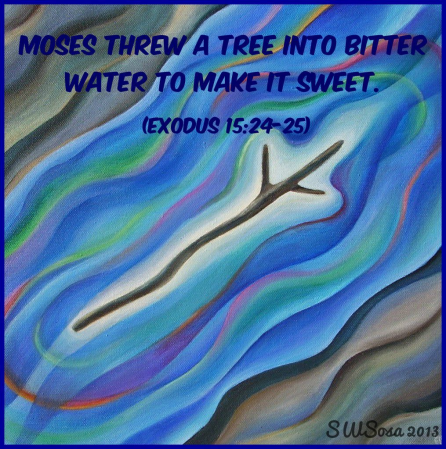
In Exodus 15 there’s an incident that carries weight for today. Israel has come to the springs of Marah. The water is bitter. The people turn to Moses. They challenge him and the complaint voraciously. “Why have you brought us here?” They press Moses to the point of mutiny. They are furious.

Some commentators believe this bitter water was a laxative, and anyone who drank this “bitter” water made many trips to the outhouse!

Moses is shown a branch of a common tree. The Lord speaks a word of the direction he’s to throw the branch directly into the spring. It’ll cure the water, and make it sweet and drinkable.

t seems to me that this awful cross cures the bitterness we absorb as we make our way through life.

The cross of Jesus is critically important. When that ugly tree touches our lives it makes what is bitter sweet. He has changed us by that incredible sacrifice on the hill of Golgotha.

.

Those Strange Christians

I was thinking about this today.

Do you have any idea how ridiculous unbelievers must see us? Just imagine for a minute that you’re on the outside of faith looking in.

———————

They get very solemn as they slowly take the bread and wine. They say that when they sing it’s to God Himself. Some get loud raising hands in surrender to Him. Some will even dance in the worship of someone who’s invisible. How bizarre is that?

They call a man who died a long time ago, they declare that He was their Lord and Master.

They’re gathering to read from a special and “magical” book, and they say that it speaks to them. They talk about living a life separated from Him. They truly think that others need to join them in this silly group. They regard each other as brothers and sisters and they serve each other.

They tell us that Jesus is God in human flesh, who was put to death on a cross and is now alive. They also believe that His blood saves them from their “sin.” These very odd ones think this man is going to return and rule the world, physically bring the Kingdom of God to this planet.

How very odd of them. How very strange these Christians are.

—————————

There exists a letter written to Diogenes, who is known as the Cynic. It was written around 130 AD. This letter itself is fairly extensive. I suggest that you read it in its entirety. It describes the faith and beliefs of the Christian to a man who really has no idea about them but wants to understand–here is a small portion of this epistle. Remember that this is one of the very first observations of our Faith:

“They live in the flesh, but they are not governed by the desires of the flesh. They pass their days upon earth, but they are citizens of heaven. Obedient to the laws, they yet live on a level that transcends the law. Christians love all men, but all men persecute them. Condemned because they are not understood, they are put to death, but raised to life again. They live in poverty, but enrich many; they are totally destitute, but possess an abundance of everything. They suffer dishonor, but that is their glory.” 

The Hidden Power of the Kingdom

Mix it up and watch out!

 “He told them another parable.” 

“The kingdom of heaven is like leaven that a woman took and hid in three measures of flour, till it was all leavened.”

Matthew 13:33

One version says 50 lbs (or 40 liters for your metric fiends) of flour. Crazy, why that much is beyond me–some figured it out and it would be enough bread for 100 people at least. Far more flour and yeast that was close to normal use. The parable that Jesus taught would certainly be humorous to the listeners. I suppose their imaginations were in overdrive.

What Jesus taught in these stories was incredibly practical and it engaged the listeners. They would leave and the stories would stick. Whether they realized it or not, His truth would impact them.

These stories were like bombs that would eventually explode in the hearts of the people.

Sooner or later, maybe when they least expected it, these parables would suddenly make sense. A lightning strike. Very seldom did they connect immediately. We can see this by the disciples’ desire to have them explained. They didn’t get it at first. But when Jesus illuminated them, they understood.

I believe that the Kingdom of God is hidden in us and it has outrageous power.

It works secretly, it’s not visible to anyone. It just does its stuff. The yeast, combined with the flour is a hidden process–something that isn’t observable. Perhaps that’s the way God’s kingdom comes, quietly, secretly but powerfully. Once the flour and yeast combine it’s pretty difficult to stop it.

That kingdom is working in our lives.

And most of the time it’s a hidden work. We can’t understand the process or grasp how it’s happening. We seldom know what God is doing. We may concentrate on being a witness to our neighbor, (which is a good thing, please do) but perhaps the Holy Spirit is working instead on our patience or love.

Usually, what we think is going on isn’t.

I’ve been in ministry for almost 40 years now, and I’ve tried to be faithful and worked on my discernment. But it seems I don’t quite grasp yet what the Father is doing inside of me. And I admit, I’m not really sure what’s going on in the lives of those I teach and counsel. Most of the time, I have no idea what he’s doing.

And that’s alright. I know he loves me very much and I trust him to work in me.

“And I am sure of this, that he who began a good work in you will bring it to completion at the day of Jesus Christ.”

Philippians 1:6

alaskabibleteacher.com