“I Kept You From Sinning”

Genesis 20:6

This is called restraining grace, the doctrine that teaches that God intervenes to prevent sin from happening.

Both the pagan king Abimelech and the patriarch Abraham have problems. One wants to add Sarah to his harem (lust), and the other pretends that Sarah isn’t his wife, but his sister (cowardice).

The dream:

Abimelech goes to bed and has a “God dream.” The Lord threatens him with death for taking another man’s wife. King Abimelech protests and pleads for his life. (Dreams were significant in Genesis.)

God relents and to Abimelech’s credit the Lord understands that this was done from a clear conscience. It seems that Abraham’s spinelessness has given the wrong idea about Sarah. She isn’t his sister, but his wife!

There are some interesting issues here. Not only is the king prevented from sinning here, but we see the lengths God went to protect Abraham and Sarah’s marriage. They were to be the parents of the nation of Israel. God would see to that.

There are real consequences to our sin. We will reap what we sow (Galatians 6:7), but God’s grace protects the believer who desires to be Christ-like. He is a shield to the man who runs to Him.

It probably happens more than you realize. I’ve found that there is a still, small voice that speaks to the Spirit-filled believer. Sometimes we ignore it and sometimes we obey it, but it’s there. It’s meant to guide us.

Our conscience is the “sheriff” of our souls. It’s our compass.

It seems that little is said about conscience anymore, but it’s imperative that you recognize it. Conscience tells you whether something is right or wrong. It’s our guide and must be closely watched over. It can become seared and clouded–it can be defiled. But it also can be purified and made holy.

Our conscience knows this. It’s a spiritual fact.

Ligonier.org

For further study: Psalm 12:7; Proverbs 11:6; Proverbs 13:6; 1 Peter 3:12.

alaskabibleteacher.com

The Shepherd’s Own Voice

John 10:1-5, ESV

 “Truly, truly, I say to you, he who does not enter the sheepfold by the door but climbs in by another way, that man is a thief and a robber. But he who enters by the door is the shepherd of the sheep. To him the gatekeeper opens. The sheep hear his voice, and he calls his own sheep by name and leads them out. When he has brought out all his own, he goes before them, and the sheep follow him, for they know his voice. A stranger they will not follow, but they will flee from him, for they do not know the voice of strangers.”

What joy can be found in the Shepherd’s care, and to hear his voice. Nothing really can match this wonder. We follow as he leads us. The voice is an integral part of this passage and the foundation of discipleship that is real.

Please understand: You really can’t walk with him unless you hear him. We belong to him. We’re his flock that he keeps and provides for.

And He knows our name!

That’s the intimacy found in these verses. We’re never forgotten and he will never overlook us. To think otherwise is slander and an attack on his present-day ministry. Jesus is our good shepherd. He always will be.

“Intimacy with God comes in whispers, not shouts.”

     Woodrow Kroll

He sometimes whispers, and yet this world can’t hear him (or they refuse to). To be perfectly honest, my ‘busy-ness’ silences Him. I suppose that the real issue isn’t with Him, but with myself.

“And after the earthquake, there was a fire, but the Lord was not in the fire. And after the fire, there was the sound of a gentle whisper.”

1 Kings 19:12

He doesn’t speak through a windstorm, earthquake, or fire. He chooses to speak very quietly, and that’s a problem for me. In the original Hebrew, the word “whisper” can be translated as “calm, something gentle.” He speaks this way if only we shut up for a little while.

If we are to recognize God’s voice, we must belong to Him. We hear His voice best when we spend time in Bible study and quiet prayer. The more time we spend intimately with God and His Word, the easier it is to recognize His voice and His leading in our lives. He’s always speaking, and we’re seldom listening.

The flock hears the shepherd, and it’s that voice that breaks through our cluttered-up life. We can hear, and it’s that communication that encourages us to walk through life—one day at a time. Just today. That’s all you must do.

There are so many other voices. Please dear one, you must ignore them.

So many are speaking, and so many want us to hear and follow them. But in reality, they want us to leave the Shepherd and his flock behind. But we can’t allow this, we must learn to listen to him alone.

alaskabibleteacher.com

Art by Eugène Burnan

Yirah, Fear/Awe

Hebrew for Awe and Fear

Psalm 33:8, ESV

Whenever I’m in Northern California I simply have to visit the redwoods. Walking through them always directs me to the immense God who created these massive trees. Since I live in Alaska I’m also surrounded by stunning beauty: mountains, glaciers, eagles, forests and fireweed.

To truly see reality is to live in yirah.

I believe that God intentionally created the world to inspire awe in us. The complexity of creation is truly remarkable, with scientists dedicating their lives to understanding it. There is so much about the cosmos that remains beyond our comprehension, which leads us to consider how much more unfathomable its Creator must be.

Often missing from our lives and worship is yirah, or “awe, fear.”

“The fear [yirah] of the Lord is the beginning of wisdom, and the knowledge of the Holy One is insight.”

Proverbs 9:10

Three observations I need to make. These are something to consider:

  1. Believers are to teach our children the yirah of the Lord. It must be learned which implies that it’s not something natural to us. “So that they may learn to fear me all the days that they live on the earth, and that they may teach their children so.” (Deut. 4:10.)
  2. His love for us can’t be diminished by His power and might. I believe that these three are not mutually exclusive–you can’t have one without having the other. They can’t be separated. “But with you there is forgiveness, that you may be feared.” (Psalm 130:4.)
  3. Submitting to God with awe and yirah will lead you to obedience and consistency. Loving Him becomes a joy when we respect and honor in fear of our Father.

“Just as obedience to the Lord is an indication of our love for him, so is it also a proof of our fear of God.”

Jerry Bridges

alaskabibleteacher.com

Shama, Listening

1 Samuel 15:22, ESV

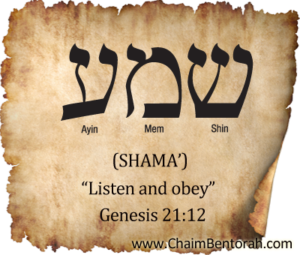
In Hebrew, the word ‘shama’ has a powerful meaning which is hard to translate into English. The word actually means “listening and doing.” Shama is a word that combines both ideas into one. To hear and obey is one word to the Hebrews.

It’s all about activity that’s a result of hearing.

Here, the word shama means to allow the words to sink in, to provide understanding that requires a response—it’s about becoming obedient when you hear His voice. In Hebrew, hearing and doing are the same thing. Obedience to these laws is not about legalism or trying to earn God’s favor—it’s about love and active listening.

We desperately need “shama” as disciples of Jesus.

We must understand that listening to God is needed, but obedience is required. Shama tells us this. We can’t just hear Him without obeying. I believe that obedience becomes easy when we are listening to Him.

And that’s a good thing.

Henry T. Blackaby

alaskabibleteacher.com