Learning to Love Prodigals

Learning how to forgive

Once I was punched in the face while preaching. I served as a full-time evangelist with SOS Ministries in 1987. I was leading a group to Haight/Ashbury St. in San Francisco. I remember it was really busy, and the it was a good team, and they were excited to take their church to the streets.

Haight/Ashbury was the place the “summer of love” kicked off, it peaked in 1968. It has a certain sense of notoriety, and even in 1983 it still had a dubious reputation as a center of the counter-culture. “A cult a day is born in San Francisco,” a pastor friend once shared with me.

Normally the neighborhood where I took a team would direct me on how to preach. Tonight I focused on God’s love for sinful people.

That message seemed appropriate for this place, and especially on this street. God loves these people very much.

A young man came forward. He told me that he was a backslidden Christian, and his father was an Assembly of God pastor. He had run away from home. Suddenly he began to weep. The entire team seemed to lean forward and I know they were praying earnestly for him. It seemed to me that he was teetering on the brink.

The punch came unexpectedly.

His fist hit me square in the nose. My eyes began to water. Oddly enough he took a step back and began to really cry out. My team wasn’t quite sure how to respond, but I hoped they prayed even harder. I sort of gasped and tried to shake it off. Someone must have called the police.

The Holy Spirit was very much present, both convicting and comforting each of us.

One or two minutes went by and suddenly he stopped sobbing and he became really angry. He took a step and then tried to kick me in the stomach, but I dropped the mic and caught his foot. I was ready for him this time.

About 20 minutes went by before SFPD showed up and asked if I wanted to press charges. I thought for a bit, but deep down I knew that wasn’t the will of my Father. Maybe I should of, I don’t know. But I thought about my own sin and couldn’t judge no one.

The Father was reaching him while teaching me!

God loves His prodigal children very much, He understands the guilt and shame (and frustration) they feel. The Father however is always watching and waiting. He works through life’s circumstances to lead them home. Each belongs to Him. He continues far past what we think is possible. He will never give up.

“We know what real love is because Jesus gave up his life for us. So we also ought to give up our lives for our brothers and sisters.”

1 John 3:16

I suddenly saw a “wounded” brother, very confused and quite angry. Not with me, the team, or the music–but with God who created him, and died for him.

At that moment I just happened to be God’s love for this prodigal.

“How did Jesus expect His disciples to react under persecution? (In Matthew 5:12 He said), “Rejoice and be glad!” We are not to retaliate like an unbeliever, nor sulk like a child, nor lick our wound in self-pity like a dog, nor just grin a bear it like a Stoic, still less pretend we enjoy it like a masochist. What then? We are to rejoice as a Christian should even “leap for joy” (Lk. 6:23).”

     John Stott

“How did Jesus expect His disciples to react under persecution? (In Matthew 5:12 He said), “Rejoice and be glad!” We are not to retaliate like an unbeliever, nor sulk like a child, nor lick our wound in self-pity like a dog, nor just grin a bear it like a Stoic, still less pretend we enjoy it like a masochist. What then? We are to rejoice as a Christian should and even “leap for joy” (Lk. 6:23).”


The Older Brother Syndrome

Luke 15:25-32

25-27 “All this time his older son was out in the field. When the day’s work was done he came in. As he approached the house, he heard the music and dancing. Calling over one of the houseboys, he asked what was going on. He told him, ‘Your brother came home. Your father has ordered a feast—barbecued beef!—because he has him home safe and sound.’

28-30 “The older brother stomped off in an angry sulk and refused to join in. His father came out and tried to talk to him, but he wouldn’t listen. The son said, ‘Look how many years I’ve stayed here serving you, never giving you one moment of grief, but have you ever thrown a party for me and my friends? Then this son of yours who has thrown away your money on whores shows up and you go all out with a feast!’

31-32 “His father said, ‘Son, you don’t understand. You’re with me all the time, and everything that is mine is yours—but this is a wonderful time, and we had to celebrate. This brother of yours was dead, and he’s alive! He was lost, and he’s found!’”

I hated him. I know I shouldn’t but I did. He betrayed all of us with his nonsense. It all started when he demanded that our father immediately divide up our inheritance. Strange I know. It was a shock, like a punch in the stomach. No one knew what to say, it was so bizarre. I have no idea where this idea came from.

He insisted that we divide things up right this instant. He didn’t have the decency to wait for our father’s funeral. It was such a shameful thing that I couldn’t begin to tell you how mortified I was. No one ever heard of anything happening like this before. Even now, after these many years, I can hardly talk about it.

My father simply did what was asked, there was no argument, no resistance.

The property was appraised, and the money was divided up according to custom. We sat at the kitchen table, and the ass watched to make sure that he received every penny that was coming to him. His hungry greed was beyond belief. He oozed arrogance–it was then I really began to hate him.

Never ever had I been so angry and ashamed.

My younger brother never even batted an eye and my father simply did what was asked. My brother didn’t even have the decency to say “thank you.” I desperately wanted to leave, and I couldn’t. I had to be there, and I felt like I was going to throw up.

Enough of that. Let’s move on.

That ass, that brother of mine, suddenly packed up and left. Oh, occasionally I heard of his escapades. There were awful reports of his drunkenness and whoring. He was spending our father’s money as if it would never going to run out. Even talking about it now makes me angry.

The last I had heard was he was now feeding pigs. He had spent every last dime and now it seems he was getting what he deserved. I didn’t shed a tear, I felt no pity. Good, he was getting what he should have gotten all along. I only wished that things would get even worse.

Coming in from the fields I heard a raucous party coming from the house.

I asked one of the servants what was going on. When they told me I was even more shocked. Our father had arranged a celebration, all because my brother had returned. The fatted calf had been killed, the one that was saved for parties, and I heard shouts of joy and dancing. They were celebrating, and that made no sense to me at all.

I had served the estate faithfully, I had sweated to make things work, and I never got a party like this.

My father came out to find me, I had hidden out in a shed–I didn’t want to be a part of this awful charade. When he found me he said that the party had to happen. It seems the scoundrel had the audacity to return–the money was spent, and apparently, he came home in rags–it served him right. He got what he deserved.

He told me that this celebration must happen.

My mind reeled. Could things get even crazier? Never had I heard of anything so bizarre. It was beyond belief. My father wanted me to come in and join them; I’d rather die. You have no idea.

He kept telling me that this had to happen–apparently he was given a new robe, and worst of all he was given the family ring, the ring that declared that he was now a full-fledged son, someone who could have all of the privilege and authority of a son. I had never heard of such foolishness.

My father said this was necessary, that my brother who I hoped was dead, was now alive.

How bad could things get? Perhaps my father had lost his mind.

“Just so, I tell you, there will be more joy in heaven over one sinner who repents than over ninety-nine righteous persons who need no repentance.”

Luke 15:7

Painting: “The Return of the Prodigal Son by Rembrandt, c. 1667, oil on canvas. This picture shown is a small part. Scripture is The Message, a translation by Eugene Peterson.

alaskabibleteacher.com

Lost & Found

On a warm afternoon, a lamb takes a peek at a visitor while eating hay at Fat Rooster Farm in Royalton, Vt., on April 27, 2003. (Photo by Geoff Hansen)

 “All the tax collectors and sinners were approaching to listen to him. And the Pharisees and scribes were complaining, “This man welcomes sinners and eats with them.”

3 “So he told them this parable: “What man of you, having a hundred sheep, if he has lost one of them, does not leave the ninety-nine in the open country, and go after the one that is lost, until he finds it? And when he has found it, he lays it on his shoulders, rejoicing. And when he comes home, he calls together his friends and his neighbors, saying to them, ‘Rejoice with me, for I have found my sheep that was lost.’ Just so, I tell you, there will be more joy in heaven over one sinner who repents than over ninety-nine righteous persons who need no repentance.

Luke 15:1-7

What does it mean to be lost? Some have that much figured out by now, (and if not, we will.) The Bible nails us with this story, and it rings true of the human condition. You don’t need a Ph.D. in Psychology to understand this. The heart and soul of a man and a woman are in an awful state of separation from God, and some are beginning to understand this.

The three stories reveal that the Pharisees and the scribes have issues.

Their whole belief system–the idea of who’s righteous and who’s not, is being rocked. The sinners are coming to listen to Jesus (maybe for the stories, maybe for something else?) The religious regime is mystified, and maybe a bit jealous. Perhaps they were irked at the grace of God they see in Jesus?

Jesus tells His first story, (and he loves to tell stories I’ve found.) Anyway, the parable he shares is 100 words (more or less) and it describes the condition of every man, woman, and child–everyone who has ever existed. He clearly cuts through “religion” like a hot knife through cold butter. He quite succinctly describes us. And wow, these stories are eye-openers.

We’re all lost sheep–wandering, and sometimes very confused.

The paths we’ve taken to get out of our “lost-ness” have only confused us even more. We’ve had to deal with thorns and vultures; it hasn’t been easy, and we’ve never been able to reconnect to safety. Some become “smart” people, others buy fast cars, and some kill their lost-ness with booze or drugs. We find many different ways to keep us from feeling this separation from God.

A very lost sheep.

In Luke 15, we find three parables that all deal with lost things–sheep, coins, and sons. Essentially, they each explain what now has happened to us. Most of us know that the religion of the Pharisees hasn’t worked. Even the sinners understand that much. Sometimes even the very lost have figured that much out, even before the so-called righteous do.

Jesus tracks us down–our confusion has finally lifted enough to see his outstretched arm. The Father has this odd preference for those who know they’ve lost, and these three parables come in a deliberate succession–that should make things pretty clear.

So dear one, will you insist on wandering? Is that what you really want?

alaskabibleteacher.com

w

Calibrating Your Heart to His

scalingchart1080tf3

A chart used to calibrate video

“May the patience and encouragement that come from God allow you to live in harmony with each other the way Christ Jesus wants.”

Romans 15:5

“Now make me completely happy! Live in harmony by showing love for each other. Be united in what you think, as if you were only one person.”

Philippians 2:2

The science and method of calibration provide us with a way to bring two, or more things into harmony.  It’s done frequently on diverse things such as scientific instruments, avionics, or music.  Without this need for ‘blending’ things degrade into a symphony of confusion.

A piano is tuned, and the worship leader then tunes into that piano.   

The worship team is blending simultaneous sounds of different pitch or qualities, making chords. This takes practice and a gift. This principle is enhanced when we think of several gears that mesh and turn together.  There is a certain congruity or symmetry that makes it successful. Beautiful music can happen only if the musicians have been calibrated with each other.

We need a calibration of our spirit with God’s Holy Spirit.  We tune in to Him.  His Word is a little bit like a tech manual, showing us, and helping us.  He helps us adjust so that we are harmoniously flowing with Him and with others. Sometimes this takes time.

Have you ever met a believer and they were no longer in harmony? 

I bet you have. They may have a belief that is out of balance.  It may be health or sickness.  That is quite common today.  A common issue is the area of politics. Lately, it’s become a danger for many believers. Be very careful.

I served in San Francisco in the 1980s with SOS Ministries.  There was a small church down in Pacifica that would drive up to ‘worship on the street’ with us.  They were incredible.  They had a sensitivity and anointing that other groups didn’t have.  They loved Jesus very much and loved each other, and it showed.

Within six months they disbanded and went their own ways.  I was told that their meetings were essentially gutted out.  They became fanatical about the ‘anti-abortion’ message to such an extreme they didn’t even have a church service anymore.  It was now nothing more than a political rally, and they were not even reading the Word or worshiping together. 

They were no longer calibrated to the Spirit or the Church. They were no longer aligned with the truth.

I have to be regularly adjusted to harmony with the promises of God.  I need my gauges to be consistent with the Word.  Not to be ‘heavy’ on certain things or ‘light’ on others. I can easily err on emphasis. That’s a real possibility. If I’m not calibrated, I become a spiritual danger to others, my family, and to myself.

“Finally, all of you, have unity of mind, sympathy, brotherly love, a tender heart, and a humble mind.”

1 Peter 3:8

alaskabibleteacher.com

When God Puts You Into a Quarantine

quarantine

Quarantines are a real possibility, even to this day. A quarantine is imposed when a disease is contagious enough that it would harm a society: Measles, Smallpox, and the recent COVID-19 are just a few physical diseases where isolation must be imposed.

It can be severe— an epidemic, with desperate consequences if not adhered to; in some rare cases, the use of deadly force has been authorized to maintain a quarantine until the disease is no longer communicable.

This may surprise you, but there are examples of ‘quarantines’ in the Bible.

The term ‘unclean’ was used for ‘leprosy.’ Those afflicted had to isolate themselves; they had to ‘announce’ their presence when in contact with society. Lepers lived in groups away from the general populace, as a result of their disease.

In Paul’s epistle to the Corinthians, he addresses another kind of ‘quarantine.’ The situation was dire; the church had advocated a Christian living with his father’s wife.

“I have already passed judgment on this man in the name of the Lord Jesus. You must call a meeting of the church. I will be present with you in spirit, and so will the power of our Lord Jesus. Then you must throw this man out and hand him over to Satan so that his sinful nature will be destroyed and he himself will be saved on the day the Lord returns.”

1 Corinthians 5:3-5, NLT

Understanding the Principle of Usefulness

Now in a large house, there are not only gold and silver vessels, but also vessels of wood and of earthenware, and some to honor and some to dishonor.”

2 Timothy 2:20, NASB

Found in God’s pantry are lots of pots and pans of various uses.  Paul writes Timothy about the ‘large house’ which is the Church inclusive. Look around Timothy, there are gold ones, and there are silver ones. They have a noble purpose fitting for such a great house. These are the ones the guests will use; they befit the significance of the Lord himself. These vessels have great value for they are made of precious metals.

There are vessels of different categories. These are the ones made of wood, and of clay. These are part of the household, make no mistake about it. But their use is one of function, they’re utilized in common and ignoble ways. (A clay ‘bed-pan’ perhaps?!)

21 “Therefore, if anyone cleanses himself from these things, he will be a vessel for honor, sanctified, useful to the Master, prepared for every good work.”

2 Timothy 2:21

Paul, the author of the New Testament doctrine of grace emphasizes the place of personal holiness. We are to ‘cleanse’ ourselves to become a vessel of honor. There is good news here:

  • All are vessels in the Father’s house. Each of us belongs to Him. He alone determines their use.
  • Things are not yet in their final state. Changes in status can be experienced. In God’s economy, clay pots can become ‘golden.’ Silver can become ‘wood.’

Some sin is contagious.

It affects believers, and the Church becomes compromised by what we’ve done. And then sometimes we are quarantined by the Holy Spirit–until the contagion passes. This spiritual disease must not be permitted.

I have experienced this several times in my own discipleship. These are not pleasant times, but there is no condemnation. I’m still His servant, His love for me stays outrageously constant. He has never turned away a sinning child who repents of their sin.

“Yes, I am His servant, but I must wait out in the hall. I haven’t been faithful. So I sit in His waiting room, waiting for His call. This is for my good. And my Father knows what is best.” 

alaskabibleteacher.com

Listening to A.W. Tozer

I believe that these quotes by A.W Tozer will really touch your heart. I’ve tremendous respect for him and his ministry. His is a voice that we really don’t hear too often anymore–but we should.

― A.W. Tozer, The Pursuit of God: The Human Thirst for the Divine

“Between the scribe who has read and the prophet who has seen there is a difference as wide as the sea. We are today overrun with orthodox scribes, but the prophets, where are they? The hard voice of the scribe sounds over evangelicalism, but the Church waits for the tender voice of the saint who has penetrated the veil and has gazed with an inward eye upon the Wonder that is God. And yet, thus to penetrate, to push in sensitive living experience into the holy Presence, is a privilege open to every child of God.”

“Complacency is a deadly foe of all spiritual growth. Acute desire must be present or there will be no manifestation of Christ to His people. He waits to be wanted. Too bad that with many of us He waits so long, so very long, in vain.”

“To men and women everywhere Jesus says, “Come unto me, and I will give you rest.” The rest He offers is the rest of meekness, the blessed relief which comes when we accept ourselves for what we are and cease to pretend.”

“Whoever defends himself will have himself for defense, and he will have no other. But let him come defenseless before the Lord and he will have for his defender no less than God Himself.”

“How tragic that we in this dark day have had our seeking done for us by our teachers.”

“Lord, make me childlike. Deliver me from the urge to compete with another for place or prestige or position. I would be simple and artless as a little child. Deliver me from pose and pretense. Forgive me for thinking of myself. Help me to forget myself and find my true peace in beholding Thee. That Thou mayest answer this prayer I humble myself before Thee. Lay upon me Thy easy yoke of self-forgetfulness that through it I may find rest. Amen.”

alaskabibleteacher.com

Restore the Sparkle or I Will Die

Trials are hard, at times they seem to suffocate us and weaken our walk with God. David shares with us his own difficulty in these six verses.

Buckle your seat belt folks!


Commentary, Psalm 13

For the choir director: A psalm of David.
 

Lord, how long will you forget me? Forever?
    How long will you look the other way?
How long must I struggle with anguish in my soul,
    with sorrow in my heart every day?
    How long will my enemy have the upper hand?

V. 1-2, David believes that he has been forgotten. A phrase is repeated an astounding four times, “How long?”  It seems that impatience is a significant issue for him. Often when it gets this bad, we desperately look around to find anything to fill the gap. Anything.

Something else struck me. Within these two verses, you’ll find five hard questions. Whenever you find a question in the psalms especially, you must stop reading and take a closer look–why is he asking this?

V. 2, “Anguish…sorrow, every day.” Somehow David is alert enough to recognize (and admit) that his life is saturated with real difficulty. It seems it comes and when it comes there’s  no relief– it’s a constant, gnawing, challenging pain which can be physical, emotional, or spiritual (or all three).

Turn and answer me, O Lord my God!
    Restore the sparkle to my eyes, or I will die.
Don’t let my enemies gloat, saying, “We have defeated him!” Don’t let them rejoice at my downfall.

V. 3,  Turn and answer me, O Lord my God! Restore the sparkle to my eyes, or I will die.” (I love this version–“sparkle). David knew that life could be exceptional, it was meant to gleam and shine. There is much more than just breathing in life. He speaks of being restored. He looks toward God to change his world again.

V. 4, Also, he is quite aware that his life is being threatened. The word, “gloat” is an interesting translation. It has the idea of relishing someone else’s failure. The dark prince savors your defeat. He has been looking forward to this desperate moment. The enemy rejoices at his failures.

But I trust in your unfailing love.
    I will rejoice because you have rescued me.
I will sing to the Lord
    because he is good to me.

V. 5,  But I trust in your unfailing love. I will rejoice because you have rescued me.” The Lord has covered David with His hand. His life has been saved by a love that never falters or weakens. Never! He knows that God has rescued him.

Notice how David responds to the wonderful goodness of God.

  • I trust. 
  • I rejoice.
  • I sing.

V. 6,  Tremendous verse; it is really wonderful. When we finally get to this last verse, we see that we have “run the gauntlet” with David. And we have learned how to sing.

Often good jewelers display their diamond necklaces on a black background. The darkness intensifies the brightness of the jewels. They become even more beautiful to look at. David is singing and praising the Lord in His nearness. The darkness has only strengthened his faith.

I truly believe that this is what we were made to do.

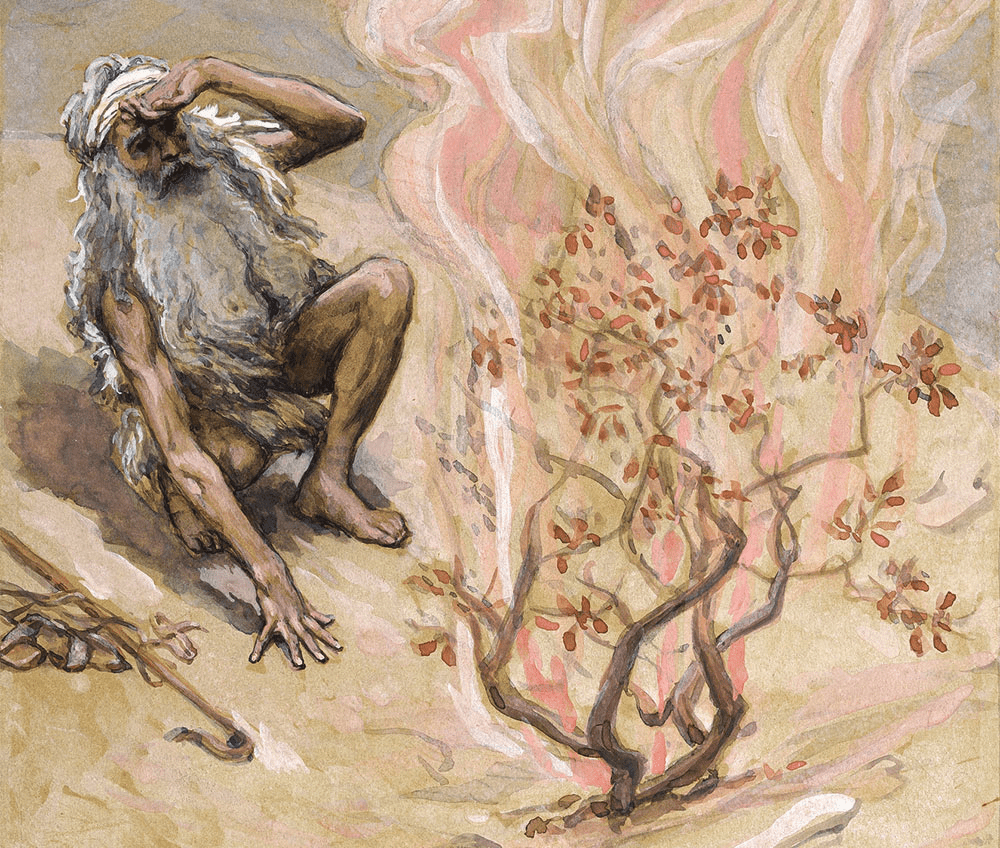
A Burning Bush, or Blackberries?

“Earth’s crammed with heaven, And every common bush afire with God; But only he who sees, takes off his shoes, The rest sit round it and pluck blackberries.”

Elizabeth Barrett Browning

In some odd way, our lives seem to be always getting interrupted by God. And it can happen a lot. We need to see the invisible. When we can, it can be quite amazing. Our night sky here in Alaska is wonderful. If it’s clear out, it’s amazing what you can see.

Probably the most phenomenal night skies were in Mexico though, while camping on the beach. As I lay there I looked and the Milky Way was on full display. It really was as good as it could be. It seemed there were 10x more stars than ever before.

Once as I gazed up, a weird sort of fear gripped me, it was almost a panic.

I started to tremble and shake. I got up and ran to our tent. I just couldn’t handle the incredible universe with no buffer. I was completely undone and reduced to a quivering speck of dust. I tried to tell my wife Lynn what had just happened to me, but I couldn’t. I was too scrambled. I couldn’t speak.

MINOLTA DIGITAL CAMERA

Reflecting on this, I now realize I had experienced “awe.” It was something much more common a few generations ago. There is a kind of existential crisis which we side-step in these more modern times. We rarely contemplate the night sky. We seldom, if ever, have seen fire in a bush.

It seems we have traded our awareness of a truly Almighty God, and in turn, we get to pick all blackberries we can haul.

We reason it out, and we feel that we have made a better bargain. But when we extricate this from our souls, don’t be surprised if we suddenly find that we have become spiritual paupers.

Maybe we should learn to see through things; each of us has the opportunity now to see the spiritual world that swirls around us. Why wait for heaven? Ask our Father to reveal His glory now in this present moment. Learn to see that which can’t be seen, but by faith.

“The heavens declare the glory of God, and the skies announce what his hands have made.”

Psalms 19:1, NCV

alaskabibleteacher.com

When You Set Yourself on Fire

Difficulty and pain sometimes come from others, and challenges to the Lordship of Jesus often come from our unique circumstances.

But what if it was something we’ve done?

I remember the classic picture of a Buddhist monk who sat in the middle of a street. He was serene as he soaked himself with gasoline, and lit himself on fire as a protest against a war he believed was wrong and evil. He burned himself in front of the cameras.

All too often we’re pretty much responsible for our own self-immolation. It is we (and we alone) that set ourselves ablaze. Sin affects our minds and hearts. We set ourselves on fire.

When we sin– when we walk in ‘known’ disobedience we always put ourselves in an awful place. We love it but learn to hate it too. But we continue to do it regardless of the awful death that ensues.

God promises to forgive us. Out of our ashes, He keeps bringing us life and hope.

You can be forgiven. You can find life again, even if you’re fully responsible for the evil we’ve done to yourself. Yes, we all sin, and yes we walk in our own personal rebellion. But Jesus knows it all. These awful things we’ve all done can be forgiven.

As a man and a preacher of the Gospel, I realize that I choose to sin. In spite of all I know and teach I realize that I can live in the ashes of my own making. As one who also struggles with bipolar, I understand that I’m even more susceptible to doing awful things. I understand that I choose darkness even though others sometimes call me “a man of God.”

As you read this I’m praying that you find His forgiveness and mercy. You’ve come a long way it seems, but you must see His blood that was ‘released’ from His veins and arteries for you.

He desperately loves you–even if you’ve set yourself on fire, and sit in the ashes of your doing.

“To appoint unto them that mourn in Zion, to give unto them beauty for ashes, the oil of joy for mourning, the garment of praise for the spirit of heaviness; that they might be called trees of righteousness, the planting of the Lord, that he might be glorified.”

Isaiah 61:3

alaskabibleteacher.com

Our Father is in Control

Tapestry: Front and Back

 “Thus says the Lord, You shall not go up or fight against your relatives the people of Israel. Every man return to his home, for this thing is from me.’ So they listened to the word of the Lord and went home again, according to the word of the Lord.”  

 1 Kings 12:24, KJV

You can never accuse the Lord of being cold and distant and aloof.  He doesn’t detach Himself from the needs of His people.  He doesn’t ever disconnect and isolate Himself from you.  On the contrary, He is constantly thinking and acting on your behalf.  He is a proactive God, and that’s impressive.

The God of the Bible is always intensively involved in the affairs and concerns of His covenant people.

What we see as a muddled-up mess is actually His work. Perhaps in eternity we’ll see and understand. We see the backside of the tapestry now but (I assure you) we’ll know the beauty of His handiwork.

“For this thing is from Me.” 

God directs a confused king who has significant issues.  (Sound familiar?) God decides that the civil war between Judah and Israel is wrong.  In 1 Kings 12, He sends His prophet Shemaiah to stand before the king of Judah, and speak out a word to the nation.  The Lord is involved, and it is He who is actively enmeshed in this issue.

“For this thing is from Me.” 

There is something here that can mystify and perplex the best of us.  He begins to weave and guide His active presence into the confusing issues of that time.  He is not a “landlord God,”  but He is intensely involved in our affairs.  He initiates and directs the very things that concern us.

“For this thing is from Me.” 

The text clearly opens up this ugly situation.  In the midst of this bizarre issue, God has assumed control.  His prophet Shemaiah carries this a Word of power into a room of possibly explosive personalities.  Now the arrogance of the king can be a strong and strange thing.  But God decides and moves wherever He wills. Kings are never an issue when God enters in. They must serve now, like anyone else.

Dear one, He is incredibly involved in your affairs. 

He draws you and He has engaged to be intricately focused on your situation.  “For this thing is from Me.”  and that truth opens up His purposes to our desperate poverty.  We may try very hard to try to maintain control and direction.  But God directs and superintends. 

He is big enough to touch and direct my small heart.  We will come into confusion if we try to sidestep His lordship.

 “The Lord can control a king’s mind as he controls a river;  he can direct it as he pleases.” 

Proverbs 21:1

bry-signat (1)