The Forbidden First Stone

“They kept demanding an answer, so he stood up again and said, “All right, but let the one who has never sinned throw the first stone!”

(John 8:7, NLT)

“None knows the weight of another’s burden.”

-George Herbert

As believers, we must discern motives and false doctrine. We’re to be constantly aware of people and issues that swirl around us–of this, there is no doubt, we mustn’t be ignorant. This is a healthy “discernment.” But we must learn that having discernment isn’t a way that passes out a ‘guilty’ penalty. We are ‘seeing’ things these things–not to pass judgment, but that we might pray clearly and earnestly, and grow into His love for the weak.

But to pass out a guilty sentence is God’s exclusive jurisdiction.

It’s far beyond our ‘pay grade.’ He is the final judge in everything. He judges justly and lovingly. He alone knows and understands everything very clearly. We don’t.

And yet how foolish we are. Do we really have the ability to pronounce a penalty to someone else? Could it be when we decide to throw rocks at certain people we’re in terrible danger of forfeiting our own salvation? “But if you do not forgive others their sins, your Father will not forgive your sins.” (Matt. 6:15.)

We discern, not to pass judgment, but to pray more clearly and effectively. What you see or sense is for the prayer closet, not before a judge’s bench.

(If you have a ‘rock’ in your hand, you are in definite danger.)

“Don’t judge others, or you will be judged. You will be judged in the same way that you judge others, and the amount you give to others will be given to you.

We really don’t have a problem with worldly people. We understand that they are lost in their sins, terribly wrapped up in their own personal darkness, and that should definitely disturb us. We must point to the Blood of Christ that forgives us. We share the good news of true repentance and faith. His Spirit teaches us to be witnesses of His love to everyone we meet.

But in light of this, isn’t strange that almost all of our judgment is somehow directed at other believers! Why?! For some strange reason, it ‘seems,’ we think that we must pronounce guilt and (by doing so) we declare our own “holy” attitude to our place in the Body. In a weird sense, we think we have the supreme calling to condemn someone else’ walk, and by doing so exalt our own!

“The life of faith is a struggle enough in a broken world without us complicating it for other believers.”

–Jake Colsen

It just may come as a shock to some, but it’s extremely difficult to throw stones at someone when we are busy “washing” their feet.

“The nature and end of judgment or sentence must be corrective, never vindictive; it is always for healing, and never for destruction.”

–John Owen

Perhaps when we judge others, we reveal that we don’t understand what ‘real’ discipleship with Jesus is? Somehow it seems, we really aren’t quite grasping the immensity of His grace on guilty people? Do we really understand His profound love for the fallen? “God so loved the World…” Have we had any idea how patient He is with us? Do we doubt His ability to correct others? (These are awfully hard questions.)

“Judge not lest you be judged.” (Jesus’ words really do scare me sometimes.)

Certainly, I intend to confront the darkness. “You are the light, a city set on a hill!” I am His salt and light and I do shine into this dark night. But that is His doing, not mine. I do not generate light on my own. The Bible declares me as ‘self-righteous’ when I try. I am a broken person, who is just starting to understand the scope of my own brokenness and weaknesses. I’m starting to realize I’m not in a position to judge someone else. I’m not quite healed myself yet and I must not think I can point to someone else as being worse than me.

Quite simply, I can’t throw ‘rocks’ at other believers anymore.

I can no longer pass out any condemnation from my own limited understanding. My chief concern right now is to be a humble, earnest Christian who is always ready to forgive those who, in their awful sin and confusion, are hurting others. I’m beginning to see that my calling is to be; a simple servant to my brothers and sisters, nothing more, and nothing less.

Refusing to Give Up

Luke 18:1-8

“Now he told them a parable on the need for them to pray always and not give up. “There was a judge in a certain town who didn’t fear God or respect people. And a widow in that town kept coming to him, saying, ‘Give me justice against my adversary.’”

“For a while he was unwilling, but later he said to himself, ‘Even though I don’t fear God or respect people, yet because this widow keeps pestering me, I will give her justice, so that she doesn’t wear me out by her persistent coming.’”

“Then the Lord said, “Listen to what the unjust judge says. Will not God grant justice to his elect who cry out to him day and night? Will he delay helping them?”

8 “I tell you that he will swiftly grant them justice. Nevertheless, when the Son of Man comes, will he find faith on earth?”

This parable deals with heavy-duty prayer—not the weak watered-down stuff. But rather something that’s bold and confident. Jesus teaches us to intensify our prayers. There are parallels here with the woman from Canaan. We see Jesus seemingly ignore a seeker (Matthew 15:21-28, Message). I guess that bothers me somewhat. But he wants her faith to grow.

Jesus uses the word “unjust” to accentuate the story to his listeners. It more or less creates a tension where true faith can be seen up close. Back in the Old Testament we read of Jacob refusing to let go of the angel (Gen.32:22-25). We see Rachel who demanded children, “or else I die,” (Genesis 30:8). Both prevailed even when confronted with difficult situations.

“Don’t give up” in verse 1 explains this passage.

Discouragement is a frontal assault on a believer’s faith. Satan uses different tactics, but attacking ones faith is his specialty. Whenever Satan sees faith, he attacks. He absolutely hates your relationship with the Father. He will turn you against him if he can. We are told that our faith must become a shield when he tries to assault us, (Ephesians 6:16).

It seems that to me that some believers refuse to wear their armor. They don’t realize how vulnerable they really are.

This parable is clear. Often God seems to be distant and unconcerned, but that isn’t true, and yet Satan insists that it is. As believers we’re told to press the father about our need. Repeatedly, we’re told that God is very much aware of us, he only wants to build our faith—to make it strong. He uses Satan’s assault on us to magnify the fathers glory.

The widow is a case in point. She demands that the judge listen to her case, and finally he relents. Her insistence is finally rewarded. He realizes that this widow isn’t going away. She’s starting to give him a headache, and she is very persistent. Her faith is stronger than his reluctance.

Our faith needs to be exercised. It’s very much like working out in a gym.

Weights are used, and once you’ve mastered one level, it’s increased. It may sound like a cliche, but God won’t give you anymore than you can handle, our faith isn’t much different. Sometimes we’ll sweat and strain spiritually, but we must understand that our faith has to be strengthened. We never seem to arrive.

You must understand that our faith will be tried, but that isn’t a bad thing. If God withdraws, then we must pursue. If he doesn’t answer we must crank it up. Like the widow we need to persevere; we must not give up. This is how your faith grows. Hebrews 11 declares what faith looks like when it’s wrapped up in flesh and bone.

“For everyone who asks receives, and the one who seeks finds, and to the one who knocks, it will be opened.”

Luke 11:10

Art by Eugène Burnand

Covering the Sins of Others

“And don’t build an altar that requires steps; you might expose yourself when you climb up.”

Exodus 20:26

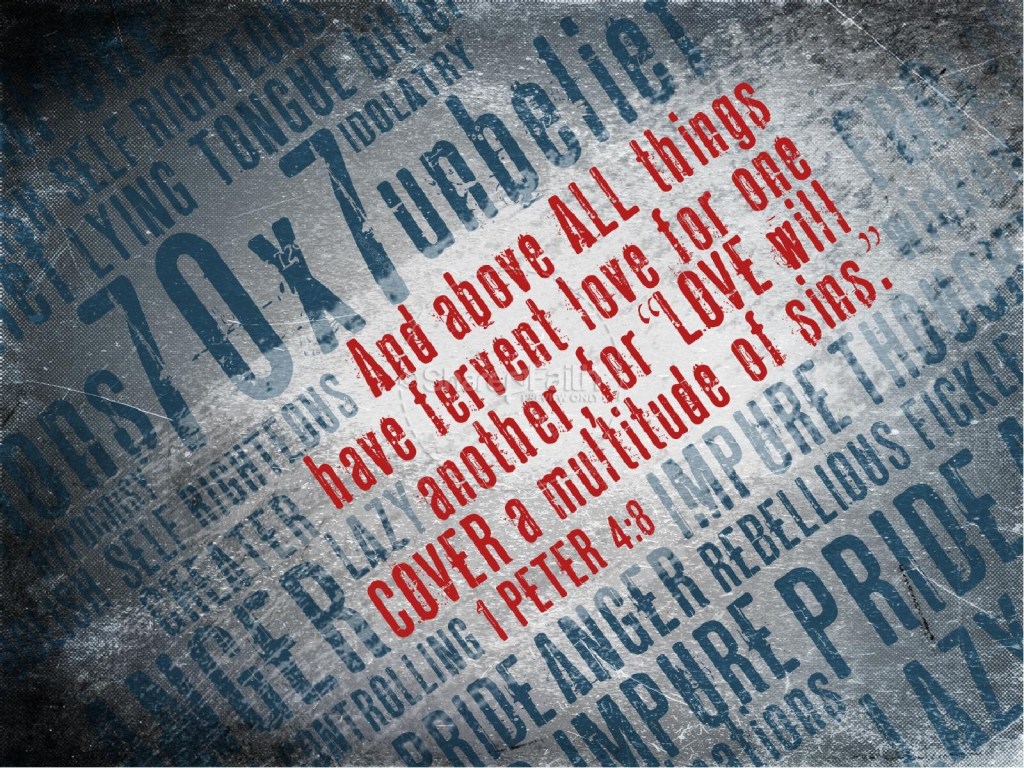
“Most important of all, continue to show deep love for each other, for love covers a multitude of sins.”

1 Peter 4:8

While I lived in the SOS Ministry house in the Mission District of San Francisco a dear brother taught me this principle.  Living in a Christian community was wonderful, but it also could be a tremendous challenge at times.  What Michael taught me allowed my understanding to grow into my own calling in the Kingdom.

The principle is this:  

Throughout the scripture “being naked, or nakedness” is always a shame.  It comes welded to the concept of being vulnerable to the sight of those who are mature.  It carries the idea of sin; it’s sin that some can see, it is hidden to most but causes terrible shame. Exposure of their nakedness seems like the worst thing that could happen.

For those who often sin, we latch onto the idea of keeping a lid on it, and being secretive about it.  We believe that people will never know.  Often sex sins, drugs, and alcohol sin, are kept hidden from the view of family and friends, and the Church. Hidden sin will never be healed by hiding it. (That’s a very common deception.)

Noah and his nakedness, Genesis 9

“Noah became a farmer and planted a vineyard. When he drank wine made from his grapes, he became drunk and lay naked in his tent. Ham, the father of Canaan, looked at his naked father and told his brothers outside. Then Shem and Japheth got a coat and, carrying it on both their shoulders, they walked backwards into the tent and covered their father.”

“They turned their faces away so that they did not see their father’s nakedness.”  

Genesis 9:20-24, (See Lev. 18).

Granted, it’s hard to process this patriarch’s gross sin. However in all fairness, Noah had lost practically everything in the flood, so perhaps we should be gentle with him.

The Church needs people who cover up the nakedness of others, people who are gentle and humble.  They would never, ever dream of making a scandal.  They are trustworthy and understand to a great degree the things that make a man or woman of God.

Mature believers will protect the open areas of others. 

They will refuse to judge or point out sins. Any discernment that’s given from God is for intercession, not for fault-finding.  They stand in the gap, shielding and protecting. And praying. This is God’s heart, and they understand.

But the issues for leadership are quite clear.

The principle of spiritual responsibility and active sin requires definite action for the health of the Church. A pastor or teacher who practices evil cannot remain in their place of authority. The standard for them is different. They have been charged for care and oversight over God’s flock.

With the ordination vows comes scrutiny. I believe special grace is given to each leader, but with that comes the commitment to following Jesus faithfully. It’s a serious call and deliberate sin invalidates that. The man may be quite gifted but can no longer be trusted to serve in their office.

I’m convinced that Paul’s epistles support this.

God’s final word on nakedness is in Revelation 3:18, and perhaps this is a good place to end this post.

alaskabibleteacher.com