The Father is Looking for You

Luke 15:20, ESV

There comes a time when the prodigal stands up–looks around, and then decides he can’t live this way anymore–it’s now time to return home.  But he is no longer a ‘rich man’s son,’ the pig-pen completely crushed that idea.  He returns home, thinking that at least he can be a slave.

The devastated prodigal now understands.

And it’s that which gives him the propulsion to leave the pigs behind, and begin to somehow be received by his father. The trip is a long one, lots of walking, and yes, it’s hard–he’s far from where he’s supposed to be. He is tired, ragged and worn.

But please dear one, you must understand this about Jesus’ parable–the story isn’t so much about the prodigal son, rather I think that the focus should really be on the father. Jesus is teaching us that the love of God is a searching/seeking kind of love, and it cannot be shut down, or go away over time. Not ever.

You see, it is a 24/7/365 day kind of love. Intense and constant.

Think of it like high intensity radar that steadily sweeps over extreme distances, it is always looking, seeking, and it won’t be denied.  The Father is seeking for His sons and daughters.  He intends to find them. If we refuse we will continue to feed pigs, over and over, and we will starve.

He continues to search, even when things get really nasty for the son. He won’t give up.

Jesus is explaining the deep love the Father has for prodigals like us. This story is so revealing, for in it we see that the Father who is running. We must know this about Him. We must internalize it and understand the compassion He has. If we stall in our discipleship it’s often because we don’t grip the awesome depth of His love.

There seems to be very few people who understand a God who runs.

As the prodigal hits bottom he realizes the futility of his choices and yearns to return to the forgiving embrace of his father. Overwhelmed by guilt and shame, he makes the long journey back to the home he once took for granted. Little does he know it, behind the scenes, his father has been watching, waiting, and hoping for his return.

And then, in a moment that encapsulates the beauty of unconditional love, the father catches sight of his boy from afar. Without a second thought, the father runs towards him with outstretched arms, his love insisting on forgiveness. His arms reaching through the filth.

Here we see a love that surpasses all human understanding.

Jesus teaches us a different kind of love. It’s not based on achievements or what society says. This love is given to everyone, regardless of their flaws, but in order to have it, they must leave the pigs behind. Sometimes that isn’t always easy. I hate to tell you this, but some will never make the journey home.

This profound depth of His love often leaves us feeling totally doubtful or skeptical.

Our logical minds struggle to grasp how such boundless love can exist, especially when we witness the failings and flaws of human love. Yet, it is precisely because love transcends logic that it is so powerful. It operates on a different plane, bypassing our human limitations and revealing a deeper truth about the nature of God’s infinite compassion.

We’re simply beggers telling other beggers where to find bread.

Let’s speak out boldly of this love that will transform lives. For when we approach Jesus’ parable with a bit more humility and faith, we may just catch a glimpse of its astronomical power and love that will never give up on His sons who are camouflaging themselves as pig farmers.

We shout of the love the Father has for His blundering and wayward children.

If the Church can just keep up with our running God, we will finally understand who He really is. And if we only accept the love of the Father towards prodigals—no matter what the sin—it’s then we will finally understand the ‘white-hot’ love of the Kingdom of Jesus.

And the Church will finally be doing His will in the world.

(Finally.)

Bryan Lowe
alaskabibleteacher.com

Leave the Spear in the Wall

And Saul hurled the spear, for he thought, “I will pin David to the wall.” But David evaded him twice.

1 Samuel 18:11, ESV

And Saul sought to pin David to the wall with the spear, but he eluded Saul so that he struck the spear into the wall. And David fled and escaped that night.

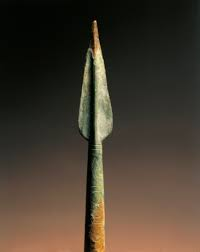
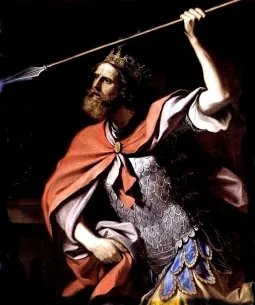
Saul’s spear shows up later in David’s life, and it becomes a vital component in his growth as Israel’s next king.

But David doesn’t know that yet. In 1 Samuel 26 we read about David’s second encounter with the spear of Saul.

The scene is in the wilderness and David’s on the run. Now the badlands are a good place to hide as any Western movie knows. I think David had his scouts and I suppose that there were also men who knew every rock and cave in that wasteland. They were hiding from Saul.

“So David and Abishai entered the encampment by night, and there he was—Saul, stretched out asleep at the center of the camp, his spear stuck in the ground near his head, with Abner and the troops sound asleep on all sides.”

1 Samuel 26:7

Sneaking into Saul’s camp was bold and audacious. Saul was sleeping and scripture says that David’s companion desperately wanted to kill Saul, but David refused, David, looking through the darkness lighted on Saul’s spear. Perhaps he remembered back to when Saul tried very hard to kill him.

He avoided that spear a long time ago, and now he escapes it again.

The tables have completely turned. Given a chance to end King Saul’s life, he refused; he would not kill him. When you think about it, many problems would’ve been solved, and David would take his rightful place as Israel’s new king.

But David spiritually understood God’s heart. He understood the spiritual principle of “turning the other cheek” and “loving your enemies.” He overcame with love and kindness. And lots of grace.

“Do not be overcome by evil, but overcome evil with good.”

Romans 12:21, ESV

The Greek word for “overcome” is νικάω which can be translated as “to conquer or to come forth victorious.” It is also used when someone is arraigned before a court of law but wins the case.

To follow Jesus means you entirely reject using the spear. It’s not for you. Never.

“We win by tenderness. We conquer by forgiveness.”

Frederick W. Robertson

We must leave the spear in the wall. You must not throw it back.

Like David, we are to trust the Father. We’re to be secure in His timing. And yes, we each must use kindness and brokenness to overcome dark things. When you think about it, Jesus also faced evil without defending Himself. The spear showed up again and we see that our Savior allowed it to pierce His side on the cross.

You must leave the spear in the wall.

You mustn’t use the spear when it seems you can wield it at the perfect moment, and like Jesus you need to allow it to save your enemies from their sin.

These three spears are evidence you “have God’s heart.”

Only Two Pennies

Mark 12:41-44

41-44 Sitting across from the offering box, he was observing how the crowd tossed money in for the collection. Many of the rich were making large contributions. One poor widow came up and put in two small coins—a measly two cents. Jesus called his disciples over and said, “The truth is that this poor widow gave more to the collection than all the others put together.”

All the others gave what they’ll never miss; she gave extravagantly what she couldn’t afford—she gave her all.”

It wasn’t much but it’s all I had. Some might laugh–but truthfully, I really wasn’t giving just my money, I was giving my heart. That’s really all I had, simply my heart.

When my husband died, I was left with very little. What I did have I hid in a hole in the wall, but I was concerned, money was going out and nothing was coming in. Often I sat on my stool and stared at that hole, and I was frightened. There is nothing to live on. What was I going to do?

You must understand. No one was going to help me.

I got up one morning to pull out the leather sack, all that was there were two pennies. That’s it. Two very small pennies, and that’s all I had to live on! I knew that this day would come, but it seemed to come so soon. I was afraid of what was going to happen to me, a widow that had nothing.

There were six stone receptacles placed in strategic spots, where people could tithe as the Law required of every Jew. Occasionally there was a procession: trumpets blowing and bright banners waving. Another rich man announced to everyone that he was coming to contribute to the Temple.

Jesus was watching closely to all of this.

Suddenly an old woman came to give, and there were no trumpets, no fanfare. She simply came to give what she had–two very small copper pennies. Just two pennies. Most would laugh I suppose. After all, the rich were dropping in thousands of silver.

Jesus turned to His disciples. They sat and listened carefully to what He had to say:

“Truly, I say to you, this poor widow has put in more than all those who are contributing to the offering box.”

They gasped as they struggled to understand the Teacher. It seemed idiotic, but Jesus often said many outrageous things. You could see their minds working to grip this. It made absolutely no sense to their carnal minds.

“They all contributed out of their abundance, but she out of her poverty has put in everything she had, all she had to live on.”

The twelve were dumbfounded.

When I gave, I gave my heart. I had nothing, but you have to understand, a strange peace came over me. I rejoiced to give to God and His work. Yes, I now had nothing–nothing but the grace and care of God. Maybe I was a fool. Maybe I was stark raving mad. But I knew what I wanted to do. When I threw in my two pennies, I threw myself into the heart and care of God.

What was going to happen next? I really don’t know, but we will find out, won’t we?

“Don’t be afraid, you tiny flock! Your Father plans to give you the kingdom. Sell your possessions and give the money away. Get yourselves purses that never grow old, inexhaustible treasure in Heaven, where no thief can ever reach it, or moth ruin it. For wherever your treasure is, you may be certain that your heart will be there too!”

Luke 12:33, Phillips

Art: Coin Week; verses used are from The Message, a translation of Eugene Peterson

We Were Born to Serve

We Were Born to Serve Others

“When a servant comes in from plowing or taking care of sheep, does his master say, ‘Come in and eat with me’? No, he says, ‘Prepare my meal, put on your apron, and serve me while I eat. Then you can eat later.’” 

And does the master thank the servant for doing what he was told to do? Of course not. 10 In the same way, when you obey me you should say, ‘We are unworthy servants who have simply done our duty.’”

Luke 17:7-10

After years of ministry— this particular passage has slowly become one of my favorites. The path I’ve walked has been challenging, and it seems to me that I haven’t done it very well at all. I’ve been a fool much of the time, and yet, if anything, God has held me firmly in place. I haven’t always been faithful. But He has.

I used to kill rattlesnakes when I lived in Mexico. (You might say it was my hobby.) But it demanded a certain cautiousness, and lesson #1 was this–you never, ever take your eyes off of the snake–no matter what. We must approach ourselves that carefully. Our hearts are desperately wicked. We must understand this.

“I am more afraid of my own heart than of the pope and all his cardinals. I have within me the great pope, self.

    Martin Luther

Please let me explain what I’m thinking.

The Lord Jesus tells us one of those stories of his. This parable is one of his best. It makes a lot of sense, and it resonates within me. It tells me that I must watch myself, lest I forget the idea behind this passage. I’m His slave and not deserving some kind of special treatment.

Jesus’ parable explains our duty as His servant.

It seems that after a hard day’s work, a slave still needed to prepare his master’s dinner. No matter how much he toiled out in the fields, he had a duty to serve his master in this way; and it does seem unfair–we live in a land “where all men are created equal.”

But this is how the God’s Kingdom works.

We get dirty, we toil hard, and we sweat under the hot sun. We dream of a glass of cold lemonade (with ice), and a cool shower when we quit the fields. But that isn’t the way it works. Yes, Jesus gives his laborers rest–but the work continues.

The work goes on, even when God buries his workers. Hopefully, the next generation will continue my almost humble efforts, and his work in his fields will continue. But, in the meantime I must “watch” myself carefully, and do his will out in his fields.

Just as a servant knows that he must first obey his master in all things, so the surrender to an implicit and unquestionable obedience must become the essential characteristic of our lives.

Andrew Murray

Yes, it’s a foreign concept, and we can’t really relate–we either skip its message, or apply it to others. Jesus uses it quite adroitly, the servant works for his master; completely, exclusively. A slave who has no rights of his own. We serve and obey our Master.

Any desire for promotion, pleasure, riches, or fame will quickly make one a servant of the Beast. And, I’m afraid, that is exactly what many of today’s pastors and preachers have become.

    Chuck Baldwin