

“After he had spent everything, a severe famine struck that country, and he had nothing.”
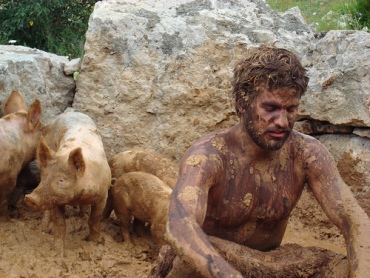
“So he got a job with one of the citizens there who sent the son into the fields to feed pigs. 16 The son was so hungry that he wanted to eat the pods the pigs were eating, but no one gave him anything.”
“The Prodigal Son,” Luke 15:14-16
God has a definite way of arranging things to get our undivided attention. The prodigal had blown through his inheritance money and now had nothing. And then there was this famine–a really bad one. (The word can be translated, as “violent.”) I think the Father was working.
Flat broke and having a need to eat, he started looking through the want ads for work. All he found was an ad for a “pig feeder.” That was it, there was nothing else to be had. So now began his new career in porcine agriculture! He was desperate and he was hungry.
A Jewish boy feeding pigs. Oh boy, how the mighty have fallen!
Verse 18 in this passage takes it a step further. As he poured out the slop the things he was feeding the pigs looked mighty tasty. His mouth began to water. He thought seriously about reaching into the trough and grabbing some of the good pods for himself. (Several days without food does funny things to a man.)
God does some interesting things to bring this prodigal home. Not all of them are pleasant and self-affirming. His circumstances got pretty brutal. He still allows hard circumstances to bring back the stupid. It’s very likely his soul was so valuable that this kind of intervention was necessary.
“When he realized what he was doing, he thought, ‘All of my father’s servants have plenty of food. But I am here, almost dying of hunger.”
(v. 17)
What happened at that precise moment of real repentance can be seen in the following translations of verse 17:
- “he came to himself,”(King James Version and ESV)
- “he came to his senses,” (Christian Standard Bible)
- “he realized what he was doing,” (New Century Version)
- “he turned again to himself,” (Wycliffe Translation)
That I suppose is the power of the trough. It’s a hard place to live.
The prodigal son is jolted by a very real revelation of home. And even though he grossly underestimates the love of the father, he leaves the pigs and returns. No longer does he have any desire to eat pig food.
Often the side effects of our own stubborn rebellion debase and shame us. It reduces a man or woman to a place of ruin and failure. We feel worthless and very much defeated. We know we’re a dirty rotten mess and we believe Satan’s infamous lies about our ‘impossible-to-forgive” sin.
The spiritual danger in self-degrading thoughts and feelings is that we will start to believe things such as, “God’s Holy Spirit can’t help someone like me” or “I’m helplessly addicted to sin” or even “I’m damned without any hope.”
These are some of the vicious lies Satan tells people to keep them in their sin and rebellion. (It has worked well for him over many millennia.) The enemy tells us that we’ll always live with the pigs, and eventually, over time, we will come to enjoy eating the pig slop. Sadly many accept that lie as the truth.
It is not.
God’s Holy Spirit is transformative and powerful; therefore, if we continue to think we are failures and worthless after receiving Spirit, what are we really saying? Do we doubt His power, or question His love? I hope not.
It’s time to come home.
“Because you have been down there Neo, you know that road, you know exactly where it ends. And I know that’s not where you want to be.”
(“The Matrix”)



 Alaska Bible Teacher