
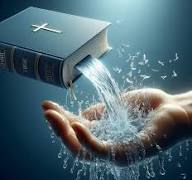
“The sacred moments, the moments of miracle, are often the everyday moments, the moments which, if we do not look with more than our eyes or listen with more than our ears reveal only…a gardener, a stranger coming down the road behind us, a meal like any other meal. But if we look with our hearts, if we listen with all our being and imagination.. what we may see is Jesus himself.”
Frederick Buechner
Having a “Sanctified Imagination”
I need to be very clear. We’re not trying to shape reality or mold anything. We’re not supposed to be involved in creating an alternate world. We’re talking about using your imagination, and not creating the imaginative.
The New Testament is over 70% narrative. The dictionary definition is “a spoken or written account of connected events; a story.” That means that we’ll need to approach it, sometimes anyway, picturing it in the minds that God has given us. I suppose that this requires that we see and understand it, differently.
I like to call this—a ‘sanctified imagination.’
The parables of Jesus are heavenly stories that declare the truths of God’s Kingdom. When we read about the parable of the Prodigal Son, we must imagine the son partying away from his father’s money. We must see the husks, and fill our noses with the stench of the pig poop. We need to see the prodigal coming to his senses, and returning to the father who runs out to meet him.
Jesus’ parables are designed purposefully for you.
This is what I mean when I say we use our sanctified imagination. We engage these parables with our hearts and mind. God has given us this ability, it’s part of the way we communicate with him. I become that prodigal, it’s I who returns to the Father. I see it and understand it better that way. But it’s imagination–it’s never supposed to be imaginary.
Our imaginations can be used for evil as well. A man pictures a new type of machine gun and then makes and designs it. Another presses into pornography and engages his mind in lust over a picture. There are many dark ways we use to alter our worlds. We can use the images in our minds to commit sin.
God’s truths seem to go deeper if we press into using our minds to engage what the Father desires.
“With our imagination and reason, with our five bodily senses, and especially with our emotions, we become secondhand witnesses of the events of Scripture.” The idea is to place yourself in the biblical story, becoming a person in the crowd, a disciple following Jesus along dusty roads or the boy with the loaves and fish. Imagine the sights, sounds, smells, feels, and tastes of the biblical world. You step into the story and let it enter your mind—not just as a series of facts, but as a story with real, living people.”
© Phil Collins, Ph.D., 2014. This material was created in partnership with the Taylor University Center for Scripture Engagement.
The accounts of Jesus’ miracles are also meant for our imaginations. We see Jesus healing a leper, and we imagine him touching us as well. We encounter our own uncleanness before the Holy One. We must really understand that spiritual truth can never be generated without the Holy Spirit’s guidance.
Sometimes I pray the old words of those who have gone before me: “Lord Jesus, Son of God, have mercy on me.” Often this (or a close variation of this) was the cry of the desperately needy in the Gospel accounts. When I pray this I imagine I’m blind Bartimaeus sitting by the side of the road, or the woman with a sick child. I see myself standing and waiting for His touch. This is the power of sanctified imagination.
“When the Spirit of truth comes, he will guide you into all the truth, for he will not speak on his own authority, but whatever he hears he will speak, and he will declare to you the things that are to come. 14 He will glorify me, for he will take what is mine and declare it to you.”
John 16:13-14
Some additional reading:
A good (and simple) can be found at Crossway.com. I would also suggest Focus on the Family and Christianity Today. Both are really clear and explain it much better than I can. Also, check out biblegateway.com for more info






 Alaska Bible Teacher