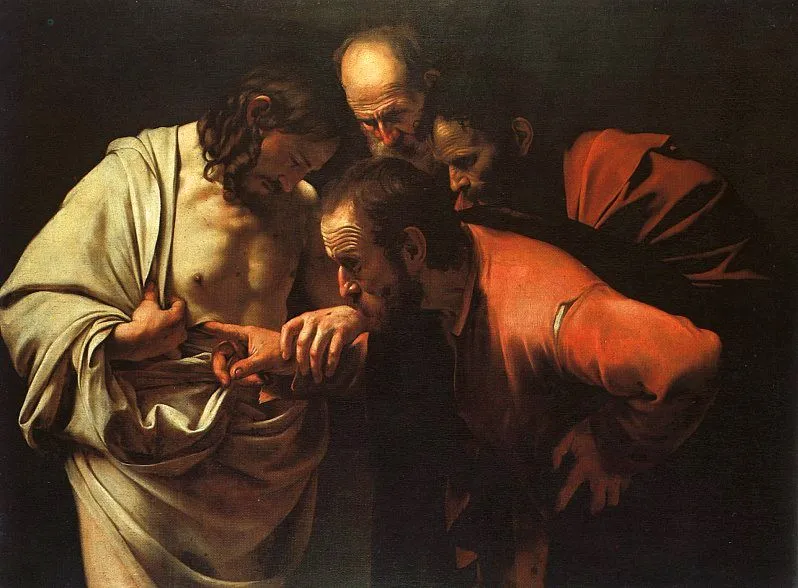
Doubting Thomas Speaks Up

John 20:25-29

But Thomas, sometimes called the Twin, one of the Twelve, was not with them when Jesus came. The other disciples told him, “We saw the Master.”

But he said, “Unless I see the nail holes in his hands, put my finger in the nail holes, and stick my hand in his side, I won’t believe it.”

Eight days later, his disciples were again in the room. This time Thomas was with them. Jesus came through the locked doors, stood among them, and said, “Peace to you.”

Then he focused his attention on Thomas. “Take your finger and examine my hands. Take your hand and stick it in my side. Don’t be unbelieving. Believe.”

Thomas said, “My Master! My God!”

Jesus said, “So, you believe because you’ve seen with your own eyes. Even better blessings are in store for those who believe without seeing.”

The others had told me that they had seen Jesus. But this couldn’t be. Either they imagined it or they saw His ghost. I saw him brutalized, crucified, and buried, and I knew He was really dead. I was never into pretending, or wish fulfillment. No, not me. When you’re dead, you’re dead. (At least that’s what I thought.)

I told the others that I would only believe them if I could see and feel the scars–the nail holes and the hole in his side. I needed proof, something tangible or solid before I could believe their stories. Part of me hoped it was so, but I honestly couldn’t join the others in their excitement.

Some would call me a doubter–a skeptic. But that isn’t quite true.

A realist is how I would describe myself. To go along with the others wasn’t going to cut it. They said that they had seen Him and He was very much alive, that somehow, someway He was now resurrected. But for me, I couldn’t believe it. I myself must know it for myself.

Was Jesus alive after all they had done to Him?

We had all gathered in a large room. We had locked the door–we were afraid that the authorities would come for us next. In spite of the confinement, we had some good fellowship that Sunday morning, catching up and sharing stories of the last three years, thinking about all the things Jesus had taught and done.

And then, suddenly, Jesus showed up! Trust me on this if you can–the door was locked, and there was no other way to get in. When Jesus “dropped in” we were completely amazed. He was very much alive–and how can this be? We were all in shock as He stood right in front of us!

Immediately Jesus looked at me, and I looked back–it was really Him!!

Jesus immediately focused on me, He asked me to come close; He wanted me to touch Him, to inspect and see for myself that He was as real as you or I. He asked me to come and see the nail prints in His hands, and stick my hand in the hole where the Roman soldiers had thrust a spear into His side.

And I was completely undone.

It was really Him, and I couldn’t explain it away. Jesus was real flesh and blood! In a second I went from doubt to faith. How He knew that I had voiced my hesitation out loud I didn’t know. But I now knew for certain Jesus was very much alive. Death was now dead.

“My Master! My God!” (That was all I could say.)

At that moment I became a “believing believer.” It wasn’t second-hand anymore; I wept and laughed at the same time! I couldn’t explain it, I must believe it. Jesus had overcome death and He was now commanding me to believe.

Immediately I knew, I saw Him for myself.

Looking back I admit my foolishness and doubt; Jesus had sought me out, and somehow He knew that of all His disciples, I needed that special touch. He understood and came me just for me. To this day I realized how much He really loved me–the doubting Thomas.

According to Christian tradition, Thomas, was killed by jealous Hindu priests of Kali India. He was burned to death in 72 AD. A church is now established there and still recognizes him as an apostle.

Bryan’s note: I can relate to Thomas. I was also one who needed to know for myself that Jesus was really God and that He really did rise from the dead. It was reading “More Than a Carpenter” by Josh McDowell that propelled me into belief. If you need to know for yourself, I suggest you buy this book. (If you can’t afford it, I’ll buy it for you.)

Art: Caravaggio’s The Incredulity of Saint Thomas, c. 1601-1502, oil on canvas–Verses are from The Message, a translation by Eugene Peterson.


Tether Me to His Cross

We live in this place.

St. Francis of  Assisi once wrote, “The devil never rejoices more than when he robs a servant of God of the peace of God.” 

Sometimes I think I’ve made the devil dance far too many times.

I confess that peace has never been really high on my list. Love, joy, kindness, and even goodness are clear priorities. Peace… not so much. Until it’s not there. And then I get frantic by its absence and look for it with manic bewilderment.

Sometimes I don’t understand why God still loves me. Anxiety eats at me. I beat myself up by my last failure. The guilt of my latest sin grows until it looms larger than the blood that saved me. Sometimes religious people have the most neurosis.

I’m afraid that we are taking “the present tense’ out of the Gospel. The past tense is far preferable to us as we manage the Christian life. We like to make check marks on our list. Repentance– check. Baptism– check. Bible study– check. I think it gives me a definite feeling of ‘maturity.’

These matter little without intimacy with Jesus.

I certainly haven’t arrived, and it seems I’m still the hideous sinner I always was. I cannot pretend otherwise, even with a truckload of cosmetics at my disposal. I know, I’ve tried. And I’m still ‘ugly.’ I do know forgiveness, and I do walk in its wonderful light (by grace.)

I read Luther 30 years ago. (And Bonhoeffer would say something similar.)

“When our Lord and Master Jesus Christ said, ‘Repent,’ he willed the entire life of believers to be one of repentance.”

Martin Luther

This is the first of his 95 Theses nailed to the door of Wittenburg. There is a present tense here we can’t ignore. I don’t just repent over smoking, beer drinking, fornication, or hypocrisy, once and done. But my entire way of living is to be one of repenting.

Repentance is the key to opening the door of grace.

“All of the Christian life is repentance. Turning from sin and trusting in the good news that Jesus saves sinners aren’t merely a one-time inaugural experience but the daily substance of Christianity. The gospel is for every day and every moment. Repentance is to be the Christian’s continual posture.”

John Piper

Luther’s last words, on his deathbed, written on a scrap of paper words, “We are beggars! This is true.” Thirty years before, he was only echoing his first thesis. It seems dear ones, we are to live at the foot of the cross. Everyday. Because we desperately need to.


“Be quiet!” many of the people yelled at him. But he only shouted louder, “Son of David, have mercy on me!”

Mark 10:48

The Authority of the Lord Jesus Christ

“My teaching is not mine, but his who sent me. 17 If anyone’s will is to do God’s will, he will know whether the teaching is from God or whether I am speaking on my own authority.”

John 7:16 (context, Vv. 14-24)

Spiritually, Jesus is superior to everything and everyone. All that he did in the Gospels revealed that salient fact–whether he was healing the sick, walking on water, or teaching the Sermon on the Mount, he had total command. An authority soaked all that he did, just like water saturates a sponge. (See Matthew 28:18.)

The Greek word most often translated as “authority” (exousia) in the New Testament basically means: “right, permission, freedom.” Jesus was completely free to do whatever he knew was the Father’s will–he had full and total authorization to do whatever he wanted. (That seems to be what his baptism was all about. See Luke 3:21-22.)

Kittel’s Theological Dictionary of the New Testament

The Greek word “teach” (didaskō) in the NT means “give instruction, impart doctrine, to explain.” Jesus’ teaching was a marvel, he explained God’s kingdom to us crisply, succinctly, and precisely. All we need to understand was freely given to us in red letters. Everything necessary to us was taught with confidence and freedom. (See Matthew 7:29.)

Since Jesus perfectly combined the two words, both teaching, and authority, He could dictate to us everything we need, everything we must have, in straightforward terms. This can’t be stressed enough, the scripture we read–when ignited with the Holy Spirit, seems to be the only thing that can change the human heart.

The preceding verses in this passage reveal the setting for this statement.

  • Jesus stays out of Jerusalem because of the murderous hatred of the Pharisees.
  • There was a deep concern in his family who doubted Jesus’ timing and direction.
  • The origin of his teaching was questioned. He was speaking with the authority of the Messiah. Jesus completely understood the trustworthy source of his teaching.
  • There was a general consensus among the people of Jesus’ authority. Many were finally arriving at a decision in favor of him. Many would reject him.

We have never seen anyone of his impressive caliber, and we can only imagine the impact he was having on everyone he met. Under the Spirit’s direction, his disciples would retain all that Jesus did and taught. (The author of this passage was the Apostle John, and when you read his letters to us, we see that his memories were quite vivid.)

The Lord’s authority soaked all that he did, just like water saturates a sponge.

So what do we do now? What kind of “lordship” does he have over us? First of all, we learn (slowly) that we MUST teach ourselves to submit to our lord, constantly. He carries the authority we need, the authority human beings require. The Holy Spirit knows exactly how to pierce our pride and independence. Our teacher, comforter (and coach) understands us perfectly.

“His authority on earth allows us to dare to go to all the nations. His authority in heaven gives us our only hope of success. And His presence with us leaves us no other choice.”

-John Stott

Opting Out of Cynicism

Cynical

sinikəl/adjective

1.  believing that people are motivated by self-interest; distrustful of human sincerity or integrity. Contemptuous; mocking; derisive; sarcastic.

Dictionary.com

I want to speak from my heart. I woke up this morning intensely cynical about the world. I hate to think I’m becoming critical or judgmental, but whatever it is I must take it in prayer to Jesus. I feel like I’ve been bit by a snake– a venomous one at that.

When I think of our Lord’s example, it helps a great deal. He knows every man’s heart and motives and that didn’t discourage him. He knew when he came what each of us had done, and was capable of doing.

There was this incident at the Temple:

23 Because of the miraculous signs Jesus did in Jerusalem at the Passover celebration, many began to trust in him. 24 But Jesus didn’t trust them, because he knew all about people. 25 No one needed to tell him about human nature, for he knew what was in each person’s heart.

John 2:23-25, NIV

People can’t be trusted. Our motives and our desires, although hidden from men, are clear to God. And yet He loves us deeply. And love, “keeps no record of wrongs” (1 Cor. 13:5.) In his humanity, Jesus was tempted in every way. Discouragement and despair over the sin of men were resisted.

We can become cynical and jaded over the repeated wrongs we see or hear– it’s easy to do. There can become a ‘coarsening’ and hardness of our hearts. That is dangerous. It requires a touch from Jesus. It means it’s time we get on our knees.

When Jesus sent out his disciples he encouraged them, ““Behold, I send you out as sheep in the midst of wolves. Therefore be wise as serpents and harmless as doves.” (Matt. 10:16.) He knew the hostile human heart had its own agendas– people would be like wolves. But though they would see first-hand the deceitfulness of many, they were to be wise and be completely harmless.

The Holy Spirit will keep us close as we seek his victory in this matter. We will be transformed into the likeness of Christ. Exchange your attitude with His. He will strengthen you. We can renounce the spirit of judgmentalism that is so pervasive. We will love the way he loves.

I know there is much more to say about this. But now the Spirit is prompting me to pray through this issue myself.

Cynicism and skepticism are the crudest form of quasi-intellectualism… Let the cynic become cynical of his cynicism and the skeptic skeptical of his skepticism and join the battle.

     R.C. Sproul