White Trash

Acts 4:13

“God created the world out of nothing, and so long as we are nothing, He can make something out of us.”  

—Martin Luther

Consider this: the jawbone of a donkey, a sling shot. and barley loaves, a woman’s tears, a young boy’s lunch, a young colt, and a talking donkey, they all suggest that God touches the common and the insignificant. He uses what we consider of minor importance.

We often turn to the talented and gifted far too readily.

Peter and John are being seen by the Sanhedrin (the Jewish “Supreme Court”). They are to give account of themselves before the highest court of the land. There had been a healing, and there was the matter of preaching as well. Both Peter and John exude a confidence that these religious leaders couldn’t deny. Their perception was that they were ignorant men. Uneducated and common. But. They also knew they had been with Jesus.

In the minds of the leadership, they were nothing more than religious white trash.

God loves to use what we consider common. His revealed history has been to take anything at His disposal and utilize it to redeem lost souls. A staff or a sling-shot are used with an adroitness that seems extraordinary among men. The things we think are simple and common are used to further God’s work among mankind.

But the message always returns back to the preachers. The Sanhedrin knew of the disciples preaching. They had absorbed the fact of a miracle; a crippled man had just been healed. (This they couldn’t deny.) But they were troubled. And they didn’t really know what to do.

What more could this be, but a direct intervention of God? And yet, God is working through “common people.” Then look…

“…if we are being examined today concerning a good deed done to a crippled man, by what means this man has been healed,”

Acts 4:9

Within this preaching was woven this healing. The Holy Spirit was ‘rocking their  world.’ The people who came in contact with these disciples would never be the same. Paul tells the Corinthian church that:

“Instead, God chose things the world considers foolish in order to shame those who think they are wise. And he chose things that are powerless to shame those who are powerful.”

1 Corinthians 1:27, NLT

If God has a specialty it would be this. He desires all the glory. He goes out of the way to use the broken and weak. He shows His strength through insignificant and minor things and people.

Please dear heart, think through the following:

Acts 4:13

“God created the world out of nothing, and so long as we are nothing, He can make something out of us.”  

“Now when they saw the boldness of Peter and John, and perceived that they were uneducated, common men, they were astonished. And they recognized that they had been with Jesus.”

Acts 4:13

“God created the world out of nothing, and so long as we are nothing, He can make something out of us.”  

—Martin Luther

Consider this: the jawbone of a donkey, a sling shot. and barley loaves, a woman’s tears, a young boy’s lunch, a young colt, and a talking donkey, they all suggest that God touches the common and the insignificant. He uses what we consider of minor importance. We often turn to the talented and gifted far too readily.

Peter and John are being seen by the Sanhedrin (the Jewish “Supreme Court”). They are to give account of themselves before the highest court of the land. There had been a healing, and there was the matter of preaching as well. Both Peter and John exude a confidence that these religious leaders couldn’t deny. Their perception was that they were ignorant men. Uneducated and common. But. They also knew they had been with Jesus.

In the minds of the leadership, they were nothing more than religious white trash.

God loves to use what we consider common. His revealed history has been to take anything at His disposal and utilize it to redeem lost souls. A staff or a sling-shot are used with an adroitness that seems extraordinary among men. The things we think are simple and common are used to further God’s work among mankind.

But the message always returns back to the preachers. The Sanhedrin knew of the disciples preaching. They had absorbed the fact of a miracle; a crippled man had just been healed. (This they couldn’t deny.) But they were troubled. And they didn’t really know what to do.

What more could this be, but a direct intervention of God? And yet, God is working through “common people.” Then look…

“…if we are being examined today concerning a good deed done to a crippled man, by what means this man has been healed,”

Acts 4:9

Within this preaching was woven this healing. The Holy Spirit was ‘rocking their  world.’ The people who came in contact with these disciples would never be the same. Paul tells the Corinthian church that:

“Instead, God chose things the world considers foolish in order to shame those who think they are wise. And he chose things that are powerless to shame those who are powerful.”

1 Corinthians 1:27, NLT

If God has a specialty it would be this. He desires all the glory. He goes out of the way to use the broken and weak. He shows His strength through insignificant and minor things and people.

“We are all wounded. But wounds are necessary for his healing light to enter into our beings. Without wounds and failure and frustrations and defeats, there will be no opening for his brilliance to trickle in and invade our lives.”
“Failures in life are courses with very high tuition fees, so I don’t cut classes and miss my lessons: on humility, on patience, on hope, on asking others for help, on listening to God, on trying again and again and again.”

Bo Sanchez

Consider this: the jawbone of a donkey, a sling shot. and barley loaves, a woman’s tears, a young boy’s lunch, a young colt, and a talking donkey, they all suggest that God touches the common and the insignificant. He uses what we consider of minor importance. We often turn to the talented and gifted far too readily.

Peter and John are being seen by the Sanhedrin (the Jewish “Supreme Court”). They are to give account of themselves before the highest court of the land. There had been a healing, and there was the matter of preaching as well. Both Peter and John exude a confidence that these religious leaders couldn’t deny. Their perception was that they were ignorant men. Uneducated and common. But. They also knew they had been with Jesus.

In the minds of the leadership, they were nothing more than religious white trash.

God loves to use what we consider common. His revealed history has been to take anything at His disposal and utilize it to redeem lost souls. A staff or a sling-shot are used with an adroitness that seems extraordinary among men. The things we think are simple and common are used to further God’s work among mankind.

But the message always returns back to the preachers. The Sanhedrin knew of the disciples preaching. They had absorbed the fact of a miracle; a crippled man had just been healed. (This they couldn’t deny.) But they were troubled. And they didn’t really know what to do.

What more could this be, but a direct intervention of God? And yet, God is working through “common people.” Then look…

“…if we are being examined today concerning a good deed done to a crippled man, by what means this man has been healed,”

Acts 4:9

Within this preaching was woven this healing. The Holy Spirit was ‘rocking their  world.’ The people who came in contact with these disciples would never be the same. Paul tells the Corinthian church that:

“Instead, God chose things the world considers foolish in order to shame those who think they are wise. And he chose things that are powerless to shame those who are powerful.”

1 Corinthians 1:27, NLT

If God has a specialty it would be this. He desires all the glory. He goes out of the way to use the broken and weak. He shows His strength through insignificant and minor things and people.

Bo Sanchez

The Pharisee & the Tax Collector

Luke 18:10-14

 “Two men went to the Temple to pray. One was a proud, self-righteous Pharisee, and the other a cheating tax collector. 11 The proud Pharisee ‘prayed’ this prayer: ‘Thank God, I am not a sinner like everyone else, especially like that tax collector over there! For I never cheat, I don’t commit adultery, 12 I go without food twice a week, and I give to God a tenth of everything I earn.’

13 “But the corrupt tax collector stood at a distance and dared not even lift his eyes to heaven as he prayed, but beat upon his chest in sorrow, exclaiming, ‘God, be merciful to me, a sinner.’ 14 I tell you, this sinner, not the Pharisee, returned home forgiven! For the proud shall be humbled, but the humble shall be honored.”

Meet the Pharisee:

I had it all together. I had shaped myself to be the ultimate Pharisee–the Pharisees of the Pharisees. I understood the Law; I could quote whole books, forward and backward. I fasted twice a week, and tithed everything, right down to my herbs and spices. I had it all together.

And I made sure everyone saw my commitment.

I strenuously kept God’s Law. I was consumed by understanding it, I tried to grasp all its nuances and complexity. The 10 commandments were emblazoned on all that I did. I wanted everyone to know that I was one of “the pure ones,” for that was the meaning behind the word Pharisee. I knew that I was pure.

I went to the Temple every day to pray, I stood holy and set apart, standing before a real and holy God. I was always the truest example to the people of Israel. I always stood when I prayed, for I was completely committed to doing all that the Law demanded of me.

One day I saw a wicked man in God’s holy temple. I had to thank God that we were total opposites. He was a tax collector and an evil person. I really was nothing like him. I rejoiced that I had become a true example of a righteous man.

I knew I was righteous, and certainly not at all like that sinful tax collector.

———————-

Meet the Tax Collector:

I didn’t have it all together. I understood this and was horrified that I had become so evil. I came to the Temple, driven by my guilt and shame–no one had to tell me this, for I knew my sin and I was deeply ashamed.

Why I came, I don’t know. I honestly didn’t belong here, and I kept a distance from the front. I guess that’s where I belonged. On the fringes before the Holy One. It seemed now that I was drawn to this place, and I’m still not sure why I came that day.

I knew that I breathed evil and had become evil.

I fell to my knees, and I begged God to forgive me. I saw the Pharisee standing in the presence of God, but I knew I wasn’t at all like him. He was righteous and I knew I was not. Oh, how I wanted God to forgive me for all the sins I had committed.

I must tell you that my spirit was in agony.

“Humble men are very fortunate!” he told them, “for the Kingdom of Heaven is given to them. Those who mourn are fortunate! for they shall be comforted. The meek and lowly are fortunate! for the whole wide world belongs to them.

Matthew 5:3-5, LB

Jesus clearly told us who was truly forgiven that day. When we think we have it all together, we’re deceiving ourselves.

Let’s not pretend otherwise, okay.

alaskabibleteacher.com

Art: Eugene Burnand, 1850-1924, litho; Scripture used here is from the Living Bible.

When Rags Became Grace

Jeremiah 38:8-13

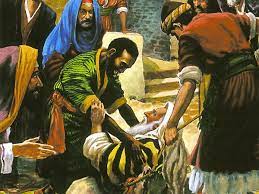
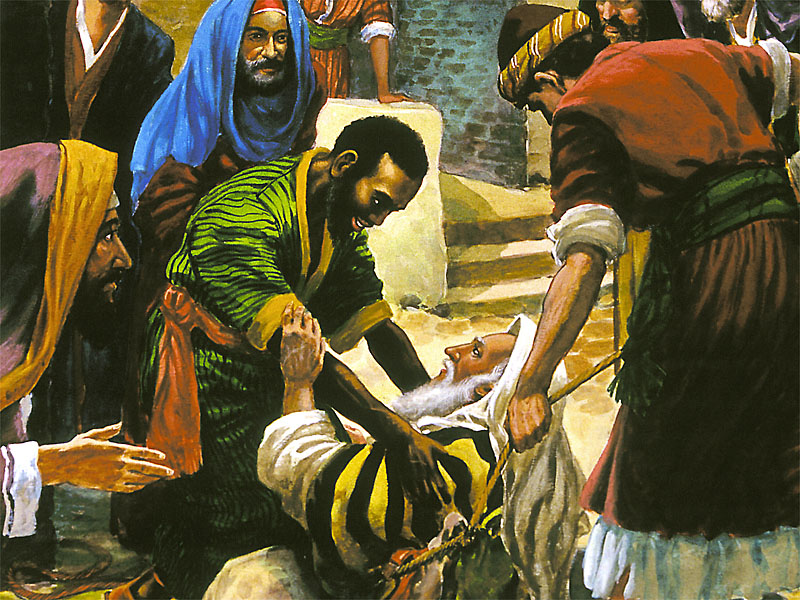
At the very last, there was just one faithful person remaining.  A single man, Ebedmelech.  He was an Ethiopian; castrated by the will of the king.  The situation in Jerusalem has gotten very difficult.  In an action of revenge and reprisal, certain men intend to kill the prophet Jeremiah.  They take a certain satisfaction in this, and Jeremiah is thrown into a very deep cistern.  They intend for him to starve to death, which is a terrible way to die.

The king in these last pathetic days is being manipulated by the surviving leadership of the city.  Zedekiah gives tacit approval for the destruction of Jeremiah.  He just lets it happen without a good reason.  The prophet is lowered in the muddy cistern.  Without food, he will soon starve.  In the minds of this evil mob, they have taken care of the last vestiges of a godly ‘righteousness.’

But there is one, he is a wild card.  And no man would have guessed it.  Ebedmelech, the Ethiopian eunuch steps forward and decides to change history.  Not only his ethnicity, but his state as a castrated man are definite issues.  This mob never recognized him as someone who would intervene.  He was a non-entity, a non-factor. He was black, and a eunuch, and a nobody.

But Ebedmelech is intervening, in the face of terrible risk, he steps out boldly to make an intercession.  He doesn’t appear to be intimidated, and makes a cry for the truth.  He becomes an intense and strong advocate for the release of Jeremiah from the deep mud.

Ebedmelech is given the ‘green-light’ by king Zedekiah. Ebedmelech rounds up thirty men to assist him as he delivers the prophet.  Ropes are brought out, and out comes Ebedmelech with a big armload of rags.  They shout down to Jeremiah.  The instructions are called down to him of what needs to take place for the extraction.

It’s interesting, but the rags are the most fascinating.

They are really an extra touch, not a necessity.  The rags become essentially, a form of grace.  They would pad the ropes, providing a degree of comfort as the prophet is pulled up out of the mud.  Ebedmelech showed the heart of God in what he did.  There was his desire to somehow make the prophet comfortable.  In doing so he communicated a kindness and concern that was saturated with God’s own enveloping presence.

Our weaknesses have moved us to a lonely place on the edge. 

We are those on the so-called ‘margins.’ Ebedmelech has now become a carrier of God’s grace.  Jeremiah could have been lifted up by just the ropes.  It would’ve been more difficult, granted.  But the rags sent down by Ebedmelech provided the prophet an extra gentleness.  And I am certain it did not pass by without notice.  Their mention in this Book of Jeremiah is significant, and shows Jeremiah’s deep appreciation of kindness.

We can gather up much from what has been written.  We will sometimes find ourselves in parallel situations.  But our kindness and concern can make the difference.  Admittedly, they are quite insignificant–quite minor. Call it ‘icing on the cake.’ But when you show the kindness of our Father, you will infuse the situation with love, and grace.  

So be an  Ebedmelech, an outcast perhaps– but now in a position of kindness. Maybe you can use your “rags” to help another.

Intercession Matters

“For this reason I bow my knees before the Father, 15 from whom every family in heaven and on earth is named, 16 that according to the riches of his glory he may grant you to be strengthened with power through his Spirit in your inner being, 17 so that Christ may dwell in your hearts through faith—that you, being rooted and grounded in love, 18 may have strength to comprehend with all the saints what is the breadth and length and height and depth,.”

Prayer does what preaching can’t. Some need a reminder. This idea of being “rooted and grounded in love” is crucial to growing up Christians. And it most often happens when the preacher is driven to his knees by a sticky situation.

Teaching has certain limitations, but prayer drives discipleship home.

You must settle on this spiritual fact, only a disciple can make a disciple. Too many preachers are developing believers who don’t understand a prayer life. They end up using the pulpit (and the worship) as their sole ‘means of support.’ I can guess you can see how tragic this becomes.

A prayer meeting is almost unheard of lately. The focus has shifted I suppose, but I still believe that there are still small groups of Christians who believe that both doctrine and prayer are God’s way of growing us up into His image.

Strengthened with power through his Spirit in your inner being, 

Prayer is Paul’s way of building up the Ephesian church. In my personal opinion, he was locked up in a Roman prison for a couple of good reasons–the first is that he would discover he could disciple at a distance. Paul seems to understand this, and he rediscovers the way of intercession.

Prayer for Paul becomes a tool of considerable force.

Ephesians 3 papyrus from c. 275 A.D.

from wikipedia.org

The “inner being” is what he’s aiming at, and it’s Paul’s way of touching the heart of anyone the Holy Spirit is dealing with. Mr. Dry Eyes will never reach the hearts that the Father is working in. Rather it is tears, not impeccable logic or great theology that completes the work.

The walk of a true disciple is always inside first, never the outside.

So that Christ may dwell in your hearts through faith—that you, being rooted and grounded in love.

The immense power is Jesus living inside us. Faith is God’s own key that He gives. Love is our root; it helps us grow. It gives us stability which is critical living in a confused and fallen world.

“Can Jesus Christ see the agony of His soul in us? He can’t unless we are so closely identified with Him that we have His view concerning the people for whom we pray. May we learn to intercede so wholeheartedly that Jesus Christ will be completely and overwhelmingly satisfied with us as intercessors.”

    Author: Oswald Chambers


Going to War

13 Therefore take up the whole armor of God, that you may be able to withstand in the evil day and having done all, to stand firm. 14 Stand therefore, having fastened on the belt of truth and having put on the breastplate of righteousness, 15 and, as shoes for your feet, having put on the readiness given by the gospel of peace. 16 In all circumstances take up the shield of faith, with which you can extinguish all the flaming darts of the evil one; 17 and take the helmet of salvation, and the sword of the Spirit, which is the word of God,

Eph. 6:13-17, ESV

You’re called to be armor-plated. Ephesians is quite clear about this, and we DARE not live without spiritual protection, and as a matter of fact, we must wear each piece to survive spiritually. To be ‘naked’ is to invite disaster. Neglecting to dress appropriately brings cataclysmic disaster. We dare not minimize the need for armor.

Each piece listed must be worn. This is a scriptural mandate for every believer in Jesus.

“The whole armor of God” explains the equipment we need to survive spiritually. Here’s a list and a brief comment on the six:

  • The belt of truth–this pulls everything together and holds us and keeps us secure in the truth.
  • The breastplate of righteousness–our spiritual heart is protected by knowing we’re accepted by the Father. Being right with God is not a feeling nor is it a mere hopeful wish.
  • The shoes of the gospel (of peace)–the idea of standing in place (“to stand”) explain our ability to be fixed on grace. When we wear battle shoes we cannot be pushed back or lose our footing. Wearing gospel shoes brings us spiritual stability. We can stand in place, rooted and strong.
  • The shield of faith–is a vital way of protecting ourselves from the evil arrows shot by the enemy. Satan targets us when he thinks that we aren’t using faith to defend ourselves.
  • The helmet of salvation–this is the realization that our mind is protected. This vital piece brings us wholeness as we understand what Jesus has done. We know we are saved and wearing our helmet is our protection from demonic-inspired lies.
  • The sword of the Holy Spirit–the only offensive weapon we have, and it’s all we need. The Word of God will frighten the enemy and push him back. The Word slices and cuts down every obstacle and every lie.

Only those who are spiritual perceive the reality of the spiritual foe and hence engage in battle. Such warfare is not fought with arms of the flesh. Because the conflict is spiritual so must the weapons.

     Watchman Nee

I must stress that clothing yourself is vital. You dare not live spiritually naked wearing nothing. You will be totally vulnerable to the satanic wickedness that is swirling around you. I’m afraid it’s all very real and sobering and there is no escape clause until you finally arrive in heaven.

“We know [positively] that we are of God, and the whole world [around us] is under the power of the evil one.”

1 John 5:19, Amplified Bible

I’m afraid you haven’t been given an option in all of this. Our battle equipment in Ephesians 6 is not just some theological preference or concept. It’s real.

Over 40 years of following Jesus have taught me that most believers struggle because they won’t arm themselves for battle. They refuse to acknowledge the environment they’re in and don’t realize the spiritual battle they are facing. They like the sentiment behind this particular passage, (it stirs their heart) but the reality of the battle never fully sinks in.

They end up leaving their armor behind.

The good news is that we have already won because of what the Lord has done. Wearing the armor strengthens and stabilizes us. He pours out His grace, and there will be times of rest of that I am certain. “He leads me beside still waters.”

As obedient and faithful believers we need to realize we’re secure in Him. Yes, there is a terrible fight, but “The battle is the Lord’s.”

“For you equipped me with strength for the battle; you made those who rise against me sink under me.”

Psalm 18:39, ESV

My Scapegoat

“And Aaron shall lay both his hands on the head of the live goat, and confess over it all the iniquities of the people of Israel, and all their transgressions, all their sins. And he shall put them on the head of the goat and send it away into the wilderness by the hand of a man who is in readiness.”

Leviticus 16:21

The ritual was profoundly simple. Every year two goats were brought into the Temple. Goat #1 was sacrificed for the sins of the high priest. Goat #2 was not killed, but became the “scapegoat.” The priest would lay his hands on its head

“Surely He has borne our griefs (sicknesses, weaknesses, and distresses) and carried our sorrows and pains [of punishment], yet we [ignorantly] considered Him stricken, smitten, and afflicted by God [as if with leprosy].” (Isaiah 53:4, Amplified)

The Kindness of Rags

ebedmelech

Jeremiah 38:8-13

They wanted to starve Jeremiah to death.

At the very last however, there was just one who would stand.  Ebedmelech was an Ethiopian; made a eunuch by the will of the king.  The situation in Jerusalem has gotten very difficult.  In an action of revenge and reprisal, certain men intend to kill the prophet Jeremiah.  They take a certain satisfaction in this, and Jeremiah is thrown into a deep cistern and sinks in the mud. 

The king in these last pathetic days is being manipulated.

The surviving leadership of the city wants Jeremiah dead.  Zedekiah gives tacit approval to murder him. Without food, he will soon starve.  In the minds of this evil mob, they have taken care of the last vestiges of a godly ‘righteousness.’ They will not have to listen to a prophetic voice again.

And yet there is one, a believer who stood for truth.

And no man would have guessed it.  Ebedmelech, an Ethiopian eunuch steps forward and decides to change history.  Not only his ethnicity, but his state as a castrated man are definite issues.  This mob never recognized him as someone who would intervene.  He was a non-entity, a non-factor. He was black, and a eunuch, and a nobody.

But Ebedmelech intervenes, in the face of terrible risk to himself.

He steps out boldly to make an intercession.  He doesn’t appear to be intimidated, and makes a cry for the truth. But he becomes an intense and strong advocate for the release of Jeremiah from the deep mud.

Ebedmelech is given the ‘green-light’ by king Zedekiah. Ebedmelech rounds up thirty men to assist him as he delivers the prophet.  Ropes are brought out, and out comes Ebedmelech with a big armload of rags.  They shout down to Jeremiah. The rags are to be used to pad the ropes.

It’s interesting, but you know, it’s the rags that are the most fascinating. 

They are really an extra touch, not a necessity.  The rags become essentially, a form of grace.  They would pad the ropes, providing a degree of comfort as the prophet is pulled up out of the mud.  Ebedmelech showed the heart of God in what he did.  There was his desire to somehow make the prophet comfortable.  In doing so he communicated a kindness and concern that was saturated with God’s own enveloping presence.

Ebedmelech becomes a carrier of God’s grace. 

Jeremiah could have been lifted up by just the ropes.  It would’ve been more difficult, granted.  But the rags sent down by Ebedmelech provided the prophet an extra gentleness.  And I am certain it did not pass by without notice.  Their mention in this Book of Jeremiah is significant, and shows Jeremiah’s deep appreciation of kindness.

We can gather up much from what has been written.  We will sometimes find ourselves in parallel situations.  But our kindness and concern can make the difference.  Admittedly, they are quite insignificant–quite minor. Call it ‘icing on the cake.’ But when you show the kindness of our Father, you will infuse the situation with love, and grace.

So be an  Ebedmelech,—  an outcast perhaps– but in a position of kindness.

Jeremiah 38:12, NLT

alaskabibleteacher.com

It Gets Even Better

I just saw a t-shirt. “It gets better,” and inside me something connected, it resonated. If there is something like spiritual mirth and laughter, I could barely contain myself. I wanted to shout and dance, but being an old man I knew I had to take extra Advil if I did. (Besides I was in Safeway.)

Romans 8:18

 The last 20 years are something I’d rather forget and erase. It seems I’ve been hit with just about everything awful you can imagine. After each incident I find myself thinking, “finally, it’s done,” but no, it’s not really done, there’s more coming. I’m smiling as I write these words. “But no, it’s not.” Ha!

Being slammed over and over has created within me a special longing for my real home. When I ponder the eternity of heaven the knots of this life begin to unravel, and I see life as it really is. You see present day life is quite temporary, and these many issues will be forgotten.

The Apostle is remarkably clear about this.

“Neither count my life dear unto myself, so that I might finish my course with joy,” is Paul’s take on his life’s issues. To finally complete all of the moments–and do it with joy, is his goal. Crossing the tape triumphantly is the hope of the staggering believer. And it is mine.

My pain is just for a simple singular moment, but eternity is time on steroids.

It is forever and ever and ever and ever.

On my end, the exchange I make is hardly perfect. I turn in my “sawdust” and get gold in return, and who can turn this trade down? My ugliness becomes eternal beauty and who can resist such a deal? These terrible things that hurt me so badly carry an everlasting weight of glory.

Brother, please believe this. Yes, I know, it hurts.

The Greek word “worthy” in verse 18 can be translated “having weight” which suggests a heaviness or burden that must be carried. But even so, it’s temporary. It enters but passes, even though at the moment it seems forever. You carry it for a moment–but that is all. and it’s done.

I look, and gaze into eternity, and laugh in joy.

A Collection of Twenty Pearls

1. I’ve learned that you cannot make someone love you. All you can do is be someone that can be loved. The rest is up to them.

2. I’ve learned that no matter how much I care, some people just don’t care back.

3. I’ve learned that it takes years to build up trust, and only seconds to destroy it.

4. I’ve learned that it’s not what you have in your life, but who you have in your life that counts.

5. I’ve learned that you shouldn’t compare yourself to the best others can do.

6. I’ve learned that you can do some thing in an instant that will give you heartache for life.

7. I’ve learned that you should always leave loved ones with loving words. It may be the last time you see them.

8. I’ve learned that you can keep going long after you can’t.

9. I’ve learned that it’s taking me a long time to become the person I want to be.

10. I’ve learned that we are responsible for what we do, no matter how we feel. That either you control your attitude or it controls you.

11. I’ve learned that heroes are the people who do what has to be done regardless of the consequences.

    12. I’ve learned that money is a lousy way to keep score.

    13. I’ve learned that my best friend and I can do anything or nothing and have the best time.

    14. I’ve learned that just because someone doesn’t love you the way you want them to doesn’t mean they don’t love you with all they have.

    15. I’ve learned that maturity has more to do with what types of experiences you’ve had and what you’ve from them and less to do with how many birthdays you’ve celebrated.

    16. I’ve learned that you should never tell a child their dreams are unlikely or outlandish. Few things are more humiliating, and what a tragedy it would be if they believed it.

    17. I’ve learned that no matter good a friend is, they’re going to hurt you every once in a while and you must forgive them for that.

    18. I’ve learned that no matter how bad your heart is broken the world doesn’t stop for your grief.

    19. I’ve learned that our background and circumstances may have influenced who we are, but we are responsible for who we become.

    20. I’ve learned that even when you think you have no more to give, when a friend cries out to you, you will find the strength to help.

       Proverbs 8:11

    Not sure about the author of this. Whoever it is they’ve done a wonderful job.

    Not of Works, For Good Works

    “For by grace you have been saved through faith. And this is not your own doing; it is the gift of God, not a result of works, so that no one may boast.”

    For we are his workmanship, created in Christ Jesus for good works, which God prepared beforehand, that we should walk in them.”

    Ephesians 2:8-10

    We will never deserve what He has done.

    We struggle with this, and we try very hard to earn our salvation. Paul reminds us that this is simply given and we can’t work enough to deserve it.

    Grace-saved-faith, these definite words bring a triple lesson in how the Father makes salvation happen. It’s grace first. Saved is second, and our faith makes it all real.

    Works in the original is ἔργον which can be translated as “energy.” That stresses work, effort, and labor. Paul is amazingly clear and our obfuscation is thrown out the window. It confuses us and we often try to produce good works.

    “In contradistinction to the Gospel of Christ, the gospel of Satan teaches salvation by works.

         A.W. Pink

    The gift of grace mystifies. It is a handout that befuddles. But you must realize that your “energy” will never be enough. Salvation will always be charity, an undeserved endowment that gives us eternal life without us making an effort.

    I’m thinking now of the thief on the cross dying with Jesus. (Read Luke 23:42-43.) He had nothing. He deserved nothing–all he could do is ask. And Jesus promised that he would be saved.

    What we have is His gift. It’s only given and never earned. It’s the blood of Jesus that saves you.

    Let’s think about this, and let’s pray that we understand. Works (energy), workmanship, and good works–words mentioned in this verse. There’s a real connection here between the three which may need an explanation.

    • “Works” is what we do to earn salvation.
    • “Workmanship” is God’s effort in making us like His son. He is creating us to be like Jesus.
    • “Good works” is what happens when we understand what He has done.

    Good works are not the cause of our salvation; good works are the evidence of our salvation. Our spiritual efforts can’t save us, but as a result of being saved (free) we’ll do good things.

    Good works do not make a good man, but a good man does good works.

        Martin Luther

    alaskabibleteacher.com