
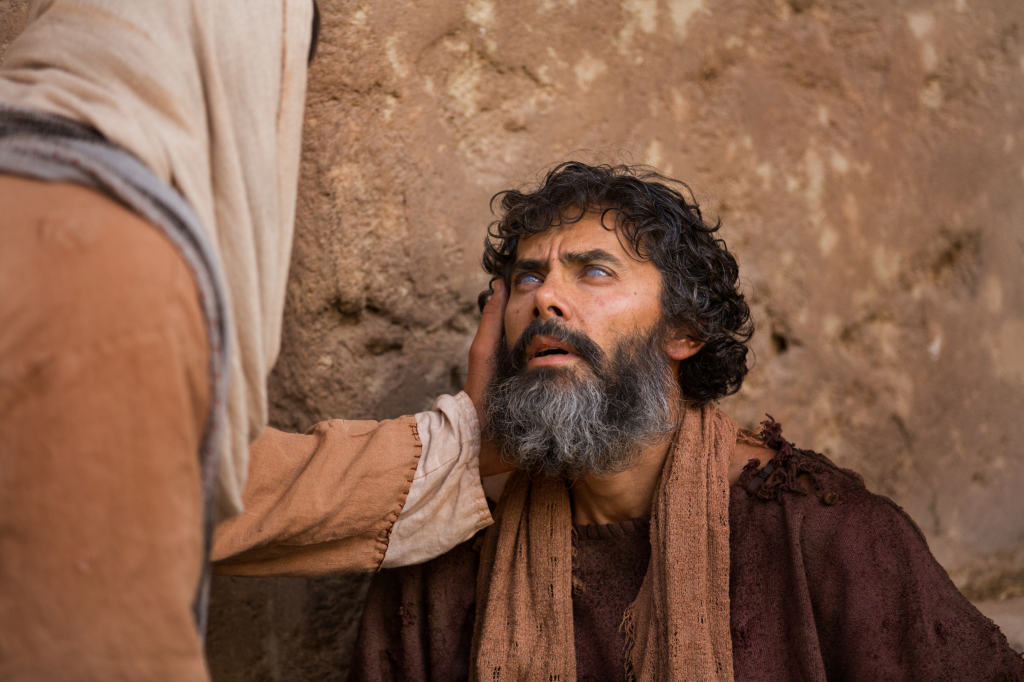
“As he was walking along, he saw a man blind from birth.“
2 “Master,” his disciples asked him, “why was this man born blind? Was it a result of his own sins or those of his parents?”
3 “Neither,” Jesus answered. “But to demonstrate the power of God. 4 All of us must quickly carry out the tasks assigned us by the one who sent me, for there is little time left before the night falls and all work comes to an end. 5 But while I am still here in the world, I give it my light.”
6 Then he spat on the ground and made mud from the spittle and smoothed the mud over the blind man’s eyes, 7 and told him, “Go and wash in the Pool of Siloam” (the word Siloam means “Sent”). So the man went where he was sent and washed and came back seeing!
I suppose we can only imagine what blindness to this degree would be like.
Somehow I’ve come to an idea that this represents fallen men–we’re spiritually blind to the workings and truths of Jesus’ Kingdom. It seems a pretty good explanation of each of us–“blind from birth.” But when you’re blind spiritually you haven’t the slightest of what is real and taking place around you.
“One great power of sin is that it blinds men so that they do not recognize its true character.“
Also notice the response of the disciples who first met this unfortunate man. They don’t see his needs, rather, they want to know the theology behind this. Perhaps that’s how we respond much of the time–we don’t see the needs, we only want to know the reasons. We’re not wise or discerning enough to see what’s really really going on.
Perhaps this is how we operate as immature Christians.
We don’t engage the need, but rather we like having good theology over understanding true passion. It’s easy to philosophize–it’s hard to get down and serve and really love others.
If we really don’t love needy people, we re probably not following Jesus.
It’s funny but Jesus declares Himself to be the light of the world while speaking to the man who is born blind. And it’s also funny that just like there was physical blindness there is a blindness of the Spirit by the disciples–I think it’s even worse.
Third, we discover the gentle mercy that Jesus has when He meets needy people. Now the Lord does accommodate His followers, but not at the expense of engaging the need of the moment. Jesus is full of compassion–most especially when He meets broken people–and as His followers, we must grasp this.
As I mature in Christ I’m learning (slowly) that people are His real focus. He has come, not to theologise or philosophize, but to meet needs! Sure the reasons why become clearer, but that really isn’t Jesus’ primary goal. I suspect that people will never have impeccable theology.
Classes in systematic theology are really good, but I believe soup kitchens are better.
The blind man is profoundly healed, and Jesus’ love and desire to restore this man is ‘front and center.’ The Lord’s methodology is interesting. Spit and mud, wiped on the blind man’s eyes. In Genesis 1-2 we discover that God made man out of dirt and dust of the ground. Perhaps what He has done here mirrors that work.
And it’s also important to understand that Jesus never performs the exact same healing in the exact same way. For some reason He ‘tailors’ His work to the individuals deepest need. I suppose He doesn’t want us to grab a hold of a formula, as that’s what we want to have.
The story is primarily about a blind man’s healing. It also speaks to the spiritual darkness that afflicts many.
We really must understand this, and we need to understand the tremendous mercy and power of God to both heal and restore. The Lord wants to give you real sight, true spiritual discernment. He really wants this.
There’s a ton more here we can grab, but I suppose there isn’t time. This is merely my take on John 9.
The Spirit of the Lord is upon me; he has appointed me to preach Good News to the poor; he has sent me to heal the brokenhearted and to announce that captives shall be released and the blind shall see, that the downtrodden shall be freed from their oppressors, and that God is ready to give blessings to all who come to him.”
Luke 4:18



 Alaska Bible Teacher