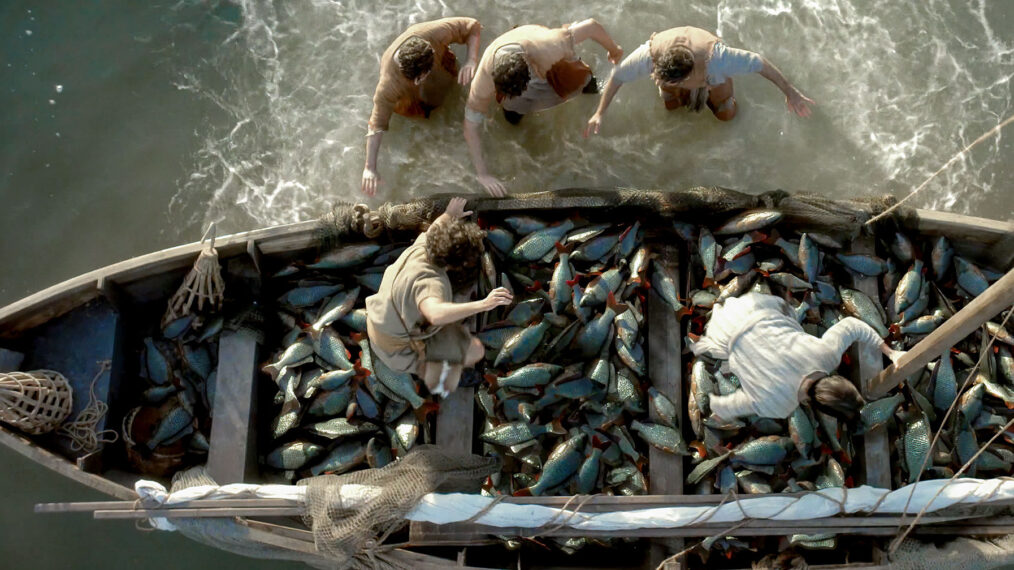
For I’m a Sinful Man

Luke 5:4-8, ESV

Man, could He teach. Jesus sat in my boat speaking to the crowd–His words had the ring of truth–authoritative. I had never in my life encountered anyone like Him. His teaching was masterful and it pierced through the religious rhetoric we grew up with.

But it just wasn’t words. My mother-in-law had a terrible fever, and Jesus had healed her. He had also healed many others as we watched. Never had a man done this, it was unprecedented. And now this very same Jesus was sitting in my boat.

He directed us to go out and fish again.

You must know that we had already fished during the night away, and had caught nothing. Sometimes that happens. But Jesus was asking us to make another try. Fishing during the day just wasn’t done and I suppose I wasn’t thrilled about working again.

We rowed out some distance and threw out our nets. I expected nothing. Suddenly, without warning, the nets began to fill with fish–big, beautiful fish! We scooped out as fast as we could, and our boat began to sink. There were so many and they kept coming. I shouted out to the other boat. We needed help.

Soon both of our boats had taken all they could possibly handle.

I was completely overwhelmed, and I turned around to see Jesus in a new light. He was more than a powerful man–He was the Lord and the Messiah! I instantly knew and believed. It was then I collapsed at His feet. I spoke that which was in my heart.

“Depart from me, for I am a sinful man, O Lord.”

Life was about to change for Peter. Radically. I believe that it was at this point that his discipleship began. As he knelt there on the slimy fish he was told that he was going to become a “fisher of men.” That moment of brokenness would become a moment of real strength for him. I suppose that this is how it works.

Peter would commit a multitude of sins–he fell woefully short on several different occasions, and yet Jesus would forgive him over and over. At the end Peter would end up denying the Lord three times, and yet he repented.

Peter is an example of God’s grace and mercy.

God uses broken things. It takes broken soil to produce a crop, broken clouds to give rain, broken grain to give bread, broken bread to give strength. It is the broken alabaster box that gives forth perfume. It is Peter, weeping bitterly, who returns to greater power than ever.

     Vance Havner

alaskabibleteacher.com

Repairing Your Nets

“Yet those who wait for the Lord
Will gain new strength;
They will mount up with wings like eagles,
They will run and not get tired,
They will walk and not become weary.”

Isaiah 40:31, NASB

The word “wait” used here is powerful. It’s an awesome word, never used casually in the Hebrew scriptures. It does not mean to be uncaring or idle. Sometimes we wait in line at the grocery store, or maybe we’re waiting for a phone call. We wait all the time, and often, we don’t even realize it.

The Hebrew word for ‘wait’ is special. It’s qāvâ. It means, ‘to bind together by twisting.’ It’s an active word.

It sometimes means to work like a fisherman repairing his nets to get them ready for tomorrow’s catch.

(There are always holes to mend after a long night’s efforts.)

When we wait spiritually, repairing our nets, the following should be used. Much of this can be done in prayer.

  • Calming ourselves, setting aside everything that doesn’t fit
  • Reading His word
  • Seeing His face
  • Hearing His voice
  • Keeping pace with Him, whether He moves (or doesn’t)

Fixing our nets is a cool way to describe our journey, right? Sometimes, when we think about waiting, we usually only think about it in English, and that can be annoying. It often stops us from truly understanding the true meaning of ‘wait’.

I strongly believe that the Holy Spirit wants us to understand the concept of being closely connected to Him. Sadly, we are often held back by our own definitions, rather than embracing the definitions found in God’s Word.

“The LORD is good to those who WAIT for him,
to the soul who seeks him.”

Psalm 27:14

Sometimes we are instructed by someone to “wait on the Lord.” This instruction can be challenging and we are unsure exactly how we should do it. It’s usual for us to simply show agreement through a smile and a nod. We never completely grasp the essence of that word.

He becomes my source of power that comes from waiting.

He is now the sturdy bond that I am intertwined with. (Maybe this is how He gives strength and power to His people?) We must listen to this, and the Lord is very enthusiastic about guiding us into this fresh form of closeness.

The promise in Isaiah 40:31 talks about receiving new strength, like an eagle’s wings, a holy energy. This verse is important for us, especially today; we need this kind of strength right now. We need to repair our nets as often as we can.

“Waiting for God is not laziness. Waiting for God is not going to sleep. Waiting for God is not the abandonment of effort. Waiting for God means, first, activity under command; second, readiness for any new command that may come; third, the ability to do nothing until the command is given.”

    G. Campbell Morgan

alaskabibleteacher.com

Catching Men

“The Morning of the Fisherman,” Valentina Kostadinva, oil

“And so also were James and John, sons of Zebedee, who were partners with Simon. And Jesus said to Simon,

“Do not be afraid; from now on you will be catching men.”

Luke 5:10

Fear is an ugly thing, it turns men into timid cowards who cannot really trust God. Simon Peter is promised courage. Throughout his life this will be a constant battle for him. It seems like Simon Peter will always struggle with what people will think about him. He is ‘crippled’ and he needs Jesus to intervene. And He does.

I remember Jody and I were sent out by a pastor to do “door-to-door” evangelism. I was terrified. We knocked on a door and then I sort of freaked out, I left her on the porch and hid behind a tree. Witnessing scared me. She shared Jesus while I ran away. How ‘Peter-like’ I am.

“Catching men” is a reference to Peter’s occupation as a fisherman. Jesus speaks so Peter will understand. He expresses evangelism in a way that describes the work of the Kingdom. Fishing describes the main task of the believer. All too often we’re ‘fixed’ on self-improvement, and our vision becomes blurred. Evangelism is to be our work.

“Evangelism is not a professional job for a few trained men, but is instead the unrelenting responsibility of every person who belongs to the company of Jesus.”

-Elton Trueblood

To Leave Your Nets

Tools used to mend nets

“And going on from there he saw two other brothers, James the son of Zebedee, and John his brother, in the boat with Zebedee their father, mending their nets, and he called them.”

Matthew 4:21, ESV

“And immediately they left their nets and followed him.”

Mark 1:18

To mend nets was tedious but necessary. You would take your net and spread it on the ground in an open space. Every knot would be carefully examined. All holes would be repaired. Nothing was overlooked. Fishing nets were painstakingly maintained. Every day, without fail.

Fish would school, and if your gear was right, and you were in a prime place, you could catch a lot. But simultaneously, you could let hundreds of fish escape through a hole in your net. Each fish that escaped meant money lost.

Jesus walking along the beach surveyed the boats and crews. Since most of these guys had worked through the night, they were tired and maybe a bit “punchy.” Some had gotten lucky, while others had little to show for working so hard. I suppose the different crews teased each other as they unloaded.

Jesus walked through the bunches of fishermen. He looked at their hauls to see what they had caught. But it wasn’t the catch He was looking at, it was the men. It was from these laboring fishermen that He would choose. These men were rough-and-tumble rednecks. If they had chewing tobacco back then, they would use it.

He looks, sees, and commands.

Now if you are looking for disciples– future apostles and leaders, the seashore is not the best place to recruit. They really have a rudimentary education. No theology, and just a meager understanding of Jewish ritual and religion. Essentially there was no time for them to think outside their occupation. Sure there just might be one, or two that possessed more, but that would be the exception.

But Jesus had no desire to interview them, and take the best of the lot. He didn’t have a Human Resources Department, and there were no tests and no forms that had to list references. He simply commanded, and those who understood followed. Only after they left it all did He get their names and addresses. I think that it is the same today.

Will we leave our boat, with your nets?

Really, you can keep mending or follow Him– it’s your choice. Most of the time though, decisions have a tendency to be irrevocable. Perhaps you have a moment, an instant of time to decide.

Sometimes mending nets can be back-breaking and tedious. But following the Lord Jesus is an unknown; too many choose to keep fixing their nets. Others though are launched into something new, and eternally significant.

The glaring truth is the necessity of obedience to Jesus’ command. There is no other voice we must hear. As a matter of fact, hearing (and really apprehending) is the only foundation we can trust to make our obedience true.

You can keep mending your nets and preparing for another night on the water. That is always your prerogative. But if you decide to follow you will need to leave what you know behind.

That is authentic discipleship.

“Rest in this – it is His business to lead, command, impel, send, call or whatever you want to call it. It is your business to obey, follow, move, respond, or what have you.”

-Jim Elliot, missionary to the Auca Indians