Love you,
Bryan


Love you,
Bryan


Difficulty and pain sometimes come from others, and challenges to the Lordship of Jesus often come from our unique circumstances.
But what if it was something we’ve done?
I remember the classic picture of a Buddhist monk who sat in the middle of a street. He was serene as he soaked himself with gasoline, and lit himself on fire as a protest against a war he believed was wrong and evil. He burned himself in front of the cameras.

All too often we’re pretty much responsible for our own self-immolation. It is we (and we alone) that set ourselves ablaze. Sin affects our minds and hearts. We set ourselves on fire.
When we sin– when we walk in ‘known’ disobedience we always put ourselves in an awful place. We love it but learn to hate it too. But we continue to do it regardless of the awful death that ensues.
God promises to forgive us. Out of our ashes, He keeps bringing us life and hope.
You can be forgiven. You can find life again, even if you’re fully responsible for the evil we’ve done to yourself. Yes, we all sin, and yes we walk in our own personal rebellion. But Jesus knows it all. These awful things we’ve all done can be forgiven.
As a man and a preacher of the Gospel, I realize that I choose to sin. In spite of all I know and teach I realize that I can live in the ashes of my own making. As one who also struggles with bipolar, I understand that I’m even more susceptible to doing awful things. I understand that I choose darkness even though others sometimes call me “a man of God.”
As you read this I’m praying that you find His forgiveness and mercy. You’ve come a long way it seems, but you must see His blood that was ‘released’ from His veins and arteries for you.
He desperately loves you–even if you’ve set yourself on fire, and sit in the ashes of your doing.
“To appoint unto them that mourn in Zion, to give unto them beauty for ashes, the oil of joy for mourning, the garment of praise for the spirit of heaviness; that they might be called trees of righteousness, the planting of the Lord, that he might be glorified.”
Isaiah 61:3


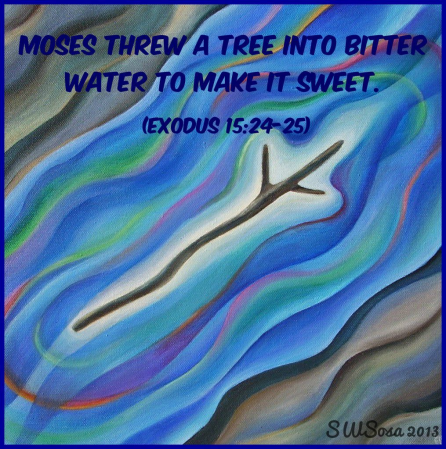
In Exodus 15 there’s an incident that carries weight for today. Israel has come to the springs of Marah. The water is bitter. The people turn to Moses. They challenge him and the complaint voraciously. “Why have you brought us here?” They press Moses to the point of mutiny. They are furious.
Some commentators believe this bitter water was a laxative, and anyone who drank this “bitter” water made many trips to the outhouse!
Moses is shown a branch of a common tree. The Lord speaks a word of the direction he’s to throw the branch directly into the spring. It’ll cure the water, and make it sweet and drinkable.
t seems to me that this awful cross cures the bitterness we absorb as we make our way through life.
The cross of Jesus is critically important. When that ugly tree touches our lives it makes what is bitter sweet. He has changed us by that incredible sacrifice on the hill of Golgotha.

.

Isaiah 40:31, NASB
It’s not a passive word in the original Hebrew. It does not mean being apathetic or lazy. Sometimes we wait in line at the grocery store, or maybe we’re waiting on a phone call. We regularly wait all the time, and usually, we don’t even realize it.
It literally means to “braid, or twist, using a rope.” It becomes an interesting word picture? Sometimes we only take the English idea of waiting and turn it turns into a frustrating delay. Often, this is why we lose out on what ‘wait’ is really about. I have to believe the Holy Spirit wants to teach this idea of becoming ‘braided up with God.’
For those of us who are ill— physically or mentally, just to be told simply, “wait on the Lord” is a real challenge. Often, we will end up resenting this counsel (and the counselor) because we have misunderstood what it means to really ‘wait.’ We come tantalizing close to this critical idea, but we never quite make it through the doorway.
He becomes my strength; He is now the strong cord I am braided into. (Perhaps this is how He imparts strength and might to His people?) We need this, and the Lord is quite eager to lead us into this new kind of intimacy.
The promise in Isaiah 40:31 tells us about new strength–the eagle’s wings, holy stamina. This verse is relevant to us today, and we need this kind of strength now. I only want to encourage you in your own prayer time, to see yourself intertwined with the Lord, and to recognize the good gift of the Holy Spirit freely given.
Psalm 27:14


“Those who accepted his message were baptized.” (Acts 2:41)
“Repent and be baptized.” (Acts 2:38)
“Having been buried with him in baptism and raised with him through your faith in the power of God.” (Col. 2:12)
Perhaps one of the most significant decisions we’ll make is to follow Jesus Christ into the waters of baptism. This is just obedience to the Lord’s command to be baptized. It’s one of the ways that our discipleship becomes public, but it’s intensely private as well. Ideally, it will forever alter your life. At least that is the Father’s intention.
It takes faith to be authentically prepared for baptism. You will be taking a stand. By faith, you’re making public your allegiance to Christ. It is a step of something living.
“Baptism was to put a line of demarcation between your past sins when you are buried with Him by Baptism–you are burying your past sins–eradicating them–putting a line in the sand saying that old man is dead and he is no longer alive anymore and I rise up to walk in the newness of life.”
T.D. Jakes
I suggest that you prayerfully attend to the steps listed below. You will find there is a big difference between truly being baptized, and just getting wet!
The interrogative process can be used to solidify the faith before man and in front of His people. In a sense, it’s much like the vows made by a husband and wife in the vows of marriage.
This is our faith boiled down to its core essence. This declaration helps set us apart from the World, the flesh, and the devil:
“I believe in God, the Father Almighty, maker of heaven and earth. And in Jesus Christ, his only Son, our Lord,
who was conceived by the Holy Spirit, and born of the Virgin Mary, suffered under Pontius Pilate, who was crucified, died and was buried.
He descended into hell. and on the third day, He rose again from the dead. He ascended into heaven and sits at the right hand of the Father. From thence He will come to judge the living and the dead.
I believe in the Holy Spirit, the holy catholic Church, the communion of saints, the forgiveness of sins, the resurrection of the body, and the life everlasting. Amen.”
This needs to be understood and accepted. I suppose we will develop these into living discipleship; you’ll that water baptism is analogous to a master key that opens the door to a special joy. Obeying the command to be baptized pleases Jesus. And that is what we long to do.
“Indeed, baptism is a vow, a sacred vow of the believer to follow Christ. Just as a wedding celebrates the fusion of two hearts, baptism celebrates the union of sinner with Savior.”
–Max Lucado
Baptism is an outward expression of inward faith.
–Watchman Nee
Baptism separates the tire kickers from the car buyers.
–Max Lucado
A special word to “older” believers: There may come a time when you feel that you would want to be baptized again. I believe that this is not only allowable but commendable. You may have not had a good understanding of the baptismal process, but now it makes sense. I would encourage you to follow your heart. God will honor your rededication. Ask your pastor or elder what they think.

g

“He told them another parable.”
“The kingdom of heaven is like leaven that a woman took and hid in three measures of flour, till it was all leavened.”
Matthew 13:33
One version says 50 lbs (or 40 liters for your metric fiends) of flour. Crazy, why that much is beyond me–some figured it out and it would be enough bread for 100 people at least. Far more flour and yeast that was close to normal use. The parable that Jesus taught would certainly be humorous to the listeners. I suppose their imaginations were in overdrive.
What Jesus taught in these stories was incredibly practical and it engaged the listeners. They would leave and the stories would stick. Whether they realized it or not, His truth would impact them.
These stories were like bombs that would eventually explode in the hearts of the people.
Sooner or later, maybe when they least expected it, these parables would suddenly make sense. A lightning strike. Very seldom did they connect immediately. We can see this by the disciples’ desire to have them explained. They didn’t get it at first. But when Jesus illuminated them, they understood.
I believe that the Kingdom of God is hidden in us and it has outrageous power.
It works secretly, it’s not visible to anyone. It just does its stuff. The yeast, combined with the flour is a hidden process–something that isn’t observable. Perhaps that’s the way God’s kingdom comes, quietly, secretly but powerfully. Once the flour and yeast combine it’s pretty difficult to stop it.
That kingdom is working in our lives.
And most of the time it’s a hidden work. We can’t understand the process or grasp how it’s happening. We seldom know what God is doing. We may concentrate on being a witness to our neighbor, (which is a good thing, please do) but perhaps the Holy Spirit is working instead on our patience or love.
Usually, what we think is going on isn’t.
I’ve been in ministry for almost 40 years now, and I’ve tried to be faithful and worked on my discernment. But it seems I don’t quite grasp yet what the Father is doing inside of me. And I admit, I’m not really sure what’s going on in the lives of those I teach and counsel. Most of the time, I have no idea what he’s doing.
And that’s alright. I know he loves me very much and I trust him to work in me.
“And I am sure of this, that he who began a good work in you will bring it to completion at the day of Jesus Christ.”
Philippians 1:6