The Church of Many Colors

“His intent was that now, through the church, the manifold wisdom of God should be made known to the rulers and authorities in the heavenly realms, according to his eternal purpose that he accomplished in Christ Jesus our Lord.”

Ephesians 3:10-11

Now Israel loved Joseph more than all his children because he was the son of his old age. Also, he made him a tunic of many colors.

Genesis 37:3

The word “manifold” is a very curious word. In the Old Testament, this particular word is used to describe Joseph’s coat of many colors. I can only imagine that it was striped like a rainbow, (or maybe even tied-dyed?) Whatever it was, Joseph was quite distinctive as he wore his colorful coat.

Joseph’s coat

Paul in Ephesians 3, intentionally borrows this word to explain “the manifold wisdom of God.”

Paul uses this dramatic imagery of Joseph’s coat to describe God’s wonderful wisdom that has saturated the Church. There is something variegated in this wisdom (balance, comprehension, understanding) that infuses His Church.

First of all, we are people of diverse colors. There is a wisdom given to each believer. This defines us and portrays us to a color-starved world. God’s own wisdom, defined quite incredibly in our hearts and spirits, describes our coloration and hue.

Some are merciful, and other believers are bold. Some are kind, others are discerning.

Some are gentle, and others are prophetic and sharp. Some are artists, while others know how to roof a house properly. A few are discerning, and others can endure much. But our personal coloring should never threaten another. Those who see only blue– should never be shaken when another sees yellow.

Our fleshly attitudes would militate against this understanding. We seem to insist that everyone be green, or yellow even. But this isn’t how God through the Holy Spirit comes to our spirits. We should receive each brother and sister, in the wisdom that God has chosen, to flow and grow and give. It seems we are each a prism that reflects a certain light.

We can see the “gifts of the Holy Spirit” in 1 Corinthians 12:4-11.

They are carefully distributed, but definitely never dumped. They come out in many ways through many different personalities and backgrounds. But it seems we are slowly learning that each believer has a definite place and purpose.

I suppose that pride confines us into something that is restrictive. We prefer ideas and proclivities we can control (or maybe label).  Perhaps, it is we that need to be adjusted. We should see the incredible broadness of God’s grace, and how each one is touched and shaped.

The Church is now God’s unique reservoir of wisdom and grace for the world.

We gleam with the certain light of His presence and goodness. Each believer radiates an aspect of grace from the heart of God to others. We are indeed the “Church of many colors.”

“The complaint that church is boring is never made by people in awe.” 

RC Sproul

alaskabibleteacher.com

Discovering Grace Again

Some Christians are called to endure. These believers are a spectacle of grace to the church, like flaming bushes unconsumed, and cause us to ask, like Moses:

‘Why is this bush not burned up?’

Exodus 3:2-3

The strength and stability of these believers can be explained only by the miracle of God’s sustaining grace. The God who sustains Christians in unceasing pain is the same God — with the same grace — who sustains me in my smaller sufferings. We marvel at God’s persevering grace and grow in our confidence in Him as He governs our lives.

— John Newton, author of “Amazing Grace”

All of us know a brother or sister who seems to be a target of an undue amount of suffering. It seems like they’re always in the furnace. Perhaps we should give them double honor for their faith in God’s grace and providence. Their hurt is typically inside, and most carry this pain apart from others’ knowledge. They cry when they think no one is looking.

What can we say to those who seem to be in a white-hot furnace? How can we bless those who are in so much pain? They hurt deeply, and honestly, at times we have no idea what they’re having to endure. They’re being challenged in ways we never imagined. We should realize that their burden would probably destroy us.

Ministering to these sufferers can be a real challenge. Even if God is directing you!

Sometimes just a word of simple encouragement is all that is needed. A phone call or an email is good, and it’s the work of a believer to actively lift each other up like this. This is how the Church is meant to be. We watch out for each other, we care for each brother and sister, and it’s a joy to serve each other like this.

But sometimes it might be necessary to speak directly into their awful storm.

In the midst of some awful difficulties in my early walk, I had a dear brother who was so kind. He gently (and carefully) quoted Philippians 1:6 to me over and over. It was wonderful and so encouraging–he blessed me with that promise and it’s now my “life verse” fifty years later!

And I am sure of this, that he who began a good work in you will bring it to completion at the day of Jesus Christ.”

Philippians 1:6, ESV

A good reminder for us is that the pain we feel right now is not the end. Our trials have a finite duration (although it seems far away). There’s coming a day when the difficulty will suddenly cease and we’ll come out on the other side. “We’ll shine like the stars,” scripture promises us. (Daniel 12:3). I really believe we’ll see that.

Much wisdom is needed in our ministry to disproportionate sufferers. We should have a fear of intruding on the work the Lord is doing in their spiritual heart. We must be patient and humble in this matter. There is no rushing God, after all, it’s His work. Most importantly we must be very much ‘present’ for our friend.

“But not only that! We even take pride in our problems, because we know that trouble produces endurance.”

Romans 5:3

But please understand. A “word” spoken out of place can cause even more ‘heartache’ for the sufferer. Let’s be careful. At times it’s better not to say anything, and to be honest, that’s okay. Job’s friends were best sitting in the ash heap saying not a word.  Please dear one, be aware, alert, and very wise about these things.

Just wait on God—-be sensitive, discerning, and pray a whole lot. It’s no small thing to speak to those who are hurting so deeply.

“The Lord GOD hath given me the tongue of the learned, that I should know how to speak a word in season to him that is weary: he wakeneth morning by morning, he wakeneth mine ear to hear as the learned.”

Isaiah 50:4

alaskabibleteacher.com

Ponder the Word

“But his delight is in the law of the Lord, and on his law he meditates day and night.”

Psalm 1:2

In Psalm 1:2 the Hebrew word for meditation is hagah. In this Psalm we have a contrast between the blessed and the “not-so-blessed,” and it commands that as Jesus’ followers that we process the reality of this to become blessed by our Father.

In Psalm 1:1 the word blessed is used, and actually just in the book is Psalms alone blessed is used 51 times. The word has a very simple and concise meaning: “to be happy.” I really don’t think we can minimize how important it is to be happy.

In 1:2 we read hagah or meditate. That Hebrew word is a little bit more complicated and it seems more nuanced than “blessed.”

Hagah, or meditate means:

  • to chew a cud like a cow
  • to growl like a lion who is eating an antelope
  • to moan or groan
  • to talk to oneself, or mutter or whisper
  • finally, it can mean to muse or imagine

Yeah, it’s an interesting word and I suppose all of these meanings are to be factored into meditation [hagah]. It seems that these five definitions shape the different meanings that go into our understanding.

Using the above definitions, this is how it might look:

  1. sometimes I regurgitate the word like a cow chewing its cud
  2. at times I attack it like a lion
  3. I moan and groan as I wrestle with it, seeking for a handhold
  4. thinking about the passage I talk to myself about its meaning
  5. I imagine being there, sometimes it’s like I’m a “fly-on-the-wall”

When we come to God’s words, the Bible, we are required to assimilate all that the Holy Spirit graciously gives. When He gives us something from the Word we must apply it to ourselves. You can do this through any of the 5 definitions I’ve given.

The Holy Spirit is the One who ignites His Word into our hearts.

Joshua 1:8, ESV

alaskabibleteacher.com

Covering the Sins of Others

“And don’t build an altar that requires steps; you might expose yourself when you climb up.”

Exodus 20:26

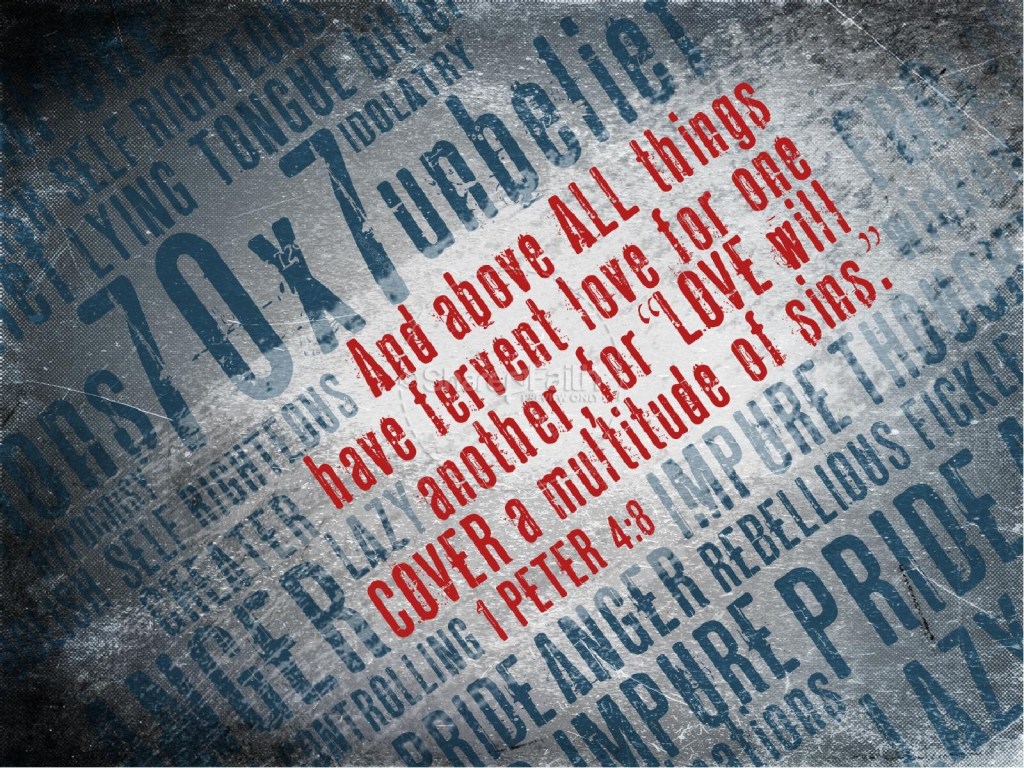
“Most important of all, continue to show deep love for each other, for love covers a multitude of sins.”

1 Peter 4:8

While I lived in the SOS Ministry house in the Mission District of San Francisco a dear brother taught me this principle.  Living in a Christian community was wonderful, but it also could be a tremendous challenge at times.  What Michael taught me allowed my understanding to grow into my own calling in the Kingdom.

The principle is this:  

Throughout the scripture “being naked, or nakedness” is always a shame.  It comes welded to the concept of being vulnerable to the sight of those who are mature.  It carries the idea of sin; it’s sin that some can see, it is hidden to most but causes terrible shame. Exposure of their nakedness seems like the worst thing that could happen.

For those who often sin, we latch onto the idea of keeping a lid on it, and being secretive about it.  We believe that people will never know.  Often sex sins, drugs, and alcohol sin, are kept hidden from the view of family and friends, and the Church. Hidden sin will never be healed by hiding it. (That’s a very common deception.)

Noah and his nakedness, Genesis 9

“Noah became a farmer and planted a vineyard. When he drank wine made from his grapes, he became drunk and lay naked in his tent. Ham, the father of Canaan, looked at his naked father and told his brothers outside. Then Shem and Japheth got a coat and, carrying it on both their shoulders, they walked backwards into the tent and covered their father.”

“They turned their faces away so that they did not see their father’s nakedness.”  

Genesis 9:20-24, (See Lev. 18).

Granted, it’s hard to process this patriarch’s gross sin. However in all fairness, Noah had lost practically everything in the flood, so perhaps we should be gentle with him.

The Church needs people who cover up the nakedness of others, people who are gentle and humble.  They would never, ever dream of making a scandal.  They are trustworthy and understand to a great degree the things that make a man or woman of God.

Mature believers will protect the open areas of others. 

They will refuse to judge or point out sins. Any discernment that’s given from God is for intercession, not for fault-finding.  They stand in the gap, shielding and protecting. And praying. This is God’s heart, and they understand.

But the issues for leadership are quite clear.

The principle of spiritual responsibility and active sin requires definite action for the health of the Church. A pastor or teacher who practices evil cannot remain in their place of authority. The standard for them is different. They have been charged for care and oversight over God’s flock.

With the ordination vows comes scrutiny. I believe special grace is given to each leader, but with that comes the commitment to following Jesus faithfully. It’s a serious call and deliberate sin invalidates that. The man may be quite gifted but can no longer be trusted to serve in their office.

I’m convinced that Paul’s epistles support this.

God’s final word on nakedness is in Revelation 3:18, and perhaps this is a good place to end this post.

alaskabibleteacher.com