Leave the Spear in the Wall

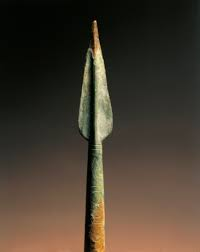
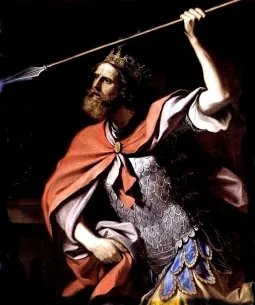
And Saul hurled the spear, for he thought, “I will pin David to the wall.” But David evaded him twice.

1 Samuel 18:11, ESV

And Saul sought to pin David to the wall with the spear, but he eluded Saul so that he struck the spear into the wall. And David fled and escaped that night.

Saul’s spear shows up later in David’s life, and it becomes a vital component in his growth as Israel’s next king.

But David doesn’t know that yet. In 1 Samuel 26 we read about David’s second encounter with the spear of Saul.

The scene is in the wilderness and David’s on the run. Now the badlands are a good place to hide as any Western movie knows. I think David had his scouts and I suppose that there were also men who knew every rock and cave in that wasteland. They were hiding from Saul.

“So David and Abishai entered the encampment by night, and there he was—Saul, stretched out asleep at the center of the camp, his spear stuck in the ground near his head, with Abner and the troops sound asleep on all sides.”

1 Samuel 26:7

Sneaking into Saul’s camp was bold and audacious. Saul was sleeping and scripture says that David’s companion desperately wanted to kill Saul, but David refused, David, looking through the darkness lighted on Saul’s spear. Perhaps he remembered back to when Saul tried very hard to kill him.

He avoided that spear a long time ago, and now he escapes it again.

The tables have completely turned. Given a chance to end King Saul’s life, he refused; he would not kill him. When you think about it, many problems would’ve been solved, and David would take his rightful place as Israel’s new king.

But David spiritually understood God’s heart. He understood the spiritual principle of “turning the other cheek” and “loving your enemies.” He overcame with love and kindness. And lots of grace.

“Do not be overcome by evil, but overcome evil with good.”

Romans 12:21, ESV

The Greek word for “overcome” is νικάω which can be translated as “to conquer or to come forth victorious.” It is also used when someone is arraigned before a court of law but wins the case.

To follow Jesus means you entirely reject using the spear. It’s not for you. Never.

“We win by tenderness. We conquer by forgiveness.”

Frederick W. Robertson

We must leave the spear in the wall. You must not throw it back.
Like David, we are to trust the Father. We’re to be secure in His timing. And yes, we each must use kindness and brokenness to overcome dark things. When you think about it, Jesus also faced evil without defending Himself. The spear showed up again and we see that our Savior allowed it to pierce His side on the cross.

You must leave the spear in the wall.

You mustn’t use the spear when it seems you can wield it at the perfect moment, and like Jesus you need to allow it to save your enemies from their sin.

These three spears are evidence you “have God’s heart.”
Under the Knife

John 15:2, ESV

 “Dead wood is worse than fruitlessness, for dead wood can harbor disease and decay…God removes the dead wood from his church and disciplines the life of the believer so that it is directed into fruitful activity.”

Merrill C. Tenney

It takes a sharp eye and a sharper knife to do the Father’s work of cutting.  He slices to the quick, and all that is not useful falls to the ground.  The vine must produce grapes, and every bit of “grape-energy” needs to be used productively. Fruitlessness will be cursed, sterility is condemned. This is a hard choice to make.

I want to encourage you though–fruitless believers can possibly become fruitful ones. 

Understand, the vine dresser isn’t attacking the vine with his knife.  He is not malicious or vengeful.  All that He does is for the good of the vine.  He is motivated to produce fruit.  That is what He thinks about as he cuts away the dead branches.

Pruning and fruit are concepts that we vacillate over, some days we understand and other days we don’t.  After over 40 years, I’ve heard every “John 15 sermon” known to man.  And most of the time I turn down my spiritual hearing aid. That is tragic–I listen, but I don’t listen.

I need to grapple with this imagery.  If I don’t, bad things are bound to happen.

For years I have asked God to “show me His ways.” I’d like to believe that this understanding of pruning has changed me.  I would like to think that I have attained a clearer view of wisdom.  This pruning business is all well and good.  But being sanctified by the knife is decidedly unattractive and uncomfortable.

I grew up in the northwoods of Wisconsin and wondered if the trees that were designated with a ‘red X’ understood that they were the ones to be cut down by the lumbermen. I wondered if these trees that were marked with spray paint understood what was up? (Maybe they felt special with their new found prestige?)

You will be pruned!

I completely and absolutely declare this to you. (It’s one of those “thus says the Lord” moments.) Pieces of your life are earmarked to be lopped off. You will probably not understand why and you will chafe at what is coming.

The Christian life is as much about subtraction as it’s about addition.

He will cut you and you’ll think you’re dying. But I assure you, Jesus loves you, and all that He does is for your good. He trims you to bring you true life.

There is simply no other way He can work.

“And if it be painful to bleed, it is worse to wither. Better be pruned to grow than cut up to burn.”

John Trapp

Will You Deny Him?

deny

“Suddenly Jesus’ words flashed through Peter’s mind: “Before the rooster crows, you will deny three times that you even know me.” And he went away, weeping bitterly.”

Matthew 26:75, NLT

Three denials are followed by three reaffirmations.

A third time he asked him, “Simon son of John, do you love me?” Peter was hurt that Jesus asked the question a third time. He said, “Lord, you know everything. You know that I love you.” Jesus said, “Then feed my sheep.”

John 21:17

The apostle Peter was a fervent disciple. He knew who Jesus was before most. He was always included in special times (e.g.  the transfiguration, Gethsemane). He was favored by Jesus throughout times of ministry. I also believe that he was Jesus’ friend.

Peter is known for:

  • being called on the shores of Galilee, Matt 4:18-19
  • ‘almost’ walking on water, Matt 14:29-30
  • finding the tax money in a fish’s mouth, Matt 17:24-27
  • having his feet washed, John 13:6-7
  • in Gethsemane– cutting off an ear, John 18:10-11
  • his remorse at denying Jesus, Matt 26:75
  • at the empty tomb with John, John 20:3-8

Peter’s own denials were of a serious nature affecting who he was, and who he was to become. Jesus astutely intervenes as they ‘breakfasted’ on the seashore. There would be three affirmations; one for each denial. Peter needed to meet the resurrected Jesus and speak with him about what he had done. Peter needed this.

A denial has different intensities and can be used in many different ways.

Out of our own confusion, we realize that we can also deny Jesus. Perhaps frequently.  And none of us have immunity as of yet. We deny the Lord when we refuse to speak of him to others. We deny the Lord when we fail to do what is right. Sometimes we deny him flagrantly, other times it is a more subtle attitude. At best, we’re still inconsistent, and at worst, we’re apostate.

We’re not punished or abandoned for this behavior.

Human logic would suggest that we should be. But instead, we are gently restored. Given the opportunity, Peter the fisherman would eventually become a wise shepherd to the young Church. I would also suggest that Peter’s personal weakness would serve him well as a gentle, and caring pastor.

Peter, near the end of his life, goes full circle and uses a very precise Greek word found in only two places in the New Testament. It is the specific form of the word “shepherd.” It is only used in John 21:16-17 in Peter’s restoration, and in 1 Peter 5:2. Peter encourages the Church with the exact words Jesus himself spoke to him on the beach so long ago! Peter wrote:

Be shepherds of God’s flock that is under your care, watching over them—not because you must, but because you are willing.”

1 Peter 5:2, NIV