You’re a Steward of Your Pain

Some time ago I came across a story that connected. A visiting speaker stood in front of a congregation and shared a painful incident from his childhood. He wanted to bring healing. After he spoke, an elder came and spoke to him–

“You have learned how to become a proper steward of your pain.”

The visiting speaker was profoundly touched by this. Finally, something came together in his heart and soul. Yes, he did learn how to deal scripturally with those ugly things from his past. He was becoming a proper steward of his pain.

The word for steward in the original Greek is oikonomos. It literally means “a keeper of a home.” It describes a manager, a superintendent to whom the head of the house or proprietor has entrusted the management of his affairs, the diligent care of receipts and expenditures.

The issue seems to be of management, how can God use these awful things for building His Kingdom?

No question about it, we live in a world of darkness. Each of us has been touched by hard things. Scars are part of our lives. When we come to Christ they come with us. All of these grim things are a real piece of us, we have been hurt (or maybe we’ve wounded others?)

Are you a good steward of who you are? Whether you’ve experienced trauma–something physical, sexual, or perhaps a mental illness. It could be any scar you carry from your past, and no one is immune from them it seems. You’ll find freedom if you can use these things for Him and his Kingdom.

We must see and understand that Jesus has taken everything and redeems it all for His glory.

He understands us fully–our past, present, and future. He ‘knows’ us–the real and hidden us. The challenge I suppose is to take these sad events to the throne. He alone can heal and then use that which has devastated us. What was intended to destroy is now meant to build.

Satan has afflicted you in his dark attempt to destroy you.

Jesus intervenes to save. As we grow to accept this, the Holy Spirit comes as our comforter and guide. He starts to teach us true redemption, and the incredible healing that he brings with him. It really is his work, not ours. We finally understand. It’s then we become broken healers that God can use.

The light has truly overcome the dark.

We’re being taught (sometimes very slowly) to carry all of these things and plead the blood of Jesus over our past. He covers us completely. He has redeemed us. Luke 1:68 explains much clearer than I can:

“Blessed is the Lord, the God of Israel because he has visited and provided redemption for his people.”

Becoming a steward of our pain is his doing. We’re able to touch others with these things that would cripple and destroy others. He has made us “managers” of these things, and we are taught to teach others, declaring that God has completely saved us. He works miracles!

“Therefore, if anyone is in Christ, he is a new creation; the old has passed away, and see, the new has come!”

2 Corinthians 5:17

We’ll sovereignly meet those who need to hear our story. We’re being transformed into authentic witnesses. Yes, at times these awful things still hurt, and I suppose that’s to be expected. But we’re learning to manage them. We’ve become real-life stewards of our pain.

That’s why we can be so sure that every detail in our lives of love for God is worked into something good.”

Romans 8:28, Message

alaskabibleteacher.com

When You Set Yourself on Fire

Difficulty and pain sometimes come from others, and challenges to the Lordship of Jesus often come from our unique circumstances.

But what if it was something we’ve done?

I remember the classic picture of a Buddhist monk who sat in the middle of a street. He was serene as he soaked himself with gasoline, and lit himself on fire as a protest against a war he believed was wrong and evil. He burned himself in front of the cameras.

All too often we’re pretty much responsible for our own self-immolation. It is we (and we alone) that set ourselves ablaze. Sin affects our minds and hearts. We set ourselves on fire.

When we sin– when we walk in ‘known’ disobedience we always put ourselves in an awful place. We love it but learn to hate it too. But we continue to do it regardless of the awful death that ensues.

God promises to forgive us. Out of our ashes, He keeps bringing us life and hope.

You can be forgiven. You can find life again, even if you’re fully responsible for the evil we’ve done to yourself. Yes, we all sin, and yes we walk in our own personal rebellion. But Jesus knows it all. These awful things we’ve all done can be forgiven.

As a man and a preacher of the Gospel, I realize that I choose to sin. In spite of all I know and teach I realize that I can live in the ashes of my own making. As one who also struggles with bipolar, I understand that I’m even more susceptible to doing awful things. I understand that I choose darkness even though others sometimes call me “a man of God.”

As you read this I’m praying that you find His forgiveness and mercy. You’ve come a long way it seems, but you must see His blood that was ‘released’ from His veins and arteries for you.

He desperately loves you–even if you’ve set yourself on fire, and sit in the ashes of your doing.

“To appoint unto them that mourn in Zion, to give unto them beauty for ashes, the oil of joy for mourning, the garment of praise for the spirit of heaviness; that they might be called trees of righteousness, the planting of the Lord, that he might be glorified.”

Isaiah 61:3

alaskabibleteacher.com

Bitter Water

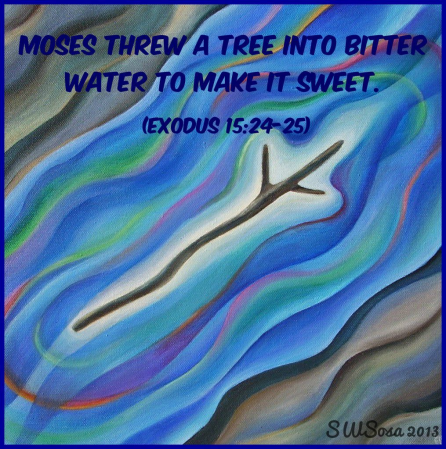
In Exodus 15 there’s an incident that carries weight for today. Israel has come to the springs of Marah. The water is bitter. The people turn to Moses. They challenge him and the complaint voraciously. “Why have you brought us here?” They press Moses to the point of mutiny. They are furious.

Some commentators believe this bitter water was a laxative, and anyone who drank this “bitter” water made many trips to the outhouse!

Moses is shown a branch of a common tree. The Lord speaks a word of the direction he’s to throw the branch directly into the spring. It’ll cure the water, and make it sweet and drinkable.

t seems to me that this awful cross cures the bitterness we absorb as we make our way through life.

The cross of Jesus is critically important. When that ugly tree touches our lives it makes what is bitter sweet. He has changed us by that incredible sacrifice on the hill of Golgotha.

.

Those Strange Christians

I was thinking about this today.

Do you have any idea how ridiculous unbelievers must see us? Just imagine for a minute that you’re on the outside of faith looking in.

———————

They get very solemn as they slowly take the bread and wine. They say that when they sing it’s to God Himself. Some get loud raising hands in surrender to Him. Some will even dance in the worship of someone who’s invisible. How bizarre is that?

They call a man who died a long time ago, they declare that He was their Lord and Master.

They’re gathering to read from a special and “magical” book, and they say that it speaks to them. They talk about living a life separated from Him. They truly think that others need to join them in this silly group. They regard each other as brothers and sisters and they serve each other.

They tell us that Jesus is God in human flesh, who was put to death on a cross and is now alive. They also believe that His blood saves them from their “sin.” These very odd ones think this man is going to return and rule the world, physically bring the Kingdom of God to this planet.

How very odd of them. How very strange these Christians are.

—————————

There exists a letter written to Diogenes, who is known as the Cynic. It was written around 130 AD. This letter itself is fairly extensive. I suggest that you read it in its entirety. It describes the faith and beliefs of the Christian to a man who really has no idea about them but wants to understand–here is a small portion of this epistle. Remember that this is one of the very first observations of our Faith:

“They live in the flesh, but they are not governed by the desires of the flesh. They pass their days upon earth, but they are citizens of heaven. Obedient to the laws, they yet live on a level that transcends the law. Christians love all men, but all men persecute them. Condemned because they are not understood, they are put to death, but raised to life again. They live in poverty, but enrich many; they are totally destitute, but possess an abundance of everything. They suffer dishonor, but that is their glory.”