Pulling the King’s Carriage

A message for younger Christians going into ministry.

“Before God can commit a ministry into a person’s hands they must submit themselves to the discipline of the Lord letting Him truly be the Lord of their entire lives. We have long since dealt with the question of open sin but now God is dealing with the inward rebellion of our own wills.” 

by Bill Britton

On a dirt road in the middle of a wide field stood a beautiful carriage, something on the order of a stagecoach but all edged in gold and with beautiful carvings. It was pulled by six large chestnut horses: two in the lead, two in the middle, and two in the rear. But they were not moving, they were not pulling the carriage, and I wondered why. Then I saw the driver underneath the carriage on the ground on his back just behind the last two horses’ heels working on something between the front wheels of the carriage. I thought, “My, he is in a dangerous place; for if one of those horses kicked or stepped back, they could kill him, or if they decided to go forward, or got frightened somehow, they would pull the carriage right over him.”

But he didn’t seem afraid for he knew that those horses were disciplined and would not move till he told them to move. The horses were not stamping their feet nor acting restless, and though there were bells on their feet, the bells were not tinkling. There were pom-poms on their harness over their heads but the pom-poms were not moving. They were simply standing still and quiet waiting for the voice of the Master.

THERE WERE TWO YOUNG COLTS IN THE FIELD 

As I watched the harnessed horses I noticed two young colts coming out of the open field and they approached the carriage and seemed to say to the horses: “Come and play with us, we have many fine games, we will race with you, come catch us.” And with that, the colts kicked up their heels flicked their tails, and raced across the open field. But when they looked back and saw the horses were not following they were puzzled. They knew nothing of the harnesses and could not understand why the horses did not want to play. So they called to them: “Why do you not race with us? Are you tired? Are you too weak? Do you not have the strength to run? You are much too solemn, you need more joy in life.” But the horses answered not a word nor did they stamp their feet or toss their heads. But they stood, quiet and still, waiting for the voice of the Master. 

Again the colts called to them: “Why do you stand so in the hot sun? Come over here in the shade of this nice tree. See how green the grass is? You must be hungry, come and feed with us, it is so green and so good. You look thirsty, come drink of one of our many streams of cool clear water.” But the horses answered them not so much as a glance but stood still waiting for the command to go forward with the King.

COLTS IN THE MASTER’S CORRAL 

And then the scene changed and I saw lariat nooses fall around the necks of the two colts and they were led off to the Master’s corral for training and discipline. How sad they were as the lovely green fields disappeared and they were put into the confinement of the corral with its brown dirt and high fence. The colts ran from fence to fence seeking freedom but found that they were confined to this place of training. And then the Trainer began to work on them with His whip and His bridle. What a death for those who had been all their lives accustomed to such freedom!

They could not understand the reason for this torture, this terrible discipline. What crime had they done to deserve this? Little did they know of the responsibility that was to be theirs when they had submitted to the discipline, learned to perfectly obey the Master, and finished their training. All they knew was that this processing was the most horrible thing they had ever known.

BUT YOU MUST UNDERSTAND THERE WAS SUBMISSION AND REBELLION 

One of the colts rebelled under the training and said, “This is not for me. I like my freedom, my green hills, my flowing streams of fresh water. I will not take any more of this confinement, this terrible training.” So he found a way out jumped the fence and ran happily back to the meadows of grass. I was astonished that the Master let him go and went not after him. But He devoted His attention to the remaining colt. This colt though he had the same opportunity to escape decided to submit his own will and learn the ways of the Master.

The training got harder than ever but he was rapidly learning more and more how to obey the slightest wish of the Master and to respond to even the quietness of His voice. And I saw that had there been no training, no testing, there would have been neither submission nor rebellion from either of the colts. For in the field they did not have the choice to rebel or submit, they were sinless in their innocence. But when brought to the place of testing and training and discipline, then was made manifest the obedience of one and the rebellion of the other. And though it seemed safer not to come to the place of discipline because of the risk of being found rebellious, I saw that without this there could be no sharing of His glory, no Sonship.

INTO GOD’S HARNESS 

Finally, this period of training was over. Was he now rewarded with his freedom and sent back to the fields? Oh no. But a greater confinement than ever now took place as a harness dropped about his shoulders. Now he found there was not even the freedom to run about the small corral for in the harness he could only move where and when his Master spoke. And unless the Master spoke he stood still.


alaskabibleteacher.com

For more of these and other messages: Bill Britton P.O. Box 707 Springfield, Missouri 65801-0707.  This is a faith ministry, made possible by members of the Body of Christ. Not copyrighted, may be translated or reprinted without further permission. All messages are free as the Lord provides
How to Hear God Clearly

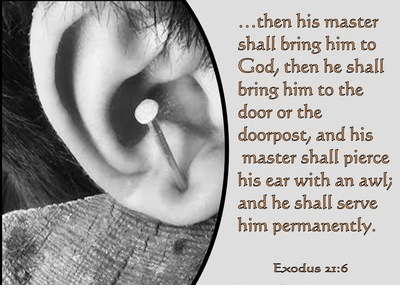
In Deuteronomy 15:12-18, slaves who are being set free by their master after six years of service, could, if they loved and were loved by their master, could choose to remain a slave to him forever.

“But if your slave says to you, “I don’t want to leave you,” because he loves you and your family and has a good life with you, stick an awl through his ear into the door; he will be your slave for life. Also, do this to a female slave.”

Deuteronomy 15:12-18, (Exodus 21:6)

This was a decision that required elders to act as witnesses.  It was significant as well as entirely binding.  I like to think of the ceremony as a cross between a wedding and circumcision. (Sounds like fun!)

The slave would be led to a doorpost and the master would take an awl, and push it through his ear lobe.  This designated the slave to be forever “owned” by a specific master.  The slave would then wear an earring to remind everyone who they were. Herein lies a picture of the consecrated Christian.

Many times in the New Testament people called themselves bondservants of Christ.

Peter, Paul, James, and Jude each referred to themselves as “bondservants of Jesus Christ” to open up their epistles. An example:

(“Paul, a bond-servant of Christ Jesus, called as an apostle, set apart for the gospel of God.”)

This is not a forced servitude. This a choice made from love!

There are many believers who have done the same, they have fallen in love with their Savior.  They do not plan on a life apart from Him. They’ve decided they won’t serve anyone else. So spiritually they have gone to the doorpost, the awl is pushed through their ear, and they are marked from that point on.

Although the ear was pierced physically in the Old Testament, a spiritual kind of piercing takes place in the New. We see glimmers of that decision,

“Surely you know that when you give yourselves like slaves to obey someone, then you are really slaves of that person. The person you obey is your master. You can follow sin, which brings spiritual death, or you can obey God, which makes you right with him.”

Romans 6:16, (NCV)

Just a thought. When the prodigal son returned home from the far country he fell before his father and humbly asked,make me your servant” (Luke 15:19, 21). He, in essence, was saying to the father, “pierce my ear.” The father made him a son, but the attitude of the son’s heart had changed into the heart of a bondservant. So it must be with us.

We each will have a chance to live out a “pierced ear life.

Perhaps it’s then will we’ll truly hear His voice in a new and clearer way. Maybe this is the next step we should take. It’s not demanded, or required. Sometimes hearing Him can be a challenge, but the Father delights in this. He will share with you what’s on His heart.

“Savior, I know Thou hast allowed me absolute liberty, to serve Thee, or to go my own way. I would serve Thee forever, for I love my Master. I will not go out free. Mark my ear, Lord, that it might respond only to Thy voice.”

— Jim Elliot, Missionary, and Martyr

alaskabibleteacher.com

Listening to A.W. Tozer

I believe that these quotes by A.W Tozer will really touch your heart. I’ve tremendous respect for him and his ministry. His is a voice that we really don’t hear too often anymore–but we should.

― A.W. Tozer, The Pursuit of God: The Human Thirst for the Divine

“Between the scribe who has read and the prophet who has seen there is a difference as wide as the sea. We are today overrun with orthodox scribes, but the prophets, where are they? The hard voice of the scribe sounds over evangelicalism, but the Church waits for the tender voice of the saint who has penetrated the veil and has gazed with an inward eye upon the Wonder that is God. And yet, thus to penetrate, to push in sensitive living experience into the holy Presence, is a privilege open to every child of God.”

“Complacency is a deadly foe of all spiritual growth. Acute desire must be present or there will be no manifestation of Christ to His people. He waits to be wanted. Too bad that with many of us He waits so long, so very long, in vain.”

“To men and women everywhere Jesus says, “Come unto me, and I will give you rest.” The rest He offers is the rest of meekness, the blessed relief which comes when we accept ourselves for what we are and cease to pretend.”

“Whoever defends himself will have himself for defense, and he will have no other. But let him come defenseless before the Lord and he will have for his defender no less than God Himself.”

“How tragic that we in this dark day have had our seeking done for us by our teachers.”

“Lord, make me childlike. Deliver me from the urge to compete with another for place or prestige or position. I would be simple and artless as a little child. Deliver me from pose and pretense. Forgive me for thinking of myself. Help me to forget myself and find my true peace in beholding Thee. That Thou mayest answer this prayer I humble myself before Thee. Lay upon me Thy easy yoke of self-forgetfulness that through it I may find rest. Amen.”

alaskabibleteacher.com

When You Set Yourself on Fire

Difficulty and pain sometimes come from others, and challenges to the Lordship of Jesus often come from our unique circumstances.

But what if it was something we’ve done?

I remember the classic picture of a Buddhist monk who sat in the middle of a street. He was serene as he soaked himself with gasoline, and lit himself on fire as a protest against a war he believed was wrong and evil. He burned himself in front of the cameras.

All too often we’re pretty much responsible for our own self-immolation. It is we (and we alone) that set ourselves ablaze. Sin affects our minds and hearts. We set ourselves on fire.

When we sin– when we walk in ‘known’ disobedience we always put ourselves in an awful place. We love it but learn to hate it too. But we continue to do it regardless of the awful death that ensues.

God promises to forgive us. Out of our ashes, He keeps bringing us life and hope.

You can be forgiven. You can find life again, even if you’re fully responsible for the evil we’ve done to yourself. Yes, we all sin, and yes we walk in our own personal rebellion. But Jesus knows it all. These awful things we’ve all done can be forgiven.

As a man and a preacher of the Gospel, I realize that I choose to sin. In spite of all I know and teach I realize that I can live in the ashes of my own making. As one who also struggles with bipolar, I understand that I’m even more susceptible to doing awful things. I understand that I choose darkness even though others sometimes call me “a man of God.”

As you read this I’m praying that you find His forgiveness and mercy. You’ve come a long way it seems, but you must see His blood that was ‘released’ from His veins and arteries for you.

He desperately loves you–even if you’ve set yourself on fire, and sit in the ashes of your doing.

“To appoint unto them that mourn in Zion, to give unto them beauty for ashes, the oil of joy for mourning, the garment of praise for the spirit of heaviness; that they might be called trees of righteousness, the planting of the Lord, that he might be glorified.”

Isaiah 61:3

alaskabibleteacher.com

Braided Up With Him, Isaiah 40:31

wait_bench_ocean

Yet those who wait for the Lord
Will gain new strength;
They will mount up with wings like eagles,
They will run and not get tired,
They will walk and not become weary.

Isaiah 40:31, NASB

The particular word for “wait” is a much more active word than we think.

It’s not a passive word in the original Hebrew.  It does not mean being apathetic or lazy. Sometimes we wait in line at the grocery store, or maybe we’re waiting on a phone call. We regularly wait all the time, and usually, we don’t even realize it.

The Hebrew word for “wait” used in v. 31 is qāvâ which means, ‘to bind together by twisting.’

It literally means to “braid, or twist, using a rope.” It becomes an interesting word picture? Sometimes we only take the English idea of waiting and turn it turns into a frustrating delay. Often, this is why we lose out on what ‘wait’ is really about. I have to believe the Holy Spirit wants to teach this idea of becoming ‘braided up with God.’

All too often we are limited by our definitions, and not God’s Word. 

For those of us who are ill— physically or mentally, just to be told simply, “wait on the Lord” is a real challenge. Often, we will end up resenting this counsel (and the counselor) because we have misunderstood what it means to really ‘wait.’ We come tantalizing close to this critical idea, but we never quite make it through the doorway.

Yet when I truly wait on God, I’m actually braiding myself into Him.

He becomes my strength; He is now the strong cord I am braided into. (Perhaps this is how He imparts strength and might to His people?) We need this, and the Lord is quite eager to lead us into this new kind of intimacy.

The promise in Isaiah 40:31 tells us about new strength–the eagle’s wings, holy stamina. This verse is relevant to us today, and we need this kind of strength now. I only want to encourage you in your own prayer time, to see yourself intertwined with the Lord, and to recognize the good gift of the Holy Spirit freely given.

“Wait for the Lord;
be strong, and let your heart take courage;
wait for the Lord!”

Psalm 27:14

alaskabibleteacher.com

How to Prepare for Water Baptism

water-baptism1

“Those who accepted his message were baptized.” (Acts 2:41)  

 “Repent and be baptized.” (Acts 2:38) 

 “Having been buried with him in baptism and raised with him through your  faith in the power of God.” (Col. 2:12)  

Perhaps one of the most significant decisions we’ll make is to follow Jesus Christ into the waters of baptism.  This is just obedience to the Lord’s command to be baptized. It’s one of the ways that our discipleship becomes public, but it’s intensely private as well. Ideally, it will forever alter your life. At least that is the Father’s intention.

Baptism becomes a public pronouncement or declaration to the physically seen world and to the invisibly unseen world of the Spirit. 

It takes faith to be authentically prepared for baptism.  You will be taking a stand. By faith, you’re making public your allegiance to Christ. It is a step of something living.

“Baptism was to put a line of demarcation between your past sins when you are buried with Him by Baptism–you are burying your past sins–eradicating them–putting a line in the sand saying that old man is dead and he is no longer alive anymore and I rise up to walk in the newness of life.”

T.D. Jakes

I suggest that you prayerfully attend to the steps listed below.  You will find there is a big difference between truly being baptized, and just getting wet!

The interrogative process can be used to solidify the faith before man and in front of His people. In a sense, it’s much like the vows made by a husband and wife in the vows of marriage.

I.  A series of questions are asked, to which the reply is always, “I renounce them.”

  1. Do you renounce Satan and all the spiritual forces of wickedness that rebel against God?
  2. Do you renounce the evil powers of this world that corrupt and destroy the creatures of God?
  3. Do you renounce all sinful desires that draw you from the love of God?

II.  The second half also must be asked, to which the reply is always, “I do.”

  1. Do you turn to Jesus Christ and accept him as your Savior?
  2. Do you put your whole trust in his grace and love?
  3. Do you promise to follow and obey him as your Lord?

III.  The Apostle’s Creed can be recited publicly (or privately in prayer).

This is our faith boiled down to its core essence. This declaration helps set us apart from the World, the flesh, and the devil:

“I believe in God, the Father Almighty, maker of heaven and earth. And in Jesus Christ, his only Son, our Lord,

who was conceived by the Holy Spirit, and born of the Virgin Mary, suffered under Pontius Pilate, who was crucified, died and was buried.

He descended into hell. and on the third day, He rose again from the dead. He ascended into heaven and sits at the right hand of the Father. From thence He will come to judge the living and the dead.

I believe in the Holy Spirit, the holy catholic Church,  the communion of saints, the forgiveness of sins, the resurrection of the body, and the life everlasting. Amen.”

This needs to be understood and accepted. I suppose we will develop these into living discipleship; you’ll that water baptism is analogous to a master key that opens the door to a special joy. Obeying the command to be baptized pleases Jesus. And that is what we long to do.

“Indeed, baptism is a vow, a sacred vow of the believer to follow Christ. Just as a wedding celebrates the fusion of two hearts, baptism celebrates the union of sinner with Savior.”

–Max Lucado

Baptism is an outward expression of inward faith.

–Watchman Nee

Baptism separates the tire kickers from the car buyers.

    –Max Lucado

A special word to “older” believers: There may come a time when you feel that you would want to be baptized again.  I believe that this is not only allowable but commendable.  You may have not had a good understanding of the baptismal process, but now it makes sense.  I would encourage you to follow your heart. God will honor your rededication. Ask your pastor or elder what they think.


1brobry-sig


You may copy and distribute this post in its entirety.


Brokenbelievers.com is a member of Faithful Bloggers

g